
Roofing Company Hiring: Overcoming High Markups and Building Field Crews
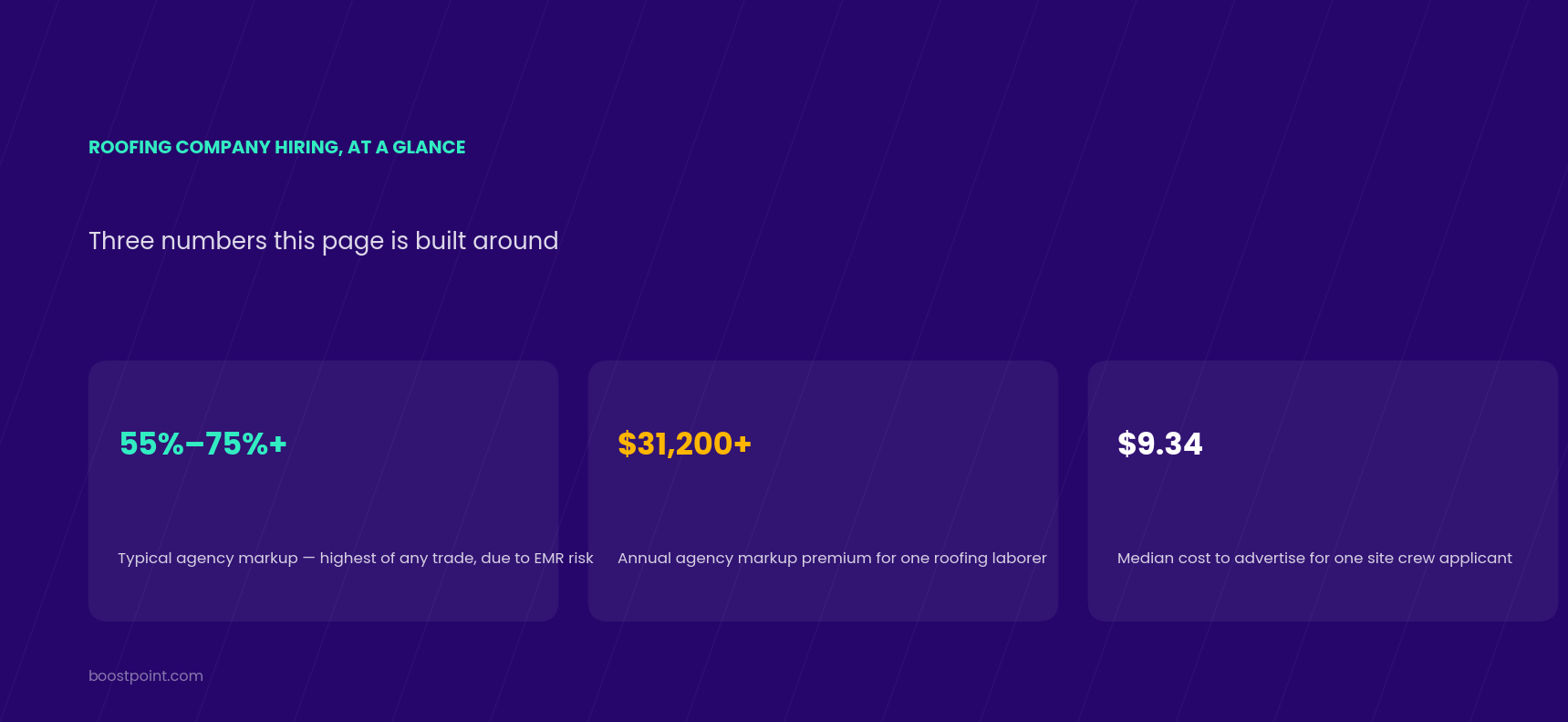
Roofing company hiring requires overcoming steep workers' compensation rates and chronic turnover. Because roofing is a high-hazard trade, staffing agencies typically charge a 55% to 75%+ markup on hourly wages, severely draining project margins. Instead of relying on expensive contingent labor or saturated job boards, roofing contractors can recruit roofers directly through targeted social media advertising, which in Boostpoint's 2025–2026 campaigns generated skilled construction applicants for an average of $6.56 to $9.34 each.
Source: Boostpoint campaign data — managed construction, skilled trades, and site crew recruitment campaigns conducted in 2025–2026 across contractors nationwide.
A note on who's writing this
Most articles on roofing company hiring are published by construction staffing agencies. Because their revenue model relies on taking a hefty percentage of every billed hour on your job site, their content frames massive agency markups as the inevitable cost of doing business in a tight labor market.
Boostpoint is not a staffing agency. We build recruitment advertising software that helps commercial and residential roofing contractors recruit skilled roofers directly through targeted social media campaigns.
We aren't going to tell you staffing agencies never make sense — for emergency disaster-recovery surges or out-of-state commercial builds, contingent labor is a necessary safety net. But we can provide the financial clarity agency guides leave out: what it actually costs to recruit qualified roofers directly, backed by real 2026 campaign data across the construction sector.
The extreme cost of roofing staffing agencies
Roofing is categorized as a high-hazard trade. When you hire through a staffing agency, the agency acts as the employer of record and must cover the elevated workers' compensation (EMR) liability premiums associated with heights and fall risks.
To absorb this risk, roofing staffing agencies charge some of the highest markups in the industrial sector — typically ranging from 55% to 75%+ over the worker's base wage.
What that markup means per hour and per crew
Consider a standard roofing crew of six workers:
| Roofing role | Base wage | 75% markup bill rate | Hourly markup premium per worker | Annual markup premium per seat |
|---|---|---|---|---|
| Roofing Laborer / Helper | $20.00/hr | $35.00/hr | $15.00/hr | $31,200 |
| Experienced Roofer | $28.00/hr | $49.00/hr | $21.00/hr | $43,680 |
| Crew Foreman | $35.00/hr | $61.25/hr | $26.25/hr | $54,600 |
If a commercial contractor utilizes an agency crew consisting of one foreman, three experienced roofers, and two laborers for a year, the contractor pays over $248,000 in pure agency markup.
Relying on agencies to staff your core roofing projects does not solve your hiring problem; it merely transforms a recruiting bottleneck into a profit margin crisis.
Why traditional job boards fail for roofing recruiting
If you are struggling to hire roofers, it is not just a localized issue with your pay rate. Your sourcing mechanics are likely misaligned with how deskless tradespeople actually look for work.
- Roofers don't sit at desks. The best roofers are currently employed on a roof. They are not actively scrolling job boards on a desktop computer.
- Mobile application friction. When a roofer does click a job board link on their phone, they are often met with an Applicant Tracking System (ATS) requiring a 15-question form and a formatted resume upload. Deskless workers abandon long forms immediately.
- Fierce local competition. In any given week, the number of experienced roofers actively searching for jobs in your zip code is near zero. If you rely solely on active search intent, you are bidding against every other contractor in town.
The passive sourcing alternative (and what it costs)
Social advertising inverts the job board model. Instead of waiting for a roofer to search for you, your job becomes an engaging video ad placed directly in their social media feed (Facebook, Instagram, TikTok) during their off-hours.
Across Boostpoint-managed construction campaigns in 2026, targeted social recruitment yielded exceptionally low acquisition costs — the full breakdown across every trade we track is in our published 2026 Social Job Advertising Benchmark data:
| Construction role category | Median cost per applicant (CPA) |
|---|---|
| Construction & Skilled Trades (Blended) | $6.56 |
| Concrete & Site Crew | $9.34 |
Source: Boostpoint campaign data — managed construction, skilled trades, and site crew recruitment campaigns conducted in 2025–2026 across contractors nationwide.
The physical labor demographic shift
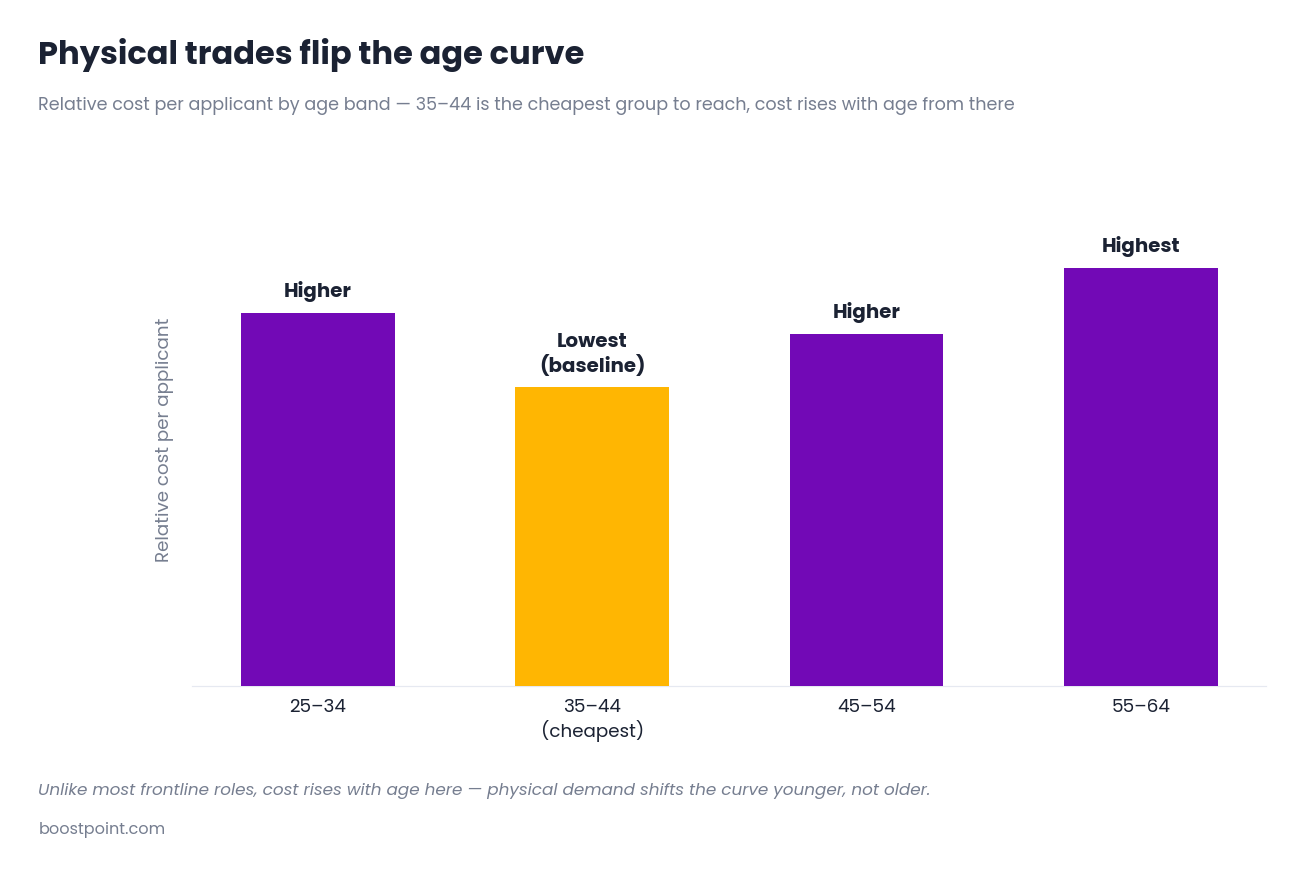
A unique demographic reality applies to roofing company hiring. In most frontline industries, older applicants are the cheapest to acquire via social media. However, physical demand flips the curve.
In physically demanding trades like roofing and site labor, mid-career applicants in their late thirties (35–44) are the cheapest to acquire, and the acquisition cost rises steadily with age from there. If you are hiring for sustained physical work, social media algorithms naturally optimize toward a younger, capable demographic.
Calculating direct ad cost per hire across screening ratios
Advertising budget generates applicants, not finished hires on the roof. To calculate your true ad cost per hire, apply your internal screening, interview, and safety-vetting conversion rate.
Here is what direct ad cost per hire looks like across three candidate screening scenarios, based on the $9.34 site crew CPA:
| Trade role | Cost per applicant (CPA) | 1 in 10 hire rate (10% — high touch) | 1 in 30 hire rate (3.3% — realistic standard) | 1 in 50 hire rate (2% — strict vetting) |
|---|---|---|---|---|
| Roofing Laborer / Site Crew | $9.34 | $93.40 | $280.20 | $467.00 |
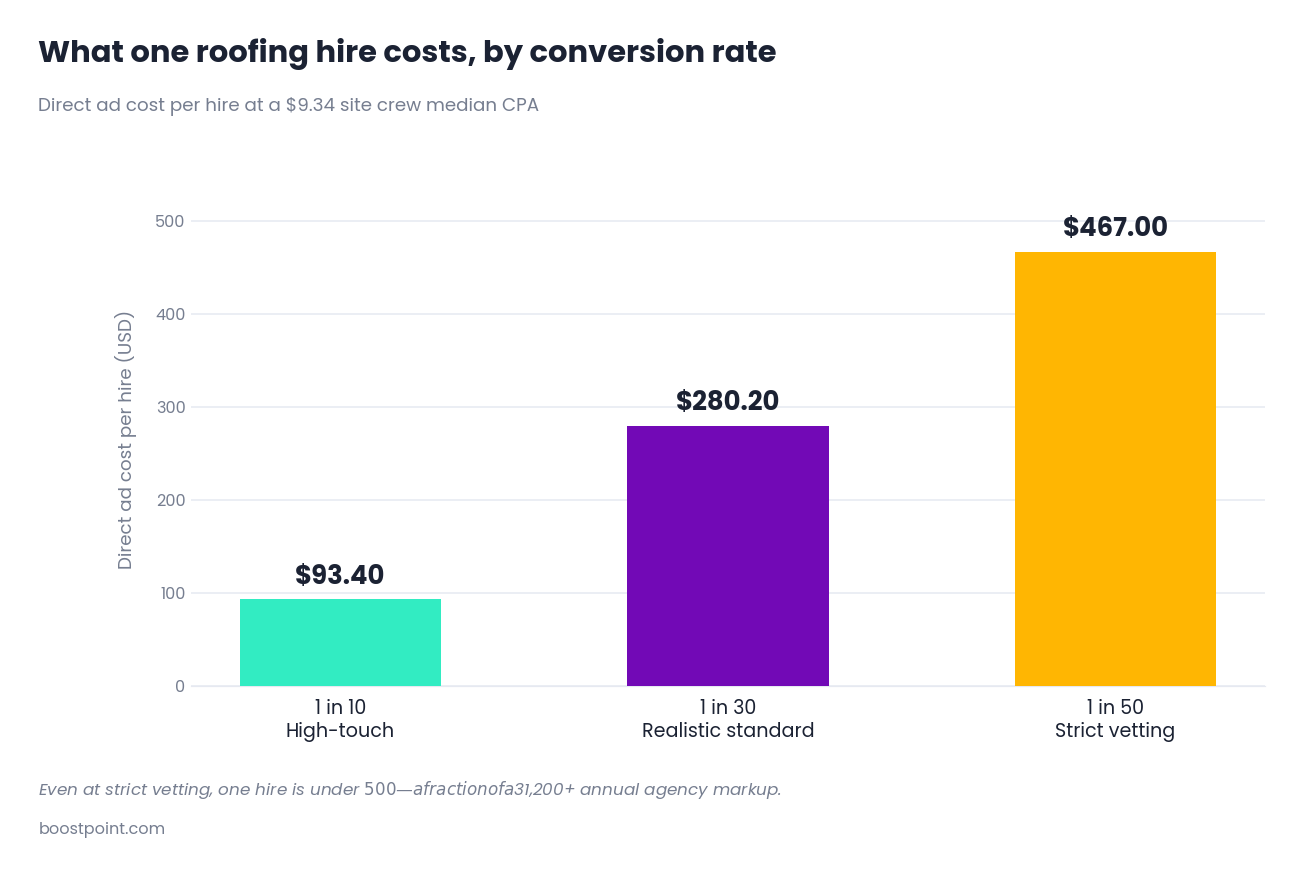
Even under a strict 1 out of 50 hire rate, generating a dedicated roofing laborer directly costs just $467.00. Compare that to the $31,200+ annual markup premium paid to an agency for a single laborer seat — the full breakdown of what those markups compound to is in roofing staffing agency markups.
4 best practices for recruiting roofers
To build a reliable talent pipeline, you must optimize for the deskless worker:
- Use 1-minute mobile knockout forms. Remove the resume upload requirement. Use 3-4 simple knockout questions (e.g., Are you comfortable working at heights? Do you have reliable transportation?) to qualify them instantly.
- Automate SMS follow-ups. Tradespeople do not check email during the day. Integrate text message automation so applicants receive an SMS the moment they apply, allowing them to reply during their lunch break.
- Showcase your equipment and safety culture. Do not use stock photos. Run 15-second mobile video ads showing your actual crews, your safety harnesses, and your trucks. Great roofers want to know they are joining a professional, safe operation.
- Hire the foreman, get the crew. In roofing, crews often travel together. Targeting experienced foremen with highly competitive sign-on bonuses often results in acquiring three or four additional experienced roofers simultaneously.
The honest summary
Agencies manage short-term surges. Direct advertising builds profitable core crews.
If a massive hailstorm hits your region and you need 30 roofers immediately to capture the disaster-recovery contracts, paying a 75% agency markup is a highly profitable trade-off. But if your firm relies on temporary staffing agencies to fill your standard daily crews because traditional job boards stopped working, you are paying emergency prices for a fixable recruiting problem.
By shifting budget to targeted social media recruitment, contractors can maintain their baseline field crews with acquisition costs under $500 per hire, protecting their project margins.
The calculation worth running this quarter
Roofing contractors and HR managers should evaluate these three metrics immediately:
- Calculate total annual agency markup spend. Take total agency invoicing across all project sites over the past 12 months and subtract direct wages paid to workers. That difference represents your agency markup premium.
- Measure your ATS drop-off. If less than 10% of candidates who click your job board link actually complete the application, your form is too long and is causing candidate abandonment.
- Compare direct acquisition against agency markup. Multiply your required hiring headcount by our direct benchmark cost per hire ($280 at a 1:30 ratio) and compare it against your projected agency markup.
How to recruit roofers: the crew ladder, the season and the training you already owe
Roofing is a small trade that everyone recruits from at once. The BLS counts 166,900 roofers (2025), projects 5.3% growth and about 12,000 openings a year through 2035, and puts the median at $55,440 a year (May 2025), with no formal credential required and moderate on-the-job training. Recruiting roofers well means treating the crew as three hires with three ads.
- Laborer or helper. The entry rung, recruited from construction, landscaping, warehouse and delivery work. The ad says the rate, the start time and place ("meet at the shop at 6:30, we drive"), "no roofing experience needed," and how a helper moves up to roofer and at what rate.
- Experienced roofer. Recruited from other crews. Name the work (residential shingle, commercial membrane, metal, repair), the rate, whether the work is year-round, and how pay works (hourly or by the square).
- Foreman or crew lead. The hire that brings people with them. Name the crew size, the truck, the territory and the pay.
Two things make a roofing ad more credible to experienced roofers. The first is the season: advertise weeks before your busy months, not during them, and if you keep crews working through winter on repair or commercial work, say so, because the question every roofer asks is whether the hours stop in December. The second is safety. OSHA's construction standard already requires that "the employer shall provide a training program for each employee who might be exposed to fall hazards" (29 CFR 1926.503(a)(1)). A contractor that runs that training properly and supplies the equipment should say so in the ad; for a new helper it is reassurance, and for an experienced roofer it signals a professional operation.
Keep the form to three questions (comfortable working at heights, a way to get to the shop, the start date), never ask age, and call the same day. For reference, the Skilled trades family in Boostpoint's 2026 Social Job Advertising Benchmark ran a median $14.14 per applicant at a 15% apply rate; that benchmark is Boostpoint's canonical, campaign-month measure and uses a different method from the earlier campaign-level figures above. The posting itself is on our roofer job description.
Frequently asked questions
How do I hire roofers?
Post the hourly rate, the start date and whether the work is year-round in the first line of a social job ad, keep the application to a couple of minutes with no résumé, and call every applicant the same day. BLS puts roofers at a national median of $26.65 an hour in May 2025. In Boostpoint's 2025–2026 campaign data, heavy physical labor and site crew applicants averaged $9.34 each. Start advertising weeks before your busy season rather than during it, when every contractor in the area is running the same ad.
Where do I find roofing workers?
Mostly among people already working, which is why job boards alone come up short: experienced roofers and laborers are on other crews and not searching. Reach them with social job ads in the feeds they already scroll, referrals from your own crew paid as a written bonus, and signage on your trucks and job sites. For laborers, look at adjacent physical work such as construction, landscaping and warehouse jobs. In Boostpoint's 2025–2026 campaign data, site crew applicants averaged $9.34 each; roofing staffing agencies typically mark up wages 55% to 75%+ instead.
How to recruit roofing crews effectively?
The most effective way to recruit roofers is to shift from active job boards to passive social media advertising (Facebook, Instagram). This reaches employed roofers during their off-hours. Use mobile-optimized, 1-minute application forms to capture their contact info without requiring a formal resume.
Why do roofing staffing agencies charge such high markups?
Roofing staffing agencies typically charge markups of 55% to 75%+ because roofing is a high-hazard trade. The agency must cover the elevated workers' compensation (EMR) insurance premiums associated with fall risks and physical labor.
What is the average cost per applicant for construction roles on social media?
Based on Boostpoint 2026 benchmark data, the blended cost per applicant for construction and skilled trades is $6.56, while heavy physical labor and site crew applicants average $9.34 each.
Is direct hiring cheaper than using a roofing temp agency?
For permanent, baseline project work, direct hiring is drastically cheaper. Direct advertising generates qualified tradespeople for under $500 in ad spend per hire (even at strict screening rates), whereas an agency markup costs $30,000 to $50,000+ per tradesperson annually.
Does social media recruiting work for physically demanding trades?
Yes. Interestingly, Boostpoint data shows that for physically demanding trades like roofing, mid-career applicants (aged 35-44) are actually the cheapest demographic to acquire via social media, providing a highly reliable and capable talent pool.
How do you recruit roofers?
Run three ads for three people: a helper ad aimed at construction, landscaping and warehouse workers ("no roofing experience needed," the rate and the path to roofer), an experienced roofer ad that names the roofing type, the rate and whether work is year-round, and a foreman ad that names the crew and the truck. Start before the busy season, keep the form to three questions, call the same day, and pay your own crew for referrals. The BLS counts 166,900 roofers with about 12,000 openings a year.
Should a roofing job ad mention fall protection training?
Yes, if you do it properly. OSHA requires construction employers to provide a fall protection training program for each employee who might be exposed to fall hazards (29 CFR 1926.503), so you already owe the training; saying in the ad that you train and supply the equipment tells a new helper the job is safe to try and tells an experienced roofer your crews are run professionally.
See what it costs to build your roofing crews directly
Book a 30-minute strategy call with our construction recruiting team. We'll analyze your local trade market, review cost-per-applicant benchmarks for your specific region, and demonstrate how to build a direct hiring pipeline using automated social ads.
Book a Demo →Boostpoint figures are derived from managed construction, skilled trades, and site crew recruitment campaigns conducted in 2025–2026 across contractors nationwide. Cost-per-applicant metrics reflect what advertisers paid for advertising. Staffing agency markups are compiled from published construction industry financial audits, workers' compensation standard tables, and third-party staffing benchmarks.