
Best Job Boards for Construction and Skilled Trades: What Each One Is Actually Good At
There is no single best construction job board. iHireConstruction publishes its employer price — $369 a month for one job slot — and most of the others do not publish one at all. Trade Hounds is free. Which board is right depends on one thing: whether the person you need is already looking.
A note on who's writing this
Boostpoint sells managed recruitment advertising on Meta, so we are not neutral about job boards and you should read this knowing it. What we offer instead of neutrality is our own numbers — cost data from 891 campaigns, including the parts that do not flatter us — and named cases where a board is the better buy. Where a board publishes no pricing, we say so rather than repeat a figure we cannot verify.
The case for the construction job board, made first
A job posting is the cheapest hiring action that exists. Twenty minutes, somewhere between nothing and a few hundred dollars, and it leaves a searchable record a candidate can find at 11pm on a Tuesday.
For a certain kind of opening it is also the right action. If you need a licensed trade in a market where the pool of license-holders is small and known, the people you want check a niche board, because that is where specialized work gets listed. If you are hiring a traveler — outage, nuclear, transmission, shutdown crews — a board exists for that audience and a general campaign will not reach it cheaper. And to fill one seat, once, with no urgency, a single paid post beats a campaign.
The problem is not that boards are bad. It is that most construction employers use them for the opening they are worst at: an urgent, local, non-credentialed crew role, in a market where every other contractor posted the same job that week. Job board ROI has the arithmetic.
The eight boards worth an employer's attention
Graded on what each is genuinely best at, not on which we would rather you skip. None of them paid for a place here.
| Board | Genuinely best at | Where it falls down |
|---|---|---|
| Indeed | Reach. Nothing matches the volume of people who start a job search here, and a free post costs nothing but time. | You compete with every employer in the metro for it, and free posts sink without sponsorship. |
| iHireConstruction | A predictable monthly cost and a construction-only audience. The only board here publishing its price openly. | iHire reports 86% of its candidates hold degrees — useful for estimators and PMs, less so for a framing crew. |
| ConstructionJobs.com | Commercial roles with a defined title: superintendent, estimator, project engineer. Plus a resume database. | No pricing on its employer pages, so you cannot budget without asking. |
| ConstructionJobForce | Syndication. Operated by Nexxt, it shares postings across affiliated sites, so one post travels further. | Broad, not targeted — more impressions, not more qualified crew. |
| Roadtechs | Traveling industrial trades: nuclear, power, petro-chemical, shipyard, transmission. Nothing serves that audience as directly. | Almost useless for a local residential or light-commercial contractor. |
| Trade Hounds | Free posting into a community the company says holds nearly 400,000 tradespeople. | A community first and a job board second — posting is easy, distribution is not yours to control. |
| Craigslist | Immediate local laborers and helpers at a price no one matches. The fastest way to fill a truck tomorrow. | No filtering, no screening, and a pool skewed to the least selective end of the market. |
| Google for Jobs | Free, and it indexes the careers page you own. Marked up correctly, postings show in search with no board in between. | A distribution layer, not an audience — it works only if people already search your role and location. |
What a construction job posting actually costs
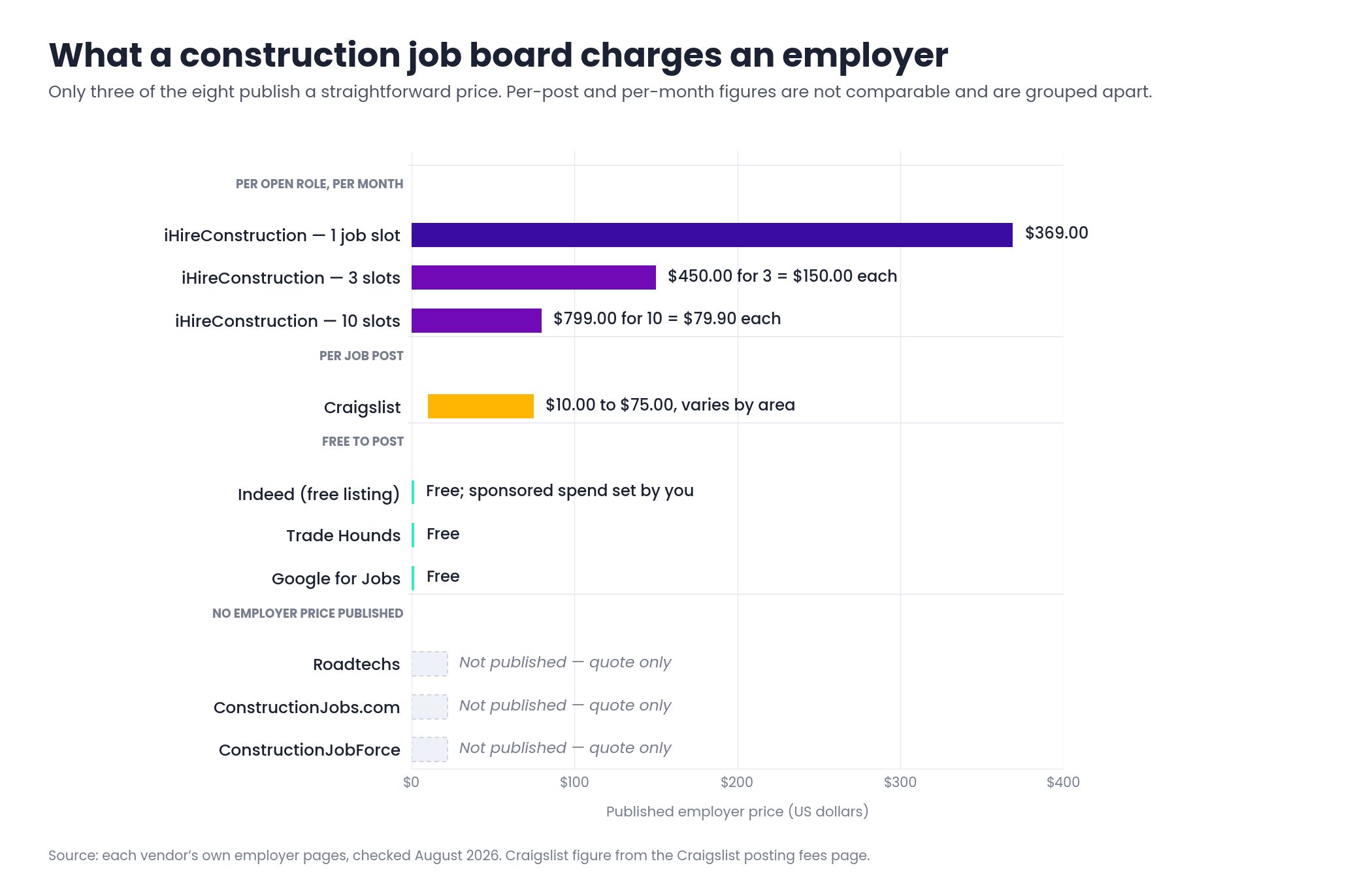
Most of these boards publish no employer pricing. That is standard in the category, not an accusation — but it means any number in a roundup came from a sales call or is out of date. We checked each vendor's own pages in August 2026.
| Board | Published employer price | Source |
|---|---|---|
| iHireConstruction | $369/month for 1 job slot; $450/month for 3, which is $150.00 each; $799/month for 10, which is $79.90 each. Quarterly billing lowers the 1-slot rate to $316/month. | iHireConstruction employer pricing page |
| Trade Hounds | Free. The company announced free job posting in January 2026. | Trade Hounds announcement, 14 January 2026 |
| Craigslist | $10–$75 per job post, varying by area. | Craigslist posting fees page |
| Indeed | Free and sponsored posting; new US accounts are offered a $75 Sponsored Job credit. Sponsored spend is set by you, not listed. | Indeed employer resources |
| Roadtechs | Not published. The employer products page calls rates “very competitive” without stating one. | Roadtechs employer products page |
| ConstructionJobs.com | Not published. A third-party roundup lists $325 per post; unconfirmed at source. | Betterteam roundup (unconfirmed) |
| ConstructionJobForce | Not published. A third-party roundup lists $199/month; unconfirmed at source. | Betterteam roundup (unconfirmed) |
| Google for Jobs | Free. | Google Search Central |
The roundup listing $325 for ConstructionJobs also puts iHireConstruction at $349 a month; iHire's own page says $369. Price a board from the vendor, not a listicle.
The arithmetic that matters is the price divided by what shows up. Take iHire's published $369 for one job slot. At 9 applicants in the month that is $41.00 each; at 3 applicants it is $123.00. Neither is knowable in advance, which is the honest problem with buying reach by the month rather than by the result.
Match the board to the opening
Tick what the opening requires and the boards re-sort into what is worth paying for, what is worth a free post, and what is a waste of the afternoon. The grades are editorial, taken from the fit table above rather than a dataset.
The ceiling every construction board shares
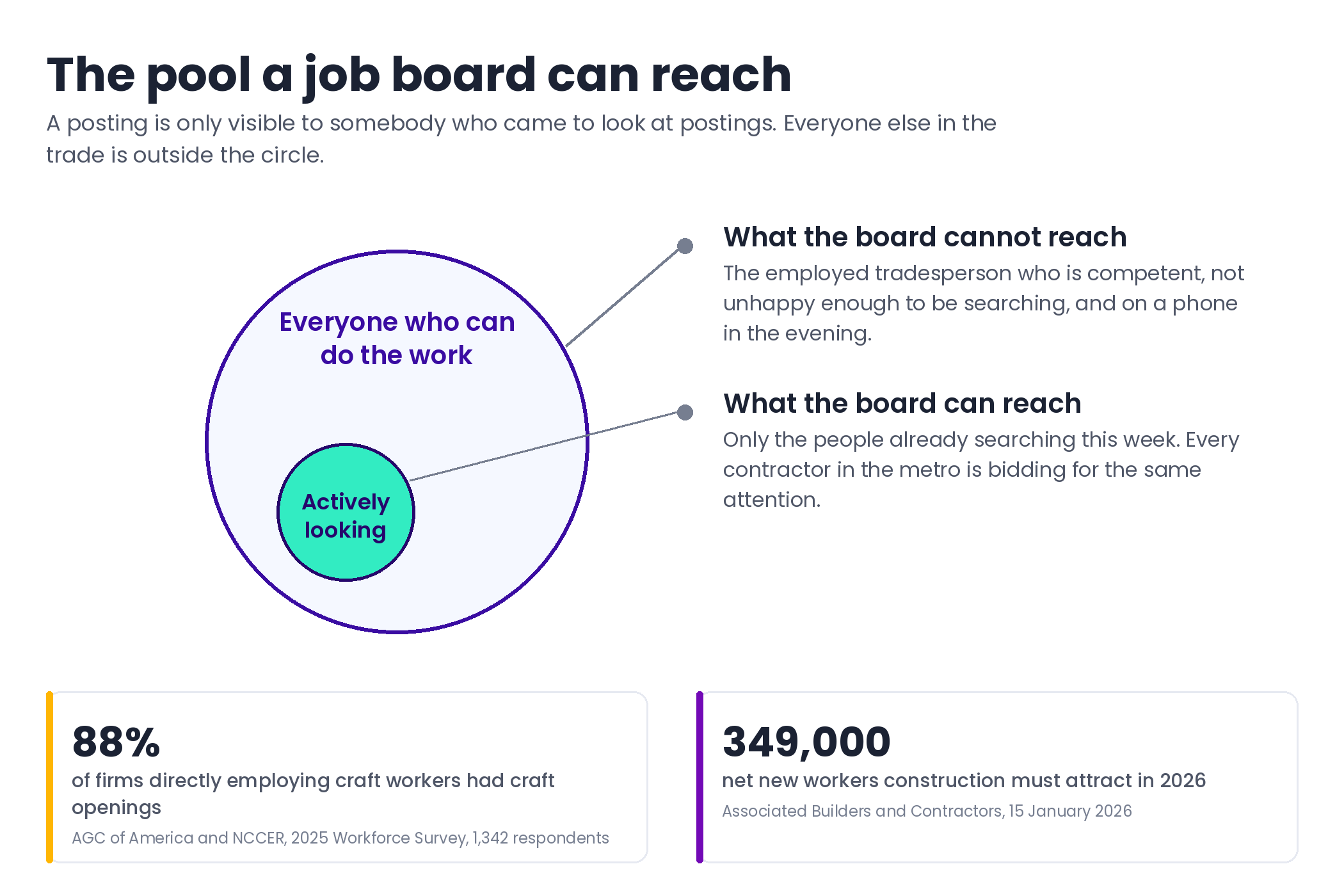
A job board can only show your opening to somebody who came to look at job openings. That is the whole ceiling, and budget does not move it. The AGC of America and NCCER 2025 Workforce Survey found 88% of firms directly employing craft workers had craft openings, and 83% of them said those roles were as hard or harder to fill than a year earlier — many employers chasing one small active pool.
The pool boards cannot reach is the one you want: employed, competent, not unhappy enough to be searching, reachable on a phone in the evening. Where to find skilled trades workers maps that split, and how to recruit construction workers who already have a job covers why postings miss them. We will not repeat either argument.
What the same role costs when you advertise instead
Across 891 Boostpoint campaigns and 1,334 campaign-months, skilled trades campaigns blend to $9.28 per applicant, with form completion running from 3.5% to 18.6% depending on the friction between the ad and the finished application. Across every industry we run the median campaign lands at $13.88 and the volume-weighted average at $8.02 — that gap is large campaigns tuned properly and small ones not tuned at all.
Set that against the iHire example: a $369 slot producing 9 applicants is $41.00 each, against a trades blend of $9.28. The comparison is real but not clean — the board figure is one hypothetical month of one slot, while $9.28 blends hundreds of campaign-months. Some postings beat $41.00 and some campaigns miss $9.28 badly.
The comparison we will not make is cost per hire. Hires happen in your applicant tracking system, not in an ad platform, so cost per applicant is not cost per hire, and a vendor quoting the second from ad data is guessing. For the fee comparison, construction staffing agency costs sets placement fees of 25% to 100% of first-year salary against direct hiring.
The same exercise exists for nursing and for CDL, and the rule they share is worth reading on its own: specialist beats general as the qualified pool narrows, and stops beating anything once the pool is small enough. That is the argument on niche job boards.
The number that decides your cost, whichever channel you pick
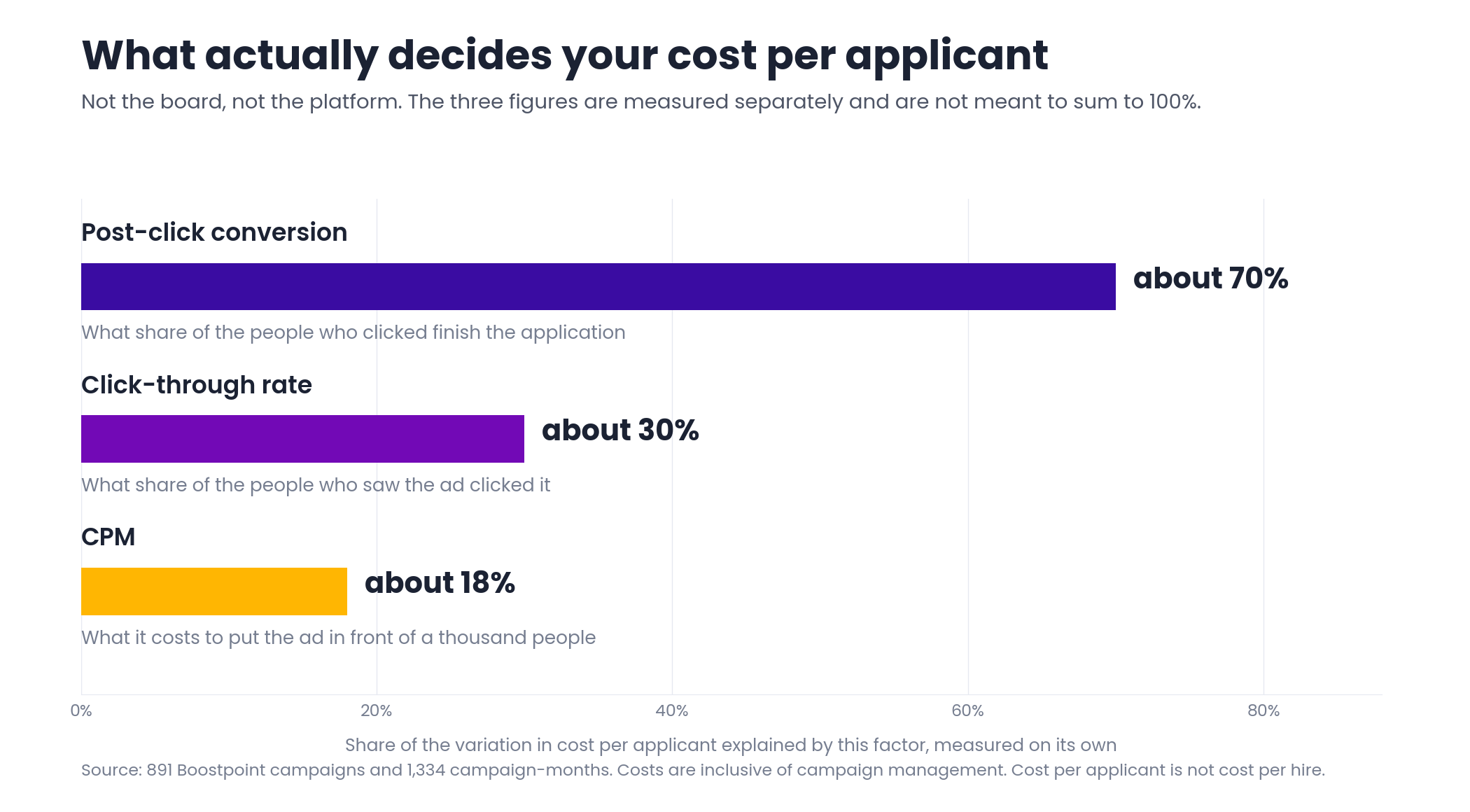
In our campaign data, post-click conversion — the share of people who clicked and then finished an application — explains about 70% of the variation in cost per applicant. Click-through rate explains about 30% and CPM about 18%, each measured separately. No choice of board or platform comes close.
The size of the effect is uncomfortable. Campaigns converting under 5% of clicks average $53.77 per applicant; campaigns above 35% average $1.61. Same platform, same kind of role. The difference is the application.
So the highest-return work available this quarter is not picking a different board. It is deleting the fourteen-field form, dropping the resume requirement for crew roles, and making the thing finish on a phone.
Choosing between construction job boards is a $369 decision. Fixing what happens after the click is a $53.77 to $1.61 decision. Most employers spend their week on the first one.
Frequently asked questions
Where to post construction jobs
If you want a working list rather than a ranking, this is the order most contractors get the most from, cheapest first:
- Your own careers page, with job posting structured data so the listing is eligible for Google’s job search results. It is free and it is the page every other channel should link back to.
- A free posting on a general board. It reaches the searching pool at no cost beyond your time.
- A construction or skilled trades job board from the eight above, chosen for the trade you are hiring rather than for construction in general. The paid slot earns its price for licensed and scarce trades, and rarely for general labor.
- Union halls, apprenticeship programs and trade schools, for the roles and markets where they supply the workforce.
- Social advertising, for the tradespeople who are working and not looking at any board, which is most of them.
Skilled trades job boards follow the same rule as construction boards: the narrower the credential, the more a specialist board is worth. The shortlists by trade are on niche job boards.
What is the best job board for construction hiring?
There is no single best one. For traveling industrial trades it is Roadtechs; for commercial titles like superintendent and estimator, ConstructionJobs.com or iHireConstruction; for local crew and helpers, Indeed or Craigslist; for a free trades-only audience, Trade Hounds. The board follows the opening.
How much does it cost to post a construction job?
Between nothing and $369 a month per role. Trade Hounds and Google for Jobs are free, Craigslist charges $10 to $75 a post depending on area, and iHireConstruction publishes $369 a month for one job slot. Roadtechs, ConstructionJobs.com and ConstructionJobForce publish no employer pricing, so you have to ask.
Are niche construction job boards worth it?
Yes when the role is specialized enough that the audience self-selects: licensed trades, traveling outage work, commercial project roles. Rarely for general laborers and helpers, because a niche board's advantage is a narrower audience and a crew role does not need one.
Is Indeed enough on its own for construction hiring?
For active seekers, usually — nothing matches its volume. What it cannot do is reach the employed tradesperson who is not searching, and with the AGC and NCCER finding 88% of craft-employing firms had openings, the active pool is what everyone is already competing over.
Why does my construction job posting get so few applicants?
Usually the application, not the posting. Post-click conversion explains about 70% of the variation in cost per applicant in our data, and campaigns converting under 5% of clicks average $53.77 each against $1.61 above 35%. Long forms and resume requirements are what crew candidates abandon.
Should I use a construction staffing agency instead?
Sometimes. An agency is the right buy when you need someone next week and cannot run a process yourself. Published construction placement fees run 25% to 100% of first-year salary, an expensive way to fill a role you could have filled in six weeks.
What is a reasonable cost per applicant for a construction role?
Across 891 Boostpoint campaigns, skilled trades blend to $9.28 per applicant, with form completion from 3.5% to 18.6%. Across all industries the median is $13.88 and the volume-weighted average $8.02. Cost per applicant is not cost per hire, and the ratio between them lives in your own applicant tracking system.
Do job boards reach tradespeople who already have a job?
Only by accident. A board shows your opening to people who came looking at openings, by definition the actively searching minority. Reaching an employed tradesperson means putting the role where they already are, which a posting cannot do.
Where should I post construction jobs?
Start with your own careers page and a free general-board posting, add a construction or trade-specific board for licensed and scarce trades, use union halls, apprenticeship programs and trade schools where they supply your workforce, and advertise on social platforms to reach tradespeople who are employed and not searching any board.
What are the best skilled trades job boards?
The best one is the board with the largest pool of your specific trade inside your commute radius. Specialist boards earn their price for licensed and scarce trades such as electricians and HVAC technicians, and rarely for general labor, where a free general posting reaches the same people.
Advertise the role instead of waiting for it to be found
We will show you what your open roles have cost other employers in your trade and market, from the same 891-campaign dataset this page cites.
Methodology and sources. Boostpoint figures come from 891 campaigns and 1,334 campaign-months. Cited: skilled trades blended $9.28 per applicant, form completion 3.5% to 18.6%; overall median $13.88 and volume-weighted average $8.02; $53.77 per applicant below 5% conversion and $1.61 above 35%; post-click conversion explaining about 70% of cost variation, click-through rate about 30%, CPM about 18%, each measured separately. Trades cost is published blended only, because 69% of the underlying trades records carry no individual trade label and a per-trade breakdown would be false precision. Cost per applicant is not cost per hire — hires are recorded in your applicant tracking system, not in an ad platform. This is a sample of Boostpoint campaigns, not an industry-wide study. Third-party sources, all checked August 2026: iHireConstruction employer pricing page; Craigslist posting fees page; Indeed employer resources for its free, sponsored and $75 credit terms; Trade Hounds free-posting announcement of 14 January 2026 and its stated community of nearly 400,000 tradespeople; Roadtechs employer products page, which publishes no rate; Betterteam’s construction job board roundup for the unconfirmed ConstructionJobs.com and ConstructionJobForce figures; AGC of America and NCCER 2025 Workforce Survey, 1,342 respondents, July to August 2025, for the 88% and 83% figures; Associated Builders and Contractors, 15 January 2026, for 349,000 net new workers needed in 2026; and published construction placement fees of 25% to 100% of first-year salary (Leapros, Hunter Recruiting). The worked example is hypothetical arithmetic on iHire’s published price, not a Boostpoint measurement: $369 divided by 9 applicants is $41.00, and $369 divided by 3 is $123.00. Board grades in the sorter are editorial judgments, not measurements. See the full benchmark report, the skilled trades hub, and the same format applied to CDL job boards and nursing job boards.