
Best Job Boards for Nurses: An Employer's Guide to Where the Applicants Are
For employers, the strongest nursing job boards in 2026 are Vivian Health (travel, contract, and per diem), Incredible Health (permanent staff RNs), Health eCareers and Nurse.com (broad clinical reach), the ANA Career Center (association credibility), and Indeed (raw volume). But every board shares one ceiling: it can only show your job to nurses actively searching — and most nurses, most of the time, aren't. This guide covers what each board does best, and the math for reaching everyone else.
A note on who's writing this
Boostpoint runs social recruitment advertising — a channel that competes with job boards for hiring budget — so you should know our angle before reading our rankings. Two commitments in exchange for your trust: we grade each board on what it's genuinely best at, because several of them are excellent at their job, and we don't quote employer pricing that boards don't publish — most don't, and dollar figures floating around the internet for them are guesses. Where a claim is a platform's own marketing number, we label it that way. The campaign data behind our side of the comparison lives across our healthcare pages. The channel we sell is social media job advertising, which reaches nurses who aren't actively browsing boards.
The 8 nursing job boards worth an employer's attention
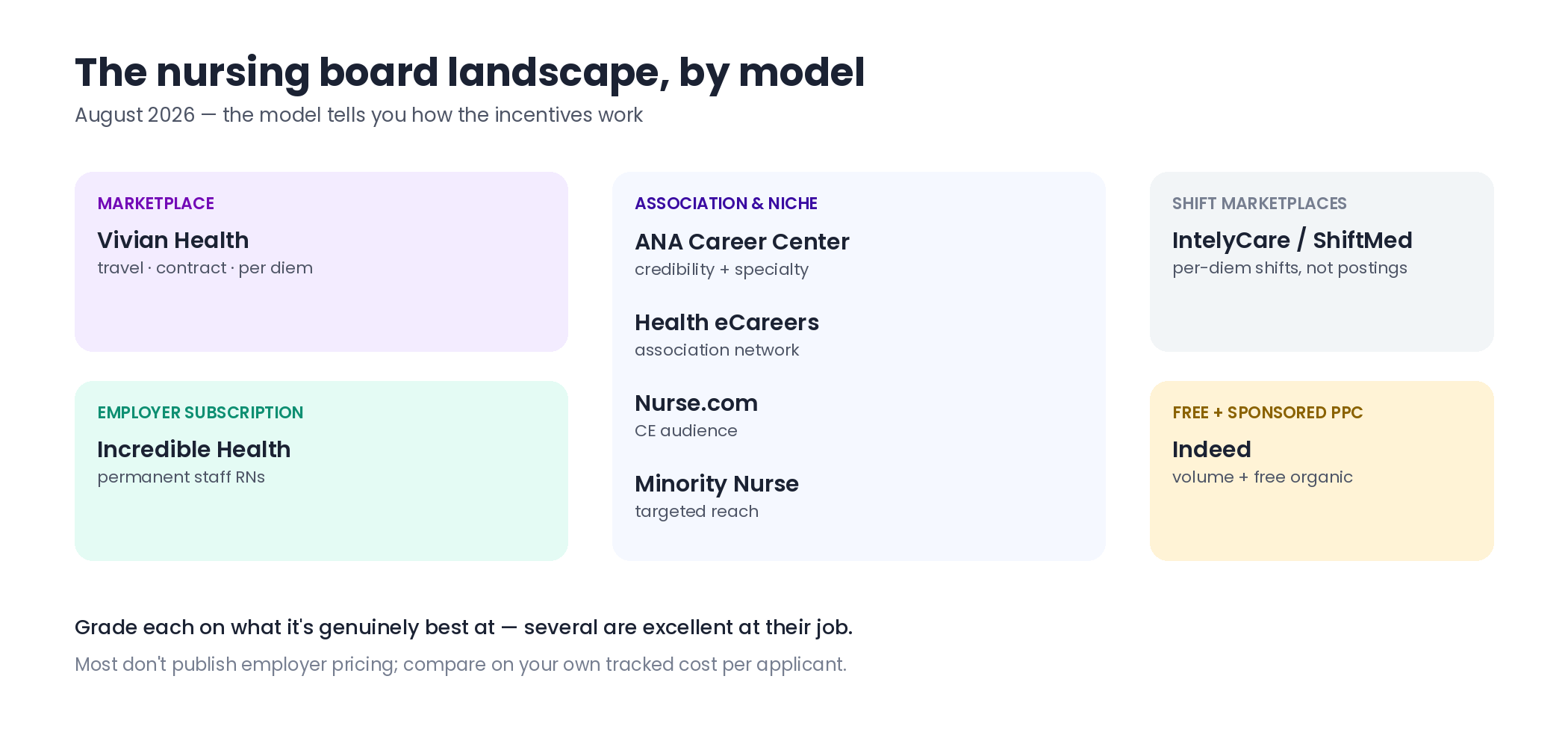
1. Vivian Health
MarketplaceThe dominant healthcare jobs marketplace for flexible work arrangements, with a reported 2M+ registered healthcare professionals and deep inventory across travel, contract, per diem, and staff roles. Nurses use it because pay is transparent and comparable across employers — which is exactly what employers need to know before posting.
Watch for: that transparency cuts both ways. Your posting sits beside competitors' with pay visible; a below-market rate doesn't hide on Vivian, it advertises itself.
2. Incredible Health
Employer subscriptionFlips the model: instead of nurses applying to postings, employers reach out to matched, pre-screened nurses who've signaled they're open. Built around permanent hospital hiring, with credential verification handled on-platform. For staff RN roles at facilities with steady hiring, the matched-candidate model addresses the biggest board complaint — unqualified applicant volume.
Watch for: subscription economics reward continuous hiring; a facility with one or two openings a year is paying for capacity it won't use.
3. Health eCareers
Network boardA healthcare-wide board whose real asset is distribution: postings syndicate across a network of professional association career centers, putting jobs in front of credentialed clinicians where they already maintain memberships. Strong for specialty nursing roles where the audience clusters around professional bodies.
Watch for: network reach is broad but shallow per site — measure applicants per posting, not impressions.
4. Nurse.com
Niche boardAttached to one of nursing's larger CE and licensure-resource audiences, which gives postings a distinctive property: they reach employed nurses who came for coursework, not job hunting. That's as close as a job board gets to passive-candidate reach.
Watch for: CE visitors aren't in application mode — expect awareness value alongside a slower applicant drip.
5. ANA Career Center
AssociationThe American Nurses Association's board carries what generalist sites can't: professional-body trust. Postings here signal legitimacy to experienced nurses, and the association ecosystem (state affiliates, specialty organizations) extends reach to niche credentials that barely exist on open boards.
Watch for: volume is modest by design — this is a precision channel, not a pipeline.
6. IntelyCare & ShiftMed
Shift marketplacesIncluded because employers keep comparing them to job boards, and they aren't one: these are W-2 shift-fulfillment marketplaces — you post shifts, their employed clinician pool claims them, and you pay marketplace rates per shift worked. For coverage gaps they're genuinely useful; they're a staffing product wearing an app.
Watch for: per-shift pricing is convenience-priced. Recurring reliance belongs in your staffing cost math, not your job-board budget.
7. Indeed
Free + sponsored PPCStill the largest applicant firehose in hiring, nursing included. Organic postings are free, and sponsored placement is pay-per-click at budgets you control. For high-turnover roles adjacent to nursing — aides, techs, support staff — the volume is real.
Watch for: everyone else is here too. Sponsored nursing keywords are among the most contested on the platform, and volume includes the screening burden that comes with generalist reach.
8. Minority Nurse & specialty boards
TargetedBoards like Minority Nurse and specialty-credential sites (OR, NICU, informatics associations) trade volume for focus. For roles where a specific community or credential matters, a modest posting fee buys presence where generalist boards have none.
Watch for: treat these as additive placements, not primary pipelines — and remember ad-copy compliance applies to targeted outreach like everywhere else.
How to choose: match the board to the opening
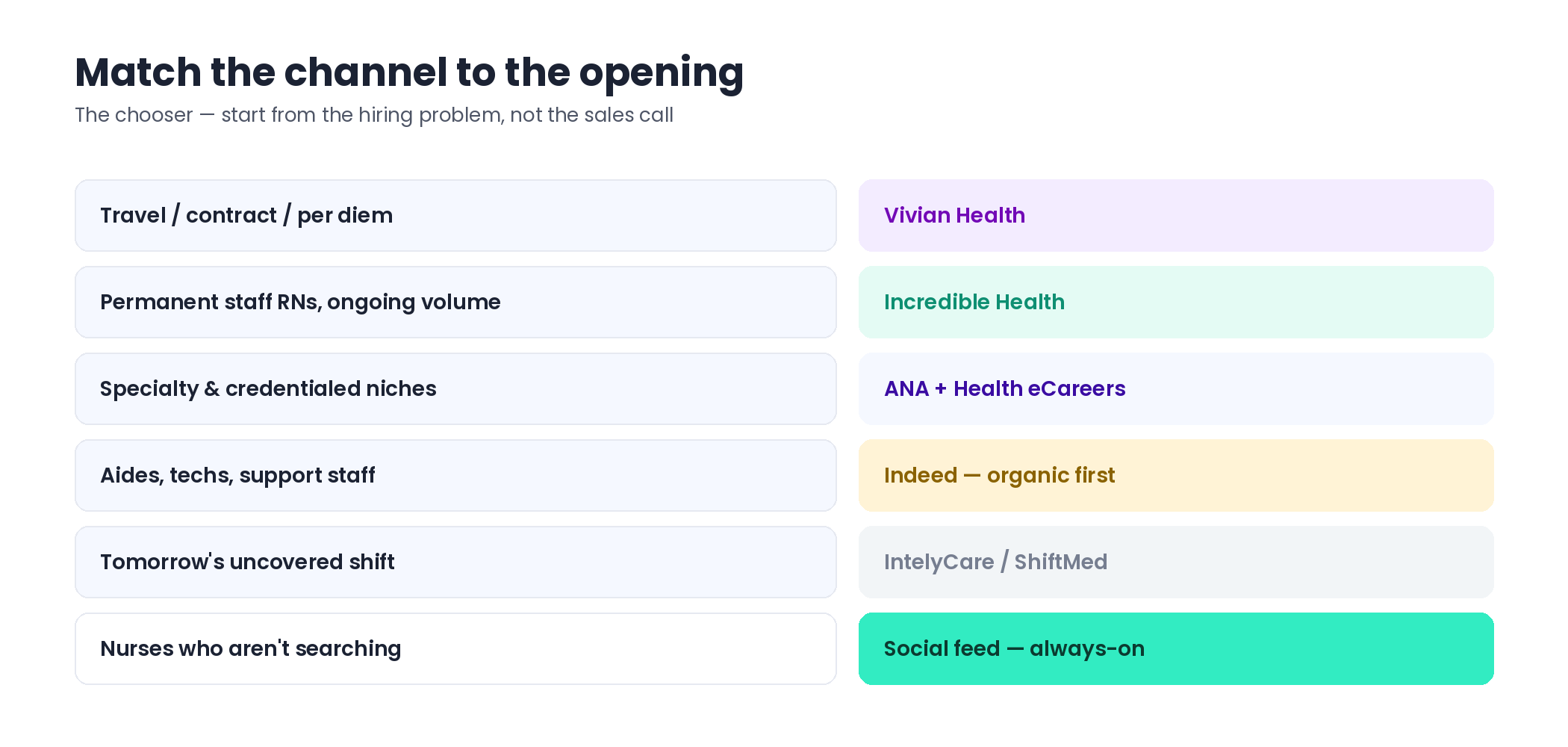
| Your opening | Start with | Why |
|---|---|---|
| Travel / contract / per diem coverage | Vivian Health | Deepest flexible-work inventory; pay-transparent audience |
| Permanent staff RNs, ongoing hiring | Incredible Health | Matched-candidate model built for hospital volume |
| Specialty / credentialed niche roles | ANA Career Center + Health eCareers | Association reach where the credential lives |
| Aides, techs, support staff | Indeed (organic first) | Free volume where generalist reach fits the role |
| Tomorrow's uncovered shift | IntelyCare / ShiftMed | Shift fulfillment, priced as such |
| Nurses who aren't job hunting | None of the above | Boards can't reach non-searchers — see below |
Where to post nursing jobs for free, and what free actually buys you
Every board above has a paid tier, and most of the ranking on this page assumes you are spending. It is worth setting out the genuinely free routes separately, because there are more of them than most employers use and because “free” means different things on each one.
Your state workforce agency job bank. Every state runs one, it is free to employers, and it is the most under-used channel in frontline healthcare hiring. Postings there also feed state re-employment programs, which means your vacancy is put in front of people a caseworker is actively trying to place. Find your state's agency and post there before you pay anybody.
Facebook job posts. Meta relaunched free job posting in October 2025 as Local Jobs — a Jobs tab inside Marketplace plus job posts across Groups and Pages, aimed in Meta's own words at “entry-level, trade, and service industry employment”, with applications arriving through Messenger. Health Aide & Assistants is one of its categories. It costs nothing to post, and for CNA, aide and support roles it reaches people who are not on any nursing board.
Your own careers page. A well-structured job posting on your own site can be indexed and surfaced in Google's jobs experience without you paying for distribution. This is the closest thing to free durable reach that exists, and the reason it underperforms for most employers is not the channel — it is that the posting is a PDF or a paragraph rather than a structured page.
Nursing school career services. Free, chronically underused, and the only channel on this list where you are talking to a cohort before it reaches the open market. For new-graduate RN and LPN hiring it is frequently the highest-yield free option available.
What free does not buy you is the thing the section below is about. Every route here still reaches people who are looking. The nurse you most want to hire is employed, not searching, and no free posting reaches her — which is a limit of the channel, not of the budget.
The ceiling every board shares: active seekers only
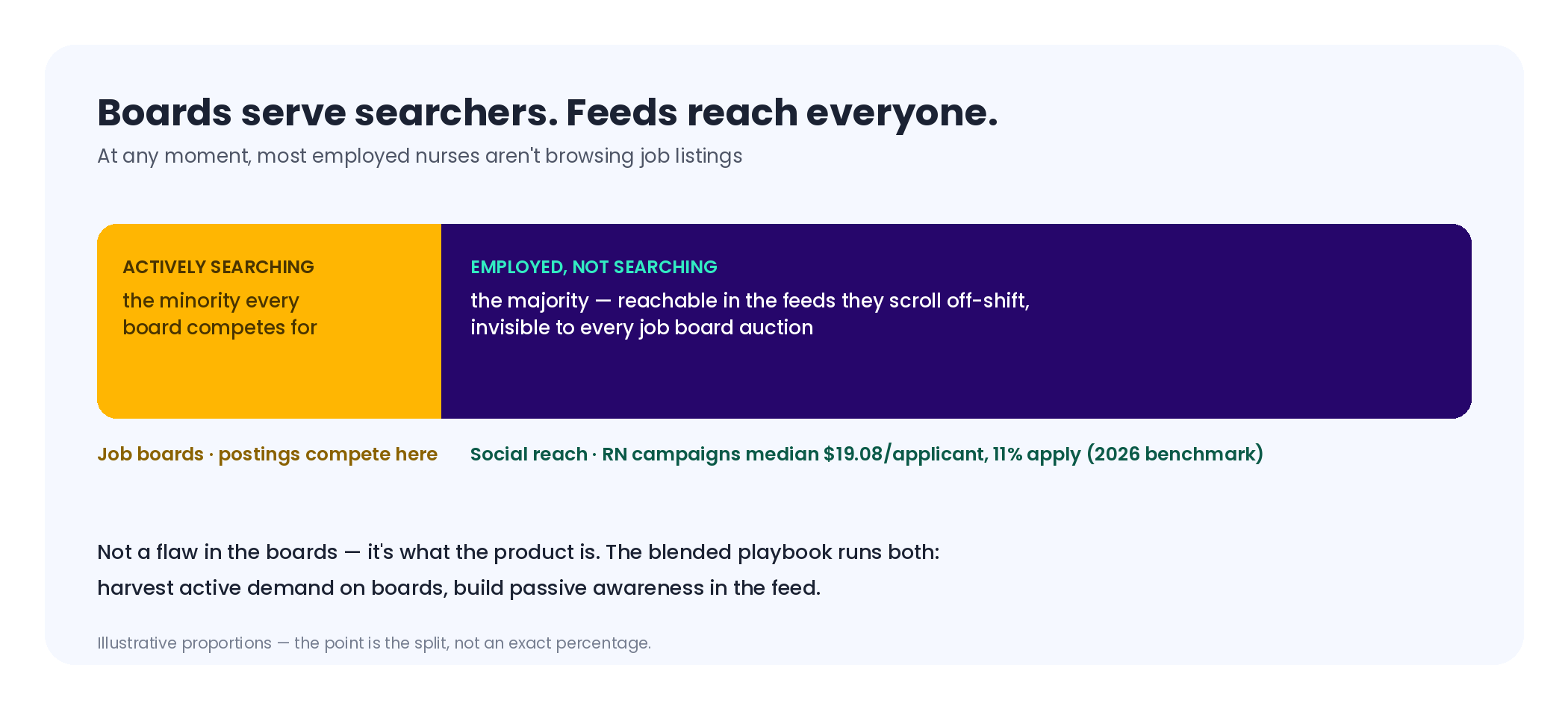
A job board is a search engine, and search engines only serve people who search. At any given moment the large majority of employed nurses aren't browsing job listings — they're working, and burnout-driven openness to change doesn't show up as board traffic. So every board, however good, competes for slices of the same active-seeker minority, and your posting competes in that auction against every other employer's. That's not a flaw in the boards; it's what the product is.
Reaching the non-searching majority is a different product: ads in the feeds nurses scroll off-shift. In our 2026 benchmark, RN campaigns ran a median of $19.08 per applicant at an 11% apply rate — real money by our own standards (healthcare's overall median is $15.42 at 16%), and honestly priced: nurses are licensed professionals, and licensed professionals apply carefully everywhere. What social reach changes isn't the applicant's care; it's the denominator — the audience includes the nurses no board will ever show your job to. Our nursing shortage solutions and RN, LPN & CNA recruiting cost pages carry the full numbers.
Beyond job boards: social ads that reach employed nurses
A board shows your job to the nurse who went looking. A social ad shows it to the nurse who didn't: the RN on nights at the hospital across town, the LPN whose facility just changed the schedule. In Boostpoint's 2026 Social Job Advertising Benchmark, LPN campaigns ran a median of $12.77 per applicant at a 21% apply rate, against $19.08 at 11% for registered nurses, and the healthcare and senior living sector as a whole ran $15.42. Those are applicants, not hires.
The ad has to do the work the search box does on a board: lead with pay, unit and shift, keep the application to about a minute on a phone, and call the same day. Our guide to nurse recruitment sets out how social ads, referrals, nursing schools, boards and agencies fit together for RN and LPN hiring.
Making any posting perform better, wherever it runs
- Put the pay in the posting. On Vivian it's expected; in a growing list of states it's law (our ad compliance guide has the current map); and everywhere, it does qualification work before the click. Postings that hide pay select for applicants who apply to everything.
- Shorten the application. Across our benchmark, what happens after the click explains 70% of cost variation — the same mechanic governs boards. A posting that routes to a 40-minute portal application loses licensed professionals it already paid to attract.
- Name the unit, shift, and ratio. "RN – Med/Surg, nights, 1:5" out-converts "Registered Nurse" everywhere it runs, because experienced nurses screen on exactly those details.
- Respond same-day. Active seekers are by definition applying elsewhere too. The first respectful contact tends to win — a rule that doesn't care which channel produced the applicant.
Nursing is one of three verticals graded board-by-board on this site. If you want the rule underneath all three rather than the nursing list — when a specialist board is worth paying for and when the pool has got too small for any of them — it is on niche job boards.
The blended playbook
The facilities that staff steadily rarely treat this as boards-versus-anything. The stable pattern: a board for the arrangement type (Vivian for flexible work, Incredible Health or Indeed for staff roles as fits your volume), association placements for specialty credentials, and an always-on social presence reaching the employed majority — so when a nurse does decide to move, your facility is already familiar rather than one more listing in the auction. Boards harvest demand that exists; the feed builds demand for the day it doesn't.
Job boards answer one question well: "who's looking right now?" The nursing shortage guarantees that's never enough people. The employers who stay staffed also answer the second question — "who'll be looking next?" — before their competitors do.
Frequently asked questions
Where can I post nursing jobs for free?
Four routes cost nothing. Your state workforce agency job bank, which every state runs and which also feeds state re-employment programs. Facebook job posts through Local Jobs, which Meta relaunched in October 2025 across Marketplace, Groups and Pages, and which carries a Health Aide and Assistants category. Your own careers page, if the posting is a structured page rather than a PDF, so it can be surfaced in Google's jobs experience. And nursing school career services, which for new-graduate RN and LPN hiring is often the highest-yield free channel there is. All four reach people who are actively looking, which is the limit they share.
What is the best job board for nurses overall?
For employers, it depends on the arrangement: Vivian Health leads for travel, contract, and per diem roles; Incredible Health is built for permanent staff RN hiring at hospitals; and Indeed offers the most raw volume, including free organic listings. There's no single best board — the model has to match the opening, which is why the chooser table above starts from the hiring problem.
What's the best job board for travel nurses?
Vivian Health, by a wide margin in inventory and audience. It's the marketplace flexible-work nurses check by default, with transparent pay across postings. The practical consequence for employers: your rate is visible beside everyone else's, so post there when your package is competitive — and know that an under-market rate is publicly under-market.
Are there free ways to post nursing jobs?
Yes: Indeed's organic listings are free (sponsored placement is optional pay-per-click), and your own careers page plus Google's job indexing costs nothing but setup. Free organic reach skews toward high-search-volume generalist roles — it does more for aides and support staff than for specialty RN openings, where paid or association placement usually earns its cost.
How much do nursing job boards cost for employers?
Most don't publish employer pricing — models range from per-posting fees and subscriptions to pay-per-click and per-shift marketplace rates, quoted after a sales conversation. Treat any specific dollar figure you read online as a guess unless it's on the board's own pricing page. The reliable comparison is the one you compute yourself: tracked cost per applicant and applicants per hire, by channel.
Why do job board postings produce so few nurse applicants?
Because boards only reach nurses actively searching, and at any moment most employed nurses aren't. Every employer's postings then compete for that same active minority. Add licensed professionals' careful apply behavior and long portal applications, and the funnel narrows further — across our benchmark, post-click conversion explains 70% of cost variation, on boards and ads alike.
Job boards vs social media advertising for nurse recruiting — which is better?
They solve different halves of the problem. Boards harvest active seekers — efficient when demand exists, capped when it doesn't. Social advertising reaches the employed majority who never visit a board; in our benchmark, RN campaigns median $19.08 per applicant at an 11% apply rate. Steadily staffed facilities typically run both: boards matched to the arrangement type, plus an always-on social presence for the passive audience.
Should a small facility bother with nursing job boards?
Selectively. Start free (Indeed organic, your careers page), add one paid placement matched to the actual opening — Vivian for flexible arrangements, an association board for a specialty credential — and skip subscriptions built for continuous hiring volume you don't have. Small facilities lose to big systems on board auctions; they win locally on speed, named managers, and community familiarity.
How do I make a nursing job posting perform better?
Four levers, in order of impact: put the pay in the posting (expected on marketplaces, legally required in a growing list of states, and a qualifier everywhere); shorten the application — long portals shed licensed professionals; name the unit, shift, and staffing ratio, because experienced nurses screen on specifics; and contact applicants the same day, since active seekers are applying elsewhere simultaneously.
What is the best site to recruit nurses?
There isn't one site that is best for every nursing opening, so match the site to the arrangement. Vivian Health leads for travel, contract and per diem roles, Incredible Health is built for permanent staff RN hiring, association boards such as the ANA Career Center suit specialties, and Indeed brings raw volume. Every board reaches only nurses who are searching, so many employers add social ads for the employed majority; in Boostpoint's 2026 benchmark, RN campaigns ran a median of $19.08 per applicant.
Where is the best place to recruit nurses?
Wherever the nurses you want already spend time. Nurses who are actively looking use job boards and marketplaces, so post there for travel, per diem and specialty roles. Most employed nurses are not looking, so reach them in the social feeds they scroll off-shift, and add referrals from your own staff and nursing school career services for new graduates. In Boostpoint's 2026 Social Job Advertising Benchmark, LPN campaigns ran a median of $12.77 per applicant and RN campaigns $19.08.
Reach the nurses who aren't searching
Boards cover the active minority. We'll show you what it costs to reach the rest — with RN campaign data from 891 real campaigns.
Book a Demo
Board descriptions reflect publicly available information and platform positioning as of August 2026; models, features, and pricing change frequently, and figures attributed to platforms (such as Vivian Health's reported 2M+ registered professionals) are the platforms' own marketing numbers, not our verification. We quote no employer pricing for boards that don't publish it. Boostpoint advertising figures (RN $19.08 median cost per applicant at 11% apply; healthcare sector $15.42 median at 16%; conversion explaining 70% of cost variation) come from the 2026 Social Job Advertising Benchmark — 891 campaigns, 1,334 campaign-months. Cost per applicant is not cost per hire. Boostpoint sells social recruitment advertising and this page's rankings should be read with that disclosed interest in mind.