
Nursing Shortage 2026: The Numbers and the Solutions
Yes, there is a nursing shortage in 2026, and most of it is a replacement problem: the Bureau of Labor Statistics projects about 180,800 registered nurse openings a year through 2035, against employment growth of 194,700 over the whole decade. The fix is a pipeline of your own applicants. In Boostpoint’s 2026 Social Job Advertising Benchmark, the median registered nurse applicant cost $19.08, paid once per applicant, while agency premiums recur for every hour a vacancy is covered.
Source: BLS Occupational Outlook Handbook, registered nurses, read at source 24 September 2026. Boostpoint 2026 Social Job Advertising Benchmark — 891 Boostpoint-managed campaigns on Meta (1,334 campaign-months); costs include campaign management and cover advertising only; cost per applicant is not cost per hire.
A note on who's writing this
Most articles offering nursing shortage solutions are written by travel nursing agencies or healthcare consulting firms. Their solutions typically revolve around buying their outsourced staffing services or embarking on multi-year culture overhauls.
Boostpoint is a recruitment advertising platform. We build the software that helps hospitals, senior living facilities, and home care agencies bypass expensive external recruiters by generating their own clinical applicants directly through social media campaigns.
We aren't here to offer generic advice on workplace culture or nurse burnout. We are providing the exact financial benchmarks and recruitment mechanics required to get qualified clinicians through your doors, backed by real 2026 campaign data across the healthcare sector.
Nurse shortage 2026: the numbers, and the one nobody quotes
The federal projection everyone cites is the registered nurse one. In December 2025 the National Center for Health Workforce Analysis, part of the Health Resources and Services Administration, released projections running from 2023 to 2038, and they put the nationwide shortage in 2038 at 108,960 registered nurses measured in full-time equivalents. The figure sitting next to it in the same release is the one almost nobody quotes: a shortage of 245,950 licensed practical and vocational nurses — more than twice the RN gap.
The nursing shortage is mostly a map, not a headcount
The same projections split registered nurses by geography, and the split is the most useful sentence in the whole document for an employer: in 2038 there is a projected shortage of 11 percent for RNs in nonmetropolitan areas against 2 percent in metropolitan areas. Five and a half times the gap, same country, same year. If you are recruiting in a metro area and cannot fill an RN post, the national shortage is not your explanation — your pay, your shift pattern or your speed to first contact is. If you are rural, the shortage is real, structural, and it will not be solved by trying harder at the same radius.
Set that against the flow rather than the stock. The Bureau of Labor Statistics projects 180,800 registered nurse openings a year through 2035 against employment growth of 194,700 over the whole decade, which works out to about 19,470 a year. Subtract one from the other and roughly 89 percent of nursing openings are replacements rather than new posts. A shortage measured in FTEs is a level; the openings figure is the rate you have to hire at to stand still, and the two answer different questions. The comparison across the whole non-physician workforce, where nursing turns out not to be the biggest line, is on the healthcare workforce shortage by role.
The reality of the nursing shortage
The nursing shortage is a well-documented macroeconomic crisis. Driven by an aging population, retiring clinicians, and widespread burnout, the American Nurses Association projects a massive ongoing deficit in bedside RNs. The measured side of it is narrower and more useful: the current nurse turnover rate and where in a nurse's tenure the departures actually happen.
However, for a Director of Nursing or Chief Nursing Officer, the macro problem is irrelevant. Your problem is micro: you need 15 nurses to safely staff your floors next month.
When traditional job boards fail to produce applicants, hospitals traditionally default to the most expensive solution available: travel nursing and per diem agencies.
The true cost of agency reliance
Healthcare staffing agencies typically charge a 45% to 70% markup on a clinician's hourly wage to provide immediate coverage.
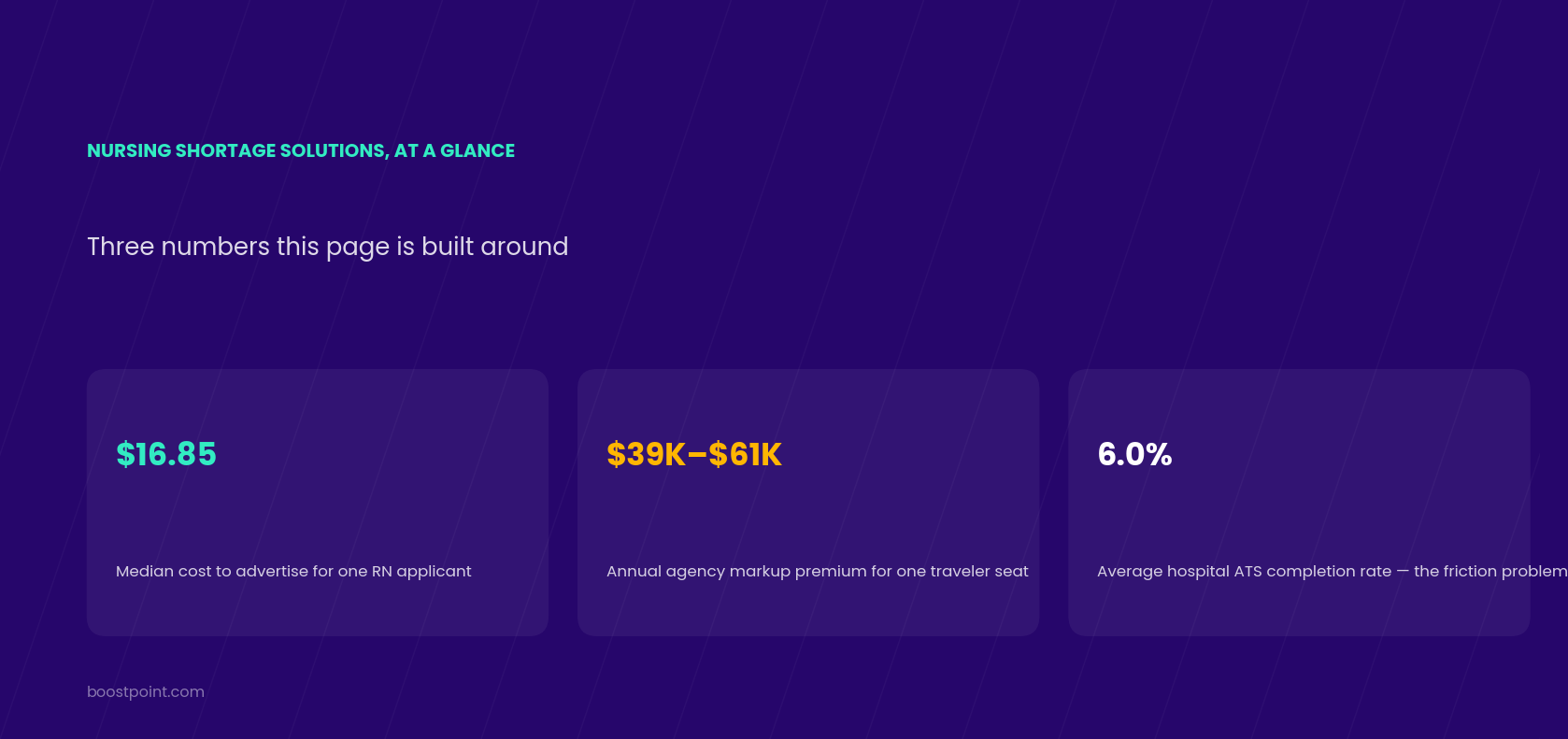
For a Registered Nurse earning $42.00/hour, the agency bills the facility $60.90 to $71.40 per hour. Over the course of a year, that single agency seat carries a markup premium of $39,000 to $61,000+ — money that goes entirely to agency overhead and profit, not patient care or clinical compensation.
Relying on agencies is not a nursing shortage solution; it is a temporary, highly expensive band-aid.
The nurses shortage in numbers, and what the number actually means
The phrase “nurses shortage” gets used to describe two different things, and conflating them is why so much money gets spent on the wrong lever. Here are the figures, from the Bureau of Labor Statistics Occupational Outlook Handbook for registered nurses, read at source on 9 September 2026.
Registered nursing employed 3,465,400 people in 2025 at a median wage of $97,550 a year. The occupation is projected to grow 6% between 2025 and 2035 — faster than average — which works out at 194,700 additional jobs over the decade. And BLS projects about 180,800 openings a year, on average, across that same decade.
Put those last two figures next to each other, because almost nobody does. Roughly 180,800 openings a year over ten years is on the order of 1.8 million openings. Growth accounts for 194,700 of them. That means something like nine in ten nursing vacancies are not new jobs at all — they are somebody's replacement, created by a nurse who retired or left the occupation.
That is the whole argument in one line. There is a genuine national supply problem, and it is real. But the vacancy on your unit next month is overwhelmingly likely to exist because a nurse left, not because the job was newly created. A hiring strategy aimed only at attracting more nurses is aimed at the smaller tenth of the problem.
Two practical consequences follow. First, retention arithmetic beats recruitment arithmetic at almost any realistic cost per hire — every nurse who does not leave removes an opening you would otherwise have to fill at market rate. Second, when you do recruit, the person you are trying to reach is far more likely to be a nurse currently employed somewhere else than a nurse who is out of work. That is a targeting problem, not a job-board problem, and it is the reason the rest of this page is about reaching employed clinicians rather than about posting harder.
Source: U.S. Bureau of Labor Statistics, Occupational Outlook Handbook, Registered Nurses, read at source 9 September 2026. The 1.8 million figure is our own arithmetic on the published annual-openings average across the projection decade, not a BLS-published total.
Nursing shortage statistics 2026
These are the nursing shortage statistics worth quoting in 2026, each copied from the body that publishes it. They measure different things (projected full-time-equivalent gaps, annual openings, survey answers about intent, and school capacity), so do not add them together or compare one against another as if they were the same unit.
| Statistic | Figure | Source |
|---|---|---|
| Projected RN shortage, 2028 | 8% (supply meets 92% of demand) | HRSA, NCHWA projections released December 2025 |
| Projected RN shortage, 2038 | 108,960 FTEs (3%): supply of 3,509,970 against demand of 3,618,930 | HRSA, NCHWA |
| Projected LPN shortage, 2038 | 245,950 FTEs; supply meets 70% of demand, down from 83% in 2028 | HRSA, NCHWA |
| State RN range, 2038 | From a 22% shortage in California to a 79% oversupply in Wyoming | HRSA, NCHWA |
| Registered nurses | 3,465,400 jobs in 2025; about 180,800 openings a year, 2025 to 2035 | BLS Occupational Outlook Handbook |
| LPNs and LVNs | 666,900 jobs in 2025; about 51,800 openings a year; 3% growth to 2035 | BLS Occupational Outlook Handbook |
| Nursing assistants and orderlies | 1,558,700 jobs in 2025; about 203,300 openings a year | BLS Occupational Outlook Handbook |
| Nurses who left the workforce since 2022 | More than 138,000 | NCSBN 2024 National Nursing Workforce Study |
| Intend to leave or retire within five years | 39.9% of RNs and 41.3% of LPN/VNs | NCSBN 2024 |
| Licensees actively employed in nursing | 87.7% of RN licensees and 70.6% of LPN/VN licensees | NCSBN 2024 |
| Qualified applications turned away by nursing schools | 92,672 in 2025 (baccalaureate and graduate programs) | AACN |
| Nurse faculty vacancy rate | 7.2% (1,588 full-time vacancies across 863 schools surveyed) | AACN, October 2025 |
Three readings matter for an employer. First, the federal RN projection is worst in the near term: an 8% gap in 2028 narrowing to 3% by 2038, while the LPN gap widens over the same period. If you staff with LPNs, your problem is getting harder, not easier. Second, intent to leave is a survey answer, not a departure count, but at 39.9% of RNs it tells you where retention effort belongs. Third, only 70.6% of LPN/VN licensees reported working in nursing, against 87.7% of RN licensees. Some of the LPNs you need already hold the license and are working somewhere else, which is an audience a job ad can reach.
Sources, read at source September 24, 2026: HRSA Bureau of Health Workforce, Nurse Workforce Projections 2023–2038 (full-time equivalents); BLS Occupational Outlook Handbook for registered nurses, LPNs and LVNs and nursing assistants; NCSBN 2024 National Nursing Workforce Study; AACN Nursing Faculty Shortage Fact Sheet.
Nursing shortage solutions that actually work
To permanently solve local staffing shortages, healthcare facilities must modernize how they capture and convert talent.
1. Shift from active job boards to passive social sourcing
Traditional job boards (Indeed, ZipRecruiter) are saturated. Active job seekers represent only a small fraction of the clinical workforce. However, great nurses are passively scrolling social media platforms (Facebook, Instagram) every day. Targeted recruitment ads place your facility's sign-on bonuses, shift differentials, and unit culture directly in their feed, capturing their interest before they ever visit a job board. If you still need boards in the mix, best job boards for nurses grades eight of them by how they charge and who they actually reach.
There is a geographic lever most facilities leave unused as well. Forty states now issue and honor the nurse multistate license, so an RN or LPN living in another compact nursing state can accept the job without waiting on your board of nursing — which widens the audience a campaign may lawfully address.
2. Eliminate the ATS "black hole"
Hospital application processes are notoriously difficult. The average hospital Applicant Tracking System (ATS) completion rate is an abysmal 6.0%. Nurses applying from their smartphones between shifts will not spend 30 minutes uploading a resume and manually typing out their past 10 years of clinical rotations.
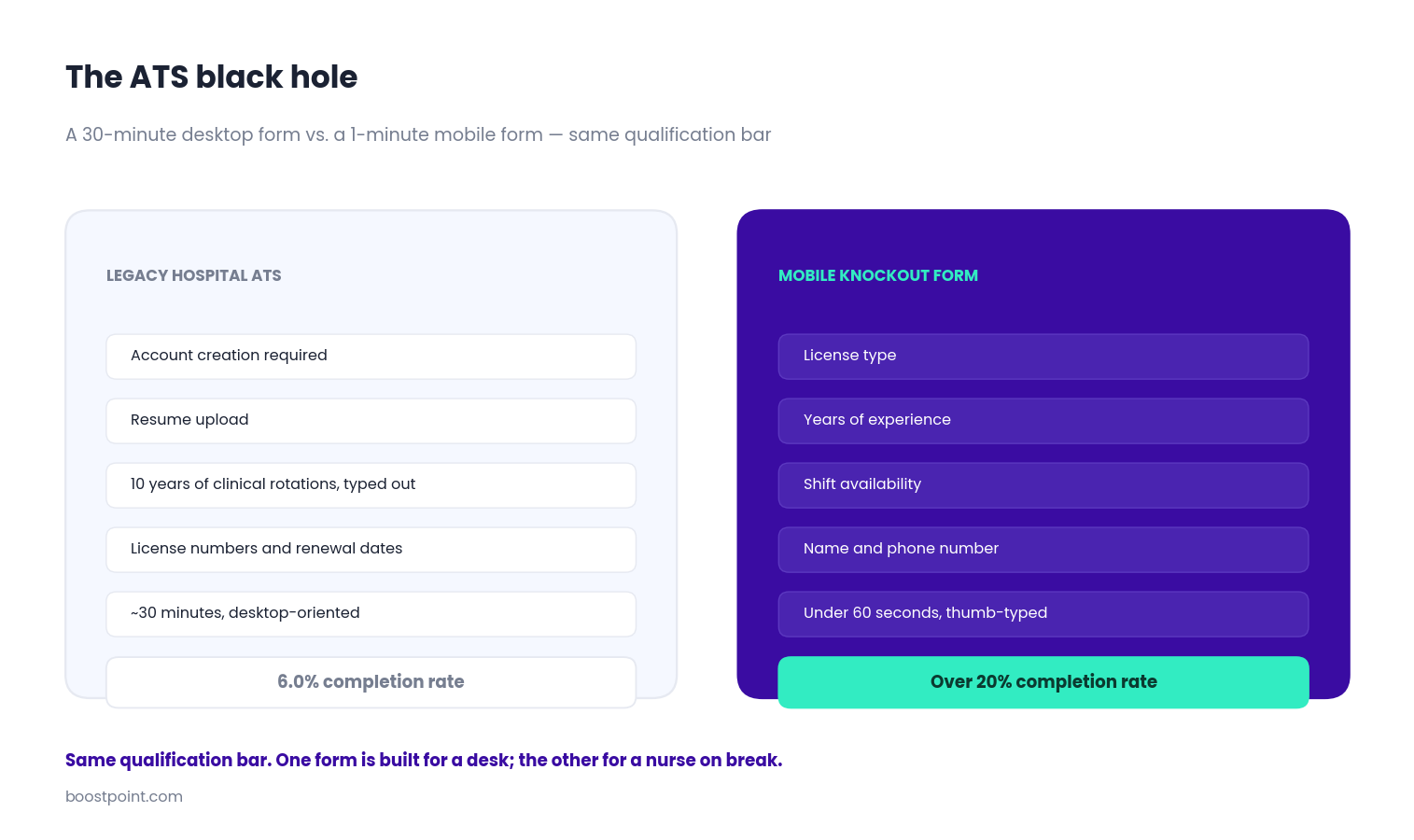
The solution: use 1-minute mobile knockout forms. Ask only the essentials (license type, years of experience, shift availability) to capture their contact info instantly, then let your recruiters handle the rest.
3. Build an internal PRN float pool
Instead of paying a 60% markup to a per diem agency for weekend coverage, use direct advertising to recruit local nurses looking for supplemental part-time shifts. Building your own internal PRN bench ensures continuity of patient care and keeps shift costs contained to actual wages — the full economics of how to build an internal float pool are covered separately.
What it actually costs to recruit nurses directly
To transition away from agency labor, talent acquisition teams need real candidate acquisition benchmarks. How to use them for RNs and LPNs, channel by channel, is set out in our guide to nurse recruitment.
Across Boostpoint-managed healthcare campaigns in 2026, targeted social recruitment yielded the following applicant acquisition costs — the full breakdown across every role we track is in our published 2026 Social Job Advertising Benchmark data:
| Clinical role category | Cost per applicant (CPA) | Application completion rate |
|---|---|---|
| CNA / Nurse Aide | $6.82 | 20.4% |
| LPN / LVN | $12.14 | 14.2% |
| RN / Registered Nurse | $16.85 | 11.8% |
| Specialized Therapy (PT/OT) | $44.58 | 4.8% |
Source: Boostpoint campaign data — 2025–2026 managed healthcare campaigns comprising tens of thousands of completed applications across hospitals, health systems, and senior living facilities nationwide.
Data based on the 2026 Boostpoint Healthcare Benchmark Report covering tens of thousands of clinical applications.
Calculating direct cost per hire across screening ratios
Advertising budget generates applicants, not onboarded clinicians. Because hospitals must verify licenses, conduct background checks, and complete clinical interviews, conversion rates are strictly managed.
Here is what direct ad cost per hire looks like across three candidate screening scenarios based on Boostpoint data:
| Clinical role | Cost per applicant (CPA) | 1 in 10 hire rate (10% — high touch) | 1 in 50 hire rate (2% — realistic standard) | 1 in 100 hire rate (1% — strict vetting) |
|---|---|---|---|---|
| CNA / Nurse Aide | $6.82 | $68.20 | $341.00 | $682.00 |
| LPN / LVN | $12.14 | $121.40 | $607.00 | $1,214.00 |
| Registered Nurse (RN) | $16.85 | $168.50 | $842.50 | $1,685.00 |
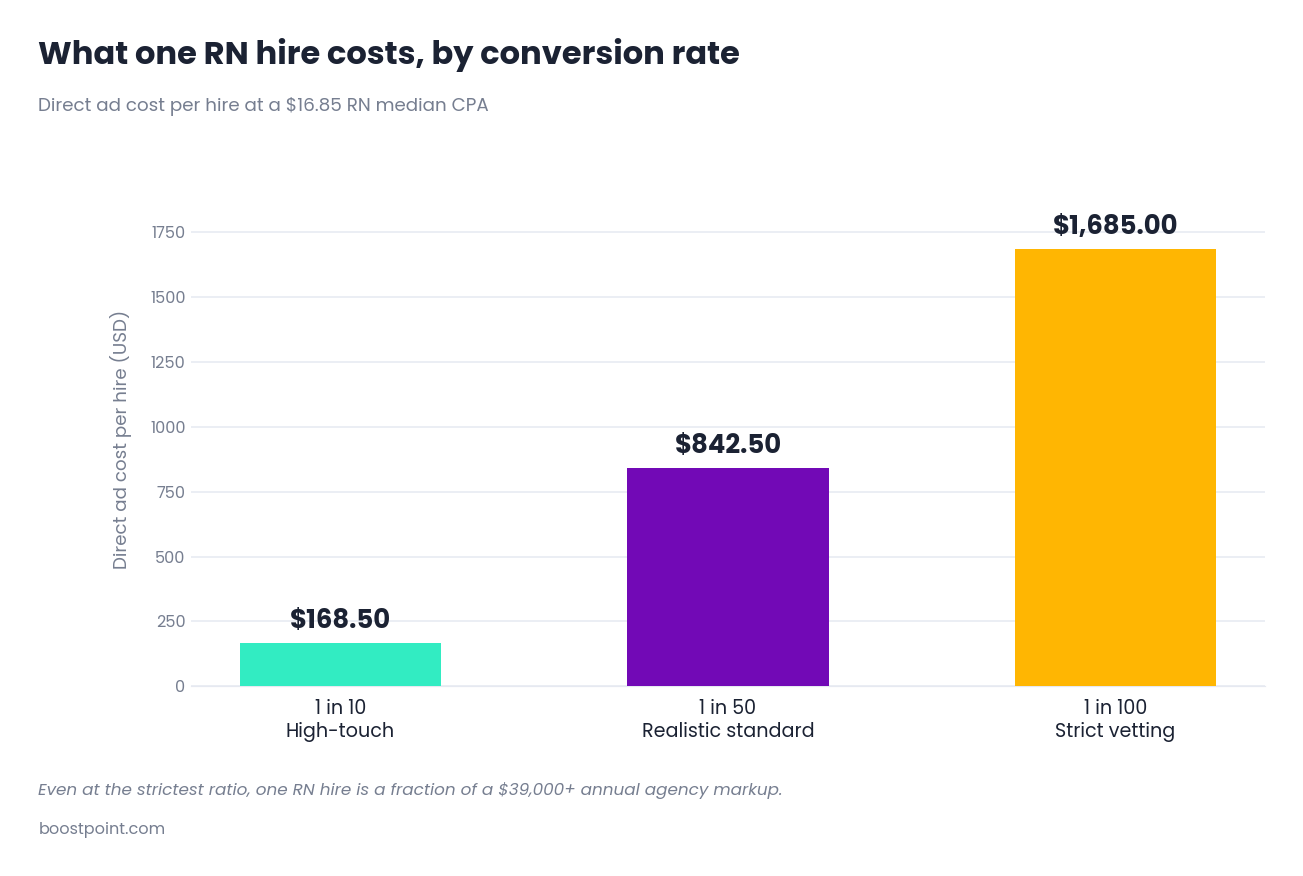
Even under a highly strict 1 out of 100 hire rate (where you screen 100 applicants to secure 1 bedside RN), your direct advertising expense is $1,685. Compare that to the $39,000+ annual markup paid to a staffing agency for a single traveler seat.
The honest summary
The nursing shortage is a pipeline problem, not just a people problem.
If your facility relies on staffing agencies to maintain standard baseline shift ratios because traditional job boards stopped delivering clinical applicants, you are paying permanent surge pricing for a fixable candidate generation problem.
Leading healthcare systems utilize a strategic hybrid approach: direct recruitment advertising to staff 90%+ of baseline clinical roles (keeping RN acquisition costs under $1,700 per hire), while reserving expensive agency labor exclusively for true emergency coverage.
The calculation worth running this quarter
Four metrics every healthcare CFO and Chief Nursing Officer should evaluate together:
- Calculate total annual agency markup spend. Take total agency invoicing across all care units over the past 12 months and subtract direct wages paid to workers. That difference represents your preventable markup premium.
- Audit long-tenure agency contracts. Identify every contract nurse or CNA who has worked at your facility longer than 90 days. These represent permanent baseline needs being billed at surge pricing.
- Analyze application form friction. Measure your application completion rate. Upgrading from a legacy hospital ATS to a mobile-friendly 1-minute form can triple your applicant volume overnight without increasing ad spend.
- Compare direct acquisition against agency premium. Multiply your open core clinical headcount by our direct benchmark ad cost per hire ($842 for RNs at a 1:50 ratio) and compare it against your projected agency markup.
Nursing staff retention: where nurses actually leave, and what holds them
If most nursing vacancies are replacements, nursing staff retention is the cheapest shortage solution on this page. The most useful public data on it is the 2026 NSI National Health Care Retention & RN Staffing Report, which surveyed 527 hospitals in forty states covering 262,405 registered nurses for calendar year 2025. Its headline: hospital RN turnover was 17.6%, and the report puts the average cost of turnover for a bedside RN at $60,090, with each percentage point of RN turnover costing or saving the average hospital about $295,000 a year.
The figure that should shape a retention plan is where in a nurse's tenure the leaving happens. In the same report, 22.7% of newly hired RNs left within a year, and first-year departures made up 29.0% of all RN separations. The report also found that 74% of responding hospitals have a formal retention strategy, and rated nurse residency programs, a common strategy for new graduates, at 3.9 on a five-point effectiveness scale. Put together, the first twelve months are where retention is won or lost, and that period is mostly within a unit's control.
What to do in the first year
- Assign a named preceptor and protect their time. A new nurse who is handed to whoever is on shift learns the unit as a series of strangers.
- Keep the schedule you advertised. A new hire recruited for three twelves on days who is floated to nights in month two is the easiest resignation to predict.
- Hold stay conversations at 30, 60 and 90 days, and again before the one-year mark. Our stay interview questions give the wording.
- Watch the early workload signals. Patient assignments, missed breaks and mandatory overtime for new hires are visible to a manager week by week, long before a resignation letter.
What to do for everyone else
- Check pay against the market once a year, including differentials, not only at hire.
- Offer schedule control: self-scheduling, shift trades and a PRN or float option for nurses who would otherwise leave for flexibility. The PRN staffing guide covers the float pool.
- Measure turnover the way the benchmark does, separations over average headcount for the year, split by tenure, so you can see whether the first year is your problem. The nurse turnover rate page breaks the NSI figures down by specialty and region.
Retention and recruitment work as a pair. Every nurse kept is an opening you don't have to fill, and every opening you do fill is cheaper when the pipeline is your own. For the recruitment half, the median registered nurse campaign in Boostpoint's 2026 Social Job Advertising Benchmark cost $19.08 per applicant and the LPN / LVN family $12.77; cost per applicant is not cost per hire.
Frequently asked questions
How bad is the nurses shortage?
Registered nursing employed 3,465,400 people in 2025 and is projected by the Bureau of Labor Statistics to grow 6% to 2035, adding 194,700 jobs, with about 180,800 openings a year on average across the decade. The important comparison is between those last two numbers: roughly 1.8 million openings over ten years against 194,700 of net growth, which means the large majority of nursing vacancies are replacements for nurses who left rather than newly created posts.
How can hospitals solve the nursing shortage locally?
To overcome local nursing shortages, hospitals must shift from passive job boards to proactive social media advertising to reach employed, passive clinicians. Additionally, reducing ATS application friction and offering flexible internal PRN shift options dramatically increases applicant flow.
What is the average cost per applicant for nurses on social media?
Based on Boostpoint 2026 benchmark data, targeted social media recruitment campaigns generate Registered Nurse (RN) applicants for an average of $16.85 each, and LPN/LVN applicants for $12.14 each.
Why do hospitals rely on travel nurses instead of hiring directly?
Hospitals often default to travel nurses because their internal recruitment pipelines (job boards, career fairs) fail to generate enough qualified local candidates quickly. While travel nurses solve immediate bedside safety needs, their 45% to 70% agency markups severely drain hospital operational budgets.
How does application length affect nursing recruitment?
Long applications destroy conversion rates. Standard hospital ATS portals see a 6.0% completion rate because nurses abandon the process on their mobile phones. Switching to short-form "knockout" applications can increase completion rates to over 20%.
Is direct nursing recruitment cheaper than using an agency?
Yes. Direct recruitment advertising generates RN candidates for $168 to $1,685 in ad spend per hire (depending on strict screening ratios), compared to tens of thousands of dollars in annual markup paid to an agency per contract nurse.
How many nurses is the United States short?
HRSA’s National Center for Health Workforce Analysis projects a nationwide shortage in 2038 of 108,960 registered nurses and 245,950 licensed practical and vocational nurses, both measured in full-time equivalents, in projections released in December 2025 covering 2023 to 2038. The LPN and LVN shortage is more than twice the registered nurse shortage and receives a fraction of the attention.
Is the nursing shortage worse in rural areas?
Substantially. The same federal projections put the 2038 registered nurse shortage at 11 percent in nonmetropolitan areas against 2 percent in metropolitan areas. For a metro employer that means a national shortage is rarely the reason a post is unfilled; for a rural one it means the gap is structural and recruiting has to reach further than the usual radius.
Is the nursing shortage a training problem or a retention problem?
Mostly retention. The Bureau of Labor Statistics projects about 180,800 registered nurse openings a year through 2035 while the occupation grows by 194,700 over the whole decade, so roughly 89 percent of those openings are replacements for people leaving rather than new positions. Training capacity addresses the other tenth, which is why pay, schedule and supervision move the number faster than school places do.
What are the nursing shortage statistics for 2026?
HRSA projects an 8% registered nurse shortage in 2028, narrowing to 108,960 full-time equivalents (3%) by 2038, and an LPN shortage of 245,950 in 2038. BLS projects about 180,800 RN openings a year to 2035. NCSBN found more than 138,000 nurses left the workforce since 2022, and 39.9% of RNs intend to leave or retire within five years.
Is there a nursing shortage in 2026?
Yes, though its size depends on the role and the place. HRSA projects the registered nurse shortage at 8% in 2028, narrowing to 3% by 2038, while the LPN shortage widens to 245,950 full-time equivalents in 2038. BLS projects about 180,800 RN openings a year through 2035, many of them replacing nurses who leave or retire. For employers recruiting directly, the median registered nurse applicant in Boostpoint’s 2026 Social Job Advertising Benchmark cost $19.08.
What are the best nursing retention and recruitment strategies?
Treat them as one plan. On retention, concentrate on the first year: the 2026 NSI National Health Care Retention & RN Staffing Report found 22.7% of newly hired RNs left within a year and first-year departures made up 29.0% of RN separations, so named preceptors, residency programs, the schedule you promised and early stay conversations do the most work. On recruitment, build your own pipeline of employed nurses with short mobile applications and fast follow-up rather than relying on agency coverage. In Boostpoint's 2026 benchmark the median registered nurse campaign cost $19.08 per applicant.
What is the nursing staff retention rate in hospitals?
The 2026 NSI National Health Care Retention & RN Staffing Report put hospital RN turnover at 17.6% for calendar year 2025, across 527 hospitals and 262,405 registered nurses. Turnover there is separations divided by average employees over the year, excluding agency and travel staff. The report estimates the average cost of turnover for a bedside RN at $60,090. Turnover is concentrated early: 22.7% of newly hired RNs left within their first year.
How do you improve retention and recruitment of nurses at the same time?
Start with the first year, because that is where both efforts meet: a nurse you recruit and lose in month six costs you the recruitment and the turnover. Advertise the real schedule and pay so the people who apply are the ones who will stay, give every new hire a named preceptor, check in at 30, 60 and 90 days, and track turnover by tenure so you can see whether new hires or experienced nurses are the ones leaving.
See what it costs to build your own clinical pipeline
Book a 30-minute strategy session with our healthcare recruitment specialists. We'll analyze your regional labor market, review role-specific applicant benchmarks for your care settings, and build a direct hiring roadmap to reduce your agency reliance.
Book a Demo →Boostpoint metrics are derived from 2025–2026 managed healthcare campaigns comprising tens of thousands of completed applications across hospitals, health systems, and senior living facilities nationwide. Costs reflect what advertisers paid for advertising. Agency markups and industry benchmarks are sourced from independent healthcare financial audits and published staffing reports.