
Outsourced Recruitment Marketing: Every Fee Model Explained, Including Ours
Outsourced recruitment marketing is priced five ways: a monthly retainer, a percentage of media spend, a per-applicant or per-hire price, an RPO program, or a subscription plus ad spend, where a product subscription is quoted on a call and the ad budget is billed with it. Agency guides put retainers at $3,000–$15,000 a month and media fees at 10–20% of spend, and say the percentage model stops working below roughly $8,000–$12,000 a month in spend. Boostpoint uses the fifth model — a monthly ad budget (minimum $750 a month) plus a separate Boostpoint subscription quoted on a call, on one bill through Boostpoint — and the cost per applicant we publish — $13.88 median across the 891 campaigns in Boostpoint's 2026 Social Job Advertising Benchmark — is advertising cost only, with the subscription on top. This page shows how to put any two quotes on the same line.
Source: Boostpoint 2026 Social Job Advertising Benchmark — 891 Boostpoint-managed campaigns on Meta (1,334 campaign-months), 2026; costs are what advertisers paid for advertising only.
A note on who's writing this
If you searched this phrase, you are shopping for what we sell, so read this page as a vendor's page. Boostpoint runs social media job advertising for US frontline, healthcare, trades, and driving employers, and it is priced as a monthly ad budget plus a separate subscription; every cost per applicant we publish is advertising cost only, before the subscription. That is one of the five models below, and it is not the right one for everyone: an employer with a serious employer-brand problem, a career site that needs rebuilding, or a hundred requisitions across job boards is better served by a model we don't sell, and this page says which. Agency fee ranges here are the agencies' own published guides, named where quoted. Our figures come from the 2026 Social Job Advertising Benchmark, methodology at the bottom, and none of them is a cost per hire.
What "outsourced recruitment marketing" buys, and what it doesn't
Recruitment marketing is everything that happens before someone applies: the ad, the audience, the career page, the employer brand, the form. Outsourcing it means paying someone else to do some or all of that. It is not recruiting — nobody in this category screens candidates, schedules interviews, or makes offers unless you have bought recruitment process outsourcing, which is a different product with a different price. The single most common mistake in buying this category is comparing a recruitment marketing quote (applicants) with an RPO quote (hires) or a staffing agency quote (placements) as if they were the same unit. They aren't, and the fee model tells you which unit you're buying before the proposal does.
The fee model usually follows from the kind of firm rather than the other way around — the six kinds of firm that wear the name recruitment marketing agency covers which is which.
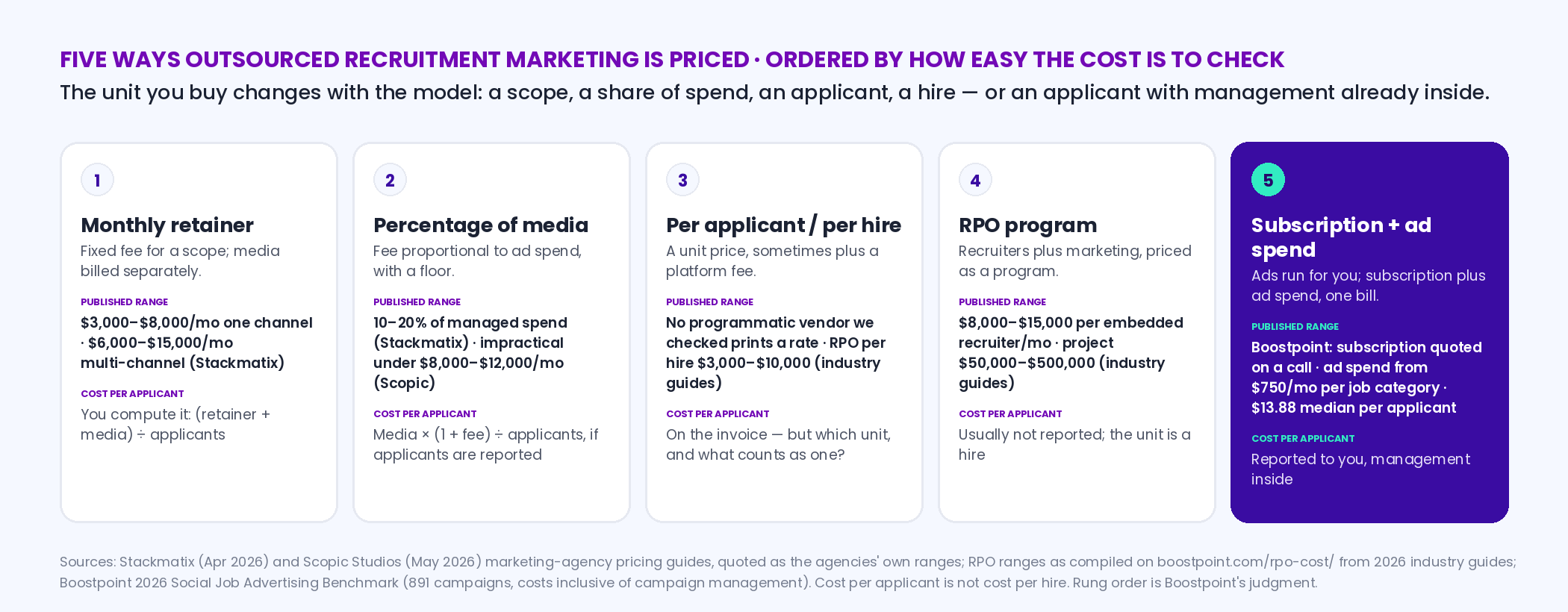
The five fee models, in order of how easy the cost is to check
Monthly retainer
A fixed fee for a scope of work, media billed separately.
Published range
$3,000–$8,000/mo single channel; $6,000–$15,000/mo multi-channel (Stackmatix)
Cost per applicant
You compute it: (retainer + media) ÷ applicants. Agencies rarely report it.
Percentage of media
A fee proportional to what you spend on ads, often with a floor.
Published range
10–20% of managed spend, falling at higher tiers (Stackmatix); 15% example, impractical under $8,000–$12,000/mo (Scopic)
Cost per applicant
Media × (1 + fee) ÷ applicants — if the agency reports applicants.
Per applicant or per hire
A unit price, sometimes with a platform fee on top.
Published range
Programmatic vendors quote per click or per application; none we checked publishes a rate. RPO per-hire: $3,000–$10,000 (industry guides)
Cost per applicant
Printed on the invoice — but check whether the unit is an applicant or a hire, and what counts as one.
RPO program
Recruiters plus marketing under one contract, priced as a program.
Published range
$8,000–$15,000 per embedded recruiter per month; project RPO $50,000–$500,000 (industry guides, see our RPO page)
Cost per applicant
Usually not reported; the unit is a hire.
Subscription plus ad spend
Ads written, targeted and run for you; your monthly ad budget plus a separate product subscription, on one bill.
Published range
Boostpoint: subscription quoted on a call; ad budget from $750/mo minimum; $13.88 median advertising cost per applicant
Cost per applicant
Reported to you as advertising cost; the subscription is a separate line.
Ranges are the sources' own: Stackmatix (April 2026) and Scopic Studios (May 2026) are marketing-agency pricing guides, not recruiting-specific; RPO ranges are the ones compiled on our RPO cost page. Boostpoint figures: 2026 benchmark, 891 campaigns. Rung order is our judgment.
What a recruitment marketing agency actually charges
We looked for public prices from the recruitment marketing agencies a buyer would find first. For what the delivery actually costs once an agency is engaged, our hiring metrics benchmarks publish the full distribution rather than a single average. NAS Recruitment Innovation and Shaker Recruitment Marketing show no pricing on their sites. Bayard, once the best-known name in the category, was acquired by Appcast in July 2023 and its site now redirects there; Appcast, Recruitics, and Radancy show no pricing either. That is not a criticism — retainer work is scoped per client — but it means the only published numbers for this category come from general marketing-agency guides, and you should read them as those agencies' own ranges, not a survey.
| Fee line | Published figure | Applies to | Source |
|---|---|---|---|
| Percentage of managed media | 10–20% of spend, decreasing at higher tiers; 15–25% effective at low budgets | Paid media management | Stackmatix, April 2026 |
| Flat monthly retainer, one channel | $3,000–$8,000 per month | Single-channel paid media | Stackmatix |
| Flat monthly retainer, multi-channel | $6,000–$15,000 per month | Two or more channels | Stackmatix |
| Creative production | $2,000–$8,000 per month, billed separately | Ad creative outside the retainer | Stackmatix |
| Onboarding / setup | $1,500–$5,000 (Stackmatix); $500–$3,000 (Scopic) | One-time | Both guides |
| Minimum spend for a percentage model | Below roughly $8,000–$12,000 a month "the percentage yields too little for the agency to properly staff the work" | Percentage-of-media engagements | Scopic Studios, May 2026 |
| Extras beyond the headline fee | Tools and add-ons "add 20–40%" | All models | Scopic Studios |
The last two rows are the ones to sit with. A percentage-of-media agency needs you to spend $8,000 to $12,000 a month before the arithmetic works for them, and the headline fee is 20–40% short of what you'll pay. Now put that beside the employer this category mostly ignores: in our benchmark the median campaign budget is $334 a month and produces a median of 20 applicants. A location hiring warehouse associates, CNAs, or drivers is a small account by agency standards, and that is not a moral failing on either side. It is why the fifth model exists: a product subscription plus an ad budget with a $750 monthly minimum — a floor a single location can meet, against the $8,000–$12,000 a month the percentage agencies say they need.
Put two quotes on the same line
The quotes you'll receive price different things, so normalize them to one number before comparing: all-in monthly cost, and the share of it that is fee rather than media. Enter your planned media spend and the terms of each quote; the third row is filled from the published guides above and you should replace it with the quote in front of you.
Nothing is stored or sent — this runs in your browser. Defaults are the low end of the published guides; enter the subscription you were quoted in the last field — it is not printed here.
| Model | Fee / month | All-in / month | Fee share | All-in per applicant |
|---|---|---|---|---|
| Retainer + media | ||||
| Percentage of media | ||||
| Subscription + ad spend |
All-in per applicant = (fee + media) ÷ expected applicants; it is a cost per applicant, not a cost per hire. The subscription row adds the subscription you were quoted to your planned ad spend — that is Boostpoint's model, one bill for both — and the cost-per-applicant figures Boostpoint reports are advertising cost only, which is why the subscription is added here; ask any vendor what theirs include. Setup fees, creative production, and tool charges are excluded — add them if quoted. Applicant expectations are yours; the benchmark median is a sample of Boostpoint campaigns, not a forecast.
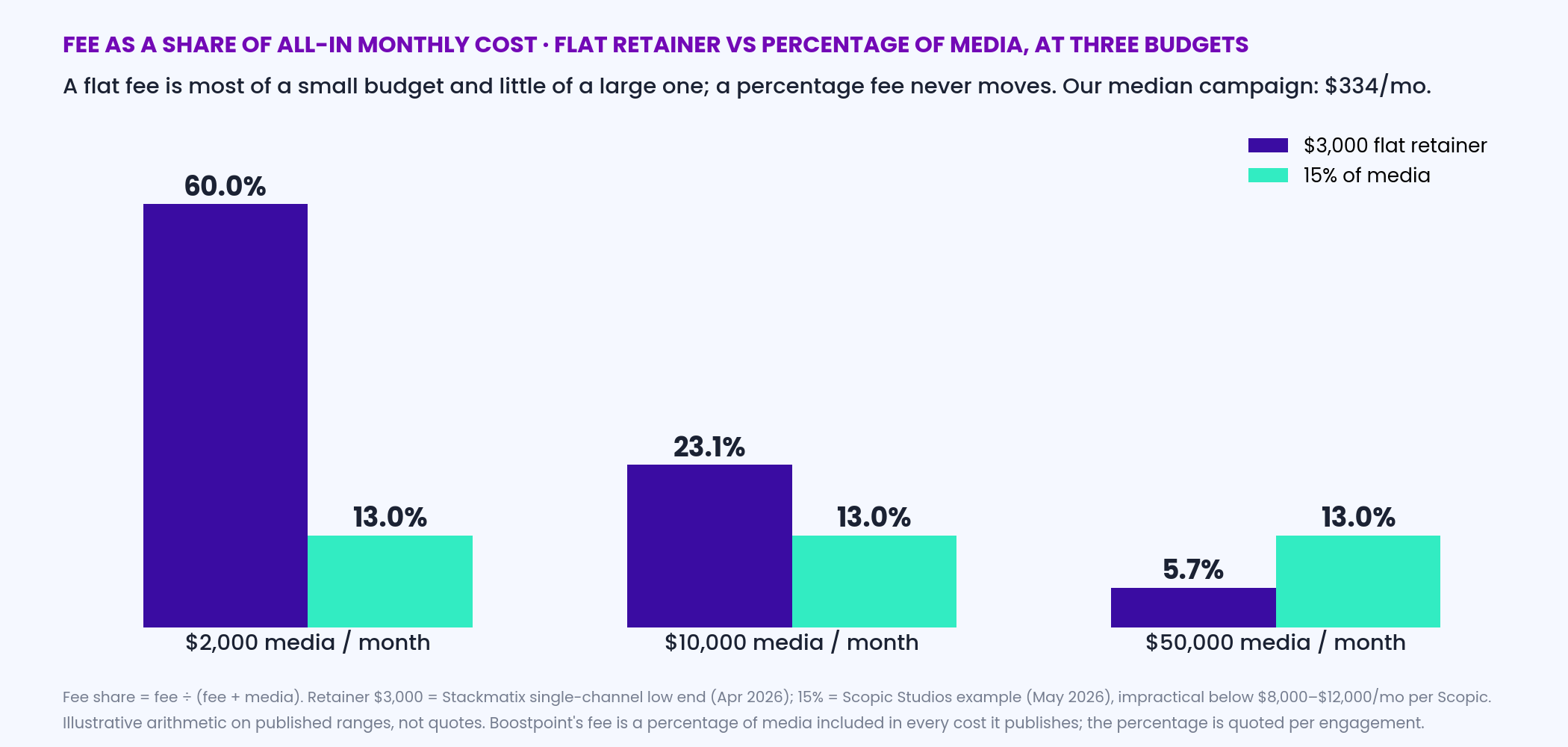
Run the defaults and the shape of the market is visible. At $2,000 of media, a $3,000 retainer makes the fee 60.0% of a $5,000 month and puts twenty applicants at $250.00 each all-in; a 15% media fee would be $300, for $2,300 and $115.00 per applicant — except the same guides say no percentage-of-media agency will take a $2,000 account. That is the gap the subscription-plus-ad-spend model fills, and it is the reason we publish the whole distribution of our costs rather than a single best case: $13.88 median, with the middle half of campaigns between $6.48 and $29.74 per applicant, all advertising cost only.
What's inside the price, model by model
| Line item | Retainer | % of media | Per applicant / per hire | RPO | Subscription + ad spend (Boostpoint) |
|---|---|---|---|---|---|
| Media spend | Billed separately | Billed separately, fee on top | Inside the unit price, usually | Usually separate | Separate from the subscription; one bill for both |
| Ad creative | Often a separate line ($2,000–$8,000/mo per Stackmatix) | Often separate | Vendor's templates | Varies | Inside the subscription |
| Application form / screening questions | Rarely | Rarely | Sometimes | Yes — recruiters screen | Inside the subscription (in-platform form) |
| Career site / employer brand | Yes, if scoped — the retainer's strength | No | No | Sometimes | No |
| Setup fee | $1,500–$5,000 (Stackmatix); $500–$3,000 (Scopic) | Same | Platform fee common | Implementation fee common | Not printed here; covered on the quote call |
| Minimum commitment | Monthly, often 3–12 months | Spend floor ~$8,000–$12,000/mo (Scopic) | Volume minimums common | Minimum-volume clauses common | Ad budget minimum $750/mo; other terms covered on the quote call |
| The unit you're buying | Hours / scope | Managed spend | Applicants or hires | Hires | Applicants |
Agency vs software for hourly hiring
For hourly hiring, software that runs the campaigns for you usually costs less than a recruitment advertising agency, because the agency models are priced for budgets most hourly employers don't have: the Scopic guide above puts the percentage-of-media floor at $8,000–$12,000 a month in ad spend, while Boostpoint's minimum ad budget is $750 a month, and the median cost per applicant across the 891 campaigns in its 2026 benchmark was $13.88 in advertising cost, before the subscription.
| Recruitment advertising agency | Self-serve software | Software with the campaigns run for you | |
|---|---|---|---|
| How it's priced | Retainer ($3,000–$8,000/mo single channel, per Stackmatix) or 10–20% of managed spend | Subscription; ad spend billed separately by the platform | Subscription plus ad spend on one bill (Boostpoint: ad budget from $750/mo minimum) |
| Who does the weekly work | The agency | Your team | The vendor |
| Application form | Rarely included; clicks often go to your career site | Yours to build in the tool | Built by the vendor inside the ad platform |
| Best fit | Employer brand, career site, several channels, large budgets | One or two roles and someone who already runs ads | The same hourly roles all year, with budgets in the hundreds to low thousands a month |
The deciding question for hourly roles is who owns the form. Cost per applicant moves in direct proportion to the share of clicks that finish the application, so a model that sends clicks to a long career-site application leaves the biggest lever with nobody. If the problem is your brand rather than your form, the agency is the right buy, and the next section says when.
When the model we don't sell is the right one
Buy a retainer agency when the problem is upstream of the ad: a career site that loses candidates, an employer brand that means nothing in the markets you hire in, a need for photography, video, and a message that lasts years. That is scoped creative work and a retainer is the honest way to price it; no per-applicant model will do it. Buy RPO when you need recruiters, not marketing — dozens of hires a quarter, interview scheduling, offer management — and read what RPO costs before you assume it is cheaper than a team. Buy programmatic job advertising when you have a hundred requisitions across job boards and the problem is allocating a large board budget efficiently; our programmatic page explains the model. Buy a staffing agency when you need people on Monday, and read the markup math first. And do it yourself in Meta Ads Manager when you have one or two roles and someone who already runs ads — see the channel comparison.
Whichever model you land on, the number it should be judged against is the same one, and it is not the one most proposals lead with. We set out which input actually moves the cost, and by how much, in digital recruitment marketing: where the cost actually moves.
When managed social advertising is the right one
Buy the fifth model when you hire the same hourly, care, trades, or driving roles all year, your monthly ad budget is in the hundreds to low thousands rather than the tens of thousands, and the thing standing between you and applicants is not your brand but your form. The arithmetic is blunt about where the cost comes from: cost per applicant is the price of impressions divided by click-through rate and by applicant conversion — what happens after the click — so if half as many clickers finish the form, each applicant costs twice as much. A vendor whose fee model doesn't put them in charge of the form is a vendor who can't move the number that matters most. The one-minute in-platform application with three knockout questions is inside our model because it is where the cost is decided, and it is described in full on social media job advertising.
Healthcare recruitment marketing, outsourced
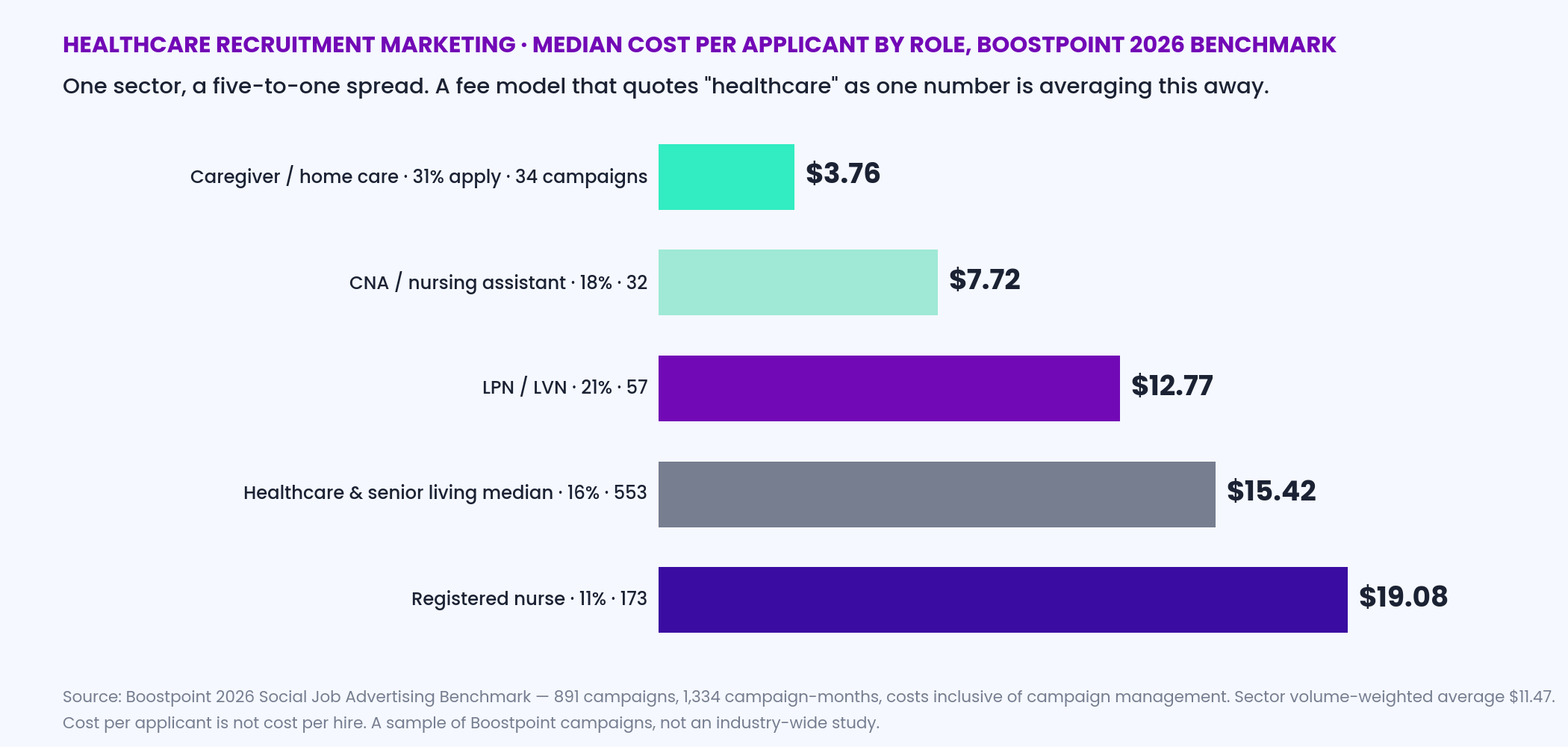
Healthcare is where fee models get tested hardest, because the same dollar buys wildly different results by role. Across 553 healthcare and senior living campaign-months in our 2026 benchmark, the sector median cost per applicant was $15.42 with a 16% apply rate; underneath that, caregivers cost $3.76 at a 31% apply rate, CNAs $7.72 at 18%, and registered nurses $19.08 at 11%. A retainer priced on scope and a per-hire price priced on the RN both hide that spread. An earlier campaign-level analysis of 478 healthcare campaigns (different methodology from the benchmark) found the setting mattered even more than the role: hospital application flows completed at 6.0% against 22.1% in senior living and 21.6% in home care, because hospitals route the click into a long ATS application. Whatever model you buy for healthcare, make the vendor accountable for the form — or expect to pay for clicks that never become nurses. The full role table is on the healthcare recruiting guide.
Seven questions that expose a fee model
- What unit am I buying — hours, spend, applicants, or hires? The answer sorts every vendor into one of the five rungs before you read the price.
- Is the fee inside the cost per applicant you'll report, or on top of it? A "$12 per applicant" with a 20% fee on top is $14.40. Get it in writing.
- What is the minimum — spend, months, or hires? Retainers run 3–12 months; percentage models have spend floors; RPO and per-hire contracts have volume clauses.
- What counts as an applicant (or a hire)? A click, a started form, a completed form, an ATS record, a day-one start, and a 90-day retention are six different products at six different prices.
- Who owns the form? If the vendor sends clicks to your career site and your form converts at 6%, the vendor's fee model has nothing to do with your cost.
- Will you show me your worst campaigns? A vendor that publishes a distribution — including the expensive tail — can be held to a number. One that publishes case studies cannot.
- What do I keep if I leave? Ad accounts, audiences, creative, and applicant data are either yours or the agency's. Ask before the first invoice, not the last.
Every fee model on this page is legitimate. What matters is that you can work out an all-in cost per applicant for each one — ad spend plus every fee, divided by applicants — because that is the only number you can compare across vendors.
Frequently asked questions
What is outsourced recruitment marketing?
Paying an outside vendor to do some or all of the work that happens before a candidate applies: job ads, audience targeting, creative, career pages, employer brand, and the application form. It is distinct from recruitment process outsourcing (RPO), which adds recruiters who screen, schedule, and make offers, and from a staffing agency, which supplies people. The unit you buy differs by vendor — hours, media spend, applicants, or hires — and the fee model tells you which.
How much does a recruitment marketing agency cost?
The recruitment-specific agencies we checked on August 25, 2026 — NAS Recruitment Innovation, Shaker Recruitment Marketing, Appcast (which acquired Bayard in July 2023), Recruitics, Radancy — publish no pricing. General marketing-agency guides put flat retainers at $3,000–$8,000 a month for one channel and $6,000–$15,000 for several (Stackmatix, April 2026), media-management fees at 10–20% of spend, creative production at $2,000–$8,000 a month billed separately, and setup at $500–$5,000. Those are the guides' own ranges, not a survey.
What is a typical management fee as a percentage of ad spend?
Stackmatix's April 2026 guide gives 10–20% of managed spend, decreasing at higher spend tiers, with an effective 15–25% at low budgets; Scopic Studios' May 2026 guide uses a 15% example and says that below roughly $8,000–$12,000 a month in ad spend the percentage "yields too little for the agency to properly staff the work." Boostpoint does not charge a percentage of spend: it is priced as a monthly ad budget plus a separate subscription, and the cost per applicant we publish is advertising cost only, so add the subscription when you compare.
How is Boostpoint priced?
As a monthly ad budget plus a separate product subscription: the ad budget has a minimum of $750 a month, the subscription is quoted on a call and billed on top, and you receive one bill through Boostpoint for both. The cost-per-applicant figures we publish — $13.88 median across 891 campaigns — are advertising cost only, before the subscription. What you get for it is the ad, the targeting, the in-platform application form with knockout questions, campaign management, and applicants delivered to you. What you don't get is a career site, an employer-brand campaign, or recruiters; if you need those, a retainer agency or RPO is the right buy.
Is outsourced recruitment marketing cheaper than RPO?
They price different units, so "cheaper" needs a denominator. RPO is priced per hire ($3,000–$10,000 in the industry guides compiled on our RPO cost page) or per embedded recruiter per month ($8,000–$15,000), and includes screening, scheduling, and offers. Recruitment marketing is priced per scope, per spend, or per applicant, and stops at the application. If you need recruiters, marketing alone won't replace them; if you have recruiters and lack applicants, an RPO fee buys capacity you already own.
What does healthcare recruitment marketing cost?
In our 2026 benchmark, 553 healthcare and senior living campaign-months produced a median cost per applicant of $15.42 (16% apply rate), spanning caregivers at $3.76 and a 31% apply rate to registered nurses at $19.08 and 11%. In an earlier campaign-level analysis, hospital application flows completed at 6.0% against 22.1% in senior living, a gap that feeds straight into cost per applicant. Costs are advertising only and are per applicant, not per hire.
What should a recruitment marketing contract include?
The unit being billed and its definition; whether the fee is inside or on top of any reported cost per applicant; every minimum (spend, months, volume); what is billed separately (creative, setup, tools — 20–40% beyond the headline fee, per Scopic Studios); who controls the application form; monthly reporting of applicants and spend; and ownership of ad accounts, audiences, creative, and applicant data at exit.
When should a small employer not outsource recruitment marketing?
When you have one or two roles and someone who already runs Meta ads — do it in Ads Manager and keep the fee. When your real problem is an application that takes twenty minutes — fix the form first, because cost per applicant rises in direct proportion as fewer clickers finish the form, and no vendor's fee model changes that. And when a vendor's minimum exceeds your media budget: the guides' $8,000–$12,000 monthly floor for percentage models works out to $96,000–$144,000 a year in ad spend, so look for a model whose floor a single location can meet rather than stretching to meet one.
See real campaign numbers before you pick a model
We'll show you the campaigns closest to your roles from 891 real ones, and tell you if a retainer agency or RPO is the better buy.
Book a DemoBoostpoint figures come from the 2026 Social Job Advertising Benchmark — 891 campaigns and 1,334 campaign-months: $13.88 median cost per applicant, $6.48–$29.74 for the middle half of campaigns; median monthly campaign budget $334, upper quartile $554, median 20 applicants per campaign-month; healthcare and senior living sector $15.42 median, 16% apply rate, 553 campaign-months; caregiver $3.76 / 31%, CNA $7.72 / 18%, LPN $12.77 / 21%, registered nurse $19.08 / 11%. Application-completion by setting (hospital 6.0%, senior living 22.1%, home care 21.6%) comes from an earlier campaign-level analysis of 478 healthcare campaigns and uses a different methodology. Cost per applicant is not cost per hire; we do not track hires and publish no cost-per-hire figure. Boostpoint is priced as your monthly ad budget (minimum $750 a month) plus a separate subscription, quoted per engagement; benchmark costs are advertising only. Third-party ranges are the sources' own: Stackmatix, "Paid Media Agency Pricing: Fee Models and What to Expect," April 6, 2026; Scopic Studios, "Digital Marketing Agency Pricing," May 27, 2026; RPO ranges as compiled on our RPO cost page from 2026 industry pricing guides. Vendor sites checked August 25, 2026: NAS Recruitment Innovation, Shaker Recruitment Marketing, Appcast, Recruitics, Radancy (no pricing shown); bayardad.com redirects to appcast.io; Appcast's acquisition of Bayard Advertising per Business Wire, July 10, 2023. Worked figures: $250.00 = ($3,000 + $2,000) ÷ 20; $115.00 = $2,300 ÷ 20; $14.40 = $12 × 1.20. Fee ranges change; re-verify before budgeting. This is a sample of Boostpoint campaigns, not an industry-wide study.