
Recruitment Marketing Agency: Six Kinds of Firm Wear That Name, and How to Tell Them Apart
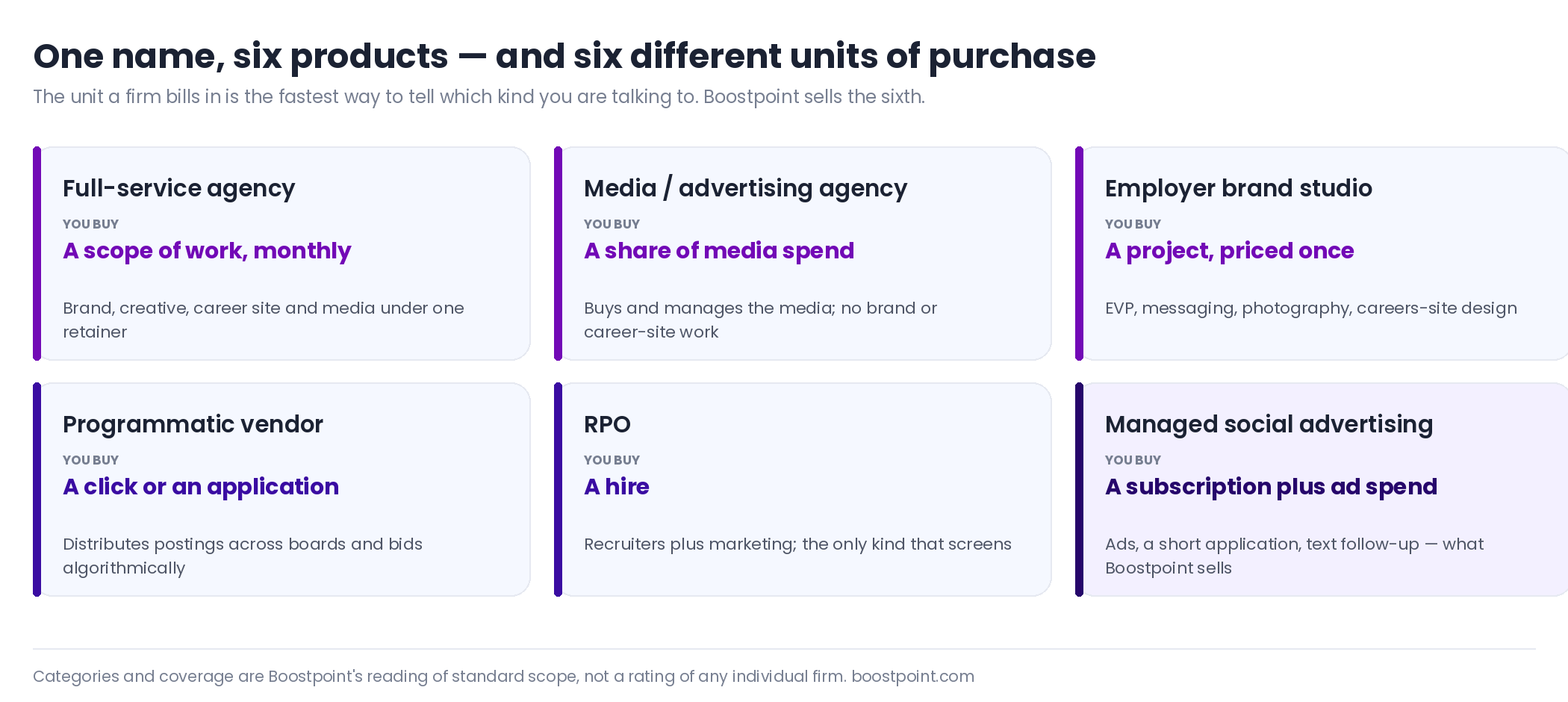
Six products are sold under the name recruitment marketing agency: full-service agencies, media-buying shops, employer-brand studios, programmatic job-ad vendors, RPO firms, and managed advertising products like ours. They cover different work and bill in different units — agency guides put monthly fees at $1,000 to $10,000-plus, embedded RPO recruiters at $8,000–$15,000. Match the kind to the problem before comparing a price.
A note on who's writing this
Boostpoint is one of the six kinds below — managed social job advertising, sold as a subscription plus your ad spend — so read the sorting with that in mind. We've tried to describe the other five fairly enough that you can tell when one of them is the right buy and we're not. Third-party figures are named in the table they sit in; ours come from the 2026 benchmark, 891 campaigns published in full. If you know which kind you want, the fee models are on outsourced recruitment marketing and the mechanics on recruitment advertising services. Our version of it is managed social job advertising for frontline hiring.
One name, six products
The definition is broad by design. Recruitics, an agency in the category, defines a recruitment marketing agency as a firm specializing in "attracting, nurturing, and engaging" candidates on a client's behalf — accurate, and wide enough to cover six businesses that share almost no operations. Ongig's 2026 roundup lists the same spread as one shopping list: employer branding, media buying, programmatic distribution, career sites, CRM, creative and analytics.
So the first question is not which agency is best, but which of the six you're looking at, and whether it covers what's broken. A career site converting at 4% is not fixed by better media buying; a warehouse shift nobody applies to at 11pm is not fixed by an EVP workshop.
Two of the six are routinely mistaken for each other. A recruitment advertising agency buys media; a full-service recruitment marketing agency buys media and owns the brand, creative and career site feeding it. If applicants are cheap but nobody finishes the application, you bought the wrong one.
What the category costs, at category level
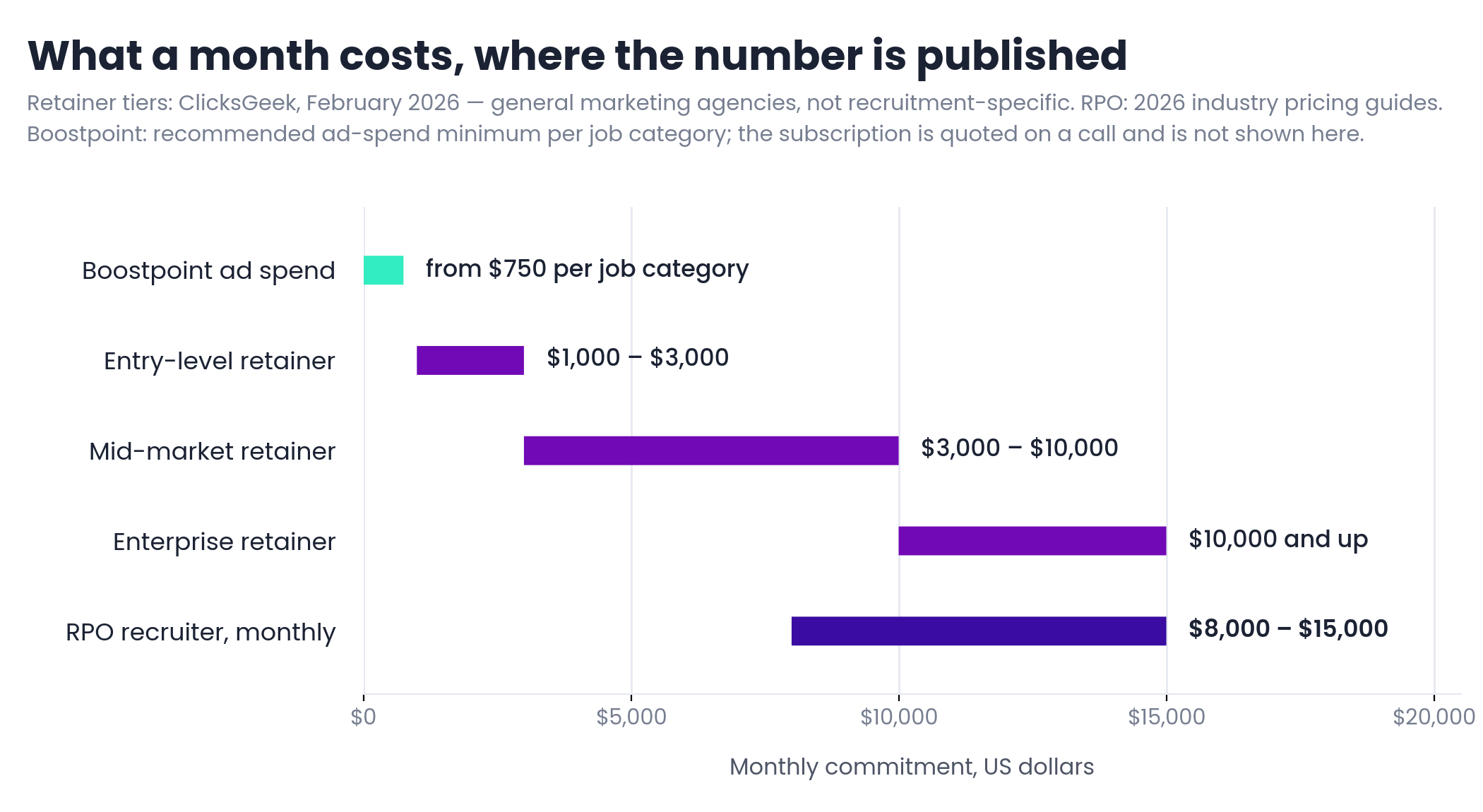
Recruitment marketing agencies almost never publish employer pricing, and neither do the roundups — Ongig's 2026 list carries none. That's not a criticism; retainer work is scoped per client. But it means the only numbers a buyer can reach come from general marketing-agency guides, read as those sources' own ranges.
| What you'd be paying | Published range | Applies to | Source |
|---|---|---|---|
| Entry-level monthly retainer | $1,000–$3,000 per month | General marketing agencies, 10–15 hours a month | ClicksGeek, February 2026 |
| Mid-market monthly retainer | $3,000–$10,000 per month | General marketing agencies, 20–40 hours a month | ClicksGeek, February 2026 |
| Enterprise monthly retainer | $10,000 and up | Multi-channel | ClicksGeek, February 2026 |
| Percentage of ad spend | 15–20% of spend | Paid media management | ClicksGeek, February 2026 |
| RPO, per hire | $3,000–$10,000; $1,500–$4,000 high-volume | Recruitment process outsourcing | EORHQ, InterviewCost, Hudson, TinRate |
| RPO, embedded recruiter | $8,000–$15,000 per recruiter per month | Embedded recruiters | EORHQ, InterviewCost, Hudson, TinRate |
| Staffing agency, direct hire | 15–30% of first-year salary | Placement, not marketing | Instawork, Davis Companies, Frontline Source Group |
| In-house recruiter, salary only | $72,910 median a year | US HR specialists, May 2024 | US Bureau of Labor Statistics |
The first four rows are general marketing-agency figures, not recruitment-specific — we'd rather say so than dress them up. The full fee-model breakdown is on outsourced recruitment marketing and RPO cost.
Put two on the same line and the decision takes shape. Assume $4,000 a month of media. At the published 15% of spend, the fee is $600 and all-in is $4,600. Under a $3,000 retainer with identical media, all-in is $7,000 — five times the fee for the same media. Either excellent value or absurd, depending on whether you need the four other things the retainer covers.
There is a seventh arrangement that does not appear on that list, because the client never sees it: the work runs under somebody else’s name. White label recruitment marketing covers what a partner is putting their name on.
The case for a full-service agency, made first
There is a real version of this argument, and a vendor has every incentive to make it badly.
- Coordination is worth money above one channel. Boards, social, careers site and campus events means four vendors and four sets of numbers that don't reconcile. One firm holding all of it is how anyone answers where the hires came from.
- Employer brand is not an advertising problem. If nobody applies because your company is unknown, or known for the wrong thing, media buying doesn't fix it. EVP research, messaging and the careers site are what studios do well, and that work compounds.
- Professional and salaried hiring is different. Most of what we publish is frontline and hourly. For engineers or senior clinicians the economics change, and a specialist agency wins.
- RPO buys capacity, not attention. If nobody screens the applicants you already get, more make it worse. RPO puts recruiters on your requisitions; break-even is commonly quoted at 15–25 hires a year.
- A retainer buys senior attention. ClicksGeek puts a loaded marketing specialist at $75–$150 an hour, so $3,000 for 20–40 hours of expert attention is not obviously overpriced.
If two or more describe you, go get agency proposals. We wouldn't win that comparison, and a product doing one of the six jobs is not the answer to a four-job problem.
Before comparing firms at all, it is worth knowing which lever you are buying. Across 891 Boostpoint-managed campaigns, 70% of the variation in cost per applicant comes from what happens after the click rather than from the advertising itself, which is the subject of our page on digital recruitment marketing and where the cost actually moves.
Where this gets bought wrong
The failure mode isn't paying too much. It's buying scope you can't use, in two directions.
One: a single location with four open frontline roles signs a retainer sized for an employer with forty. In our benchmark the median campaign ran on $334 a month for 20 applicants from 6,061 people reached. Twelve campaign-months at that budget is $334 × 12 = $4,008 — about one month of a mid-market retainer, before any media. Neither number is wrong; they describe different buyers.
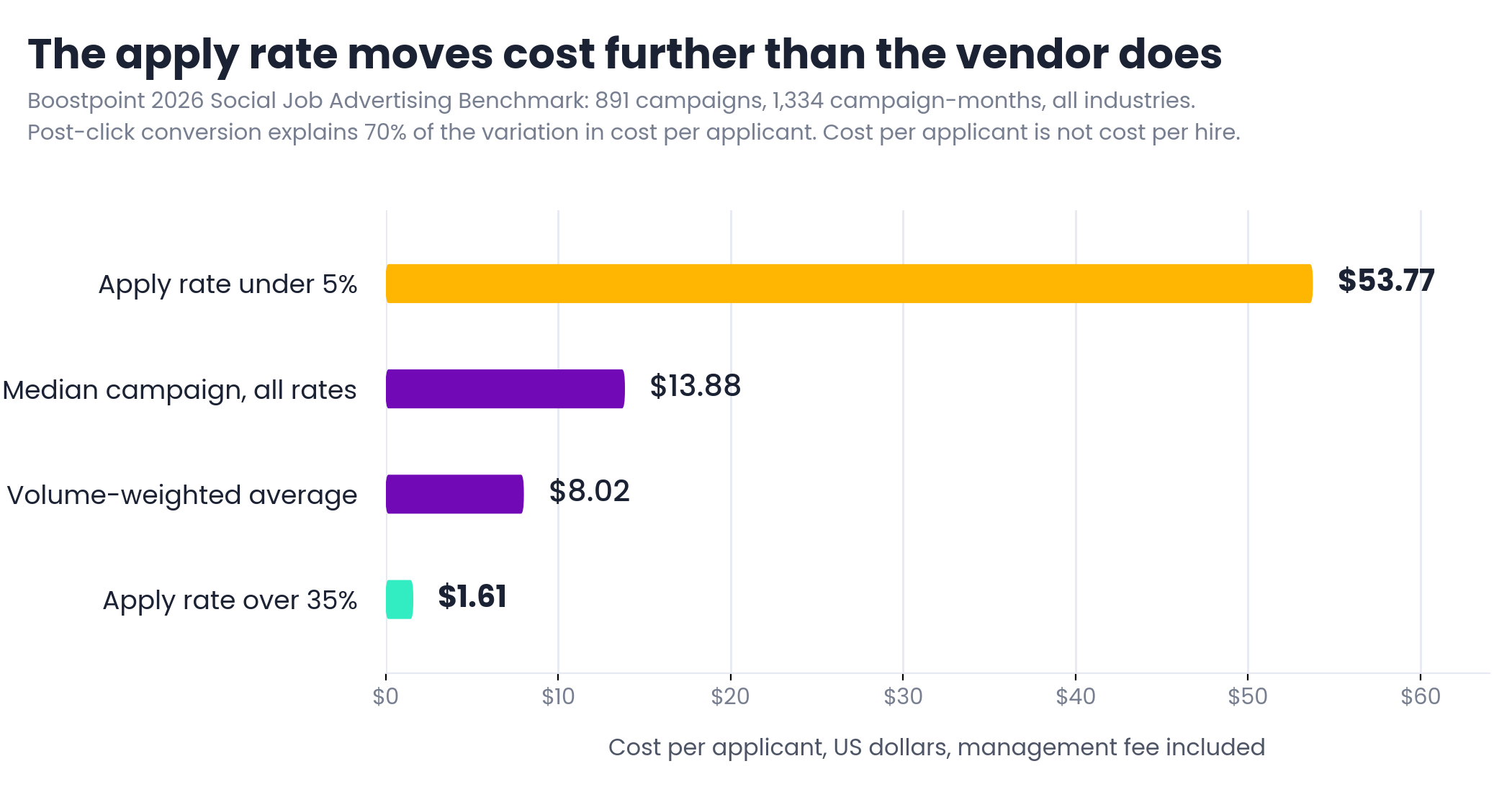
Two, and more expensive: an employer with a real brand and career-site problem buys media instead — from us or anyone — and it works exactly as advertised while applicants leak out of a twelve-field form. It's visible in our own data. Across 891 campaigns, post-click conversion explains 70% of the variation in cost per applicant, against 30% for click-through rate and 18% for the auction price of impressions; cost per applicant by apply rate runs from a median $53.77 below 5% to $1.61 above 35%. The vendor you choose moves your cost less than the form does.
What we are, and what it costs
Boostpoint is the sixth kind. Boostpoint is recruitment marketing software for frontline employers in healthcare, trucking, skilled trades, manufacturing, agriculture and hourly roles: it turns your open jobs into targeted Facebook and Instagram ads, builds and optimizes the campaigns, collects applicants through a one-minute mobile application with automated text follow-up, and delivers them into your ATS — with a customer success team there to support you. It is software, not an agency: no retainer and no outside team taking over your recruitment marketing, but a product that does one of the six jobs, the advertising. Campaigns run on Facebook and Instagram (TikTok in beta) under the platforms' employment ad rules, and text follow-up comes with the Connect add-on. We don't build career sites, run EVP programs or screen candidates.
The pricing, plainly: subscription packages priced on how many jobs and job categories you hire for, quoted on a call, plus ad spend — recommended from $750 a month per job category — on one invoice. Across 891 campaigns and 1,334 campaign-months our median campaign cost $13.88 per applicant, volume-weighted $8.02.
This shape wins on scale across locations rather than depth in one: one multi-market client ran 110 campaigns at approximately $4.11 per applicant. Where it loses is the section above; the comparison is on Boostpoint alternatives.
Five questions that sort any proposal
- What unit am I buying — a scope, a share of spend, an applicant, or a hire? The unit identifies the firm faster than the pitch deck.
- Is your fee inside or outside the number you report? A cost per applicant with the fee outside looks better and means less.
- Which of the eight scope items are you doing, in writing? Anything not written down is not in scope.
- What will you report weekly, and what do you refuse to report? Ours: applicants, apply rate, frequency, cost per applicant. Not cost per hire — hires happen in your ATS.
- When do you tell me to spend less? Every fee model above pays the firm more when you spend more, ours included. No answer is an answer.
Six products share one name, and a price means nothing until you know which of the six is quoting you. Match the firm to what's actually broken — then compare, because the form on your application converts harder than the logo on the invoice.
What a recruitment advertising agency does
A recruitment advertising agency, often shortened to recruitment ad agency, plans, buys and manages paid media for your open jobs. It is the media-buying kind in the six above, and the narrowest: it does not usually own your employer brand, your career site or candidate screening. How that buying is priced and measured is covered in recruitment media buying.
- Channel plan. Which job boards, aggregators and social platforms each role runs on, and how the budget splits between them.
- Ad copy and creative for each role, within each platform's employment-ad rules.
- Buying and optimization. Budgets, bids, and pausing what is not producing applicants.
- Reporting in applicants and cost per applicant, ideally with the agency's fee inside the number.
It usually bills as a percentage of media spend or a monthly management fee; the general marketing-agency figures in the table above put percentage-of-spend management at 15–20%. The question that separates a good recruitment ad agency from a poor one is rarely the fee. It is what happens after the click: if applicants abandon a long application, better media buying will not fix it. How the work itself is done is on recruitment advertising services.
Frequently asked questions
What is a recruitment marketing agency?
A firm that attracts and engages candidates on an employer's behalf. The name covers six products: full-service agencies, media-buying agencies, employer-brand and career-site studios, programmatic job-ad vendors, RPO firms, and managed advertising products. They share a label, not a scope — work out which is quoting you before comparing prices.
What is the difference between a recruitment marketing agency and a recruitment advertising agency?
Scope. A recruitment advertising agency buys and manages media — ads, placements, reporting. A full-service recruitment marketing agency does that and owns the employer brand, the creative and often the career site the ads point at. If cost per applicant is fine but candidates abandon the application, the advertising agency is not what fixes it.
How much does a recruitment marketing agency cost?
The category publishes almost no employer pricing, so the numbers come from general marketing-agency guides. ClicksGeek, February 2026: entry-level retainers $1,000–$3,000 a month, mid-market $3,000–$10,000, enterprise above $10,000, and percentage-of-spend management at 15–20% of media. Read those as that source's own ranges.
Do recruitment marketing agencies publish their prices?
Mostly no. Roundups of the category, including Ongig's 2026 list, carry no pricing, and agency sites quote per client. That is normal for scoped retainer work, but any figure attached to this category should be traced to a named source before you budget around it.
Is a recruitment marketing agency the same as an RPO?
No, and the unit gives it away. Recruitment marketing is everything before someone applies; RPO puts recruiters on your requisitions and prices per hire or per embedded recruiter. Guides put RPO at $3,000–$10,000 per hire, $1,500–$4,000 high-volume, and $8,000–$15,000 per embedded recruiter monthly.
Do I need an agency to advertise jobs on Facebook and Instagram?
No. You can run job ads yourself under Meta's employment Special Ad Category, which allows no age, gender or ZIP targeting, so the copy does the selecting. What a managed service sells is the weekly work: reading apply rate, frequency and cost per applicant, and acting on them.
What should a recruitment marketing agency report to me?
Applicants by campaign, apply rate, frequency, and cost per applicant rather than beside it. Ask which figures include the fee before comparing quotes, and ask what the firm refuses to report — cost per hire cannot honestly come from an ad platform.
When is a staffing agency a better buy than a recruitment marketing agency?
When you need someone on a shift this week and will pay for employment infrastructure and speed rather than a pipeline you own. Published industry sources put direct-hire placement fees at 15–30% of first-year salary. Recruitment marketing builds applicant flow you keep; staffing rents a filled seat.
What is a recruitment ad agency?
Another name for a recruitment advertising agency: a firm that plans, buys and manages paid job ads for an employer across job boards, aggregators and social platforms, and reports applicants and cost per applicant. It does not usually own the employer brand, the career site or candidate screening. It commonly bills as a percentage of media spend or a monthly fee, so ask whether that fee sits inside the cost per applicant it reports.
See which of the six you actually need
We'll show you what applicants cost for roles like yours across 891 real campaigns — and say when a retainer agency or RPO is the better buy.
Book a DemoThird-party ranges are the sources' own, named in-table and checked August 27, 2026: ClicksGeek, "Marketing Agency Monthly Retainer Cost," February 2026 — general marketing agencies, not recruitment-specific, used because this category publishes nothing comparable; RPO ranges as compiled on our RPO cost page from 2026 industry guides (EORHQ, InterviewCost, Hudson, TinRate); staffing fees from Instawork, Davis Companies and Frontline Source Group; US Bureau of Labor Statistics, human resources specialists, median annual wage $72,910, May 2024. Definitions come from Recruitics and Ongig's 2026 agency roundup. The taxonomy and coverage marks are our judgment, not a standard. Worked examples state their assumptions and resolve exactly: $4,000 of media at a 15% fee is $600, all-in $4,600; the same media under a $3,000 retainer is all-in $7,000; twelve campaign-months at the median $334 budget is $4,008. Every Boostpoint figure here — $13.88 median and $8.02 volume-weighted cost per applicant, $334 median monthly budget, 20 applicants, 6,061 reached, apply-rate bands $53.77 to $1.61, and one multi-market client at approximately $4.11 across 110 campaigns — comes from the 2026 Social Job Advertising Benchmark: 891 campaigns, 1,334 campaign-months. Cost per applicant is not cost per hire; hires happen in your ATS and we publish no cost-per-hire figure. This is a sample of Boostpoint campaigns, not an industry-wide study. General information, not legal or financial advice.