
Boostpoint Alternatives, Pricing and Reviews: The Version Written by Boostpoint, Which Is Why It Starts With Who We're Wrong For
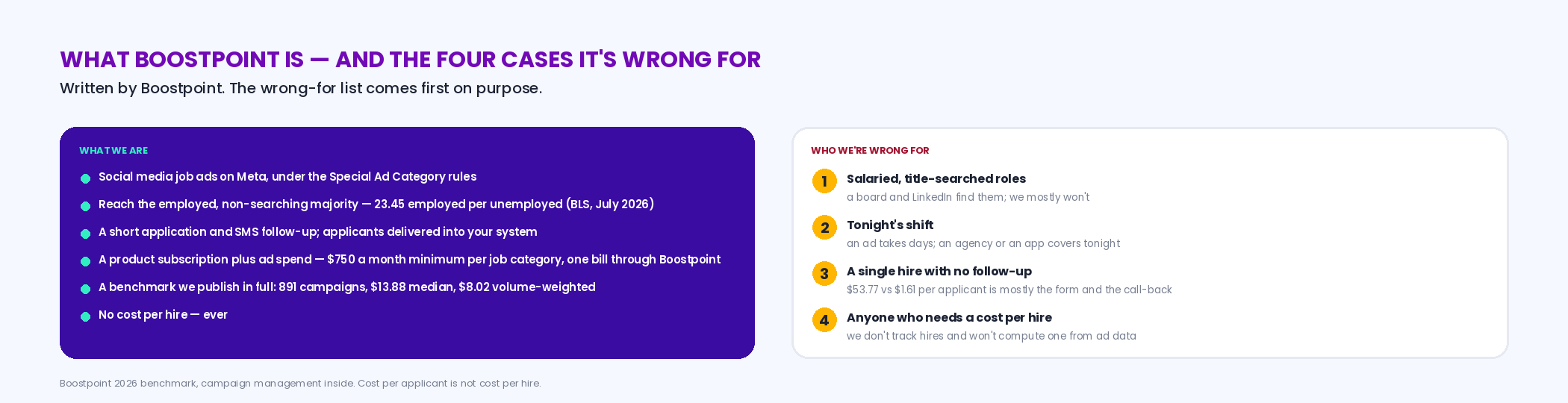
If you're comparing Boostpoint to something else, here is the comparison from our side, with the parts a third-party page would skip. Boostpoint runs social media job ads that reach employed people who aren't searching, and delivers the applicants into your system. Boostpoint is priced as a product subscription plus ad spend — the subscription on job volume, quoted on a call; the ad spend recommended at a minimum of $750 a month per job category, with one bill through Boostpoint — and every cost-per-applicant figure we publish is advertising cost only, with the subscription billed on top. We are the wrong choice for several kinds of hiring, listed first below, and the honest alternatives — job boards, running Meta ads yourself, an agency, referrals — are graded on what each does best.
A note on who's writing this
We are. That makes this page the least neutral source you could read about Boostpoint, so we have written it to a rule that neutral sources rarely keep: nothing here is a claim we can't show. Our numbers come from a benchmark we publish in full, with its suppression rules; our customers are named only where we have permission and their figures are labeled by the analysis they came from; our pricing model is stated the way it works; and the section on who we are wrong for comes before the section on who we are right for. Where a competitor publishes a price we quote it from their page with the date; where they don't, we say so and don't guess. If you want the sales version, the product page exists; this is the other one.
Who Boostpoint is the wrong choice for
Four cases, plainly. A salaried, title-searched role — an accountant, a marketing manager, a software engineer — where the people you want have profiles and search by title; a board and LinkedIn will find them and we mostly won't. Tonight's shift: an ad produces applicants over days and weeks, and a gap on Saturday is a staffing agency's or a shift app's problem, not ours. A single low-volume hire with no form, no reply process and nobody to call back: we make applicants exist, and a broken step after the application wastes them; our own benchmark shows campaigns converting under 5% of clicks paying a median $53.77 per applicant against $1.61 above 35%, and the difference is the form and the follow-up, not us. And anyone who needs a cost per hire: we measure advertising, not hiring outcomes, we don't track hires, and we won't compute a cost per hire from ad data, because the benchmark says it can't be done honestly and that honesty is worth more to us than the sale. If you are in one of those four, the alternatives section below is the useful part of this page.
Interactive
Fit check — answer four questions and get our honest read on whether Boostpoint is the right tool, and if not, what is
Nothing is stored or sent — this runs in your browser. The answers are ours and we say so; "not us" is a real outcome here.
Boostpoint pricing: a subscription plus ad spend
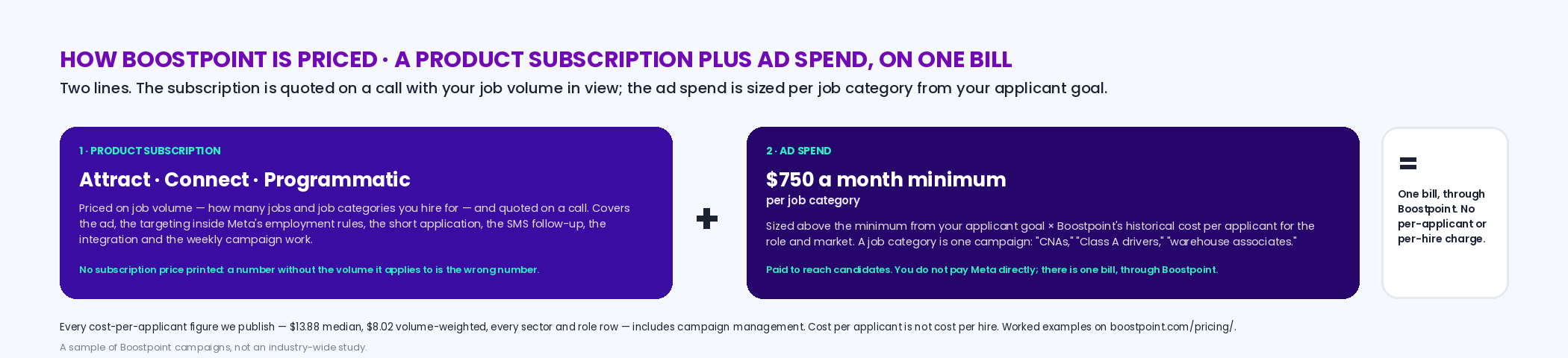
Two lines, one bill. You pay a product subscription — for Boostpoint Attract (with Connect, its text follow-up add-on) or Programmatic 2.0 — priced on your job volume, which is why it is quoted on a call rather than printed here; and you pay for the ad spend that reaches the people you're hiring, which Boostpoint recommends at a minimum of $750 a month per job category and sizes above that from your applicant goal and its historical cost per applicant for the role. The subscription covers the campaign work: the ad, the targeting inside the rules of Meta's Special Ad Category, the short application, the SMS follow-up when Connect is added, the integration into your system, and the weekly attention to frequency and conversion that the benchmark shows matters more than the budget. You do not pay Meta directly and you do not need your own ad account; the ad spend and the subscription arrive on one bill, through Boostpoint. There is no per-applicant charge and no per-hire charge, and every cost-per-applicant figure we publish — the $13.88 median, the $8.02 volume-weighted average, every sector and role row on the benchmark — is the advertising cost advertisers paid, and the subscription is a separate line on top, so add the two to see the full month. The full model, with worked examples, is on the pricing page. If a vendor quotes you a media number and a fee number separately, ask which one their cost per applicant was computed on.
Interactive
Run it yourself or have it managed — enter the subscription you were quoted and your own time, and see the month both ways
Nothing is stored or sent — this runs in your browser. The subscription field is blank on purpose: enter the monthly figure you're quoted (ours or anyone's). The applicant counts use benchmark medians as illustration, not a forecast.
The alternatives, graded honestly
Every one of these is the right answer for someone, and some of them are the right answer for people who found this page. Prices are as verified on each vendor's own site, dated; where a vendor publishes none we say so.
| Alternative | Best at | Pricing, as verified | When it beats Boostpoint |
|---|---|---|---|
| Running Meta ads yourself | Exactly what we do, if you have the hours, the creative, and someone watching frequency and conversion weekly | Meta charges no platform fee to use Ads Manager; you pay the media. Your cost is the hours. | When you have a marketer with time and the discipline to read the numbers; the calculator above prices the hours. The Special Ad Category rules are on our page. |
| Indeed | A large searching audience; title-searched roles | Published: many posts free subject to terms; Sponsored Jobs "start at $5 per day or $150 per month" (Indeed) | Salaried and title-searched roles; the between-jobs few for any role. Graded fully on Indeed alternatives. |
| Monster · ZipRecruiter | A published price with resume search (Monster); distribution to many boards (ZipRecruiter) | Monster published: from $8/day; Pro $299/month. ZipRecruiter: no prices published; free trial | Multi-market title-searched hiring through one inbox; a fixed-budget resume-search workflow |
| A staffing agency | Tonight's shift; a bridge crew; a bench for a season | An hourly markup on the wage; the arithmetic is on staffing agency markup | When the problem is a shift, not a hire; when you need people before any ad could produce them |
| An RPO or managed recruiting service | Owning the whole process — sourcing, screening, scheduling, offers — at volume | By quote; the models are on RPO cost and outsourced recruitment marketing | When you want the process run for you, not just the applicants delivered |
| Employee referrals | Often the best-retained hires a frontline employer makes | The bonus you set, paid in installments | Always — run this alongside anything, including us |
| A hiring event you run yourself | A dozen hires on one date, offers on the spot | A room, a date, and something to drive attendance | When you have the crowd already; when you don't, the event-driven campaign is what we'd sell you (the lowest median cost of any campaign structure in the benchmark) |
| A high-volume ATS with sourcing modules | Processing applicants at scale | Mostly by quote; see our Workstream page and Cadient page | When the leak is after the application, not before it — then you need processing, not us |
Boostpoint reviews: the customers we can name, and their numbers
We don't quote review-site ratings here, because we can't verify what a listing says on a given day and because a star count tells you less than a cost per applicant with a name on it. What we can do is name customers who have given us permission and show what their campaigns ran, from our earlier healthcare analysis (478 campaigns, 30 employers, 24,712 applications — a campaign-level methodology that differs from the benchmark's campaign-month cut; where the two conflict, the benchmark is canonical). In home care and senior living: Right at Home at $1.22 per applicant, Home Helpers $1.97, At Home Support $2.04, Always Best Care $2.18, Home Instead $3.16, Polaris $4.53, Alliance $5.81; in home health and hospital systems, Gentiva $7.45, CenterWell/Kindred $14.61, CommonSpirit $19.63 — a spread that says more about the roles and the forms than about the channel. In agriculture, CHS, Insight FS and Mid Kansas Co-Op are the co-ops behind the seasonal curve we publish. Elsewhere we can name Penn Waste, ADESA, Kohler, Equipter and About Kids; our homepage carries Penn Waste's statement that the company went "from spending $50k per month on temporary labor to $15k per month," which is their statement about their own spend, not a benchmark figure. Every one of those is a cost per applicant, never a cost per hire.
| Customer | Setting | Cost per applicant | Source |
|---|---|---|---|
| Right at Home | Home care | $1.22 | Earlier healthcare analysis |
| Home Helpers | Home care | $1.97 | Earlier healthcare analysis |
| At Home Support | Home care | $2.04 | Earlier healthcare analysis |
| Always Best Care | Home care | $2.18 | Earlier healthcare analysis |
| Home Instead | Home care | $3.16 | Earlier healthcare analysis |
| Polaris | Home care | $4.53 | Earlier healthcare analysis |
| Alliance | Home care | $5.81 | Earlier healthcare analysis |
| Gentiva | Home health and hospice | $7.45 | Earlier healthcare analysis |
| CenterWell/Kindred | Home health | $14.61 | Earlier healthcare analysis |
| CommonSpirit | Hospital system | $19.63 | Earlier healthcare analysis |
The benchmark we publish, and why it is the review that matters
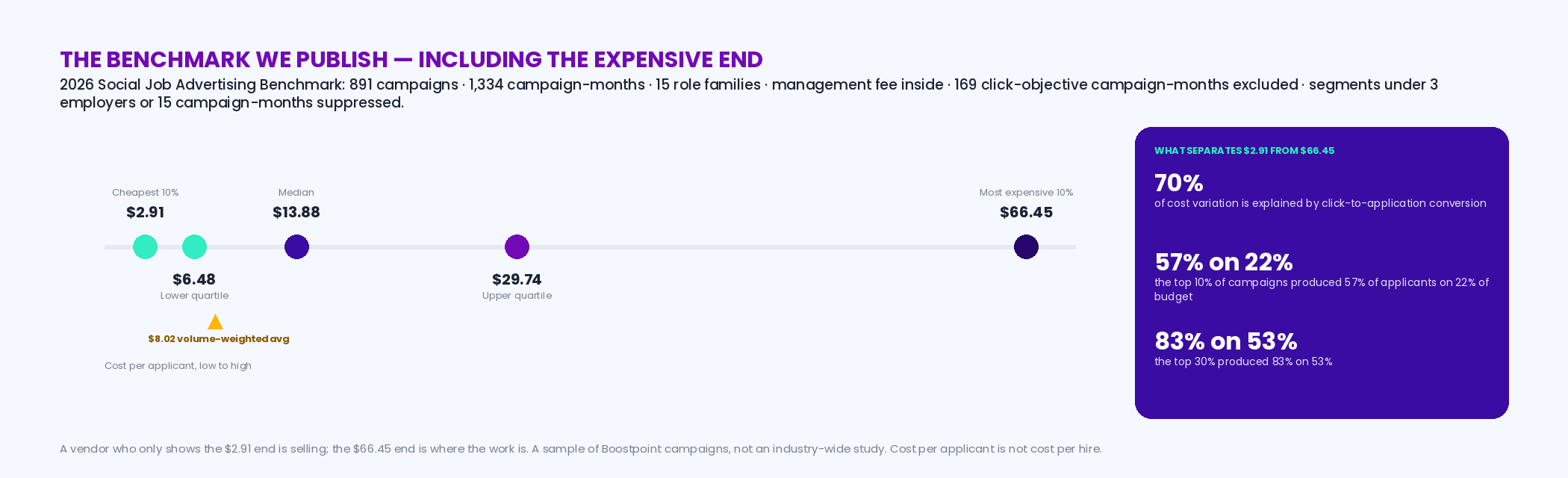
The most useful review of Boostpoint is the dataset we put our name on. The 2026 Social Job Advertising Benchmark covers 891 campaigns and 1,334 campaign-months across 15 role families; 169 campaign-months that ran with a click objective rather than a lead objective were excluded, and any segment with fewer than three employers or fifteen campaign-months is not published. The median campaign ran $13.88 per applicant and the volume-weighted average $8.02; the cheapest tenth of campaigns ran under $2.91 and the most expensive tenth above $66.45, with the middle half between $6.48 and $29.74. That spread is the honest part: it says the channel is not magic, and that what separates $2.91 from $66.45 is mostly conversion (70% of the variation) and frequency, which is why the top 10% of campaigns produced 57% of all applicants on 22% of the budget and the top 30% produced 83% on 53%. A vendor who only showed you the $2.91 end would be selling; a vendor who shows you the $66.45 end is telling you where the work is. Reading your own numbers against those is on recruiting analytics.
| Percentile | Cost per applicant | Read it as |
|---|---|---|
| Cheapest 10% | $2.91 | High-volume frontline roles with short forms |
| Lower quartile | $6.48 | |
| Median campaign | $13.88 | Use for a single requisition |
| Upper quartile | $29.74 | |
| Most expensive 10% | $66.45 | Credentialed roles, long forms, saturated audiences |
| Volume-weighted average | $8.02 | Use for portfolio forecasting; lower than the median because volume sits in cheap frontline roles |
Source: Boostpoint 2026 Social Job Advertising Benchmark — 891 Boostpoint-managed campaigns on Meta (1,334 campaign-months), 2026; costs are what advertisers paid for advertising only.
What we won't say, on purpose
A short list of things you will not find on this site, because they would be false or unprovable. A cost per hire computed from ad data — we have no hire attribution and say so. A claim that video ads beat photo ads, or the reverse — most of our spend sits in ads whose names don't record the format, so we can't tell. A trades cost by role, or a cost figure for any single trade whose sample is too small — the data doesn't support them. A seasonality claim for trades or drivers — the patterns we see are client mix, not seasons; the one seasonal curve we publish is agriculture's, from four co-ops, labeled directional. A customer we haven't been cleared to name. A competitor's price we couldn't read on their own page. If a Boostpoint page ever says one of those things, it is a mistake, and we would like to know.
Frequently asked questions
What is Boostpoint?
A recruitment advertising service: social media job ads on Meta's platforms, run under the Special Ad Category rules, that reach the employed people who aren't searching job boards — most hourly and frontline candidates — with a short application, SMS follow-up through the Connect add-on, and applicants delivered into the system you already use. We publish our results as a benchmark (891 campaigns) and we do not compute a cost per hire. The BLS counted 23.45 employed people per unemployed one in July 2026; boards reach the second group, we reach the first.
How much does Boostpoint cost?
A product subscription plus ad spend, on one bill through Boostpoint. The subscription — for Attract (with the Connect add-on) or Programmatic 2.0 — is priced on job volume and quoted on the demo, with your roles and markets in view; the ad spend is recommended at a minimum of $750 a month per job category and sized from your applicant goal. No per-applicant or per-hire charge. Every cost-per-applicant figure we publish is advertising cost only, before the subscription: the median campaign cost $13.88 per applicant ($8.02 volume-weighted). The worked examples are on the pricing page.
What are the alternatives to Boostpoint?
Running Meta ads yourself (no platform fee; your hours), Indeed (many posts free subject to terms; Sponsored Jobs from $5 a day or $150 a month, as published), Monster (from $8 a day; Pro $299 a month), ZipRecruiter (no published price; free trial), a staffing agency for tonight's shift, an RPO for the whole process, employee referrals always, and a hiring event you run yourself. Which one beats us depends on the role and the timing; the table on this page says when.
Who is Boostpoint not right for?
Salaried, title-searched roles where a board or LinkedIn finds the candidate; tonight's uncovered shift, which is an agency's job; a single hire with no follow-up process, because applicants nobody calls are wasted; and anyone who needs a cost per hire from ad spend, which we won't compute. The fit check on this page gives the honest read for your case.
Are there Boostpoint reviews?
We don't quote review-site ratings, because we can't verify a listing's state on a given day. We name customers who have given permission, with their cost per applicant from our earlier healthcare analysis — Right at Home $1.22, Home Helpers $1.97, Home Instead $3.16, Gentiva $7.45, CenterWell/Kindred $14.61, CommonSpirit $19.63, among others — labeled by methodology, and we publish the full benchmark including its expensive end ($66.45 at the ninetieth percentile). Those are the reviews we can stand behind.
Does Boostpoint publish a cost per hire?
No, and we won't. We measure advertising — reach, clicks, applications, cost per applicant — and we have no attribution of which applicant became a hire or stayed. Any cost per hire built from ad data is an assumed ratio dressed as a measurement. Take our cost per applicant, apply the applicant-to-hire ratio you measure in your own system, and the result is yours.
Can I just run the same ads myself?
Yes. Meta's Ads Manager has no platform fee; you pay the media, and the Special Ad Category rules for employment ads are public. What you would be replacing is the work — creative, the short application, SMS follow-up, integration, and the weekly attention to frequency and conversion that decides whether a campaign lands at $2.91 or $66.45 per applicant. The calculator on this page prices your hours against a subscription figure you enter.
Which customers can Boostpoint name?
Right at Home, Home Helpers, At Home Support, Always Best Care, Home Instead, Polaris, Alliance, Gentiva, CenterWell/Kindred and CommonSpirit in healthcare and home care; CHS, Insight FS and Mid Kansas Co-Op in agriculture; Penn Waste, ADESA, Kohler, Equipter and About Kids elsewhere. Some of our accounts are held through partners and we don't name those, or their clients.
Ask us the hard questions on the call
The subscription for your job volume, the ad budget per job category, the roles closest to yours in the benchmark, the expensive end and what put campaigns there, and whether you're one of the four cases we're wrong for. We'll answer all of it, with the ad budget and the subscription as separate lines.
Book a DemoBoostpoint figures come from the 2026 Social Job Advertising Benchmark — 891 campaigns and 1,334 campaign-months across 15 role families; 169 campaign-months run with a click objective were excluded, and segments with fewer than three employers or fifteen campaign-months are not published: median campaign $13.88 per applicant, volume-weighted average $8.02, cheapest 10% $2.91, lower quartile $6.48, upper quartile $29.74, most expensive 10% $66.45; a normal campaign $334 a month, 20 applicants, 6,061 reached; conversion explaining 70% of cost variation (under 5% $53.77; over 35% $1.61); top 10% of campaigns 57% of applicants on 22% of budget, top 30% 83% on 53%; event-driven campaigns the lowest median cost of any campaign structure. Named customer figures come from an earlier Boostpoint healthcare analysis (478 campaigns, 30 employers, 24,712 applications) with a campaign-level methodology that differs from the benchmark; where they conflict, the benchmark is canonical. Penn Waste's statement is quoted from the Boostpoint homepage. Vendor prices were read on each vendor's own site on August 26, 2026 and are the vendors' figures, subject to change. BLS Employment Situation, July 2026. The fit check is Boostpoint's judgment; the DIY calculator uses a subscription figure the reader enters and benchmark medians as illustration, not a forecast. Cost per applicant is not cost per hire; we do not track hires and publish no cost-per-hire figure. A sample of Boostpoint campaigns, not an industry-wide study.