
Indeed Alternatives for Employers: Nine Channels, Graded Honestly
The best Indeed alternative depends on who you're hiring. For active job seekers, Monster (published: from $8 a day), ZipRecruiter, LinkedIn, Craigslist ($10–$75 a post), Google for Jobs (free, with structured data), and your state job bank (free) all reach the same searching minority Indeed does. For hourly and frontline roles the bigger pool is employed people who aren't searching, and that pool is reached by referrals and social feed advertising — $8.02 blended cost per applicant across Boostpoint's 891-campaign 2026 Social Job Advertising Benchmark. Only two of the six paid boards publish their prices.
Source: Boostpoint 2026 Social Job Advertising Benchmark — 891 Boostpoint-managed campaigns on Meta (1,334 campaign-months), 2026; costs are what advertisers paid for advertising only.
A note on who's writing this
Boostpoint sells social recruitment advertising — the last of the nine channels below — so read this as a competitor's comparison, written with the intention of being the fairest one you'll find. Three commitments: every channel is graded on what it is genuinely best at, including the ones we compete with; the only prices on this page are ones we verified on the vendor's own website on August 25, 2026, and where a vendor doesn't publish pricing, or blocked our attempt to check, we say so instead of repeating figures from other people's blogs; and our own numbers come from our 2026 Social Job Advertising Benchmark with the methodology stated at the bottom. If your question is specifically about nursing, our best job boards for nurses page grades those; if it is about replacing an agency rather than a board, see staffing agency markup. The channel we sell is described on social media job advertising.
Why employers look for Indeed alternatives
Usually one of four reasons, and they call for different answers. Cost creep: sponsored spend rises with competition for the same keywords in the same metro, and the bill stops correlating with hires. Volume without fit: the applications arrive but the people don't match the shift, the license, or the commute. The pool is wrong: for hourly, trades, driving, and care roles the people you want are working today and not browsing a job board this week. And lock-in: a single channel that owns your applicant flow owns your pricing. The first two are fixable on Indeed itself — sharper titles, knockout questions, a real wage in the ad. The last two aren't a board problem; they are a reach problem, and no board, Indeed included, solves them.
Active vs passive: the distinction the whole decision turns on
Job boards are search engines for people who are searching. That is not a criticism — it is what they are for, and when a role is specialized and the candidate is actively looking, a well-indexed board is the right tool. But the workforce at any moment is mostly employed and mostly not searching, and for frontline roles the employed pool is where the experienced people are: the forklift operator on 2nd shift across town, the CNA who'd move for day shift, the CDL driver who'd take a regional run. Those people don't visit a board; they scroll. Reaching them means putting the job where they already are, with the rate and shift in the first line, and an application that finishes in under a minute. The channels below sort cleanly into these two groups, and the honest answer to "what's the best Indeed alternative" starts with which group you need.
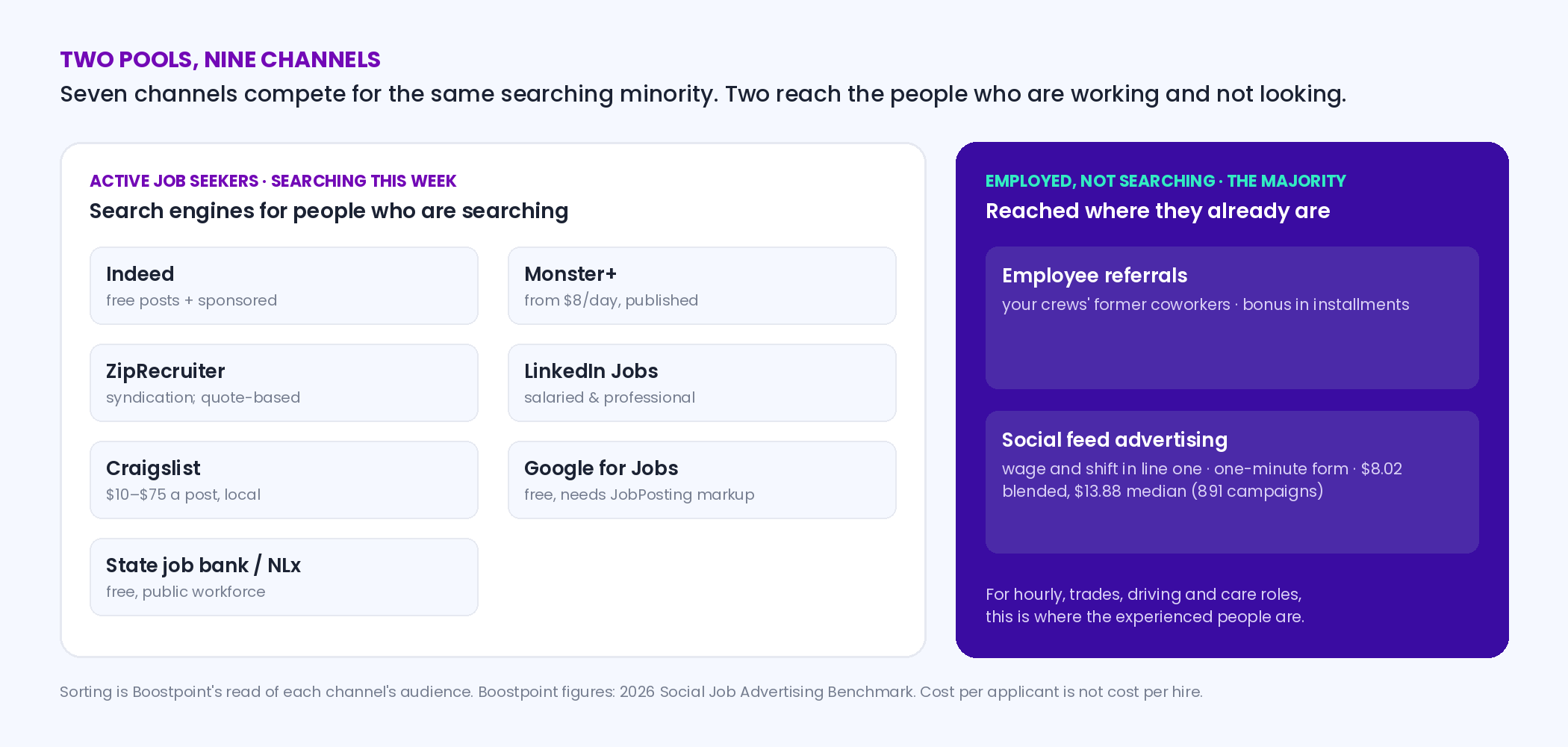
The nine channels, graded on what each is best at
| Channel | Reaches | Genuinely best at | Pricing, as verified on the vendor's site | Watch out for |
|---|---|---|---|---|
| Indeed (free posts + Sponsored Jobs) | Active seekers — the largest board audience | Volume for roles people search for by title; the default place a searching candidate starts | Indeed's pricing pages could not be retrieved for verification; publicly it describes free posts plus budget-based Sponsored Jobs. We do not restate third-party per-click figures. | Sponsored costs rise with keyword competition; free posts sink fast; applicant quality depends on your knockout questions, not the board |
| Monster (Monster+) | Active seekers, plus CareerBuilder and partner network | A clear, published price for promoted posts; resume search on the Pro plan | Published: Standard "starting at $8/day" pay-as-you-go; Pro $299/month or $2,990/year prepaid, with 299 monthly credits and resume views at 2 credits ($2) each; Enterprise "tailored to your needs" (Monster) | Smaller audience than Indeed for most metros; daily-rate spend adds up on long postings |
| ZipRecruiter | Active seekers across a distribution network of boards | Distribution — one post syndicated widely; candidate matching and invitations to apply | Not published: the pricing page offers a free trial and plan selection with no prices shown (ZipRecruiter) | Budget from a quote, not a blog; syndication can mean applicants who never saw your company |
| LinkedIn Jobs | Active seekers with profiles — heavily professional and salaried | Salaried, office, management, and licensed-professional roles; employer brand visibility | LinkedIn's pricing pages could not be retrieved for verification; publicly it describes free posts plus promoted jobs on a budget. No figures stated here. | Thin for hourly and trades roles; candidates there are often the ones every recruiter contacts |
| Craigslist | Local active seekers, especially hourly and trades | Cheap, local, immediate; still used heavily for trades, drivers, and shop roles in many metros | Published: "Job categories in US and parts of CA — $10–75 (fee varies by area)" (Craigslist) | No screening tools; spam; posting quality varies by city |
| Google for Jobs | Active seekers searching Google directly | Free reach for any job page with JobPosting structured data — including your own careers site | Free: Google's documentation lists no fee; eligibility requires JobPosting structured data on your job pages (Google) | Eligible ≠ shown; you need your own job pages and markup, or a board that syndicates for you |
| State job banks / National Labor Exchange | Active seekers using public workforce services; veterans; UI claimants | Free public reach; required for federal contractors' listings; connects to workforce-board staff who refer candidates | Free through your state job bank; the NLx is "a public-private partnership between DirectEmployers and the National Association of State Workforce Agencies" (NLx) | Modest flow; process-heavy in some states |
| Employee referrals | The employed, non-searching pool — your people's former coworkers | Retention and fit; the highest-quality single source most frontline employers have | Whatever bonus you set; pay it in installments (30/90/180 days) | Runs dry without promotion; skews toward who you already have |
| Social feed advertising (Boostpoint's channel) | The employed, non-searching majority — on their phones, by geography and interest | Hourly, trades, driving, care, and production roles where the people you want are working elsewhere; dated hiring events | Published: $8.02 blended and $13.88 median cost per applicant across 891 campaigns (Boostpoint 2026 benchmark) | Needs the wage and shift in the ad and a one-minute in-platform form; weak for executive and niche professional roles; no age or demographic targeting for employment ads |
Who actually publishes their prices
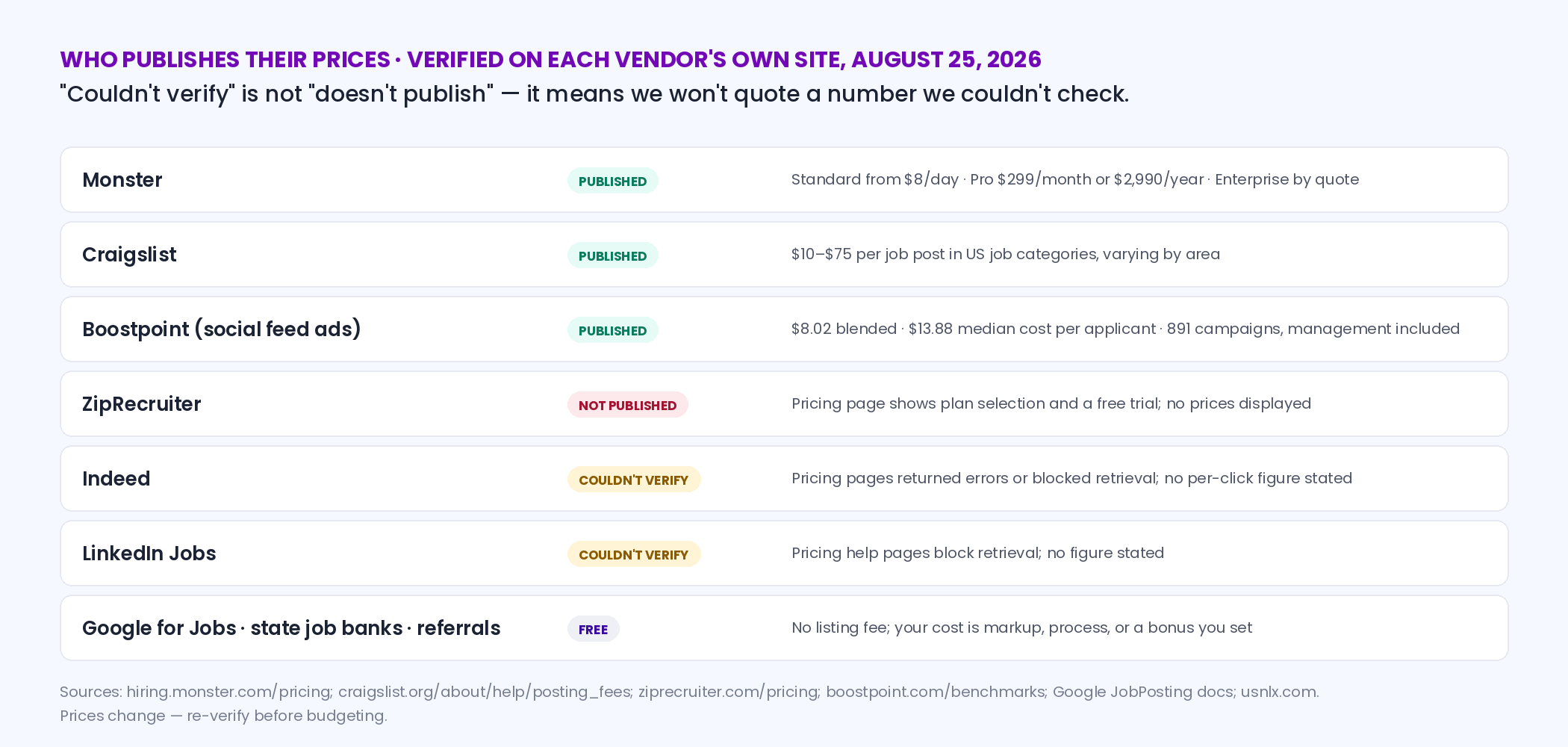
A comparison page that quotes Indeed's cost per click from someone else's blog is guessing on your behalf. Here is what we could and couldn't verify on August 25, 2026, on each vendor's own site. Two of the six paid channels publish a price. Two don't. Two blocked the check, which is not the same as not publishing — but it does mean the numbers floating around the web for them are unverified, and we won't repeat them.
The case for staying on Indeed, made fairly
For a lot of employers the right answer is to keep Indeed and fix how they use it. It has the largest searching audience of any board, its free posts cost nothing but attention, and a sponsored post with a real wage in the title, three knockout questions, and a same-day reply beats most "alternatives" for any role that people search for by name — accountants, nurses, CDL drivers who are actually looking this week. If your complaint is cost per application, the cheapest fix is usually inside the account: cut the fields, add the rate, stop paying for clicks from people the knockouts would have removed. Leaving a channel that works because it got expensive is a budget problem wearing a strategy costume.
If what you are really comparing is tools rather than boards — software that writes the posting, screens applicants and pushes it out to a hundred destinations at once — the questions change, and so does the pricing, which is charged per open job rather than per click. Wizehire alternatives works through that comparison using the vendor's own published prices.
The case for adding — not replacing — starts where the searching audience ends. When your applicants are plentiful but wrong, or absent because the people you want aren't looking, a second board reaches the same searchers again. The employed pool needs a different channel, and that is where referrals and feed advertising earn their place.
Channel is only half the decision. The other half is whether advertising is the layer your hiring is stuck on at all, which is the question recruiting software for small business works through — including the case where the honest answer is to buy applicant tracking instead.
Which channel for which hire
Pick the role and the situation; the picker suggests the two or three channels that fit and says why. It is our read, and it recommends against our own channel where the fit is poor.
Nothing is stored or sent — this runs in your browser. A recommendation, not a rule.
What social feed advertising costs — and what decides it
Because we're a channel on this page, here are our numbers with the same scrutiny we gave the others. Across the 891 campaigns and 1,334 campaign-months in our 2026 benchmark, the median campaign paid $13.88 per applicant and the volume-weighted average was $8.02; the middle half of campaigns ran $6.48–$29.74, the cheapest 10% under $2.91 and the most expensive 10% over $66.45. The median campaign budget was $334 a month and the median campaign-month produced 20 applicants — two separate medians, not a ratio. Costs include campaign management. What decides where a campaign lands is not the board-style variables. Applicant conversion — what happens after the click — explains 70% of the variation; click-through rate 30%; the auction price of impressions only 18%.
| Apply rate (click to completed application) | Cost per applicant | Share of budget | Share of applicants |
|---|---|---|---|
| Under 5% | $53.77 | 18% | 3% |
| 5–10% | $23.13 | 24% | 8% |
| 10–20% | $11.11 | 32% | 23% |
| 20–35% | $4.41 | 21% | 38% |
| Over 35% | $1.61 | 6% | 28% |
Source: Boostpoint 2026 Social Job Advertising Benchmark — 891 Boostpoint-managed campaigns on Meta (1,334 campaign-months), 2026; costs are what advertisers paid for advertising only.
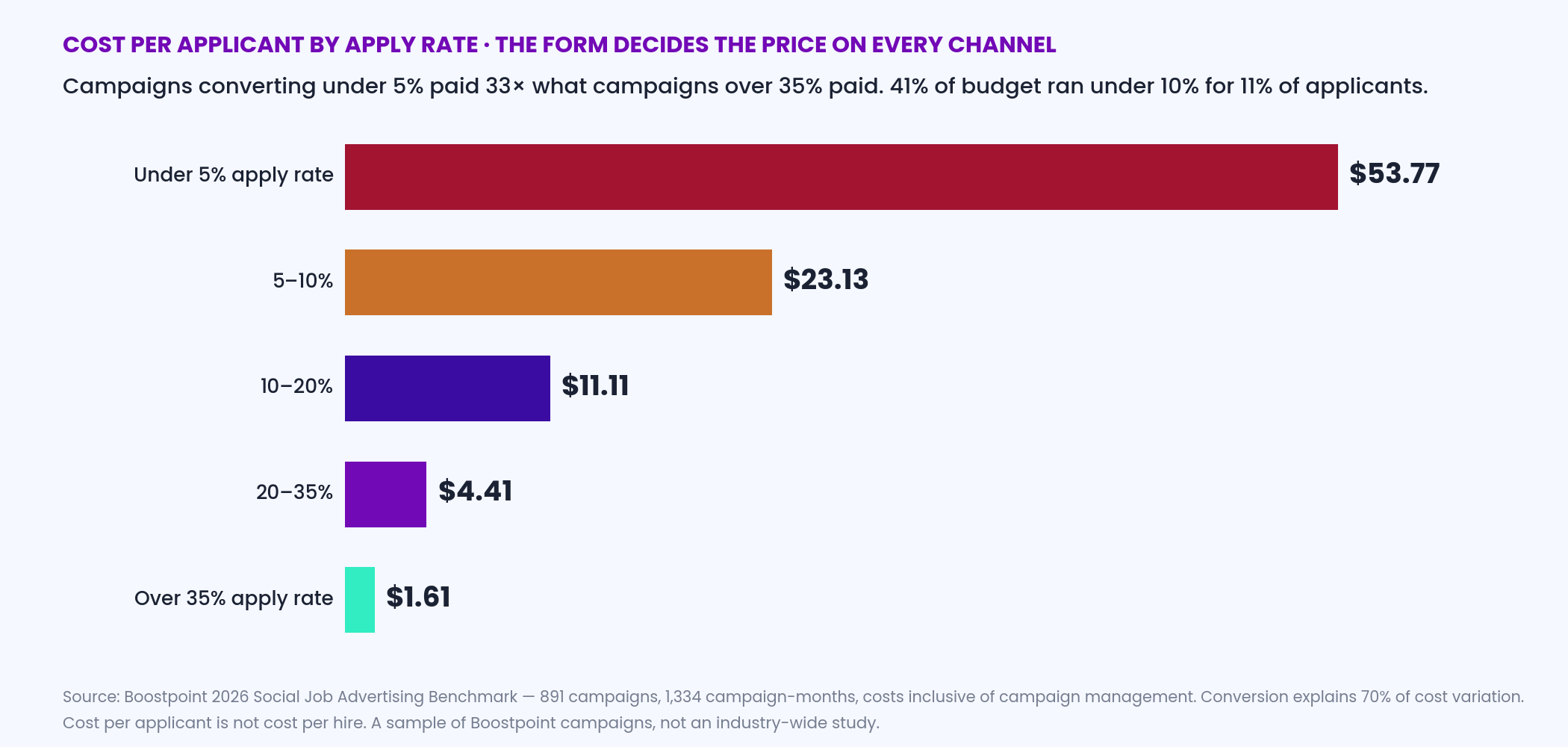
That table is the honest version of "is social cheaper than Indeed." It is cheaper when the application finishes in under a minute and the ad names the wage; it is not when the click lands on a twelve-field portal. The same is true of every board on this page. 41% of all budget in our benchmark ran in campaigns converting under 10% and returned 11% of the applicants — and that money would have been wasted on any channel.
A worked comparison, with every assumption stated
Say you promote one warehouse posting for a month. On Monster's published Standard plan at $8 a day, 30 days is $240.00; the Pro subscription is $299 a month, or $2,990 prepaid for a year (which is $598 less than twelve months at $299). On Craigslist, one post is $10–$75 depending on the metro. What those buy in applicants depends entirely on your posting and your market, and neither vendor publishes an applicant figure, so we won't invent one. On our channel, the benchmark's median campaign ran a $334 monthly budget and a median campaign-month produced 20 applicants; at the $13.88 median cost per applicant, a $334 budget implies about 24 applicants, and at the $8.02 blended average about 42 — arithmetic on published medians, not a forecast for your role. Cost per applicant is not cost per hire on any channel, and none of these figures include your time.
There is no single best Indeed alternative. There are two pools — people searching and people working — and the honest fix is usually one channel for each, with the wage in the ad and a form that finishes in under a minute on both.
Frequently asked questions
What are the best alternatives to Indeed for employers?
It depends on who you're hiring. For active job seekers: Monster (published pricing from $8 a day for promoted posts), ZipRecruiter (syndication; pricing not published), LinkedIn Jobs (salaried and professional roles), Craigslist ($10–$75 a post, local hourly and trades), Google for Jobs (free with JobPosting structured data on your own careers pages), and your state job bank (free). For hourly, trades, driving, and care roles, the larger pool is employed people who aren't searching, reached by employee referrals and social feed advertising — $8.02 blended cost per applicant across our 891-campaign benchmark.
Is Indeed free for employers?
Indeed publicly describes free job posts alongside paid Sponsored Jobs that run on a budget. We could not retrieve Indeed's pricing pages for verification on August 25, 2026, so this page states no per-click or per-application figures for Indeed and doesn't repeat numbers from third-party blogs. If you need the current model, Indeed's employer help center is the only source worth trusting; anything else is a screenshot of a moment.
What is the cheapest alternative to Indeed?
Free channels first: Google for Jobs (add JobPosting structured data to your careers pages; Google lists no fee), your state job bank and the National Labor Exchange, and employee referrals at whatever bonus you set. Among paid boards, Craigslist publishes $10–$75 per job post depending on the area, and Monster publishes promoted posts from $8 a day. "Cheapest" per listing is not cheapest per applicant, though — on every channel, including ours, the form and the wage in the ad decide the real cost.
Monster vs Indeed — which is better for employers?
Different strengths. Monster publishes its prices — Standard promoted posts from $8 a day, Pro at $299 a month or $2,990 a year with resume search — and distributes to CareerBuilder and partner sites, which makes it easy to budget and a reasonable second active-seeker channel. Indeed has the larger searching audience in most metros, which makes it the default for roles people search by title. Neither reaches the employed, non-searching pool that most frontline hiring depends on; that is a different channel, not a better board.
ZipRecruiter vs Indeed — what's the difference?
ZipRecruiter's model is distribution: one post syndicated across a network of boards, with candidate matching and invitations to apply. Indeed is primarily its own destination with the largest direct audience. ZipRecruiter's pricing page offers a free trial and plan selection without displaying prices, so budget from a quote; Indeed's pricing we could not verify. Both reach active seekers; for roles where the people you want are employed and not searching, neither is the second channel you need.
Are job boards worth it for hourly and frontline roles?
For the searching slice of the market, yes — a free Indeed post, a state job bank listing, and Google for Jobs markup on your own careers page cost nothing but process and should always be running. The limit is the pool: hourly workers are mostly employed and not browsing boards this week, so boards alone leave the experienced people unreached. In our benchmark, warehouse and production campaigns ran a $9.83 median and $4.44 blended cost per applicant on social feeds, with a 20% apply rate — the channel that reaches the other pool.
Can I get on Google for Jobs without using Indeed?
Yes. Google's documentation says job pages with JobPosting structured data are "eligible to appear" in the job search experience, and recommends the Indexing API so new postings are crawled quickly; no fee is listed. You need your own job pages with the markup — a careers site or an ATS that generates them — because eligibility applies to pages, not to a company. It is the cheapest durable fix for depending on one board, and it works alongside anything else you run.
Why does the same job cost so much more on one channel than another?
Mostly because of what happens after the click, not the channel's price list. In our benchmark, applicant conversion explains 70% of cost variation; campaigns converting under 5% paid $53.77 per applicant while those over 35% paid $1.61, and 41% of all budget ran in campaigns converting under 10%. A twelve-field portal, a hidden wage, and a slow reply do the same damage on Indeed, Monster, or a social feed. Before switching channels, cut the form to four questions and put the rate in the title; then compare.
Reach the pool Indeed can't
We'll show you what campaigns like yours cost across 891 real campaigns — with and the methodology on the page — and tell you honestly if a board is the better tool for the role.
Book a DemoBoostpoint figures come from the 2026 Social Job Advertising Benchmark — 891 campaigns and 1,334 campaign-months: $13.88 median cost per applicant, $8.02 volume-weighted average, $6.48–$29.74 middle 50%, $2.91 cheapest-10% and $66.45 most-expensive-10% thresholds; median monthly campaign budget $334 and median applicants per campaign-month 20 (separate medians, not a ratio); applicant conversion explaining 70% of cost variation, click-through rate 30%, CPM 18%; apply-rate bands $53.77 (under 5%), $23.13 (5–10%), $11.11 (10–20%), $4.41 (20–35%), $1.61 (over 35%), with 41% of budget in campaigns converting under 10% returning 11% of applicants; warehouse/production $9.83 median, $4.44 blended, 20% apply rate; event-driven $8.02 median. The worked comparison is arithmetic on published figures: $8 × 30 = $240.00; $299 × 12 = $3,588 vs $2,990 prepaid, a $598 difference; $334 ÷ $13.88 ≈ 24 and $334 ÷ $8.02 ≈ 42 applicants. Cost per applicant is not cost per hire on any channel; we do not track hires and publish no cost-per-hire figure. Third-party pricing, verified on the vendor's own site on August 25, 2026: Monster+ plans from hiring.monster.com/pricing; Craigslist job-posting fees from craigslist.org/about/help/posting_fees; ZipRecruiter's pricing page (no prices displayed); Google's JobPosting structured-data documentation (developers.google.com); the National Labor Exchange description from usnlx.com. Indeed's and LinkedIn's pricing pages could not be retrieved for verification (errors or automated-access restrictions), so no figures are stated for either, and figures published by third-party blogs are deliberately not repeated. Vendor descriptions are the vendors' own; prices change and should be re-verified before budgeting. This is a sample of Boostpoint campaigns, not an industry-wide study.