
Cadient Talent Alternatives: An ATS Is Not an Applicant Source, So Start With Which Layer Is Broken
Most searches for a Cadient Talent alternative are really searches for a fix to a problem the ATS didn't cause. A high-volume hourly ATS processes applicants — tracks, screens, scores, texts, onboards; it does not make them exist. So before comparing platforms, find the layer: too few applicants is a generation problem, losing the ones you have is a processing problem. Below: what Cadient's own site says it is (no pricing is published), a funnel leak finder, the demo questions, and alternatives by layer.
A note on who's writing this
Boostpoint is not an ATS and does not compete with Cadient Talent on Cadient's ground. We run social media job ads that produce hourly applicants and deliver them into whatever system a client uses (the integrations); an enterprise ATS is often the system on the other end. So this page has no reason to run Cadient down and doesn't: everything about Cadient here is from its own website, quoted and dated, and where it publishes nothing — pricing, most notably — we say nothing. We do have a stake in one distinction, that a processing platform and a generation channel are different purchases, and we make that case openly. Our own figures are labeled and none is a cost per hire.
What Cadient Talent says it is
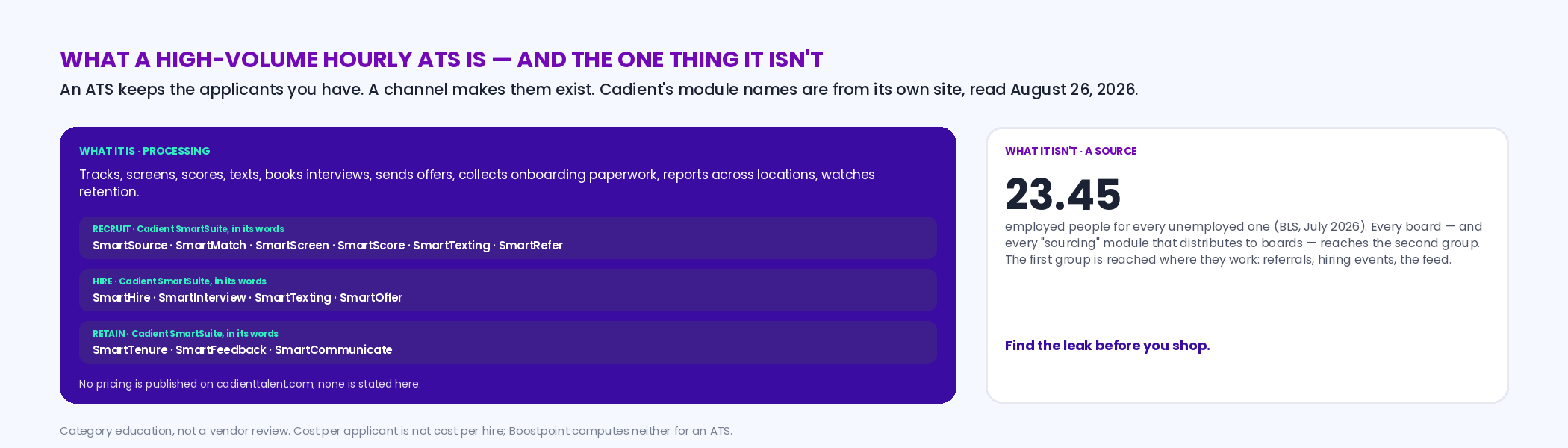
As read on cadienttalent.com on August 26, 2026, Cadient describes "AI-powered solutions" that "Streamline high-volume hiring" for "teams hiring hundreds or thousands across locations," in retail, hospitality, logistics, healthcare, manufacturing, financial services, grocery, food and beverage, and delivery. Its SmartSuite is laid out in three phases: Recruit (SmartSource, SmartMatch, SmartScreen, SmartScore, SmartTexting, SmartRefer), Hire (SmartHire, SmartInterview, SmartTexting, SmartOffer) and Retain (SmartTenure, SmartFeedback, SmartCommunicate), under the line "Hire Fast. Score Smart. Retain the Best." The site offers an ROI calculator, "Talk to an Expert" and "Schedule a Demo," and publishes no pricing; any figure you find elsewhere is a reader's report, and this page repeats none. Two honest observations. That is an enterprise-scale processing platform by its own description — screening, scoring, interviewing, offers, onboarding, retention — and for an employer hiring thousands across locations that is a real category with real value. And two of the Recruit modules, SmartSource and SmartRefer, are named for sourcing; what they reach, and whether that is the searching pool the boards sell or the employed majority who aren't searching, is a demo question, and it is the first one on the list below.
What a high-volume hourly ATS is — and the one thing it isn't
An applicant tracking system built for hourly volume does a specific set of jobs well: it takes applications from a phone or a text, screens them against knockout questions, scores and ranks them, books interviews, sends offers, collects onboarding paperwork, and in the enterprise versions integrates with the HRIS and payroll and reports across hundreds of locations. Cadient's module list is a fair map of that set. What none of it does is change how many people apply, because the applicant has to exist before the system can track them; "sourcing" inside an ATS is, in every implementation we have seen, distribution to job boards and referral capture, which reaches the pool the boards sell. That pool is the searching minority: in July 2026 the BLS counted 162,177,000 employed Americans and 6,916,000 unemployed — 23.45 employed people for every unemployed one (Employment Situation, released August 7, 2026). For hourly and frontline roles, the person you want is usually in the first group, at work, with a phone, and no processing platform reaches them there. The longer version of that frame is on passive candidate recruiting, and the plain definition is on what an applicant tracking system is.
Find the layer first: where the funnel leaks
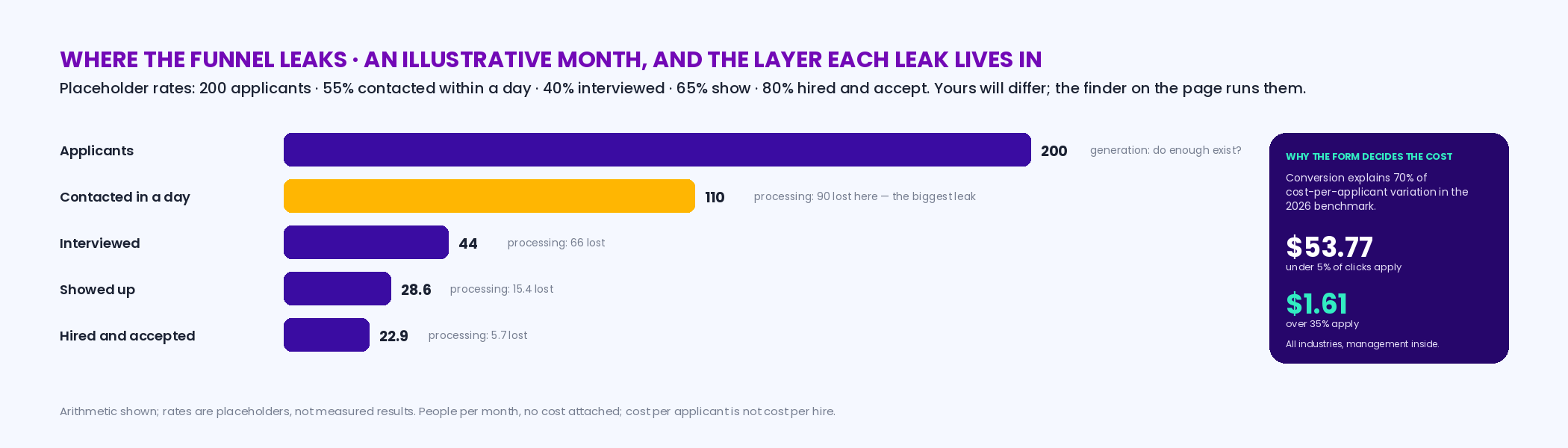
The reason to diagnose before you shop is that the two complaints that send people to a page like this point at opposite layers. "The ATS isn't producing applicants" is a generation problem, and a new ATS will not fix it. "We get applicants and lose them" is a processing problem — slow contact, no-shows, a long form — and an ad budget will not fix that either, though it will make the loss more expensive. Our benchmark shows how large the processing side is: click-to-application conversion explains 70% of the variation in cost per applicant, campaigns converting under 5% paid a median $53.77 per applicant while those over 35% paid $1.61, and 41% of all budget ran in campaigns converting under 10%, producing 11% of applicants. The form is the first processing tool, and it is free (what makes a good job ad). The finder below takes your funnel rates and names the stage that loses the most people, which tells you which layer to shop in.
Interactive
Funnel leak finder — enter your monthly applicants and your stage rates, and see which stage loses the most people and which layer that is
Nothing is stored or sent — this runs in your browser. Every rate is yours; the output is people per month and a layer, with no cost attached.
The same questions apply to any ATS sold by quote rather than by rate card, and most are. For a worked example of what a vendor publishes when it does not publish a price — tiers, commitment length, cancellation window, trial rules — see CareerPlug pricing.
The demo questions, whichever platform you're looking at
An enterprise hourly ATS is bought on a demo, so the demo is where the price and the truth live. Ask, in writing: what the pricing unit is — per location, per employee, per hire, per applicant, or a platform fee — and the number at your size; the term, and the year-two price after any promotion; what is inside the tier and what is an add-on (text-to-apply, background checks, assessments, onboarding documents, HRIS and payroll integrations); where the "sourcing" module's applicants actually come from and whether they are people who searched, people who were referred, or people who were reached where they work; the implementation fee, the timeline, and who does the configuration; what happens to the applicant data and the integrations when you leave; and whether the platform accepts applicants from an outside channel with the source tagged, so you can see which channel produced which hire. The builder below writes the list for the concerns you pick.
Interactive
Demo question builder — pick what you're worried about and get the questions to ask, with why each matters
Nothing is stored or sent — this runs in your browser. Written for any high-volume ATS demo, Cadient's included; the questions are Boostpoint practice, not a review of any vendor.
Cadient Talent alternatives, by layer
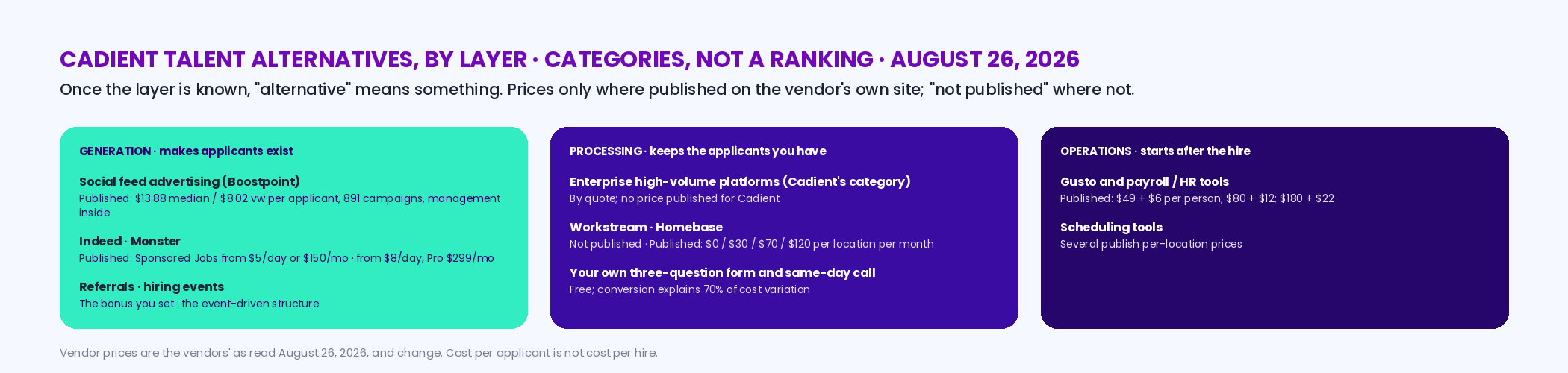
Once the layer is known, "alternative" has a meaning. If the leak is processing at enterprise scale, the alternatives are other high-volume hiring platforms, compared on the demo questions; if the leak is processing at a few locations, the alternatives may be a smaller hourly ATS or the hiring tier of a scheduling tool you already pay for; if the leak is generation, no ATS is the alternative — the alternatives are channels. Only prices verified on the vendor's own site are stated; where none is published we say so.
| Layer | Alternative | What it is | Pricing, as verified |
|---|---|---|---|
| Processing, enterprise scale | Other high-volume hiring platforms | The same category as Cadient's SmartSuite: screening, scoring, texting, interviews, offers, onboarding across many locations; compare on the demo questions | By quote in this category; ask for the unit and the year-two number |
| Processing, hourly and multi-location | Workstream | Hourly hiring platform with ATS, text-to-apply, onboarding, and HR and payroll on higher tiers | Not published: four tiers, each routed to a demo (Workstream); our Workstream pricing page |
| Processing, bundled with operations | Homebase | Scheduling and time tracking with onboarding in its top tier; hiring tools as add-ons | Published: Basic $0; Essentials $30, Plus $70, All-in-One $120 per location per month (Homebase) |
| Processing, your own | A three-question form, text reply and a same-day call | The fix that most changes what applicants cost and how many you keep; see text recruiting | Free; conversion explains 70% of cost variation in our benchmark |
| Generation | Social feed advertising (Boostpoint's channel) | Ads that reach the employed, non-searching majority on their phones; applicants flow into your ATS with the source tagged | Published: $13.88 median campaign, $8.02 volume-weighted cost per applicant, 891 campaigns (Boostpoint 2026 benchmark) |
| Generation | Job boards · referrals · hiring events | The searching pool (boards) and the non-searching pool (referrals, events) | Published: Indeed Sponsored Jobs "start at $5 per day or $150 per month"; Monster from $8/day, Pro $299/month (vendor pages); referrals at the bonus you set |
| Operations | Gusto and other payroll and HR tools | Payroll and HR that start after the hire; a separate purchase from hiring | Published: Gusto Simple $49/mo + $6 per person; Plus $80 + $12; Premium $180 + $22 (Gusto) |
The case for an enterprise ATS, made fairly
If you hire thousands of hourly people a year across hundreds of locations, you need a system that a store manager can run from a phone, that screens and scores consistently, that keeps the paperwork compliant across states, and that reports the whole thing to headquarters; that is a processing platform's job, and Cadient's site describes one built for it. Nothing on this page argues against buying that. The argument is only about sequence: find the leak first, because a platform bought to fix an applicant shortage will process the same shortage faster, and a channel bought to fix a no-show problem will deliver more people to the same broken step.
What generating the applicants costs — Boostpoint's published figures
Our 2026 benchmark, 891 campaigns and 1,334 campaign-months, puts the median campaign at $13.88 per applicant and the volume-weighted average at $8.02; a normal campaign runs on $334 a month, produces 20 applicants a campaign-month and reaches 6,061 people. For a burst of hires the dated hiring event is the cheapest structure we run — a median $8.02 per applicant at a 21% apply rate across 78 campaigns — and the volume version is on mass hiring. Reading your own funnel by layer, channel by channel, is on recruiting analytics; the sector cuts are on the benchmark. None of it is a cost per hire, because the hire happens in the processing layer, in your system, on your timeline, and we don't compute it.
Frequently asked questions
What are the alternatives to Cadient Talent?
It depends on which layer is broken. For applicant processing at enterprise scale: other high-volume hiring platforms, compared on the demo questions; at a few locations, a smaller hourly ATS such as Workstream (no published prices) or the top tier of a scheduling tool like Homebase (published: $120 per location per month). For applicant generation — too few applicants at all — no ATS is the alternative: referrals, hiring events, job boards for the searching few, and social feed advertising for the employed majority. Operations tools like Gusto (published) are a third, separate purchase.
How much does Cadient Talent cost?
Cadient does not publish pricing. Its site (read August 26, 2026) offers an ROI calculator, "Talk to an Expert" and "Schedule a Demo," with no plan prices. Any figure you find elsewhere is a reader's report, not a price list, and this page repeats none. Ask in the demo for the pricing unit, the number at your size, the term, the year-two price, what is an add-on, the implementation fee, and what it costs to leave.
What does Cadient Talent do?
In its own words, "AI-powered solutions" that "Streamline high-volume hiring" for "teams hiring hundreds or thousands across locations." Its SmartSuite is arranged in three phases — Recruit (SmartSource, SmartMatch, SmartScreen, SmartScore, SmartTexting, SmartRefer), Hire (SmartHire, SmartInterview, SmartTexting, SmartOffer) and Retain (SmartTenure, SmartFeedback, SmartCommunicate) — under "Hire Fast. Score Smart. Retain the Best." Those are Cadient's descriptions as of August 26, 2026.
Is an ATS a source of applicants?
No. An applicant tracking system tracks, screens, scores, schedules, offers and onboards the applicants who arrive; it does not make them arrive. Sourcing modules inside an ATS are, in practice, distribution to job boards and referral capture, which reach the searching pool the boards sell. The BLS counted 23.45 employed people per unemployed one in July 2026; reaching the employed majority is a channel's job — referrals, hiring events and the feed — and the ATS is where those applicants land.
How do I know whether I need a new ATS or more applicants?
Run your funnel: applicants a month, share contacted within a day, share interviewed, share who show, share hired and accepting. If the applicant count itself is the constraint, the layer is generation and a new ATS won't change it. If the biggest loss is at contact, interview or show-up, the layer is processing — a shorter form, text reply, a same-day call, and possibly a better system. The finder on this page does the arithmetic and names the layer.
What should I ask in a Cadient Talent demo?
The same things you'd ask any high-volume ATS: the pricing unit and the number at your size; the term and the year-two price; what is inside the tier versus an add-on (text-to-apply, background checks, assessments, onboarding documents, HRIS and payroll integrations); where the sourcing modules' applicants actually come from; the implementation fee, timeline and who configures it; what happens to data and integrations when you leave; and whether outside-channel applicants arrive with the source tagged so you can see which channel produced which hire.
Does Boostpoint integrate with an ATS?
Boostpoint delivers applicants into the systems clients already use — the current list is on our integrations page — with the source tagged, so the ATS keeps doing its job and the reporting shows which channel produced which applicant. We are a generation channel, not an ATS, and we don't compete with one.
What does it cost to generate hourly applicants?
In our 2026 benchmark — 891 campaigns — the median campaign ran $13.88 per applicant and the volume-weighted average $8.02; a normal campaign cost $334 a month for 20 applicants; and what decides the figure is mostly the form: campaigns converting under 5% of clicks paid $53.77 per applicant, those over 35% paid $1.61. Cost per applicant is not cost per hire; the hire happens in the processing layer and we don't compute it.
Fill the system you already run
Whatever tracks your applicants, we can make more of them exist: ads that reach the employed majority, the wage in the first line, a three-question form, and applicants delivered into your ATS with the source tagged. We'll show you the campaigns closest to yours from the benchmark.
Book a DemoBoostpoint figures come from the 2026 Social Job Advertising Benchmark — 891 campaigns and 1,334 campaign-months: $13.88 median cost per applicant, $8.02 volume-weighted average; a normal campaign $334 a month, 20 applicants, 6,061 reached; click-to-application conversion explaining 70% of cost variation, with campaigns under 5% at a median $53.77 per applicant and over 35% at $1.61, and 41% of budget in campaigns under 10% producing 11% of applicants; event-driven campaigns $8.02, 21%, 78. Vendor descriptions and prices were read on each vendor's own site on August 26, 2026 (Cadient Talent, Workstream, Homebase, Gusto, Indeed, Monster), are the vendors' claims and figures, and change; no price is stated for Cadient or Workstream because none is published, and no third-party figure is repeated. BLS Employment Situation, July 2026 (released August 7, 2026). The funnel finder computes people per month from the reader's own rates and attaches no cost; the demo questions are Boostpoint practice, not a vendor review. Cost per applicant is not cost per hire; we do not track hires and publish no cost-per-hire figure. A sample of Boostpoint campaigns, not an industry-wide study.