
Passive Candidate Recruiting: The Employed Outnumber the Unemployed 23 to 1, and Your Job Board Can't See Them
Passive candidate recruiting means reaching people who have a job and aren't searching — which, by BLS's count, is almost everyone: 162.2 million employed against 6.9 million unemployed in July 2026, and 3.2 million quits in June alone, most of them straight into another job. A job board's ceiling is the searching minority. Reaching the rest takes a channel that shows the job to people who didn't ask — a social feed on a phone — an ad that names the one thing they'd switch for, and a campaign that stays on, because a passive candidate decides on their timetable, not yours.
A note on who's writing this
Boostpoint runs social media job ads, which is the channel this page argues reaches passive candidates, so read the argument with that in mind. The labor-market numbers are the Bureau of Labor Statistics'; the campaign numbers are from our 2026 benchmark and are labeled. Two things we won't claim: that our ads change how a company is perceived — employer branding in the reputational sense — because we don't measure it; and that any particular person is "passive." The word describes a pool, not a state of mind, and the pool includes people who would leave tomorrow for the right shift. We also don't publish cost per hire.
The pool, in BLS's numbers
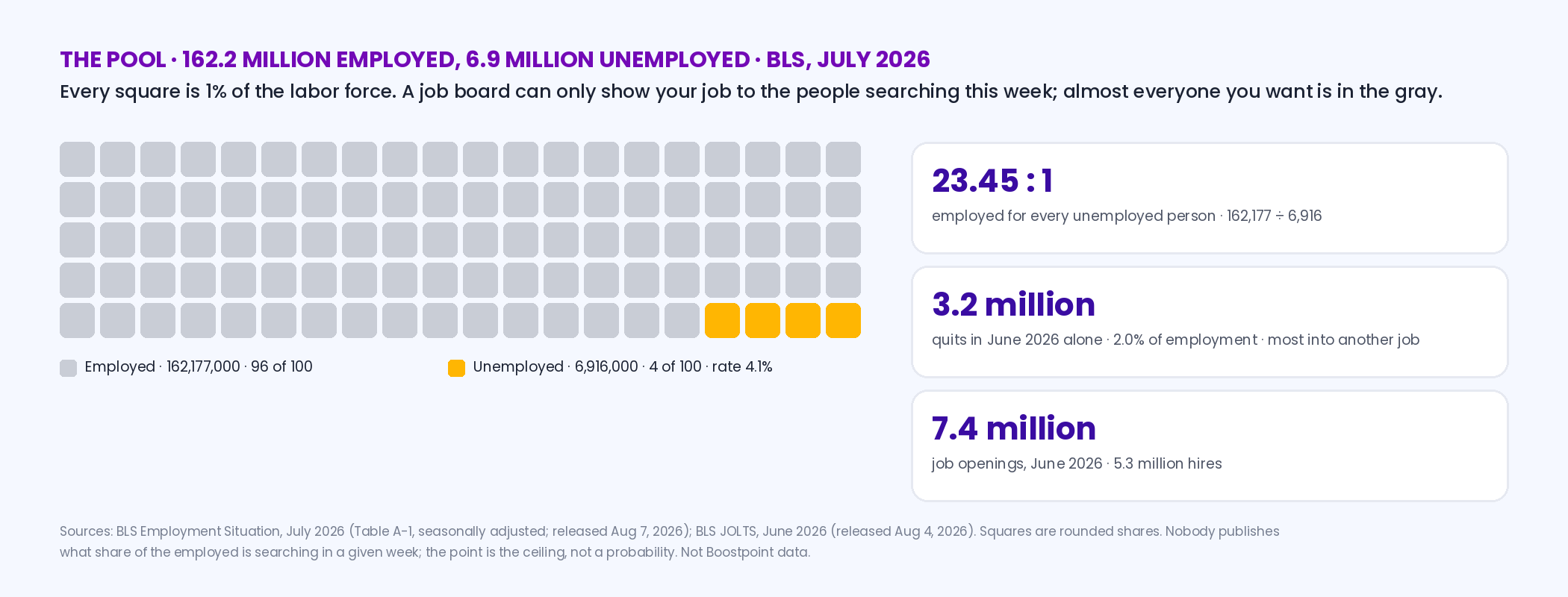
In July 2026 the Current Population Survey counted 162,177,000 employed Americans and 6,916,000 unemployed — an unemployment rate of 4.1%, and a ratio of 162,177 ÷ 6,916 = 23.45 employed people for every unemployed one. The June 2026 JOLTS release adds the motion inside that pool: 7.4 million job openings, 5.3 million hires, and 3.2 million quits (a 2.0% monthly rate), which is 3.2 million people who left a job in a single month, most of them for another one. Some of the employed are searching at any moment; nobody knows exactly how many, and we won't guess. What the arithmetic settles is the ceiling: a channel that only reaches people who are searching this week — a job board, by definition — is fishing in a pool that is at most a few percent of the workforce, and every competitor with a posting is fishing in it too.
Interactive
Reach frame — which part of the pool can each channel see?
Nothing is stored or sent — this runs in your browser. Every square is 1% of the labor force (BLS, July 2026): 96 employed, 4 unemployed. Pick a channel; the squares it can reach turn purple.
Illustrative: the reachable share for each channel is Boostpoint's read, not a measurement — nobody publishes what share of the employed is searching in a given week, and the squares show the pool, not a probability. The employed/unemployed split is BLS's (162.2M / 6.9M, July 2026). Costs are qualitative here; the benchmark's figures are in the next section.
Why passive candidates are cheaper to reach than the word suggests
The intuition is that a person who isn't looking is expensive to move. In frontline hiring the data points the other way, for two reasons. The first is that the switching cost is low: BLS puts the training for most hourly roles at days to weeks, the licensed roles (nurses, drivers, electricians) carry their credential with them, and the 3.2 million monthly quits are the proof that people move. The second is structural: an employed nurse, cook, or technician is on a phone during a break, in a feed, and an ad that says "RN · nights · 1:5 ratio · $[rate]" lands in front of her whether or not she typed a search. In our 2026 benchmark, the registered nurse row — the classic passive pool, nearly all employed — ran at a median $19.08 per applicant with an 11% apply rate across 173 campaigns, with management inside. The nurses were not searching; the ad found them anyway. What the benchmark does say about the difference is where the cost comes from: applicant conversion explains 70% of variation, the audience 30%, creative 18%. For a passive candidate, conversion is the whole game — a person who did not plan to apply will not tolerate a twenty-minute form.
Always-on: the campaign structure built for people on their own timetable
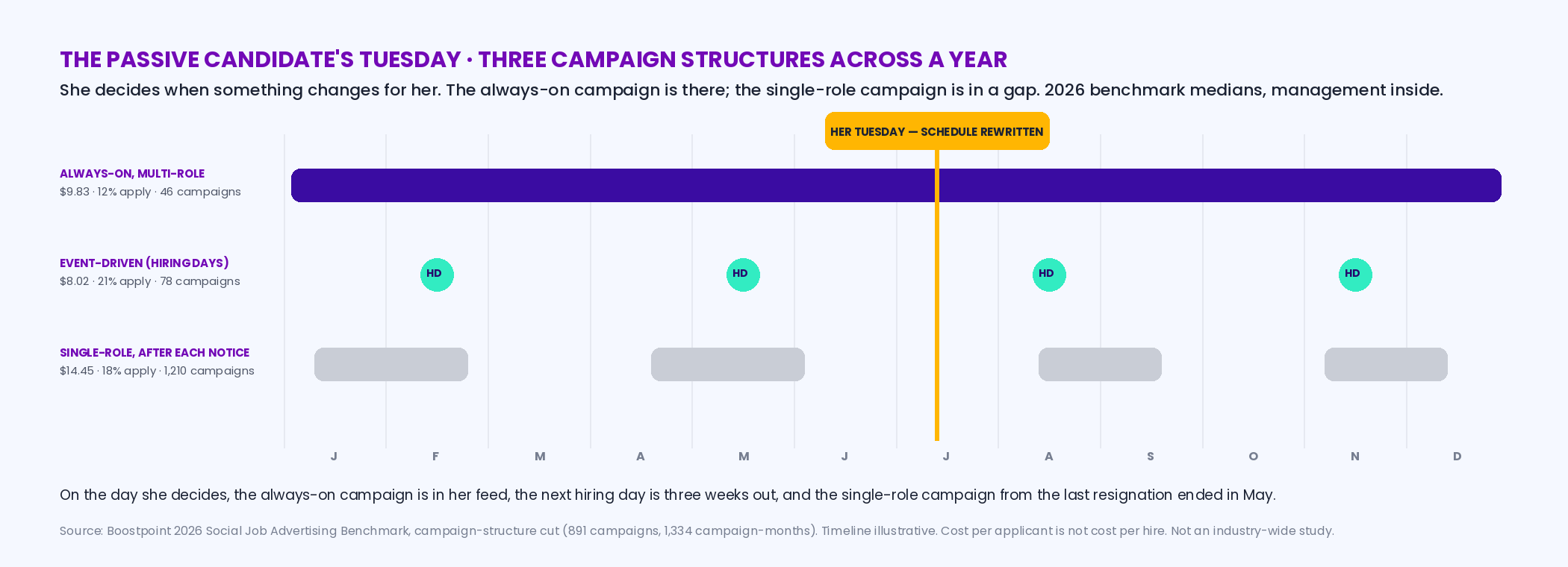
A passive candidate decides when something changes for her — a schedule rewrite, a manager, a Tuesday. The ad has to be there that Tuesday. That is the argument for a standing campaign, and the benchmark measured what it costs. A multi-role, always-on campaign — one campaign, several roles, never switched off — ran at a median $9.83 per applicant with a 12% apply rate and 1.10% click-through across 46 campaigns. A single-role campaign switched on when someone quits ran at $14.45 (18% apply rate, 1,210 campaigns). Event-driven campaigns built around a date were cheapest at $8.02 (21%, 78 campaigns), and they matter here too: a hiring day is the moment a passive candidate who has been seeing the always-on ad for a month finally walks in. The pattern that works for a passive pool is the two together — a standing campaign that keeps the employer familiar, and a dated event that gives the familiar employer a deadline. Where this sits in a wider plan is covered in our guide to social media recruiting.
| Structure | Median cost per applicant | Apply rate | Click-through | Campaigns | Role in reaching the employed |
|---|---|---|---|---|---|
| Multi-role / always-on | $9.83 | 12% | 1.10% | 46 | Keeps the employer in the feed on the day the passive candidate's situation changes |
| Event-driven | $8.02 | 21% | 1.53% | 78 | Gives the employed a date and a door — the moment familiarity becomes an application |
| Single-role | $14.45 | 18% | 1.36% | 1,210 | Reaches whoever is in the feed during the weeks it runs; off when the passive candidate is ready |
Source: Boostpoint 2026 Social Job Advertising Benchmark — 891 Boostpoint-managed campaigns on Meta (1,334 campaign-months), 2026; costs are what advertisers paid for advertising only.
One operating rule comes with always-on: watch frequency. A standing campaign in a small radius shows the same people the same ad, and the benchmark's cliff is steep — median cost per applicant rose from $7.85 under a frequency of 1.5 to $26.78 above 4.0, with 33% of all budget running above 3.0. Check weekly, act at 2.5 by rotating the lead role or the first line. The full ritual is on recruiting analytics; the surge version of the structure, for openings and seasons, is on mass hiring.
Why employer branding matters to a passive candidate — and what it actually is for frontline roles
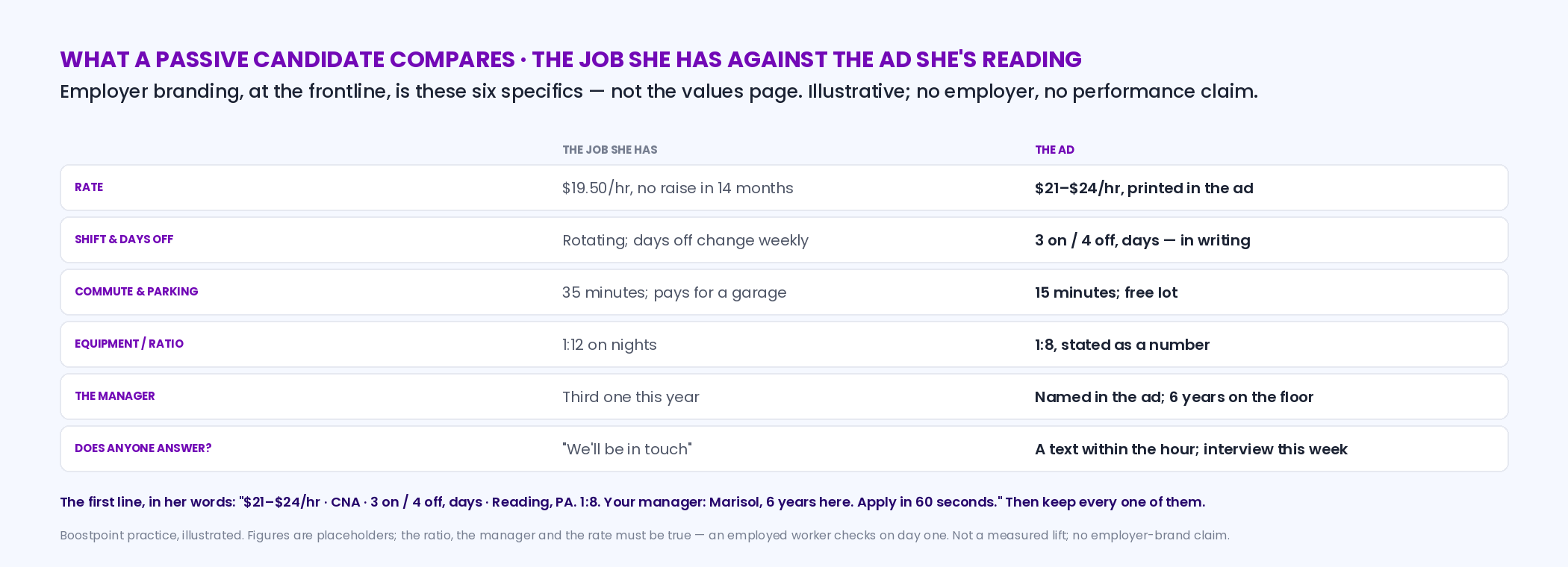
A person who applies to a job board posting has already decided to move; the posting only has to be adequate. A person who sees your ad on a break has decided nothing, so the ad has to supply the reason — and that reason is what employer branding means at the frontline. It is not the values page. It is the four or five specifics an employed worker compares against the job they have: the rate, the shift and the days off, the commute and the parking, the equipment or the ratio, the manager, and whether the company answers the phone. Those are brand to a cook or a CNA in the only sense that matters, because they are what she tells the person next to her at shift change. The reputational layer — reviews, the careers page, the story — is real and slower, and we've written up how it differs from recruitment marketing in employer branding for frontline employers. For passive candidate recruiting, the order is: specifics in the ad first, reputation over time, and never "join our team" as the headline, because the person reading it already has one.
Interactive
Reason-to-switch writer — the first line for someone who already has a job
Nothing is stored or sent — this runs in your browser. Fill in the role and the specifics, pick the one thing your job beats their current one on, and read the first line an employed person would actually stop for.
Boostpoint's practice, not a template to paste and not a measured lift. The reason has to be true — an employed person checks it on day one and tells everyone on day two. Employment ads on Meta run under the Special Ad Category: nothing about age, sex, or origin in the line or the question — see Meta's Special Ad Category.
The form, for someone who didn't plan to apply
Everything above gets a passive candidate to a tap. The tap is worth nothing if the next screen asks for a résumé. This is where the benchmark is bluntest: campaigns converting under 5% of clicks paid a median $53.77 per applicant and campaigns over 35% paid $1.61, and the difference between those bands is almost entirely the application. For an employed person on a break, the form is name, phone, the one knockout question from the writer above, and a submit button — under a minute, on a phone, no account, no upload. Then the response has to match the moment: a text within the hour, because she is deciding on her break and will not be deciding after her shift; an interview scheduled around her current schedule, not yours; and no "we'll be in touch." The rest of the ad's anatomy is on what makes a good job ad. For the licensed version of this whole argument, with the boards graded, see the best job boards for nurses — where the ceiling was first drawn.
The people you want have a job. Be in the feed on the day that changes — with the one reason they'd switch, and a form they can finish on a break.
One channel worth sizing before you invest time in it: Reddit reaches 23.1 million logged-in Americans a day across every subject, and that number grew 1 percent last year. We set out what it is and is not good for on Reddit recruiting.
Reaching people who are not looking is the first of nine moves; the rest of them, with the channel costs beside each, are on how to find employees.
Frequently asked questions
What is a passive candidate?
Someone who has a job and isn't actively searching, but would consider a better one. By BLS's July 2026 count that describes most of the workforce — 162.2 million employed against 6.9 million unemployed — and the 3.2 million quits in June 2026 show how readily the employed move. "Passive" describes the pool, not a fixed state of mind.
How do you recruit passive candidates?
Use a channel that shows the job to people who didn't search for it — a social feed on their phone — write the first line as the one specific they would switch for (rate, shift, commute, ratio, manager, path), keep the campaign always on so it is there on the day their situation changes, and make the application finishable in under a minute on a break. Then answer within the hour.
Why can't job boards reach passive candidates?
A job board shows a posting to people who search for it, so its ceiling is the share of the workforce searching that week — a small minority of the 162.2 million employed, and the same minority every competitor's posting reaches. It is a fine channel for active seekers; it is structurally unable to reach the person who hasn't opened it.
Are passive candidates more expensive to recruit?
Not in our data for frontline roles. The registered nurse row of the 2026 benchmark — a pool that is nearly all employed — ran at a median $19.08 per applicant with an 11% apply rate across 173 campaigns. What drives cost is the application, not the candidate's job status: conversion explained 70% of cost variation, and campaigns converting under 5% paid $53.77 per applicant against $1.61 over 35%.
What is an always-on recruiting campaign?
One campaign covering several roles that is never switched off. In the 2026 benchmark, multi-role always-on campaigns ran at a median $9.83 per applicant (12% apply rate, 46 campaigns) against $14.45 for single-role campaigns launched after a resignation. For passive candidates the point is timing — the ad is in the feed on the day they decide — and the rule that comes with it is to check frequency weekly and act at 2.5.
Why does employer branding matter for passive candidates?
Because a passive candidate has decided nothing, the ad must supply the reason to consider leaving, and for frontline roles that reason is a set of specifics — rate, shift, commute, equipment, manager, responsiveness — not a values statement. Those specifics are what an employed worker compares and repeats at shift change. Reputation matters over time; the specifics matter in the six seconds the ad has.
How is passive candidate recruiting different for hourly and frontline roles?
The switching cost is lower — days-to-weeks training for most hourly roles, portable credentials for the licensed ones — so a passive frontline worker moves for a concrete improvement, not a career narrative. That makes the ad simpler (the specific) and the form more decisive (under a minute, on a phone), and it makes always-on cheaper than chasing each vacancy.
What does it cost to reach passive candidates with social ads?
In our 2026 benchmark, always-on campaigns ran at a median $9.83 per applicant, event-driven at $8.02, single-role at $14.45, with management inside every figure; the RN row, the most passive pool we track, ran at $19.08. Cost per applicant is not cost per hire; we do not track hires and publish no cost-per-hire figure.
Are most job candidates passive?
For frontline roles, yes. BLS counted 162.2 million employed Americans against 6.9 million unemployed in July 2026, about 23 employed people for every unemployed one, and 3.2 million people quit a job in June 2026 alone. Boostpoint's recruiting approach starts from that ratio: the person you want is usually working and not searching, so the job has to appear in the social feed they already scroll, with an application short enough to finish on a break.
What is inbound recruiting, and how is it different from outbound?
Inbound recruiting draws candidates to you: job ads in the feeds they already scroll, employer-brand content and referrals, so that people who were not looking decide to apply. Outbound recruiting is you reaching out to specific people, by sourcing, messaging or calling them one at a time. For frontline roles inbound does most of the work, because the qualified pool is large and mostly employed, and nobody can message it one person at a time.
Be in the feed on the day they decide
We'll build the always-on campaign and the first line an employed person stops for, keep it under the frequency cliff, and show you the campaigns closest to yours — every number.
Book a DemoBoostpoint figures come from the 2026 Social Job Advertising Benchmark — 891 campaigns and 1,334 campaign-months: by structure, multi-role / always-on median cost per applicant $9.83, 12% apply rate, 1.10% click-through, 46 campaigns; event-driven $8.02, 21%, 1.53%, 78; single-role $14.45, 18%, 1.36%, 1,210. Registered nurse row: median $19.08, 11% apply rate, 173 campaigns. Applicant conversion explains 70% of cost variation, audience 30%, creative 18%; apply-rate bands under 5% $53.77 and over 35% $1.61; frequency under 1.5 $7.85, over 4.0 $26.78, 33% of budget above 3.0. Labor-market figures are BLS's (Employment Situation, July 2026; JOLTS, June 2026), attributed in place; the share of the employed reachable by each channel is not measured and the reach frame is illustrative. The reason-to-switch lines and the ordering of specifics are Boostpoint's practice, not measured results; no employer-brand lift is claimed. Cost per applicant is not cost per hire; we do not track hires and publish no cost-per-hire figure. A sample of Boostpoint campaigns, not an industry-wide study.