
White Label Recruitment Marketing for Partners: What You'd Be Putting Your Name On, the Three Ways to Do It, and the Terms We Won't Print Until We've Talked
White label recruitment marketing is a service you sell under your own name and someone else runs: the job ads in the social feed, the three-question application, the follow-up text, the delivery into the client's ATS, and the weekly management, all reported under your brand. Boostpoint offers it in three shapes — a referral, a white label resale, and an embedded integration — and each one differs in who owns the client, who sets the price, and whose name is on the report. This page says what you'd be reselling, who it fits, and what it doesn't fix. It does not print program terms, because they're set on a call, not on a web page.
A note on who's writing this
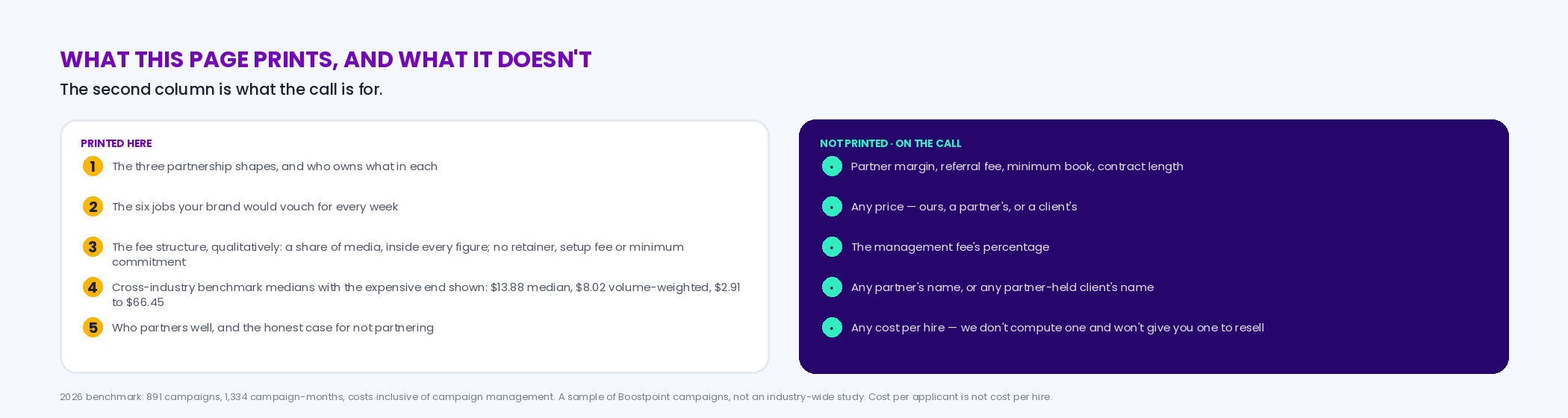
This page is written by the company you'd be partnering with, so read it as a pitch that has agreed to some rules. No partner is named on it, and no client that came to us through a partner is named anywhere on this site. No margin, referral fee, minimum book, contract length or price is printed, because the program's terms are discussed on a call and we'd rather say nothing than publish a number that turns out to differ from what you're offered. What we do say: our own pricing is a product subscription plus ad spend — the subscription priced on job volume, the ad spend recommended at a minimum of $750 a month per job category, one bill through Boostpoint — and every figure we publish includes campaign management. Our performance figures are cross-industry benchmark medians from 891 campaigns, with the expensive end shown. Cost per applicant is not cost per hire; we don't compute one and won't give you one to resell.
The case for building it yourself, made first
Anyone with a Meta business account can buy the placement we buy, and if you're an agency with a media team the honest first question is why you'd resell it rather than run it. The answer is not the placement; it's the other five jobs. A recruitment ad is a specific craft — the wage, the shift, the site and the credential in the first line, written for a phone, under Special Ad Category rules that permit no age, gender or ZIP targeting (the rules), with a three-question form behind it instead of a link to a portal. Then someone has to read frequency, apply rate and cost per applicant every week for every client and act on them, because in our benchmark click-to-application conversion explained 70% of the variation in cost per applicant and frequency past 2.5 is where campaigns go to die. An agency with two recruitment clients can build that. An agency with twenty, or a software vendor whose customers ask "can you get me applicants too," usually can't staff it at the price the client will pay, and that is the whole reason a white label exists. If you can staff it, build it; the job ad page and the benchmark are public and you're welcome to them.
What carries your name: the six jobs
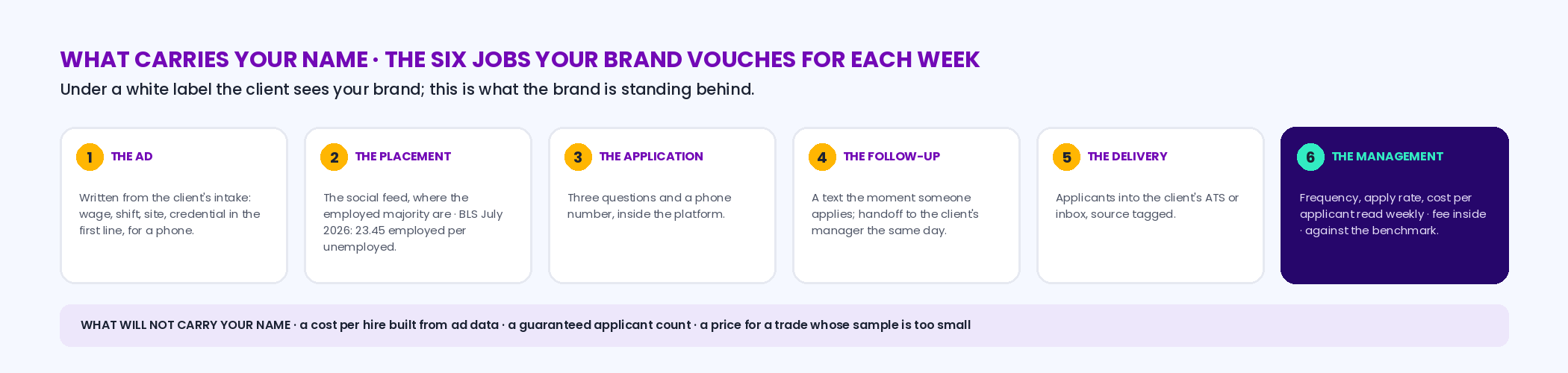
Under a white label your client sees your brand, and what your brand is vouching for is six things done every week. The ad — written from the client's intake, first line first. The placement — the social feed, where the employed majority are: the BLS counted 23.45 employed people for every unemployed one in July 2026, 162,177,000 against 6,916,000, and a job board reaches the second group. The application — three questions and a phone number inside the platform. The follow-up — a text the moment someone applies, and a handoff to the client's manager the same day, which is our practice rather than a data point. The delivery — applicants into the client's ATS or inbox with the source tagged, through the integrations. The management — frequency, apply rate and cost per applicant read weekly, with the fee inside every number, against a published benchmark. The report your client receives carries your name; the arithmetic in it is ours, and it's the same arithmetic on the analytics page. What doesn't carry your name is anything we wouldn't put ours on: a cost per hire built from ad data, a guaranteed applicant count, a price for a trade whose sample is too small.
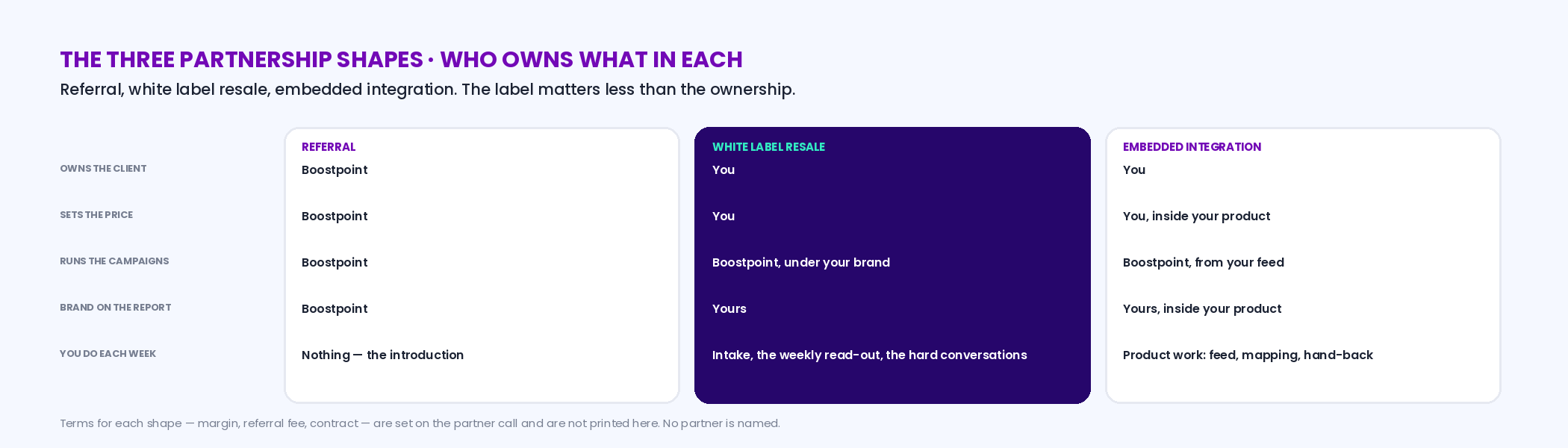
The three partnership shapes, and who owns what in each
The word "white label" gets used for three different arrangements, and the differences matter more than the label. In a referral, you introduce the client and we sell to them and serve them under our name; you're paid for the introduction and you don't do the work. In a white label resale, you own the client and the price, we run the campaigns under your brand, and your client never hears from us unless you want them to. In an embedded integration, your platform sends the jobs — an ATS, a scheduling tool, a franchise system — and the ads run as a feature of your product, the way Programmatic+ reads a job feed. The table says who does what; the terms of each are what the call is for.
| Shape | Who owns the client | Who sets the price | Who runs the campaigns | Whose brand on the report | What you do each week | Fits |
|---|---|---|---|---|---|---|
| Referral | Boostpoint | Boostpoint | Boostpoint | Boostpoint | Nothing — you made the introduction | Consultants, associations, payroll and PEO providers, anyone asked "who do you know" without wanting a second business |
| White label resale | You | You | Boostpoint, under your brand | Yours | The client relationship: intake, the weekly read-out, the conversation when a role is expensive | Marketing and recruitment agencies, staffing firms adding a direct-hire advertising line, franchisors offering it to franchisees |
| Embedded integration | You | You, inside your product's pricing | Boostpoint, from your feed | Yours, inside your product | Product work: the feed, the field mapping, the applicant hand-back | ATS and HR-tech vendors, scheduling and payroll platforms, franchise systems with a central job feed |
Interactive
Partner model picker — what you are, whether you want the client relationship, what you can staff, and how the jobs arrive; get the shape and what you'd own
Nothing is stored or sent — this runs in your browser. The recommendation is Boostpoint's judgment of fit, and "don't partner, build it" is a real outcome.
The shape
—
—
—
—
—
Who partners well, and who doesn't
The partners this works for share one trait: they already have the client's trust and the client's hiring problem, and they lack the applicant source. A marketing agency that runs a restaurant group's brand advertising and keeps being asked about hiring. An ATS or scheduling vendor whose customers open a requisition and then ask where the applicants come from — the honest answer being that an ATS processes applicants and doesn't create them, which is the argument on our own alternatives page. A staffing firm adding a direct-hire advertising line for clients who'd rather hire than rent — the wider software picture for that buyer is on recruiting software for staffing agencies. A franchisor whose franchisees each hire a handful of people a year and can't each learn recruitment advertising — the multi-unit structure is on the franchise page. An association or co-op whose members are the same employer forty times over — the agribusiness version of that is on its own page. It works less well for a partner whose clients hire salaried, title-searched roles (a board reaches those people fine), for a partner who can't or won't do the weekly read-out in a white label, and for a partner who wants a cost-per-hire promise to sell with, because we don't have one and neither does anyone else who's honest about attribution.
What the economics look like, without the numbers
The structure is simple even though the figures aren't printed. An end client pays a product subscription, priced on job volume, plus the ad spend, recommended at a minimum of $750 a month per job category, on one bill; every figure we publish includes campaign management. In a referral, your payment comes out of that; in a white label, you set the client's price and your margin is the difference between it and what you pay us; in an embedded integration, the price lives inside your product. What the reader can do on this page is size the book. Fifteen accounts at $1,200 of media a month is $18,000 of media under management; at the benchmark's median $13.88 per applicant that's about 1,296.8 applicants a month across the book, and at the volume-weighted $8.02 it's about 2,244.4 — illustrative across every industry we serve, not a forecast for any client's roles, and the fee is already inside both figures. Enter your own margin and the calculator shows your revenue; it's blank until you do, because we're not going to print a number and call it typical.
Interactive
Partner book calculator — accounts, media per account, and your margin; get media under management, an illustrative applicant range, and your monthly revenue
Nothing is stored or sent — this runs in your browser. The margin field is blank on purpose: enter the one you'd set, or the one we discuss on the call. No Boostpoint program term is pre-filled.
accounts × media per account, a month
media ÷ cost per applicant
what your book bills at your margin
client price − what you pay for media and management
What we ask of a partner
Four things, none of them a contract term. The intake is real. A campaign built from "we need people" costs more than one built from the wage, the shift, the site and the credential; in a white label you're the one collecting those, and the first line of the ad is only as good as what you send. The client replies the same day. An applicant who hears nothing for three days is gone, and no amount of campaign management recovers them; we'll text them the moment they apply, but the manager has to call. The report is the report. Under your brand or ours, it shows applicants and cost per applicant by role with the fee inside, the expensive roles as clearly as the cheap ones, and never a cost per hire we didn't measure — if you need to change what the numbers say, we're the wrong partner. The delivery goes into the client's system. Applicants land in the client's ATS or inbox with the source tagged, so the client can compute the only cost per hire that exists — theirs — and so you're never the bottleneck between an applicant and a manager.
When not to partner
Three honest cases. If your clients hire salaried, title-searched roles — accountants, engineers, managers — a job board reaches those people well and a social campaign is the wrong tool, so there's nothing to resell them. If you have a media team and a dozen or fewer recruitment clients, build it: the craft is learnable, the rules are public, and you keep the whole margin. And if the thing your clients want is a hire delivered — a recruiter who screens, a staffing bench, a guarantee — then what they're asking for is an RPO or an agency, and a recruitment advertising service under any brand will disappoint them; the fee-model comparison across those is on the outsourced recruitment marketing page. The partner call is short in those cases, and we'd rather have it than sign you.
Frequently asked questions
What is white label recruitment marketing?
A recruitment advertising service sold under a partner's brand and run by a provider. The partner — an agency, an ATS or HR-tech vendor, a staffing firm, a franchisor — owns the client relationship and sets the price; the provider writes and runs the job ads in the social feed, the short application, the follow-up, the delivery into the client's ATS and the weekly management, and reports under the partner's name. Boostpoint offers it alongside a referral shape (you introduce, we serve) and an embedded shape (your platform sends the jobs and the ads run as a feature of your product).
What's the difference between a referral partner, a reseller and a white label?
Who owns the client and whose name is on the work. A referral partner introduces the client and steps back; the provider sells, serves and reports under its own name. A reseller owns the client and the price and may or may not put its own name on the service. A white label is a resale where the partner's brand is on everything the client sees — the report, the emails, the call — and the provider stays invisible. The table on this page adds a third shape, the embedded integration, where the service runs inside the partner's product from its job feed.
What are the terms of Boostpoint's partner program?
They aren't printed on this page — no margin, referral fee, minimum book, contract length or price — because they're set on a call and we'd rather publish nothing than a number that differs from what you're offered. What we do publish: the end-client pricing is a product subscription plus ad spend — the subscription on job volume, the ad spend at a $750 a month minimum per job category, one bill through Boostpoint — and every performance figure we publish includes campaign management. Book a demo and ask for the partner conversation.
What would my clients get under my brand?
The six jobs of a recruitment advertising service: an ad written from intake with the wage, shift and site in the first line; placement in the social feed under Special Ad Category rules; a three-question application inside the platform; a text the moment someone applies and a same-day handoff; delivery into their ATS with the source tagged; and weekly management of frequency, apply rate and cost per applicant against a published benchmark — reported under your name, with the fee inside every figure. Not a cost per hire, which nobody's ad data can produce honestly.
Do you name partners or partner clients?
No. No partner is named on this page and no client that came to us through a partner is named anywhere on this site; the customers we do name are our own direct accounts, with their permission. In a white label the client relationship is yours, and it stays yours in our marketing too.
What results can I tell my clients to expect?
Give them the distribution, not a promise. Our 2026 benchmark across 891 campaigns and 1,334 campaign-months: a median $13.88 per applicant, $8.02 volume-weighted, with the tenth and ninetieth percentiles at $2.91 and $66.45; a normal campaign ran on $334 a month for 20 applicants. Where a client's roles land depends on the form, the first line and frequency — conversion alone explained 70% of the variation — so the honest expectation is a first read at day 30 against the published band for the role, not a number in advance. A partner who promises a cost per hire is promising something no ad platform can measure.
Can an ATS or software platform embed this?
Yes — that's the third shape. Your product sends the jobs from its feed or API, each opening becomes a campaign in the social feed with a budget and a cap per role, and applicants come back into your product tagged by source. It's the same mechanism Programmatic+ uses with a job feed, run as a feature of your platform under your brand. The work on your side is product work — the feed, the field mapping, the applicant hand-back — rather than account management.
Should an agency white label this or build it in-house?
If you have a media team and a dozen or fewer recruitment clients, build it: the placement is buyable by anyone, the Special Ad Category rules are public, and our job ad guidance and benchmark are free to use. White labeling starts to make sense when the weekly management across many clients — reading frequency, apply rate and cost per applicant for each and acting on them — is more than you can staff at the price the clients will pay. That's a headcount question, not a capability one, and the honest answer varies by agency.
Ask for the partner conversation
Book a demo and say you're a partner, not an employer. We'll walk through the three shapes with your client mix, show you the benchmark bands your clients' roles would be read against, and give you the terms in the one place we print them — the call.
Book a DemoBoostpoint figures come from the 2026 Social Job Advertising Benchmark — 891 campaigns and 1,334 campaign-months across 15 role families: median $13.88 per applicant, $8.02 volume-weighted, percentiles $2.91, $6.48, $29.74 and $66.45; a normal campaign $334 a month, 20 applicants, 6,061 reached; conversion explaining 70% of cost variation; frequency acted on at 2.5. Boostpoint is priced as a product subscription plus ad spend — the subscription on job volume, the ad spend at a $750 a month minimum per job category, one bill through Boostpoint — and every figure we publish includes campaign management; the subscription, and every partner-program term, is discussed on the call and not printed here. No partner and no partner-held client is named. BLS Employment Situation, July 2026. The partner model picker is Boostpoint's judgment; the book calculator computes on the reader's inputs with the margin left blank. "Same-day" follow-up is Boostpoint practice, not a data point. Cost per applicant is not cost per hire; we do not track hires and publish no cost-per-hire figure. A sample of Boostpoint campaigns, not an industry-wide study.
For the print side of the same campaign, our free recruitment flyer templates cover four formats — now hiring, hiring event, walk-in interviews and a square social post — with a builder that fills them in and prints.
If your clients run on-call rotas, our guide to on-call pay laws covers when the waiting time itself has to be paid.