
Recruitment Marketing for Franchises and Multi-Unit Brands: One Template Per Role, a Campaign Per Location, and Why the Second One Costs Less Than the First
Franchise and multi-unit hiring is the same few roles, hired again and again, in dozens of places at once — and that repetition is the whole advantage. Build the ad, the three-question form and the weekly read-out once per role, then run it as a campaign per location or per market: the second campaign is cheaper than the first because nothing has to be invented, and in our records one multi-market client ran 110 campaigns at roughly $4.11 per applicant. The honest catch is local: a small radius hits the frequency cliff fast, and the franchisor can't do the operator's part — the wage in the ad and the same-day reply. Below: the structure, the frequency trap, who does what, and two planners.
A note on who's writing this
Boostpoint runs recruitment campaigns for multi-location employers — home care franchise systems, co-ops with dozens of branches, brands with a location in every town — and this page argues that our structure works especially well for them, so read it as an interested party's case with rules attached. The customers named are ones who've agreed to be named; their figures come from an earlier campaign-level analysis and are labeled as such, and the cheapest example on the page, the 110-campaign client, is a manufacturer we don't name. The benchmark figures are cross-industry medians, and the expensive end is shown. The franchise-industry figures are the IFA's; the joint-employer paragraph is a description of a published federal standard, not legal advice. Nothing here is a cost per hire.
The case for doing it location by location, made first
The strongest argument against a central recruitment program is that hiring is local. The operator knows the wage that clears in her town, the shift that's actually open, the manager who'll make the call, and whether the last three hires came from a cousin or a job board. A franchisor who centralizes the whole thing produces a national ad that says nothing true about any one location, and franchisees who ignore it. That argument is right about the parts it names — the wage, the shift, the reply are local and stay local — and wrong about the rest. The ad structure for a home health aide, a line cook, a lube tech or a stylist does not change from town to town; neither does the three-question form, the Special Ad Category rules that permit no age, gender or ZIP targeting (the rules), or the weekly read of frequency, apply rate and cost per applicant. Those are the expensive parts to build and the cheap parts to repeat, which is why the right shape is a template per role, filled in per location, not one national campaign or forty local improvisations.
The same arithmetic applies outside franchising, wherever one employer hires in several places at once. Multi-market and multi-state hiring works through what changes when a market is a 15-mile circle and a state is a set of rules.
Why the second campaign costs less than the first
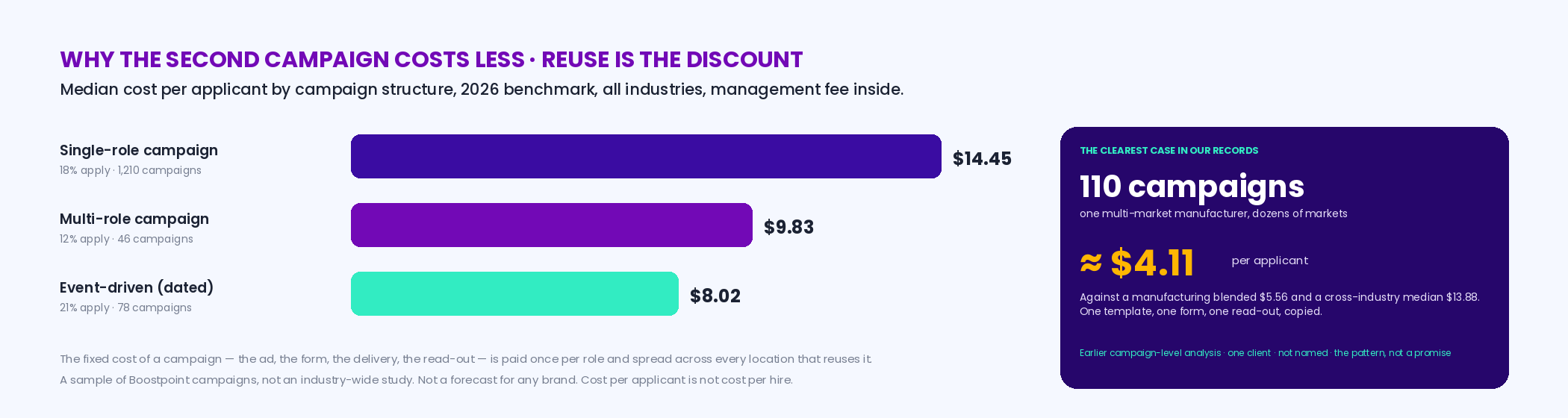
A recruitment campaign has a fixed cost and a running cost. The fixed cost is the craft: writing the ad so the wage, the shift and the site are in the first line (the job ad page), building the form, wiring applicants into the ATS or the operator's phone, and learning what a good week looks like for that role. The running cost is media and management. For a single-location employer both costs land on one campaign; for a brand with forty locations the fixed cost is paid once and spread across forty. Our benchmark shows the structure effect directly: single-role campaigns ran a median $14.45 per applicant across 1,210 campaigns, multi-role campaigns $9.83 across 46, and event-driven campaigns $8.02 across 78 — the more a campaign reuses, the less each applicant costs. The clearest case in our records is a multi-market manufacturer that ran 110 campaigns across dozens of markets at roughly $4.11 per applicant, against a manufacturing blended figure of $5.56 and a cross-industry median of $13.88 — one template, one form, one read-out, copied. That is an earlier analysis at the campaign level and one client; it's the pattern, not a promise.
The structure: a template per role, a campaign per location or per market
Three decisions, in order. One template per role, with the fields the operator fills: wage, shift, site, start date, manager's name. The template holds what doesn't change — the ad's shape, the three questions, the knockout, the delivery — and the operator changes only what's local. A campaign per location where the market is big, per market where it's small. A location in a city of 300,000 can run its own campaign; five locations in a rural county share an audience, and five separate campaigns will show the same people the same ad five times over, which is the frequency trap in the next section. The co-op version of this — six departments, twenty locations, one window — is worked through on the agribusiness page. A rollout cadence, not a launch date. Five locations a week, each with its intake done, beats forty on a Monday with thirty intakes missing; the planner below turns locations, roles and cadence into campaign counts and weeks. Where locations open in bursts — a new unit, a season — the dated event campaign is the cheapest structure we run ($8.02 median, 21% apply), and the mass-hiring version is on its own page.
Interactive
Rollout planner — locations, roles per location, launch cadence and media per campaign; get campaign count, weeks to full rollout, media under management and an illustrative applicant range
Nothing is stored or sent — this runs in your browser. Applicant figures use the benchmark medians across every industry we serve; they're an illustration, not a forecast for your roles.
locations × roles
locations ÷ launched per week, rounded up
campaigns × media per campaign, a month
at $13.88 median · at $8.02 volume-weighted
The frequency trap: why small towns cost more, and what to do about it
The failure mode that's specific to multi-unit brands is frequency. A campaign's frequency is how many times the average person in its audience has seen the ad in a month, and in our benchmark it's the second-biggest driver of cost after the form: campaigns under a frequency of 1.5 ran a median $7.85 per applicant; 1.5 to 2.0, $11.48; 2.0 to 2.5, $13.39; 2.5 to 3.0, $13.65; 3.0 to 4.0, $18.76; and over 4.0, $26.78 — with click-through falling from 1.69% to 0.94% across that range, and 33% of all budget running above 3.0. A location in a big metro can spend $600 a month and never get near 2.5. A location in a town of 9,000, with a radius that reaches maybe 12,000 adults, crosses 2.5 in a fortnight on the same budget, and after that every dollar buys the same tired people. Our clearest rural example is a co-op: CHS's campaigns in North Dakota and South Dakota ran at a CPM of $14.87 against $40.32 in denser markets — cheap impressions — but at a frequency of 5.4 against 2.3, and cost roughly three times the blended figure. The claim rural markets support is "possible," not "cheaper." The fixes are structural: share a campaign across the locations that share an audience (multi-role, multi-site — $9.83 median), cap the monthly budget to what the radius can absorb, rotate creative when frequency passes 2.5, and read it weekly, which is the whole of campaign management and what a central program is for.
Interactive
Small-radius frequency watch — media for one location, your CPM, and the adults your radius reaches; see the month's frequency against the benchmark bands and what to cap the budget at
Nothing is stored or sent — this runs in your browser. CPM and audience are your inputs (your ad account shows both); the bands are the 2026 benchmark's. This is a planning estimate, not a measurement.
media ÷ CPM × 1,000
impressions ÷ adults reached
median cost per applicant in that band
adults × 2.5 × CPM ÷ 1,000
What it looks like when it works: the home care franchise systems
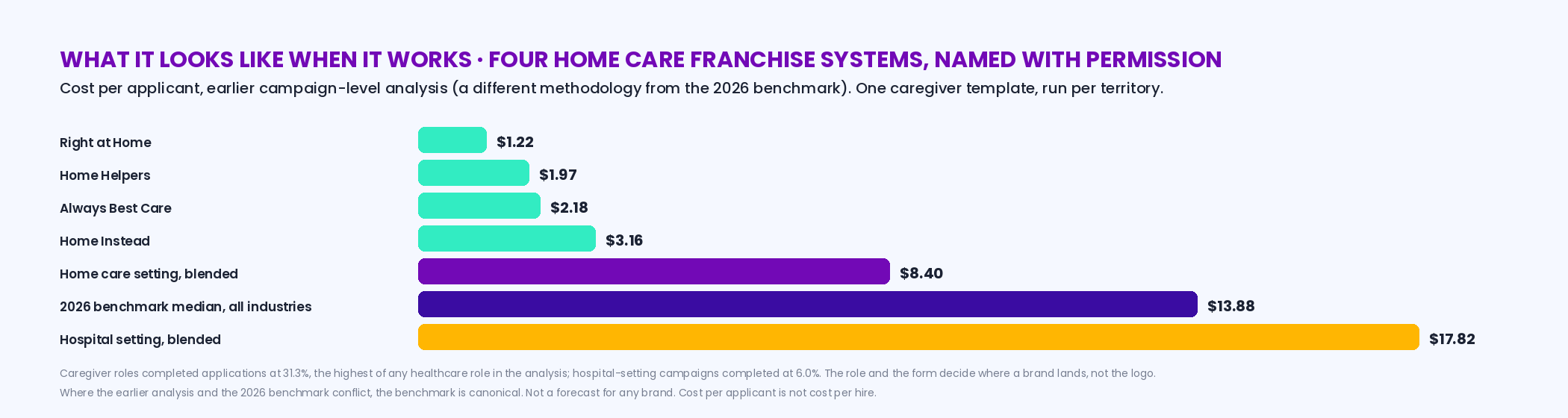
The franchise systems that have agreed to be named are in home care, where the role is the same everywhere — a caregiver or aide, hourly, local, hired continuously — and the brands run many locations. In our earlier campaign-level analysis, Right at Home's campaigns produced applicants at $1.22, Home Helpers at $1.97, Always Best Care at $2.18, and Home Instead at $3.16; the home care setting as a whole ran $8.40 and caregiver roles converted at 31.3%, the highest completion of any healthcare role. Those four figures are the pattern this page describes — one caregiver template, run per territory, with an operator who calls back — and they're also the cheap end of a distribution whose expensive end is real: hospital-setting campaigns ran $17.82 in the same analysis and CommonSpirit's at $19.63. The role and the form decide where a brand lands, not the logo. The home-health-aide playbook, with the ad and the form, is on its own page; the retail version of the same repetition is on the retail page.
Who does what: the franchisor's part and the operator's part
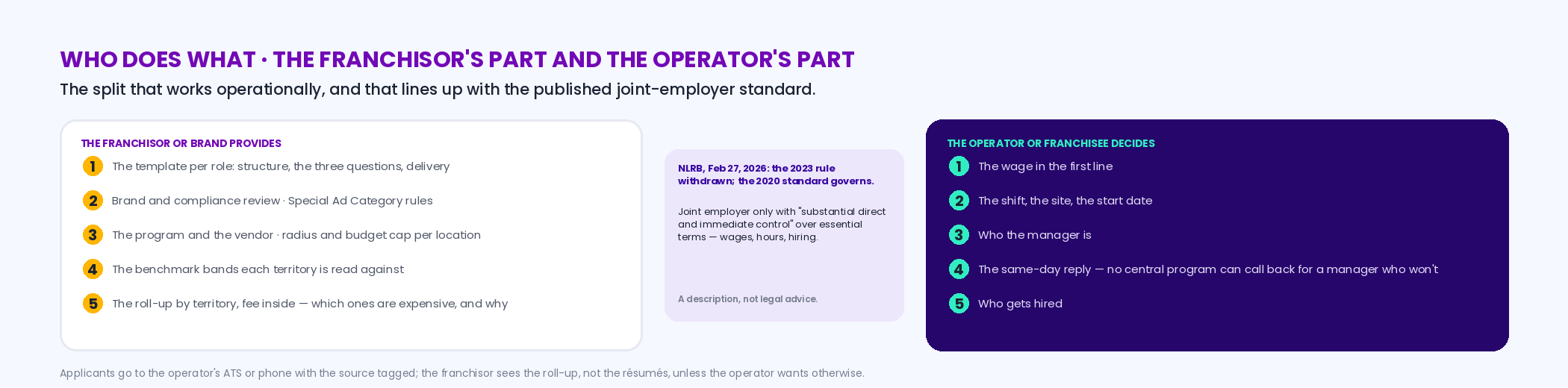
A central recruitment program fails in one of two ways: the franchisor does too much and the ads say nothing true, or the franchisor does nothing and forty operators each learn Special Ad Category rules by getting an ad rejected. The split that works is the one the law already suggests. Under the NLRB's joint-employer standard — the 2020 rule, restored when the Board withdrew its 2023 rule on February 27, 2026 after a federal court vacated it — an entity is a joint employer only if it holds "substantial direct and immediate control" over essential terms such as wages, hours and hiring. That is a description of a labor-law standard, not legal advice, and franchisors take their own counsel on it; but it lines up with what works operationally. The franchisor provides the template per role, the brand and the compliance review, the vendor and the program, the benchmark bands each territory is read against, and the reporting that shows which territories are expensive and why. The operator decides the wage in the first line, the shift, the start date, who the manager is, and who gets hired — and does the same-day reply, because no central program can call an applicant back for a manager who won't. Applicants go to the operator's ATS or phone with the source tagged (the analytics page); the franchisor sees the roll-up, not the résumés, unless the operator wants otherwise.
| Part of the program | Franchisor or brand | Operator or franchisee | Why it sits there |
|---|---|---|---|
| The ad template | Builds one per role: structure, brand, compliance, the three questions | Fills the fields: wage, shift, site, start date, manager | The structure is the expensive part and doesn't vary; the wage does and must be true |
| The campaign | Runs it, or contracts it, per location or per market; sets the radius and the cap | Says when a role opens and closes | Frequency and budget are a weekly read a manager won't do |
| The reply | Provides the applicant text and the delivery into the operator's system | Calls the same day; interviews; hires | Hiring decisions are the operator's — operationally and under the joint-employer standard |
| The report | Sees the roll-up by territory against benchmark bands | Sees the location's applicants and cost per applicant by role | The brand fixes the expensive territories' structure; the operator fixes the wage and the reply |
| The money | Funds it centrally, co-funds it, or offers it as an optional program under its brand — see the white label page | Pays its share; owns its applicants either way | Terms vary by system and are set on a call, not printed here |
The size of the problem, in the IFA's numbers
The International Franchise Association's 2026 Franchising Economic Outlook, prepared by FRANdata and released February 19, 2026, counts 832,521 franchise establishments in 2025 and projects 845,000 in 2026, employing about 8.8 million people rising to "nearly 8.9 million" — more than 150,000 added jobs, or 1.8% — with "over 12,000 new franchised businesses" expected to open in the year, and child services and commercial and residential services growing fastest at 3.2%. Divide the jobs by the establishments and the average unit employs roughly ten and a half people, which is the shape of the hiring problem: not one big hire, but a handful of hourly roles per unit, everywhere, continuously, in a labor market where the BLS counted 23.45 employed people for every unemployed one in July 2026. A brand adding 12,000 units is opening 12,000 small hiring problems that all look alike, and "all look alike" is exactly what a template is for.
When this is the wrong approach
Three cases. If the roles differ by location — a professional-services franchise hiring a licensed practitioner in each territory — a template helps less and a board that reaches title-searchers helps more; the structure advantage is for roles that repeat. If the operators won't do their part, no central program fixes it: an ad with no wage and a manager who doesn't call produces expensive applicants who go elsewhere, and the report will say so territory by territory, which some systems would rather not see. And if the brand has three locations, the fixed cost is spread thin enough that a single well-built campaign per location, run by whoever runs the brand's social, is the honest answer — the outsourcing arithmetic is on the services page, and the point at which a program beats a person is a headcount question, not a capability one.
Frequently asked questions
Franchise recruiting software: what the category covers
Franchise hiring software is sold in three layers, and a system usually needs all three. An applicant tracking or hiring platform that every location uses, so the franchisor can see the whole network while each operator hires for their own unit. Text and scheduling tools, because a location manager hiring between shifts will not work an email inbox. And recruitment advertising that can run one template per role as a campaign per location, which is the structure this page is about. The first two process applicants; only the third creates them.
When evaluating franchise recruitment software, ask how it handles the split between franchisor and franchisee: who owns the applicant data, whether each operator can see only their own locations, and whether a brand-approved job template can be launched in a new territory without being rebuilt. For restaurant systems specifically, restaurant hiring software covers the platforms in more detail.
What is recruitment marketing for franchises?
A central program that builds the recruiting ad, the short application and the weekly management once per role and runs them as a campaign per location or per market, with each operator supplying what's local — the wage, the shift, the manager, the reply. It exists because franchise hiring is the same few hourly roles hired continuously in many places, so the expensive part of a campaign (the craft) can be paid once and the cheap part (media) repeated. In our records, one multi-market client ran 110 campaigns at roughly $4.11 per applicant that way.
Should a franchisor run recruitment advertising for franchisees?
Provide it, yes; run the operator's part, no. The franchisor is well placed to build the template per role, review it for brand and compliance, contract the campaigns, set the radius and budget cap, and read the roll-up against benchmark bands. The operator has to set the wage, decide the shift, take the same-day call and make the hire — operationally because a central program can't, and because under the NLRB's 2020 joint-employer standard (restored February 27, 2026) joint-employer status turns on "substantial direct and immediate control" over essential terms including hiring. That's a description of the standard, not legal advice; franchisors take their own counsel.
Why does multi-unit hiring cost less per applicant?
Reuse. The ad structure, the form, the delivery and the read-out are built once per role and copied per location, so the fixed cost is spread. The benchmark shows it by structure: single-role campaigns ran a median $14.45 per applicant (1,210 campaigns), multi-role $9.83 (46), event-driven $8.02 (78); and the clearest case in our records, a multi-market manufacturer, ran 110 campaigns at about $4.11. That's a pattern from an earlier campaign-level analysis and one client, not a promise, and small-radius locations can lose the discount to frequency.
How do you handle small towns and rural locations?
By capping budget to what the radius can absorb and sharing campaigns across locations that share an audience. In our benchmark, cost per applicant climbs with monthly frequency — $7.85 under 1.5, $13.39 at 2.0–2.5, $18.76 at 3.0–4.0, $26.78 over 4.0 — and a small audience crosses 2.5 fast. CHS's rural campaigns are the reference: a CPM of $14.87 against $40.32 in dense markets, but a frequency of 5.4 against 2.3, and roughly three times the blended cost. Rural is possible, not cheaper. The frequency watch on this page estimates where a location's budget lands.
Which franchise systems does Boostpoint work with?
The ones we can name are in home care: Right at Home, Home Helpers, Always Best Care and Home Instead, whose campaigns in our earlier campaign-level analysis produced applicants at $1.22, $1.97, $2.18 and $3.16 respectively. We also run multi-location programs in agriculture (CHS, Insight FS, Mid Kansas Co-Op), and multi-market work in manufacturing and other sectors for clients we don't name. Figures are from a campaign-level methodology that differs from the 2026 benchmark; where they conflict, the benchmark is canonical.
What does a franchise recruitment program cost?
A product subscription plus ad spend, on one bill through Boostpoint — the subscription priced on job volume and quoted on a call, the ad spend recommended at a minimum of $750 a month per job category — and every figure we publish includes campaign management. A normal campaign in our benchmark ran on a median $334 a month (upper quartile $554, top decile $988) for 20 applicants and 6,061 people reached; a brand with 40 locations and two roles each is 80 campaigns, and the rollout planner turns that into media under management. Per-applicant cost across all industries ran a median $13.88, $8.02 volume-weighted. How a system splits the cost — central, co-funded, or an optional program under the brand — is set on a call and varies. Cost per applicant is not cost per hire.
How fast can a multi-unit rollout go?
As fast as intakes get done, which is the constraint. A location can be live within a week of its intake — wage, shift, site, manager, where applicants go — and five to ten locations a week is a sustainable cadence for a central team; forty on one Monday means thirty campaigns launched with a placeholder wage. Forty locations at five a week is eight weeks to full rollout; a burst of openings on a date is better run as a dated event campaign, the cheapest structure we run at a median $8.02.
Can a franchisor offer this to franchisees under its own brand?
Yes — that's the white label shape: the franchisor owns the program and the price to operators, campaigns run under the brand's name from one intake template, and each operator gets its own report. The three partnership shapes, who owns what in each, and what we ask of a partner are on the white label page; the terms are set on a call and aren't printed. No partner or partner-held client is named on this site.
What is franchise recruiting software?
Software that lets a franchise system hire across many independently operated locations: a shared applicant tracking or hiring platform, texting and interview scheduling for location managers, and recruitment advertising that runs one template per role as a campaign per location. The first two process applicants; advertising is the layer that creates them.
Build the template once
Bring your roles and your location list. We'll build the template per role, show you the benchmark bands your territories would be read against, plan the rollout cadence, and show you the multi-location programs closest to yours.
Book a DemoBoostpoint figures come from the 2026 Social Job Advertising Benchmark — 891 campaigns and 1,334 campaign-months across 15 role families: median $13.88 per applicant, $8.02 volume-weighted, percentiles $2.91, $6.48, $29.74 and $66.45; a normal campaign $334 a month (upper quartile $554, top decile $988), 20 applicants, 6,061 reached; structures event-driven $8.02, 21% apply, 1.53% click-through, 78 campaigns, multi-role $9.83, 12%, 1.10%, 46, single-role $14.45, 18%, 1.36%, 1,210; frequency bands under 1.5 $7.85 (1% of budget), 1.5–2.0 $11.48 (21%), 2.0–2.5 $13.39 (25%), 2.5–3.0 $13.65 (19%), 3.0–4.0 $18.76 (20%), over 4.0 $26.78 (13%), 33% of budget above 3.0, click-through 1.69% to 0.94%; conversion explaining 70% of cost variation. Earlier campaign-level analysis (a different methodology; the benchmark is canonical where they conflict): a multi-market manufacturing client's 110 campaigns at about $4.11, manufacturing blended $5.56; healthcare 478 campaigns, 30 employers, 24,712 applications, home care setting $8.40, hospital $17.82, caregiver completion 31.3%, named customers Right at Home $1.22, Home Helpers $1.97, Always Best Care $2.18, Home Instead $3.16, CommonSpirit $19.63; CHS rural CPM $14.87 vs $40.32, frequency 5.4 vs 2.3. Boostpoint is priced as a product subscription plus ad spend: the subscription is priced on job volume and quoted on a call, ad spend is separate and recommended at a minimum of $750 a month per job category, there is one bill, through Boostpoint, and every cost-per-applicant figure we publish includes campaign management. IFA 2026 Franchising Economic Outlook (FRANdata, February 19, 2026). NLRB, Federal Register, February 27, 2026 — a description of the standard, not legal advice. BLS Employment Situation, July 2026. The planners compute on the reader's inputs; the frequency estimate is a planning figure, not a measurement. Cost per applicant is not cost per hire; we do not track hires and publish no cost-per-hire figure. A sample of Boostpoint campaigns, not an industry-wide study.