
Multi-Market and Multi-State Hiring: A Market Is a 15-Mile Circle, a State Is a Set of Rules, and the Campaign Gets Cheaper the More Places It Runs
Multi-market recruiting is one template per role run as one campaign per market, where a market is an audience rather than an address: under Meta's employment rules a city or pin-drop audience is widened to a 15-mile minimum radius, so two locations closer than that share one campaign and two farther apart need two. Dense markets absorb budget; small and rural ones hit the frequency cliff fast — our co-op client's rural campaigns bought impressions at a CPM of $14.87 against $40.32 in dense markets but ran at a frequency of 5.4 against 2.3. The proof the structure scales is one manufacturing client that ran 110 campaigns across dozens of markets at roughly $4.11 per applicant. Then the state layer: the wage in the first line is a state fact, and sixteen jurisdictions now require a pay range in the posting itself. Below: what a market is, a mapper, the proof, the state checker, and how to scale the read-out.
A note on who's writing this
Boostpoint runs multi-market campaigns for employers with locations across states — co-ops with branches through the plains, home care systems, manufacturers with a plant in every region — so this page is our case, with rules attached. The named client is one that has agreed to be named (CHS); the 110-campaign client is a manufacturer we don't name, and its figure comes from an earlier campaign-level analysis that used a different methodology from the 2026 benchmark, which is canonical where they conflict. The 15-mile rule is Meta's, quoted from its help center via our Special Ad Category page. The state pay-range list is a summary of third-party legal summaries as published on our OFCCP page in August 2026, and it is not legal advice; confirm your jurisdictions with counsel. Nothing here is a cost per hire.
The case for hiring locally, market by market, made first
The best argument against a multi-market program is that every market is different and the people who know the difference are in it. The rules differ too: fourteen jurisdictions now require a pay range inside the posting, as pay transparency laws by state sets out. The wage that clears in Fargo isn't the wage that clears in Phoenix; the referral network that fills a plant in Ohio doesn't exist in the new plant in Georgia; the manager who calls applicants back the same day is a local fact, not a corporate policy. That argument is right about wages, managers and referral networks, and any central program that overrides them produces an ad that's wrong everywhere. It's wrong about the rest. The shape of a warehouse ad, the three-question form, the rules that decide who can see the ad, and the weekly read of frequency and apply rate are identical in Fargo and Phoenix; they're expensive to build and free to copy. The local strategy that works keeps the local parts local — the wage in the first line, the manager's name, the referral bonus — and copies everything else, which is what "one template per role, one campaign per market" means.
What a market is: a 15-mile circle, not a location
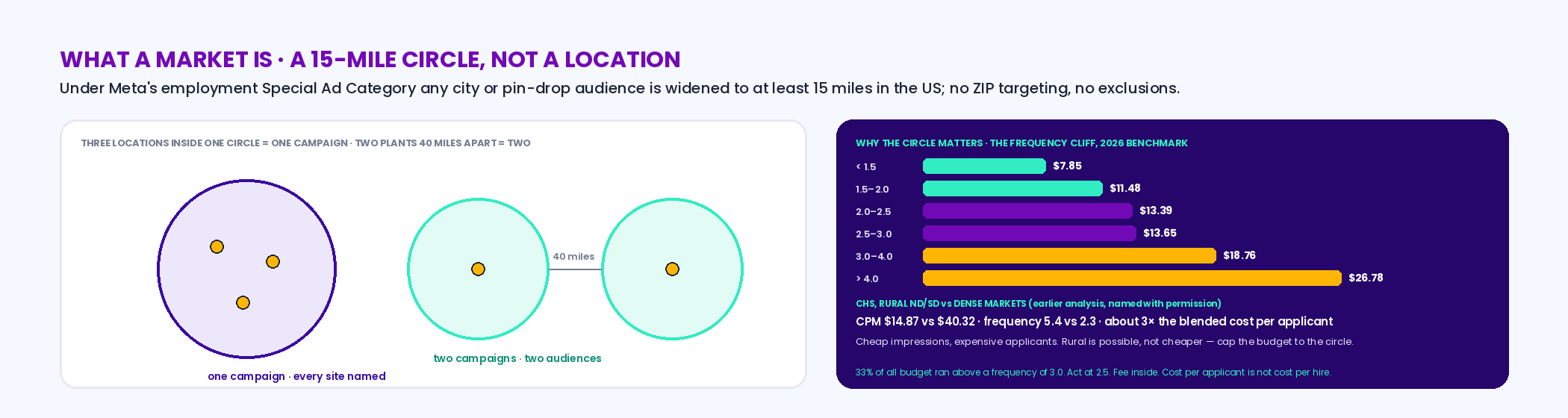
Under Meta's employment Special Ad Category — mandatory for every job ad shown to people in the US — you cannot target by ZIP code, cannot exclude a location, and any city, address or pin-drop audience "will include an expanded radius" of at least 15 miles (25 km) in the US. Meta's help center says it; every one of the 891 campaigns in our benchmark ran under it. The consequence for a multi-location employer is a definition: a market is a 15-mile circle around a point, and two locations closer than that share an audience. Three stores in one metro are one market and one campaign, with the site named in the ad and the applicant choosing; two plants forty miles apart are two markets and two campaigns, even under one brand. Run a campaign per location when the locations share a circle and the same people see the same ad two, three, four times — which is the frequency cliff: campaigns under a frequency of 1.5 ran a median $7.85 per applicant in the benchmark, campaigns over 4.0 ran $26.78, and 33% of all budget ran above 3.0. Markets also differ in what an impression costs. Sector CPMs in the benchmark ran from $14.74 (Retail/Corporate) and $14.82 (Transportation & Logistics) to $25.18 (Healthcare & Senior Living) and $29.04 (Behavioral & Education), and within a sector the dense market pays more per impression and gets more people for it. CHS is the reference case for the other end: its rural campaigns in North Dakota and South Dakota bought impressions at a CPM of $14.87 against $40.32 in denser markets, ran at a frequency of 5.4 against 2.3, and cost roughly three times the blended figure per applicant. Rural is possible, not cheaper, and the fix is budget capped to what the circle can absorb.
Interactive
Market mapper — locations, the clusters that sit within 15 miles of each other, roles per market and media per campaign; get markets, campaigns, and what the shared circles save
Nothing is stored or sent — this runs in your browser. Count your clusters from a map: any group of your locations within about 15 miles of one another is one cluster. An estimate for planning; the ad account's audience figure decides it.
locations − clustered locations + clusters
markets × roles, vs locations × roles
the same audience, not paid for twice
at $334 per campaign a month
The proof it scales: 110 campaigns, dozens of markets, about $4.11 an applicant
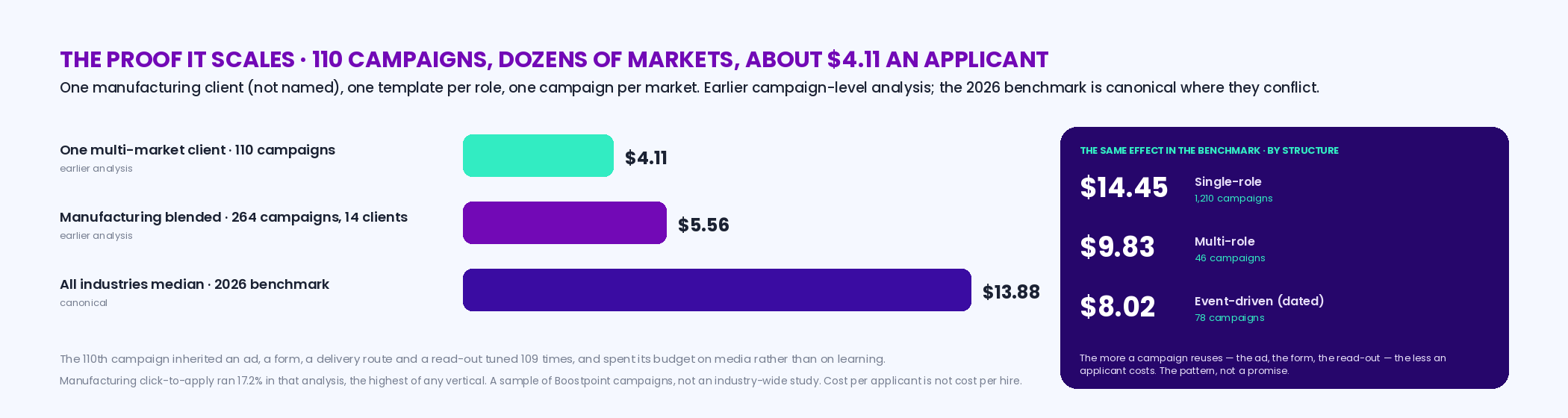
The single best proof point we own for multi-market hiring is one client. A manufacturer with plants across dozens of markets ran 110 campaigns with us — one template per role, one campaign per market, the plant and the shift named in each — and produced applicants at roughly $4.11 each. The manufacturing vertical as a whole in that same analysis ran a blended $5.56 across 264 campaigns and 14 clients, and the cross-industry median in the 2026 benchmark is $13.88. The gap is reuse: the 110th campaign inherited an ad, a form, a delivery route and a read-out that had been tuned 109 times, and spent its budget on media rather than on learning. Two honest limits. It's an earlier, campaign-level analysis with a different methodology from the benchmark, and it's one client in one vertical where click-to-apply runs high (17.2% across the manufacturing book, the highest of any vertical), so it's the pattern, not a promise. And the structure effect shows in the benchmark itself, which is the canonical source: single-role campaigns ran a median $14.45 per applicant, multi-role $9.83, event-driven $8.02 — the more a campaign reuses, the less an applicant costs.
The state layer: the wage is a fact, and in sixteen places the range has to be in the ad
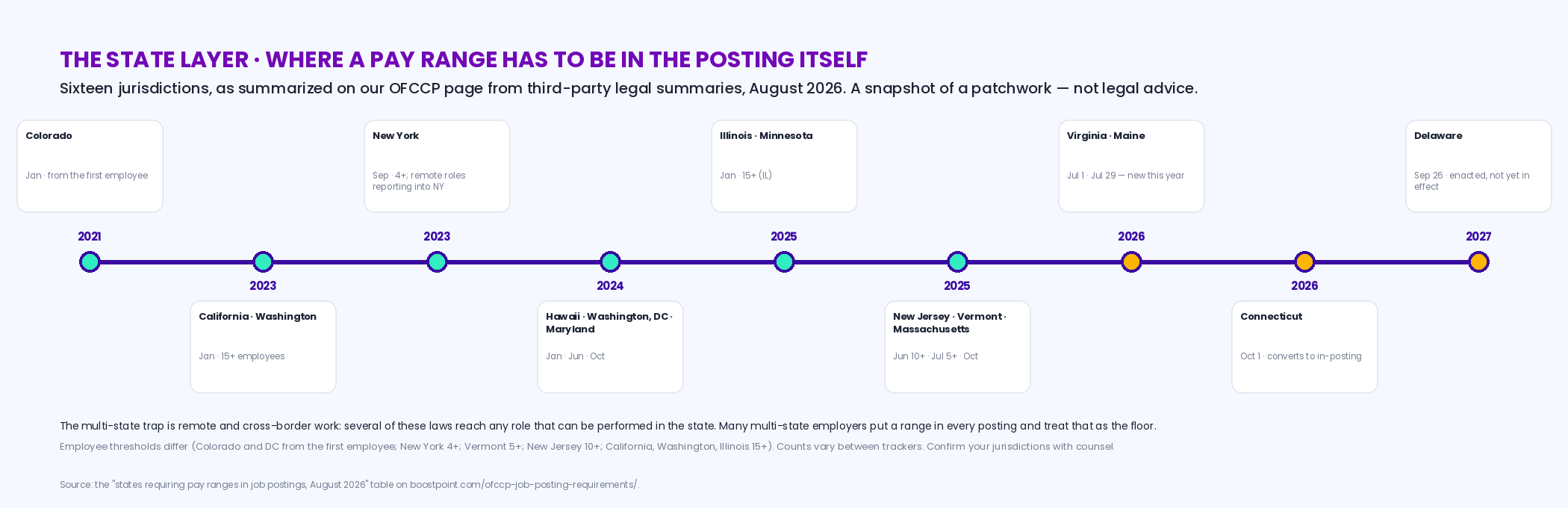
Markets are about audiences; states are about rules, and the rule that reaches a job ad first is the wage. Minimum wages, overtime thresholds and tip credits differ by state, so the number in the first line of the ad — the one that decides whether anyone taps it — is a per-state fact that a national template can only hold as a blank. The second rule is pay transparency. There is no federal statute requiring a pay range in a posting; there is a fast-growing set of state laws, and as summarized on our OFCCP page from third-party legal summaries in August 2026, sixteen jurisdictions require or will soon require a range in the posting itself: Colorado from January 2021, California and Washington from January 2023, New York from September 2023, Washington DC from June 2024, Hawaii from January 2024, Maryland from October 2024, Illinois and Minnesota from January 2025, New Jersey from June 2025, Vermont from July 2025, Massachusetts from October 2025, Virginia from July 1, 2026, Maine from July 29, 2026, Connecticut from October 1, 2026, and Delaware from September 26, 2027. Employee thresholds differ — Colorado and DC apply from the first employee, New York from four, Vermont from five, New Jersey from ten, California, Washington and Illinois from fifteen. The multi-state trap is remote and cross-border work: several of these laws reach any role that can be performed in the state, so a posting with no range can create obligations where you've never had an office. Many multi-state employers now put a range in every posting and treat that as the floor. That is a description of a patchwork, not legal advice; the full table, the OFCCP rules for federal contractors, and what changed in 2025 and 2026 are on the OFCCP page, and your counsel decides what applies to you.
Interactive
State pay-range checker — tick the states you hire in and see which of them require a range in the posting, from when, and at what employee threshold
Nothing is stored or sent — this runs in your browser. The list is the August 2026 summary on our OFCCP page, drawn from third-party legal summaries; it is a posting-requirement snapshot, not legal advice, and it changes every legislative session.
where you hire or could hire remotely
in effect today, per the summary
enacted, effective after today
Scaling recruitment across markets: the read-out is the job
Scaling recruitment is not scaling the ad; it's scaling the weekly read. One campaign needs three numbers checked a week — frequency (act at 2.5), apply rate, and cost per applicant with the fee inside — and thirty-four markets need a hundred and two, which is a process, not a person's memory. Four things make it work. A cadence, not a launch date: five to ten markets a week, each with its wage, its manager and where applicants land confirmed, beats forty on a Monday; the rollout planner on the franchise page turns a location list into weeks. Source tagged by market: applicants land in the ATS with the campaign and the market on them, so the roll-up shows which markets are expensive and the manager sees only her own — the tagging is on the analytics page. Budget capped to the circle: the small markets get what their audience can absorb and no more, and the dense ones get the rest. The template changes centrally, the wage changes locally: when the form gets shorter or the first line gets better, every market inherits it the same week, which is the whole reason the 110th campaign was cheap. Where a market opens in a burst — a new plant, a new branch — the dated hiring event is the cheapest structure we run ($8.02 median, 21% apply, 78 campaigns), and the open house page has it; the agricultural version, six departments and twenty locations in one eight-week window, is on the co-op page.
Local hiring strategies that stay local
What a central program should never touch, market by market. The wage and the differential, which are facts about a place. The manager's name and the same-day call, which are the two things that decide whether an applicant becomes an interview. The referral network — the crew that came from the plant across town, the co-op's members' families — which is the cheapest channel in every market and can't be run from headquarters. The local proof: the ad for the Georgia plant should show the Georgia plant, and the walk-in Tuesday should be on the Georgia calendar. And the market's own reality about the pool: a trucking terminal in a county where the drivers are 55-plus recruits differently from one outside a city, which is why the CDL page is about who answers, not where. The job ad's anatomy — what goes in the first line and why — is on the job ad page, and it's the same anatomy in every market with different facts in the blanks.
When a multi-market program is the wrong tool
Three cases. If you hire in three markets, you don't have a multi-market problem; three well-built campaigns run by whoever runs your social is the honest answer. If the roles differ by market — a licensed practitioner in each state — a template helps less than a board that reaches title-searchers, and the state licensing board matters more than the radius. And if the markets are all rural, the constraint is the circle, not the program: budget capped low, campaigns shared across the towns that share an audience, and the expectation set at "possible," not "cheaper." The read-out still matters in all three cases, and so does the state layer — a pay range belongs in the posting regardless of how many markets it runs in.
Frequently asked questions
What is multi-market recruiting?
Running recruitment advertising across many geographic markets from one template per role, with one campaign per market and the local facts — wage, site, manager — filled in per market. A market is an audience, not an address: under Meta's employment rules a city or pin-drop audience is widened to a 15-mile minimum radius in the US, so locations closer than that share a campaign. The proof it scales is one manufacturing client's 110 campaigns across dozens of markets at about $4.11 per applicant, from an earlier campaign-level analysis.
How do you hire across multiple states?
Treat the market layer and the state layer separately. Markets decide the campaigns (one per 15-mile audience, budget capped to what each circle absorbs). States decide the rules in the ad: the wage in the first line is a state fact, and sixteen jurisdictions — Colorado, California, Washington, New York, DC, Hawaii, Maryland, Illinois, Minnesota, New Jersey, Vermont, Massachusetts, Virginia, Maine, Connecticut and Delaware — require or will soon require a pay range in the posting itself, per the August 2026 summary on our OFCCP page. Several reach remote roles that could be performed in the state. Many multi-state employers put a range in every posting. Not legal advice; confirm with counsel.
Does rural recruiting cost less because ads are cheaper there?
No — impressions are cheaper and applicants aren't. CHS's rural campaigns in North Dakota and South Dakota bought impressions at a CPM of $14.87 against $40.32 in denser markets, but ran at a frequency of 5.4 against 2.3 and cost roughly three times the blended figure per applicant, because a small audience sees the same ad over and over. In the benchmark, campaigns over a frequency of 4.0 ran a median $26.78 per applicant against $7.85 under 1.5. Rural is possible, not cheaper; cap the budget to the circle.
Should each location have its own campaign?
Only if it has its own audience. Under the Special Ad Category any location audience is at least a 15-mile circle, so locations closer than that reach the same people; separate campaigns for them pay for the same impressions twice and drive frequency up. Share a campaign across a cluster, name every site in the ad, let the applicant choose, and run separate campaigns for locations that are genuinely apart. The market mapper on this page estimates how many campaigns that is.
What does it cost to recruit in many markets at once?
A product subscription plus ad spend per job category, on one bill through Boostpoint — the subscription priced on job volume and quoted on a call, the ad spend recommended at a minimum of $750 a month per job category — and every figure we publish includes campaign management. The benchmark's median campaign ran on $334 a month for 20 applicants; a 34-market program with two roles each is 68 campaigns. Cost per applicant falls with reuse — single-role $14.45, multi-role $9.83, event-driven $8.02 in the benchmark, and the 110-campaign client at about $4.11 — and rises with frequency in small circles. Cost per applicant is not cost per hire.
How do you scale recruitment without losing the local touch?
Keep the local parts local and copy the rest. The wage, the manager's name, the same-day call, the referral network and the local proof stay with the market; the ad's structure, the three-question form, the compliance rules and the weekly read-out are built once and inherited everywhere. When the template improves, every market gets it the same week; when a market's wage changes, only that market's ad does. Source-tagging by market lets the roll-up show which markets are expensive while each manager sees only her own applicants.
How many markets can one team manage?
As many as the weekly read-out can cover. Each campaign needs three numbers checked a week — frequency, apply rate, cost per applicant — so the constraint is process: a cadence of five to ten new markets a week, tagging by market, and a roll-up that surfaces the expensive circles first. The 110-campaign client is the existence proof that dozens of markets run from one template; the read-out, not the ad, was the work.
What's the difference between this page and the franchise page?
The franchise and multi-unit page is about many locations of one brand: the template-per-role structure, the franchisor-and-operator split, and the rollout cadence. This page is about geography: what a market is under the 15-mile rule, dense versus rural circles, the state layer of wages and pay-range laws, and scaling the read-out across markets. A franchise with locations in twelve states needs both.
When recruiting for multiple locations, how do you get each applicant to the right one?
Let the applicant choose, then route by that answer. Where one campaign covers several sites inside the same 15-mile audience, name every site in the ad and make the first form question "Which location do you want to work at?" with the list, so the answer travels with the application. Tag the source by market and location, send each applicant to that location's manager or requisition in the ATS, and text them within minutes from a number that names the location. Report weekly by location as well as by market, so a site whose applicants are not being called shows up before its manager says the ads are not working.
Map the markets, then run the template
Bring your location list and the states you hire in. We'll turn the list into markets under the 15-mile rule, place each role on the benchmark band, flag the states where the range belongs in the posting, and show you the multi-market programs closest to yours.
Book a DemoBoostpoint figures come from the 2026 Social Job Advertising Benchmark — 891 campaigns and 1,334 campaign-months: median $13.88 per applicant, $8.02 volume-weighted; a normal campaign $334 a month, 20 applicants, 6,061 reached; structures single-role $14.45 (1,210 campaigns), multi-role $9.83 (46), event-driven $8.02 (21% apply, 78); frequency under 1.5 $7.85, over 4.0 $26.78, 33% of budget above 3.0, act at 2.5; sector CPMs Retail/Corporate $14.74, Transportation & Logistics $14.82, Healthcare & Senior Living $25.18, Behavioral & Education $29.04. Earlier campaign-level analyses (a different methodology; the benchmark is canonical where they conflict): one multi-market manufacturing client's 110 campaigns at about $4.11, manufacturing blended $5.56 across 264 campaigns and 14 clients, click-to-apply 17.2%; CHS rural CPM $14.87 vs $40.32, frequency 5.4 vs 2.3, roughly three times the blended cost. Meta Business Help Center, employment Special Ad Category, as read on August 25, 2026 for our Special Ad Category page: 15-mile (25 km) minimum expanded radius in the US, no ZIP targeting, no location exclusions. State pay-range requirements as summarized on our OFCCP page from third-party legal summaries, August 2026 — a snapshot, not legal advice. BLS Employment Situation, July 2026. Boostpoint is priced as a product subscription plus ad spend: the subscription is priced on job volume and quoted on a call, ad spend is separate and recommended at a minimum of $750 a month per job category, there is one bill, through Boostpoint, and every cost-per-applicant figure we publish includes campaign management. The market mapper and state checker compute on the reader's inputs. Cost per applicant is not cost per hire; we do not track hires and publish no cost-per-hire figure. A sample of Boostpoint campaigns, not an industry-wide study.