
Agribusiness and Co-op Recruiting: Six Departments, Twenty Locations, One Eight-Week Window
Agribusiness recruiting at a co-op is six different hires — agronomy, grain, energy, feed, retail, and transportation — spread across a dozen or more rural locations and squeezed into the same spring window every competitor uses. Across 140 Boostpoint-managed campaigns for four co-ops, applicants cost a blended $10.06, from $2.16 for sales roles to $21.13 for CDL drivers, and a campaign launched in May cost 2.8 times one launched in August. The co-ops that staff on time — CHS, Insight FS, and Mid Kansas Co-Op among the ones we run campaigns for — recruit by location, by department, and before the season, not during it.
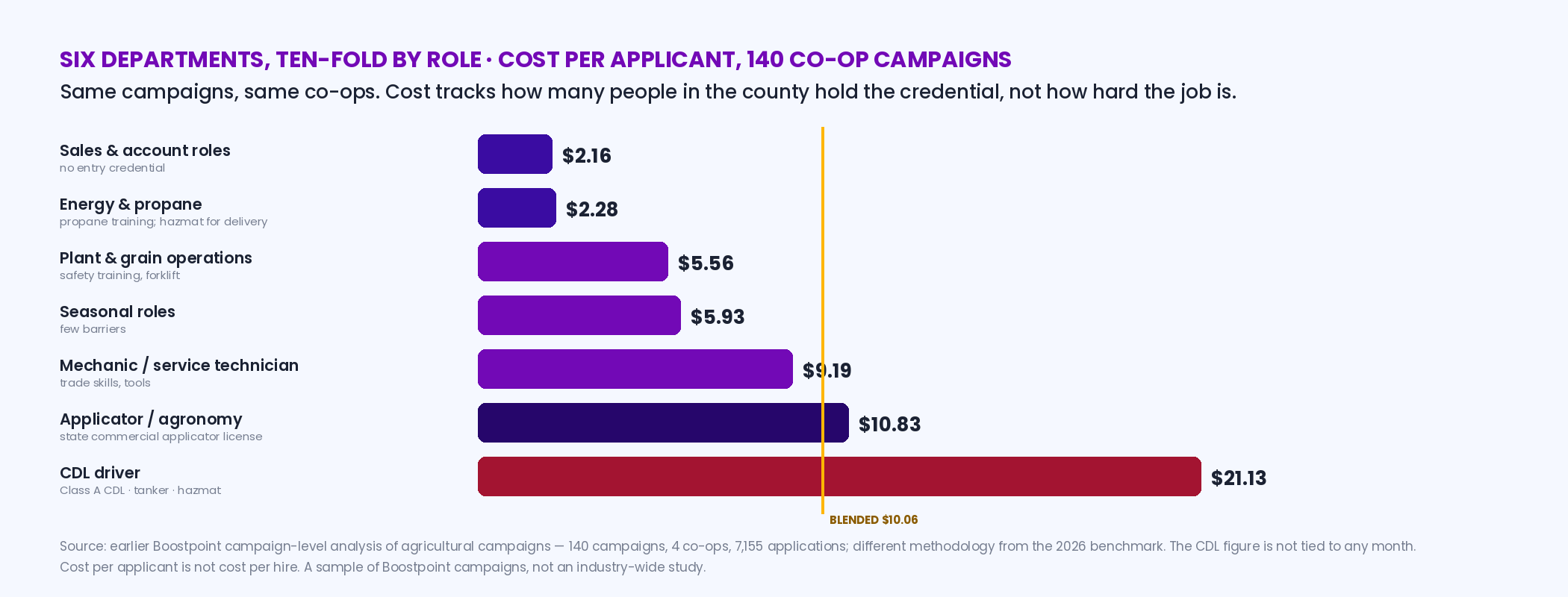
Source: an earlier Boostpoint campaign-level analysis (different methodology from the 2026 benchmark) — 140 campaigns across 4 co-ops, 7,155 applications, blended cost per applicant $10.06.
A note on who's writing this
Boostpoint runs social media job ads for agricultural cooperatives and other rural employers, so the advertising sections of this page describe what we sell. The figures are ours where labeled — an earlier campaign-level analysis of 140 agricultural campaigns across four co-ops and 7,155 applications, which uses a different methodology from our 2026 benchmark — and USDA's or the University of Missouri's where labeled. We name three customers because they've agreed to be named; every other co-op in the data is described, not identified. What we won't do is claim the numbers below predict your season: the curve is one season across four co-ops, and it is directional. The month-by-month table lives on the seasonal cost curve page; the full role list is on the agriculture hub. This page is about how a co-op should recruit given both.
What a co-op is, for recruiting purposes
USDA counted 1,620 farmer, rancher, and fishery cooperatives in 2024, with 1,735,929 memberships, 189,764 employees — about 21% of them part-time or seasonal — and $275.8 billion in gross business volume. The recruiting fact inside those numbers is the shape of the employer: a co-op is a member-owned company with many small locations, each of which needs the same handful of roles at the same time of year, in towns where the labor pool is measured in hundreds. The 2024 Midwest agribusiness workforce needs assessment, a USDA-funded survey across eight states reported by University of Missouri Extension (July 2025), found 75% of agribusinesses identifying a shortage of skilled workers as the primary barrier to expanding employment, 57% saying the physical demands of the work discourage younger applicants, and producers naming farm labor (42%) and truck drivers (16%) as the hardest entry-level positions to fill. All of that is real. What it misses is that the shortage is worst in the eight weeks when every co-op in the county is hiring the same people, and that a co-op can choose not to recruit in those eight weeks.
Six departments are six different recruits
"Co-op hiring" is not one thing, and the cost data says so. In the earlier campaign-level analysis, the same campaigns produced applicants at ten-fold different costs by role: sales and account roles $2.16, energy and propane $2.28, plant and grain operations $5.56, seasonal roles $5.93, mechanic and service technician $9.19, applicator and agronomy $10.83, and CDL driver $21.13 — four times a plant operator, because a Class A license with the right endorsements is the scarcest credential in a rural county. The pattern is the one we see everywhere: cost tracks how many people within thirty miles hold the credential, not how hard the job is. The consequence for a co-op is that the ad, the form, and the channel have to be written per department, and the budget planned per department, or the drivers eat the agronomy budget by April.
Interactive
Department board — who you're hiring, what the ad says, what the form asks
Nothing is stored or sent — this runs in your browser. Six co-op departments; the cost figure under each is the earlier campaign-level analysis, labeled, not a quote.
Boostpoint's practice, not a template to paste. Role costs are from an earlier campaign-level analysis (140 campaigns, 4 co-ops, 7,155 applications; different methodology from the 2026 benchmark) and are not tied to any month. Licensing requirements vary by state; check your state department of agriculture (applicator) and DOT (CDL, hazmat). Nothing about age, sex, or origin in the line or the questions.
One campaign per location, not one campaign per co-op
A co-op with twenty locations across three counties has twenty labor markets, not one. A single campaign covering all of them concentrates spend where the auction is cheapest and the people are densest — the county seat — and leaves the elevator forty miles out with nothing. The structure that works is one campaign per location, each with its own radius, its own first line ("applicator · [town] elevator"), and its own budget, run as a standing multi-role campaign for the location's departments. Our 2026 benchmark measured that structure: multi-role, always-on campaigns ran at a median $9.83 per applicant (12% apply rate, 46 campaigns), and event-driven campaigns built around a date — a hiring day at the elevator, an open house before the season — at $8.02 (21% apply rate, 78 campaigns), the cheapest structure we measured, against $14.45 for a single-role campaign launched when someone quits. The surge version, for a new location or a season, is on mass hiring; the hiring-day mechanics are on open house hiring events.
Rural reach: possible, not cheaper
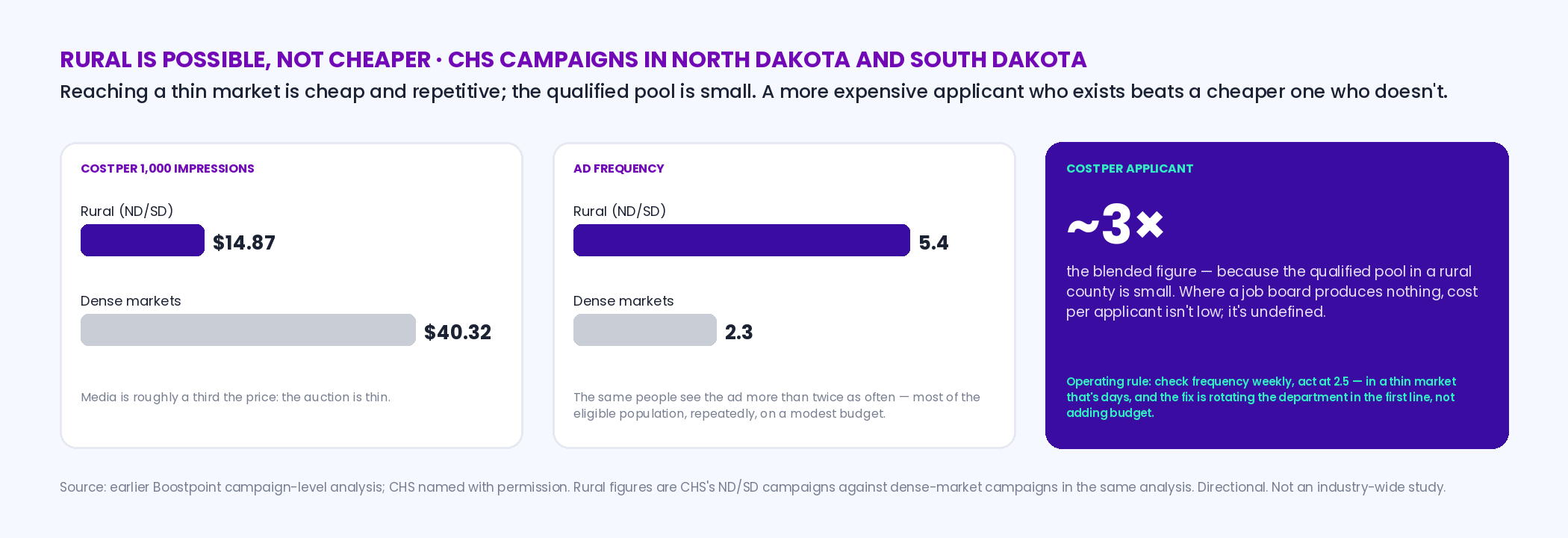
The objection every co-op raises is that social ads work in cities. The data from CHS's campaigns in North Dakota and South Dakota answers it precisely, and not in the way either side expects. Reaching people in thin rural markets was cheap: the cost per thousand impressions ran $14.87 against $40.32 in dense markets, and frequency ran 5.4 against 2.3 — meaning a modest budget put the ad in front of most of the eligible population, repeatedly. But the cost per applicant ran roughly three times the blended figure, because the qualified pool is small. The honest claim is "rural is possible," not "rural is cheaper": in a county where a job board produces nothing, cost per applicant isn't low, it's undefined, and a more expensive applicant who exists beats a cheaper one who doesn't. The operating consequence is the frequency rule from the benchmark — check weekly, act at 2.5 — applied harder: in a thin market a campaign passes 2.5 in days, and the fix is rotating the first line across departments, not adding budget.
The calendar is the budget
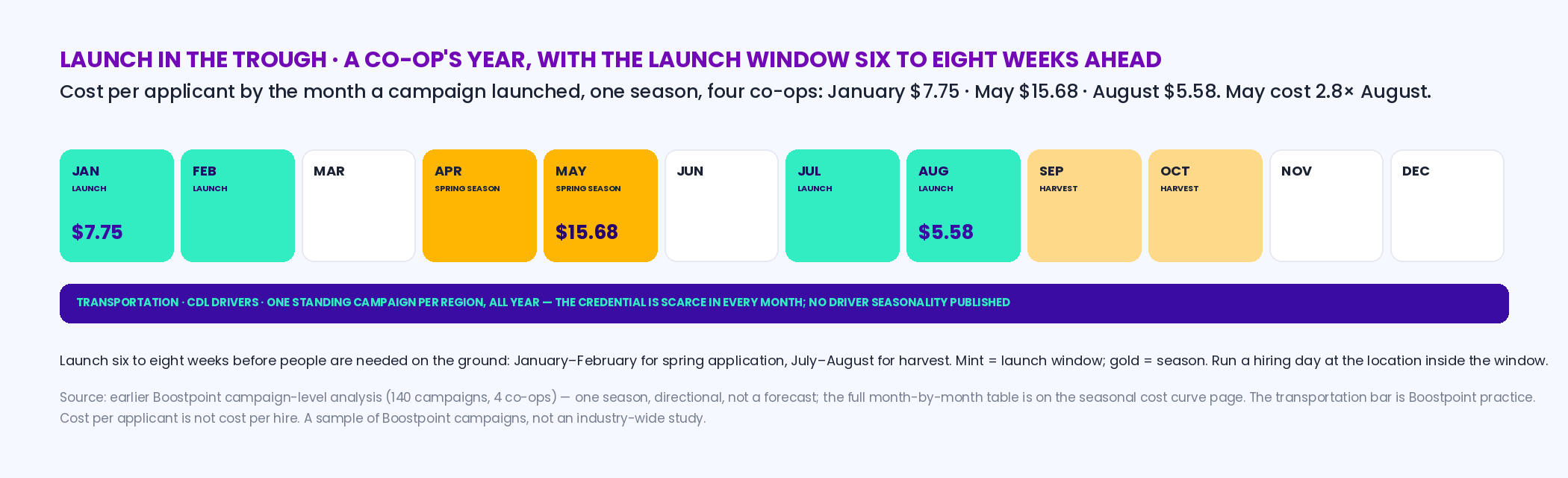
Agricultural recruiting is one of the few places we publish seasonality, because the pattern is strong enough to plan around. Across a full season for four co-ops, a campaign launched in January produced applicants at $7.75; in May, $15.68; in August, $5.58 — May cost 2.8 times August, and May also produced fewer than half the applications of March, because by May everyone who was going to move has moved and every co-op is bidding for the rest. Single season, four co-ops, directional, not a forecast; the full table and the reasoning are on the seasonal cost curve. The rule for a co-op is to launch six to eight weeks before people are needed on the ground, which for a spring application season means January and February, and to keep the transportation campaign on year-round because drivers are the scarcest credential — a statement about the license, not about the month; we publish no driver seasonality.
Interactive
Location and launch planner — campaigns to run, and the month to start them
Nothing is stored or sent — this runs in your browser. One campaign per location is the structure; the launch month is your season start minus the six-to-eight-week lead the curve argues for.
Arithmetic on your inputs; the lead time is Boostpoint's practice from the seasonal curve (one season, four co-ops — directional). No cost is computed here: the curve's figures are by launch month for the whole ag dataset and are not a quote, and cost per applicant is not cost per hire.
Who applies, and what that means for the ad
In the earlier analysis, 46% of applicants to co-op campaigns were aged 35 to 54, and applicants aged 25 to 44 were the cheapest to acquire; the cost per thousand impressions across the dataset was $13.09. Employment ads on Meta can't target by age — the Special Ad Category fixes the audience at 18 and over — so that is who responded, not who was chosen, and it is useful precisely because it corrects the assumption in the workforce survey that the applicant is a reluctant twenty-year-old. The person tapping a co-op ad on a phone is more often a mid-career worker with a license and a family in the county, employed by the competitor or the farm down the road, and the ad that works reads like a message to that person: the town, the department, the rate, the season's hours honestly stated, the license you'll pay for, and the fact that the job is still there in November. The anatomy is on what makes a good job ad; for the driver version, the CDL driver job description and the trucking hub.
What the named co-ops have in common
CHS, Insight FS, and Mid Kansas Co-Op are three of the cooperatives we run campaigns for and are able to name. They differ in size by orders of magnitude and in geography from the Dakotas to Illinois to Kansas, and the recruiting pattern that works for them is the same three things this page has described: campaigns organized by location rather than by company, ads written by department rather than "now hiring," and a calendar that starts before the season rather than in it — with the transportation campaign running all year because the license is scarce in every month. None of them found rural reach to be a problem; all of them found the form and the timing to be the levers. Which is the benchmark's finding in agricultural clothing: applicant conversion explains 70% of cost variation, audience 30%, creative 18%, and a co-op's audience is fixed by the county line.
| Department | Typical roles | Credential that sets the cost | Earlier-analysis cost per applicant | Structure and timing |
|---|---|---|---|---|
| Agronomy | Applicators, agronomy sales, crop scouts | State commercial applicator license; often a CDL for the tender | $10.83 (applicator / agronomy) | Per location; launch January–February for spring; hiring day at the agronomy center |
| Grain and plant operations | Elevator operators, plant help, scale, maintenance | Grain-handling safety training; forklift; sometimes a CDL | $5.56 (plant ops) · $9.19 (mechanic / service tech) | Per location; launch six to eight weeks before harvest; seasonal help via event-driven campaign |
| Energy and propane | Delivery drivers, service techs, bulk plant | Propane (CETP-type) training; CDL with hazmat for delivery | $2.28 (energy / propane) | Per depot; launch before heating season; the hazmat driver comes from the transportation campaign |
| Feed and mill | Mill operators, feed delivery, seasonal labor | Forklift; feed-safety training; CDL for delivery | $5.93 (seasonal roles) | Per mill; standing multi-role campaign; seasonal surge as an event |
| Retail and sales | Farm store, account managers, precision-ag sales | None to enter; product knowledge trained | $2.16 (sales and account roles) | Per store; always-on; the cheapest applicant in the dataset |
| Transportation | CDL drivers — grain, fertilizer, fuel, feed | Class A CDL; tanker and hazmat endorsements | $21.13 (CDL driver) | One standing campaign per region, all year; the credential is scarce in every month — no driver seasonality published |
A co-op isn't one employer. It's twenty locations and six departments — recruit it that way, and start in January.
Grain elevator operator job description
The grain elevator operator is the co-op role that decides whether harvest runs. The operator receives, stores, conditions and ships grain, and does it inside a facility with its own OSHA standard. O*NET has no occupation that matches the title directly, so this page does not quote a federal pay figure for it; in the earlier campaign-level analysis above, plant and grain operations roles cost $5.56 per applicant, which is the closest figure we have.
Grain elevator operator duties
- Receive trucks at the scale, probe and sample loads, and test for moisture, test weight and damage
- Direct unloading at the pit and route grain through legs, conveyors and distributors to the right bin
- Run the dryer and aeration fans and monitor bin temperatures to keep stored grain in condition
- Load out trucks, rail cars or barges to contract specification and weight
- Carry out the housekeeping program to keep grain dust off ledges, floors and equipment
- Inspect and lubricate legs, belts, bearings and conveyors, and report problems before they become ignition sources
- Follow lockout-tagout, hot work permit and bin entry permit procedures
- Keep scale tickets, grade records and bin inventories accurate
- Serve members and drivers at the scale house during harvest
The safety rules belong in the posting
OSHA's grain handling standard, 29 CFR 1910.272, applies to grain elevators, feed mills and similar facilities, and several of its requirements describe the job as much as regulate it:
- Training. Employers must train employees at least annually and when job changes expose them to new hazards, and train new employees before they start work, covering dust and ignition hazards and job-specific procedures such as clearing choked legs, housekeeping, hot work and lockout-tagout (1910.272(e)(1)).
- Bin entry. The employer issues a permit for entering bins, silos or tanks unless the employer or its representative is present for the entire operation; hazardous equipment is locked out; an employee entering from above the grain wears a body harness with lifeline positioned to prevent sinking further than waist-deep; and an observer trained in rescue is stationed outside (1910.272(g)).
- Walking down grain. “Walking down grain” and similar practices, and being on moving grain, are prohibited (1910.272(g)(1)(iv)).
- Dust. Grain elevators must address dust at priority housekeeping areas, removing accumulations that exceed 1/8 inch or demonstrating equivalent protection (1910.272(j)(2)).
Name the training you give and the bin entry rules you enforce. Experienced operators read that as the difference between a well-run elevator and one they would not work in, and new hires read it as a reason to trust you with their safety.
A template for the posting
- Title: Grain Elevator Operator, [town] location, [full-time, year-round]
- First line: $[XX]–$[XX]/hr, [harvest overtime paid], [housing or fuel allowance], we train you on the elevator and pay for your [CDL / forklift / applicator] training
- The season, honestly: [long days and Saturdays in harvest, regular hours outside it]
- What you will do: the duties above, cut to the eight that fit your site
- What you need: [valid driver's license], comfort with heights, dust, weather and ladders, and willingness to follow bin entry and lockout rules every time
- Nice to have: [grain handling or farm experience], [CDL], [forklift or loader experience]
- How to apply: three questions and a call from the location manager
General information, not legal advice; check 1910.272 and any state plan requirements for your site. For the ground-level roles that work beside the elevator, see the farm worker job description, and for the drivers who haul the grain, the CDL driver job description.
Frequently asked questions
How do agricultural cooperatives recruit employees?
The ones that staff on time recruit by location and by department: one standing multi-role campaign per elevator, agronomy center, or depot with its own radius and first line; ads written for the department's credential (applicator license, CDL with hazmat, forklift); a launch six to eight weeks before the season; and a transportation campaign that never turns off. Social feed ads reach the employed, mid-career, licensed workers in the county who aren't on job boards; referrals and hiring days at the location fill the rest.
What does it cost to recruit for a co-op?
In an earlier campaign-level analysis of 140 agricultural campaigns across four co-ops (7,155 applications), applicants cost a blended $10.06, from $2.16 for sales roles to $21.13 for CDL drivers, with. The month mattered more than the role mix: a campaign launched in May cost $15.68 per applicant and one launched in August $5.58. Directional, one season; cost per applicant is not cost per hire.
When should a co-op start hiring for spring?
Six to eight weeks before people are needed on the ground — January and February for a spring application season. In the earlier analysis a January launch produced applicants at $7.75 against $15.68 in May, and May produced fewer than half the applications of March, because by then every co-op in the region is bidding for the same people. The full month-by-month table is on our seasonal cost curve page.
Do social media job ads work in rural areas?
Yes, with an honest caveat. In CHS's North Dakota and South Dakota campaigns, reach was cheap — a $14.87 cost per thousand impressions against $40.32 in dense markets, and a frequency of 5.4 against 2.3 — but cost per applicant ran about three times the blended figure because the qualified pool is small. Rural is possible, not cheaper; where a job board produces nothing, a more expensive applicant who exists is the better deal.
Why are CDL drivers the most expensive co-op hire?
Because a Class A license with tanker and hazmat endorsements is the scarcest credential in a rural county; in the earlier analysis CDL drivers cost $21.13 per applicant, four times a plant operator at $5.56. Cost tracks how many people within thirty miles hold the credential. That is a statement about the license, not the calendar — we publish no driver seasonality — and it is why the transportation campaign should run all year.
Who actually applies to co-op job ads?
In the earlier analysis, 46% of applicants were aged 35 to 54 and applicants aged 25 to 44 were the cheapest to acquire — an organic result, since employment ads on Meta can't target by age. The typical applicant is a mid-career, licensed worker already employed in the county, not the reluctant young applicant the workforce surveys describe; the ad should be written for that person.
Is there a labor shortage in agribusiness?
The 2024 Midwest agribusiness workforce needs assessment (USDA-funded, eight states; reported by University of Missouri Extension, July 2025) found 75% of agribusinesses identifying a shortage of skilled workers as the primary barrier to expanding employment, 57% saying physical demands discourage younger applicants, and farm labor (42%) and truck drivers (16%) hardest to fill. Our data adds that the shortage is sharpest in the eight-week window when every co-op hires at once, which is the part a co-op can plan around.
Which co-ops does Boostpoint work with?
CHS, Insight FS, and Mid Kansas Co-Op are among the cooperatives we run campaigns for and are able to name; the agricultural dataset on this page covers four co-ops and 140 campaigns, described rather than identified. USDA counts 1,620 farmer, rancher, and fishery cooperatives with 189,764 employees in 2024, about 21% of them part-time or seasonal.
What does a grain elevator operator do?
A grain elevator operator receives, stores, conditions and ships grain: weighing and sampling trucks at the scale, routing grain to bins, running dryers and aeration, loading out trucks or rail cars, and keeping dust under control. The work falls under OSHA's grain handling standard, 29 CFR 1910.272, which sets training, bin entry permit, lifeline, observer and housekeeping requirements the operator follows every day.
Staff every location before the season starts
We'll set up one campaign per location, write the ad for each department, launch in the trough, and keep the driver campaign on all year — every number and the co-ops closest to yours to compare against.
Book a DemoAgricultural figures come from an earlier Boostpoint campaign-level analysis (different methodology from the 2026 benchmark): 140 campaigns, 4 co-ops, 7,155 applications, blended cost per applicant $10.06; by role, sales and account $2.16, energy and propane $2.28, plant and grain operations $5.56, seasonal $5.93, mechanic and service technician $9.19, applicator and agronomy $10.83, CDL driver $21.13; by launch month, January $7.75, May $15.68, August $5.58 (May 2.8× August; single season, directional, not a forecast); CPM $13.09; 46% of applicants aged 35–54, 25–44 cheapest (organic response — employment ads cannot target by age); CHS North Dakota and South Dakota campaigns roughly 3× the blended cost per applicant with CPM $14.87 vs $40.32 and frequency 5.4 vs 2.3. Benchmark figures from the 2026 Social Job Advertising Benchmark — 891 campaigns and 1,334 campaign-months: multi-role / always-on median $9.83 (12% apply rate, 46 campaigns), event-driven $8.02 (21%, 78), single-role $14.45 (18%, 1,210); frequency rule 2.5; applicant conversion explains 70% of cost variation, audience 30%, creative 18%. Agricultural seasonality is published as the season the data covers; no driver or trades seasonality is claimed. Third-party figures are USDA Rural Development's (Agricultural Cooperative Statistics 2024) and the University of Missouri Extension's (2024 Midwest agribusiness workforce needs assessment), attributed in place. Named customers are named with permission; the department pattern, planner lead time, and first lines are Boostpoint's practice, not measured results. Cost per applicant is not cost per hire; we do not track hires and publish no cost-per-hire figure. A sample of Boostpoint campaigns, not an industry-wide study.