
Recruitment Advertising Services: What to Expect in the First 90 Days, What You Should Be Handed, and What to Walk Away From
A recruitment advertising service does six jobs: writes the ad, places it where the people you want actually are, builds the short application behind it, follows up by text, delivers applicants into your system, and manages the campaign week by week. You should expect it to be live within a week, to hand you cost per applicant with the fee inside and a read on apply rate and frequency every week, and to tell you at day 30 whether your roles are landing near a published benchmark — ours runs $13.88 at the median campaign, $8.02 volume-weighted. Below: the six jobs, the 90 days as a dated sequence, the reports, the red flags, and when not to buy.
A note on who's writing this
Boostpoint is a recruitment advertising service, so this is a vendor describing its own category and you should read it that way. The rule we've written it to: every expectation below is one we hold ourselves to, every figure is from a benchmark we publish in full, and the section on when not to buy a service like ours is real. How services like ours are priced — the fee models, and the third-party ranges for retainers and per-hire fees — is on outsourced recruitment marketing, and our own pricing model is stated plainly below; the subscription is quoted on the demo, not printed here. The honest comparison with everything we're not is on Boostpoint alternatives. Nothing on this page is a cost per hire, which we don't compute.
What is recruitment advertising?
Recruitment advertising is paid promotion of a specific job to people who are not already on your careers page: the ad, the place it runs, and the application it sends people to. It sits between two things it is often confused with. A job posting is a listing that waits to be found on a job board or your own site. Recruitment marketing is the wider system around it: the employer brand, the career site, the ads, the follow-up and the measurement (what recruitment marketing includes). Advertising is the paid-reach part, and for hourly and frontline roles it is usually the part that decides whether anyone applies. In Boostpoint's 2026 benchmark of 891 managed Meta campaigns, what happens after the click, the share of clicks that become an application, explained 70% of the variation in cost per applicant, which is why a recruitment advertising service is judged on the application and the follow-up as much as on the ad (the benchmark).
What does a job advertising company do?
A job advertising company buys and manages paid placement for your open jobs so that you do not have to. The label covers four different businesses, and they are priced and judged differently. Job-board and aggregator advertising sells sponsored listings to people already searching, usually per click or per application start. Programmatic distribution turns your job feed into ads across many sites and bids on your behalf, which suits many open jobs (how it works). Social job advertising puts the job in front of employed people in their feed, which is where most hourly workers are, under Meta's Special Ad Category rules. Full-service agencies add creative and strategy on a retainer or a percentage of media. When you compare quotes, ask which of the four you are buying, what is handed to you each week, and whether the cost per applicant you are quoted includes the fee. The difference between an agency and a service is in recruitment marketing agency; the fee models are in outsourced recruitment marketing.
The six jobs a recruitment advertising service does
Strip the category to what actually happens and it is six jobs, and a service that does five of them is a different product. The ad: the wage, the shift, the site and the credential in the first line, written for a phone, in the creative the platform rewards. The placement: for hourly and frontline roles that means the social feed, where the employed majority are — the BLS counted 23.45 employed people for every unemployed one in July 2026, and a board reaches the second group — under the rules of Meta's Special Ad Category, which allows no age, gender or ZIP targeting for job ads (the rules), so the copy does the selecting. The application: three questions and a phone number, inside the platform, not a link to a twelve-field portal; in our benchmark, click-to-application conversion explains 70% of the variation in cost per applicant. The follow-up: a text the moment someone applies, and the handoff to a human the same day. The delivery: applicants into your ATS or inbox, with the source tagged (the integrations). And the management: someone reading frequency, apply rate and cost per applicant every week and acting on them, which is the job that separates a service from a tool. What a service is not is a career site, an employer-brand campaign, a recruiter who screens, or an ATS; if you need those, the category is a retainer agency or an RPO, and the outsourced page says when.
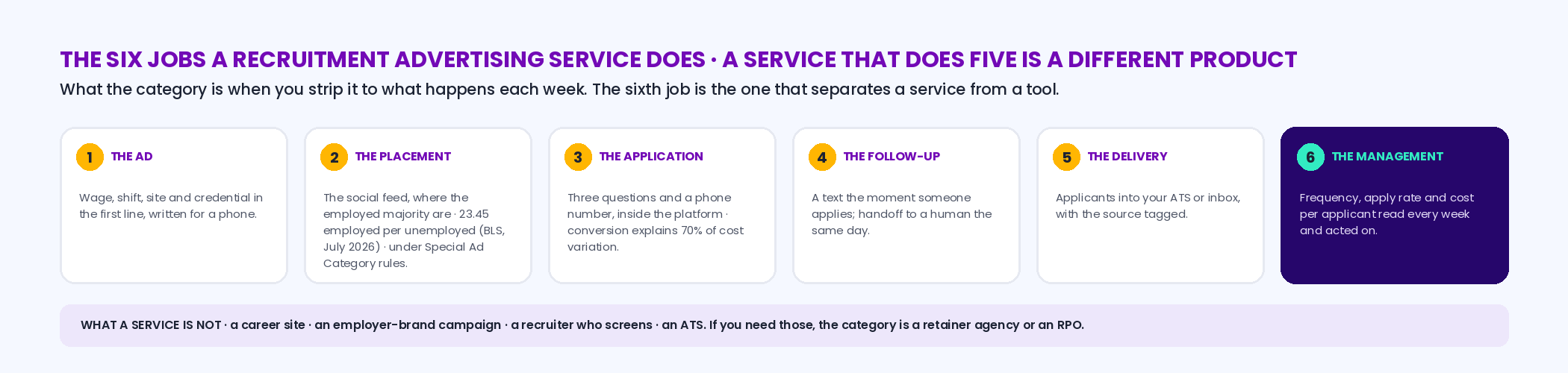
Before signing anything, name the kind of firm you are talking to. Six different products are sold under one label, and recruitment marketing agency sets them side by side so a proposal can be read for what it actually is.
The first 90 days, as a dated sequence
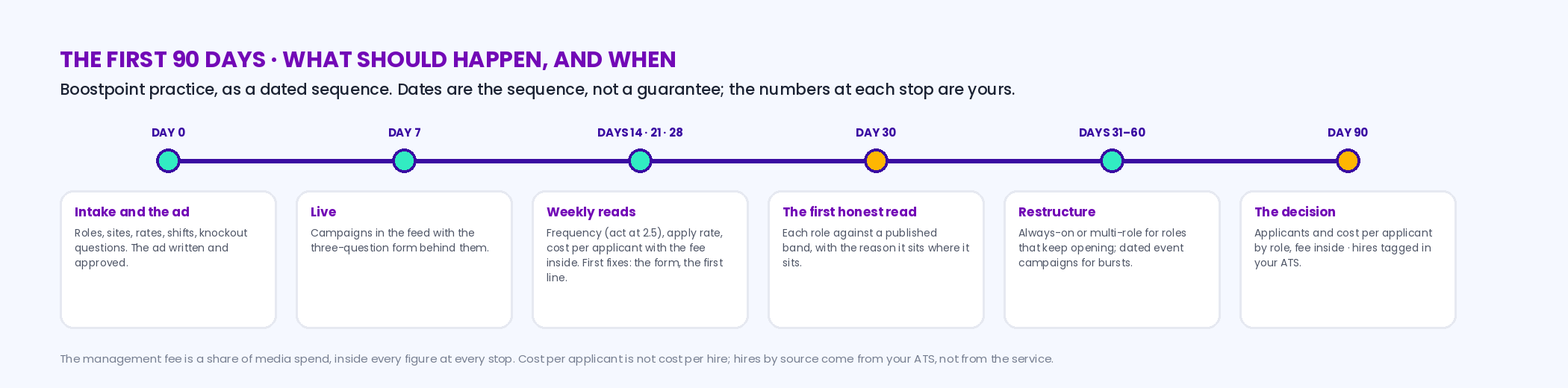
This is what the calendar should look like, and if a proposal can't put dates on it, ask why. Week one: the intake — roles, sites, rates, shifts, the knockout questions, where applicants should land — and the ad written and approved; the campaign is live by day seven, and a service that needs a month to launch is building something you didn't ask for. Weeks two to four: the campaign runs, and someone reads it weekly: frequency (our operating rule is to act when a campaign passes 2.5 — widen the audience, change the creative, or rest it — because in the benchmark cost per applicant climbs from a median $7.85 under a frequency of 1.5 to $26.78 above 4.0), apply rate, and cost per applicant with the fee inside; the first fixes are always the form and the first line. Day 30: the first honest read — enough campaign-months to compare each role against a published band — and the conversation about which roles are cheap, which are expensive, and why. Days 31 to 60: restructure — the roles that keep opening move to an always-on or multi-role structure (a median $9.83 per applicant across 46 multi-role campaigns in the benchmark against $14.45 for single-role), and a burst of hires gets a dated event campaign ($8.02, 21% apply, 78 campaigns). Day 90: the decision, on your own numbers — applicants by role, cost per applicant by role with the fee inside, and the hires your ATS tagged to the channel — which is the only cost per hire that exists, and it's yours.
Interactive
90-day expectations planner — a start date and a monthly media budget in; the dated milestones and an illustrative applicant range out
Nothing is stored or sent — this runs in your browser. The milestones are Boostpoint practice; the applicant range divides your media by the benchmark's median and volume-weighted figures and is illustration, not a forecast.
What you should be handed, every week and at day 30
A recruitment advertising service is a reporting relationship as much as an advertising one, and the reports tell you whether the service is doing the sixth job. Weekly: applicants by campaign, apply rate (applications ÷ clicks), frequency, and cost per applicant with the management fee inside, so the number on the report is the number on the invoice. At day 30: each role against a published band, with the reason it sits where it sits. And from your side, the one report the service can't produce: hires tagged by source in your ATS, which is the only place a cost per hire can honestly come from. Our benchmark's bands are the reference we use: conversion under 5% ran a median $53.77 per applicant, 5–10% ran $23.13, 10–20% ran $11.11, 20–35% ran $4.41, over 35% ran $1.61, and 41% of all budget ran under 10%, producing 11% of applicants. Reading a funnel that way, metric by metric, is on recruiting analytics.
| Figure | When | Read it against | What a bad number means |
|---|---|---|---|
| Applicants by campaign | Weekly | A normal campaign: 20 a campaign-month on a median $334 | Reach or the form; look at the next two rows |
| Apply rate (applications ÷ clicks) | Weekly | The bands: under 5% $53.77 … over 35% $1.61; conversion explains 70% of cost variation | The form is long, the wage is hidden, or the reply is slow — fixable in a day |
| Frequency | Weekly | Act at 2.5; median cost climbs from $7.85 under 1.5 to $26.78 above 4.0; 33% of budget ran above 3.0 | The audience is exhausted — widen, change creative, or rest |
| Cost per applicant | Weekly; by role at day 30 | $13.88 median campaign, $8.02 volume-weighted, $2.91–$66.45 at the tenth and ninetieth percentiles | Usually the two rows above; sometimes a role that is expensive everywhere (credentialed, saturated) |
| Structure | Day 30–60 | Event-driven $8.02 · multi-role $9.83 · single-role $14.45 | The always-on role is running as a one-off ad, or the burst has no date |
| Hires tagged by source | Yours, from your ATS, at day 90 | Nothing of ours — this is the number we can't produce | Applicants arrive and nobody calls; the service delivered and the process didn't |
What day 30 looks like — the honest range
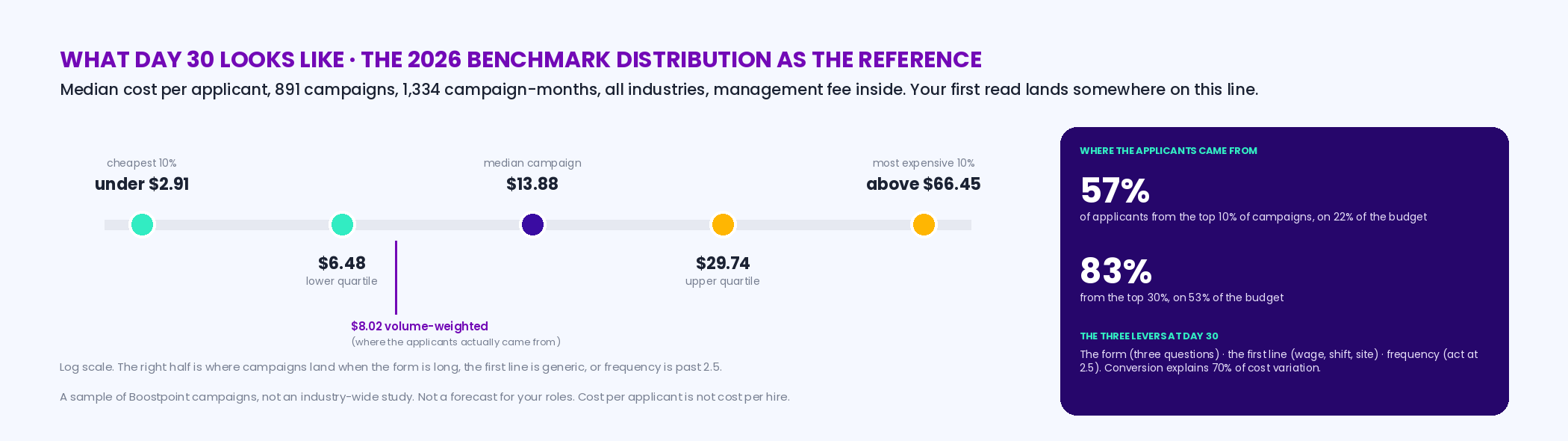
The most useful thing a service can tell you at day 30 is where your roles sit in a distribution it publishes, including the expensive end. Ours: across 891 campaigns and 1,334 campaign-months, the cheapest tenth ran under $2.91 per applicant, the lower quartile $6.48, the median campaign $13.88, the upper quartile $29.74, and the most expensive tenth above $66.45, with a volume-weighted average of $8.02 because volume concentrates in cheap, high-throughput frontline roles. That spread is the point: a high-volume warehouse or caregiver role with a short form lands near the bottom; a credentialed role with a long form and a small audience lands near the top, and the top is not a failure of the service so much as a description of the role. What the top 10% of campaigns did differently is mostly measurable — they produced 57% of all applicants on 22% of the budget, and the top 30% produced 83% on 53% — and it comes back to the form, the first line and the frequency discipline, which a service should have fixed by day 30 and should be able to show you. The sector and role cuts are on the benchmark.
How the service is priced — ours, stated plainly
The category has several fee models, and the outsourced page explains each with third-party ranges. Ours is the simplest to check: you pay a product subscription, priced on job volume, plus the ad spend, recommended at a minimum of $750 a month per job category, on one bill through Boostpoint; every figure we publish — the $13.88 median, the $8.02 volume-weighted average, the $334 normal campaign — already includes campaign management, so the report and the invoice agree. The subscription, and the ad budget per job category, is quoted on the demo where we can see your roles. Whatever service you're evaluating, the decoder below puts its quote on one line — an all-in month, and an all-in cost per applicant at the applicant count you expect — so a percentage, a retainer and a per-applicant fee can be compared.
Interactive
Quote decoder — any service's quote (a percentage of media, a retainer, a per-applicant fee, or a mix) into an all-in month and an all-in cost per applicant
Nothing is stored or sent — this runs in your browser. Every field is the quote you were given; the percentage field is blank on purpose, so no vendor's number is pre-filled, ours included.
Red flags, from inside the category
Five things to walk away from, because we've seen what they do to a client's numbers. A cost per applicant quoted without the fee. A media-only figure with the fee added on the invoice makes every report a fiction; ask which number the invoice will match. A cost per hire promised from ad data. No advertising service has hire attribution; a figure built from an assumed ratio is a sales number, and we won't produce one for our own channel. An ad account you don't own. If the campaigns live in the vendor's account, so does your history, your audiences and your leverage. A long launch. A frontline campaign should be live in a week; a month means a deliverable you didn't need. Applicants delivered nowhere. If the service can't put applicants into your ATS or inbox with the source tagged, you'll never know which channel produced which hire, and neither will they. The one thing not on this list is a quote-only price: that is normal in the category, and the questions that turn it into a number are on the outsourced page.
When not to buy a recruitment advertising service
Honestly, four cases. A salaried, title-searched role, where the candidate has a profile and searches by title; a board or LinkedIn finds them and a feed campaign mostly won't (the boards, graded). A shift that is uncovered tonight, which is an agency's or an app's problem; a campaign produces applicants over days. A single hire with nobody to call back and a twelve-field form, because applicants nobody calls are wasted and the service will look expensive for a reason that isn't the service. And a marketing team with the hours and the discipline to run Meta's Ads Manager themselves — the platform has no fee to use, the Special Ad Category rules are public, and the only thing a service adds is the six jobs done by someone who does them every day; the calculator on our alternatives page prices those hours against a fee you enter.
Frequently asked questions
What is recruitment advertising?
Recruitment advertising is paid promotion of a specific job to people who are not already on your careers page: the ad, the place it runs and the application it sends people to. It differs from a job posting, which waits to be found, and from recruitment marketing, which also covers employer brand, career site and follow-up. For hourly roles it is mostly paid social ads with a short application.
What does a job advertising company do?
A job advertising company buys and manages paid placement for your open jobs. The label covers four businesses: job-board and aggregator advertising (sponsored listings, usually per click), programmatic distribution (your job feed turned into ads across many sites), social job advertising (ads in the feed where employed workers are), and full-service agencies (creative and strategy on a retainer or a percentage of media). Ask which one you are buying and whether the quoted cost per applicant includes the fee.
What do recruitment advertising services do?
Six jobs: write the ad with the wage and shift in the first line; place it where the people you want are — for hourly and frontline roles, the social feed under Meta's Special Ad Category rules; build a three-question application; follow up by text and hand off the same day; deliver applicants into your ATS with the source tagged; and manage the campaign weekly on frequency, apply rate and cost per applicant. Not a career site, an employer-brand campaign, a screening recruiter, or an ATS.
How long does it take a recruitment advertising service to produce applicants?
Live within a week of intake, applicants in the first days after launch, and a first honest read at day 30 when there are enough campaign-months to compare each role against a band. A service that takes a month to launch is building something you didn't ask for. The 90-day sequence on this page is the one we run.
What does managed recruitment advertising cost?
By fee model: a percentage of media, a retainer, a per-applicant fee, or a mix; the models and third-party ranges are on our outsourced recruitment marketing page. Boostpoint's is a product subscription plus ad spend, on one bill — the subscription on job volume, the ad spend at a $750 a month minimum per job category — with campaign management inside every figure we publish: $13.88 median and $8.02 volume-weighted cost per applicant across 891 campaigns. The subscription is quoted on the demo; the worked examples are on the pricing page. The decoder on this page puts any quote on one line.
What reports should a recruitment advertising agency give me?
Weekly: applicants by campaign, apply rate, frequency, and cost per applicant with the fee inside, so the report matches the invoice. At day 30: each role against a published band with the reason. What no agency can give you is hires by source — that comes from your ATS, and it's the only cost per hire there is.
What is a good cost per applicant from recruitment advertising?
It depends on the role, and any service should show you the range, not just the low end. In our 2026 benchmark the median campaign ran $13.88 per applicant, the cheapest tenth under $2.91 and the most expensive tenth above $66.45, with a volume-weighted average of $8.02; conversion explains 70% of the variation. A credentialed role with a small audience lands near the top and that is a description of the role, not a failure.
Can a recruitment advertising service give me a cost per hire?
Not honestly. Advertising data has no hire attribution — the service sees applications, not starts. Any cost per hire it quotes is an assumed ratio; ask whether they tracked the hires or assumed them. Your ATS, with the source tagged, is where a real cost per hire comes from, and a good service delivers applicants there so you can compute it.
Recruitment advertising agency vs doing it in-house — which is better?
In-house wins when you have a marketer with the hours and the discipline to read frequency and apply rate weekly and act on them; Meta's platform has no fee to use. A service wins when nobody has those hours, when the roles keep opening, or when you want the six jobs done by people who do them every day. Price your hours against the subscription you're quoted — the calculator on our alternatives page does it — and decide on the number.
How is Boostpoint different from other recruitment advertising services?
Mostly in what we publish and refuse to publish: a benchmark of 891 campaigns and the expensive end shown; no cost per hire, ever; a stated pricing model — a subscription plus ad spend, on one bill; and a page that lists who we're wrong for. The six jobs are the category; the honesty is the difference we can prove.
See the 90 days on your roles
We'll walk the sequence with your roles and sites in view — the ad, the placement, the form, the follow-up, the delivery, the weekly management — quote the fee plainly, and show you where roles like yours landed in the benchmark, expensive end included.
Book a DemoBoostpoint figures come from the 2026 Social Job Advertising Benchmark — 891 campaigns and 1,334 campaign-months across 15 role families: $13.88 median cost per applicant, $8.02 volume-weighted average, cheapest 10% $2.91, lower quartile $6.48, upper quartile $29.74, most expensive 10% $66.45; a normal campaign $334 a month, 20 applicants, 6,061 reached; apply-rate bands under 5% $53.77, 5–10% $23.13, 10–20% $11.11, 20–35% $4.41, over 35% $1.61, conversion explaining 70% of cost variation, 41% of budget under 10% producing 11% of applicants; frequency bands from $7.85 under 1.5 to $26.78 above 4.0, 33% of budget above 3.0, the rule to act at 2.5; structures event-driven $8.02 (21%, 78), multi-role $9.83 (12%, 46), single-role $14.45 (18%, 1,210); top 10% of campaigns 57% of applicants on 22% of budget, top 30% 83% on 53%. BLS Employment Situation, July 2026. The 90-day sequence, the reporting expectations and the red flags are Boostpoint practice; the planner's applicant range is illustration on benchmark medians, not a forecast; the decoder computes on the quote the reader enters. Boostpoint is priced as a product subscription plus ad spend — the subscription on job volume, quoted on the demo; the ad spend at a $750 a month minimum per job category; one bill through Boostpoint — with campaign management inside every published figure. Cost per applicant is not cost per hire; we do not track hires and publish no cost-per-hire figure. A sample of Boostpoint campaigns, not an industry-wide study.