
Home Health Aide Recruiting: Hire the Credential, Make It, or Requalify It — What 42 CFR 484.80 Means for Your Pipeline
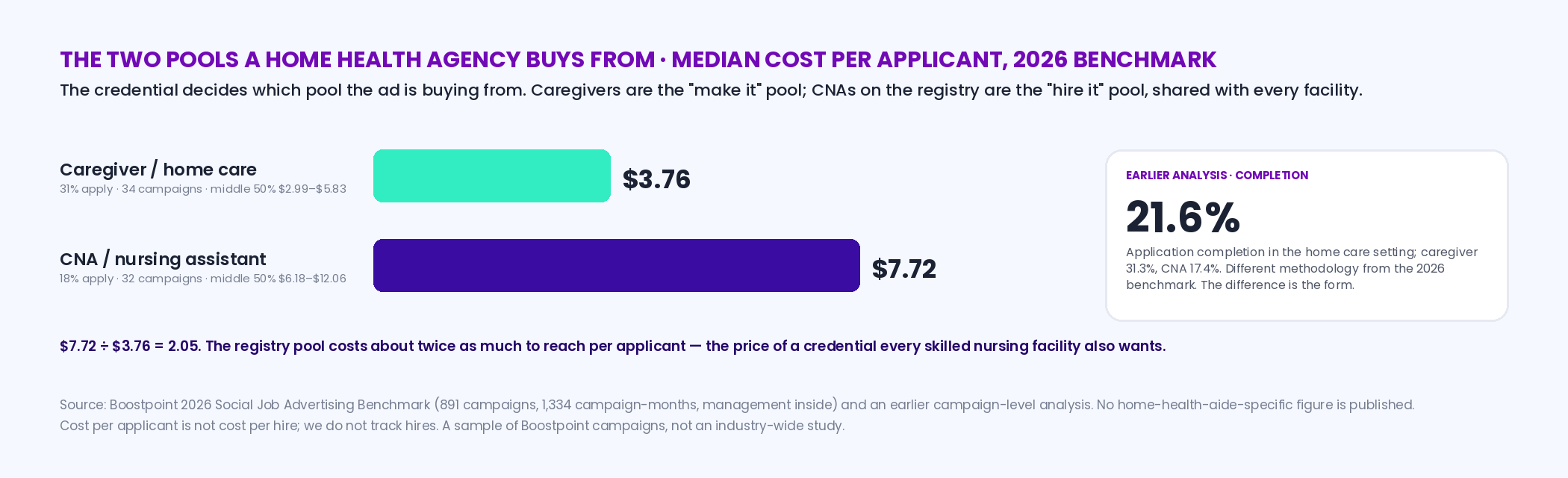
HHA recruiting is caregiver recruiting with a federal credential attached. A Medicare-certified home health agency can only send an aide who qualifies under 42 CFR 484.80 — a 75-hour training and competency program, a competency evaluation alone, or current good standing on the state nurse aide registry — which turns one labor pool into three pipelines: hire people who already hold it, train caregivers up to it in a program you run, and requalify aides whose credential lapsed after 24 months out. In Boostpoint's 2026 Social Job Advertising Benchmark, caregiver applicants ran $3.76 and CNA applicants $7.72; the credential decides which pool you're buying from.
Source: Boostpoint 2026 Social Job Advertising Benchmark — 891 Boostpoint-managed campaigns on Meta (1,334 campaign-months), 2026; costs are what advertisers paid for advertising only.
A note on who's writing this
Boostpoint runs social media job ads for home health and home care agencies — Gentiva and CenterWell among the Medicare-certified ones, Home Instead, Right at Home, Home Helpers, and Always Best Care franchises on the non-medical side — so the recruiting sections of this page describe what we sell. This page exists for one reason: the five caregiver pages on this site cover budgets, the funnel, agency fees, sourcing channels, and the job description, and none of them covers what makes a home health aide legally different from a caregiver. That difference is a federal regulation, quoted here as written, and it changes who you recruit and how. We are not compliance advisers; read the rule and your state's overlay before you build a program. We publish cost per applicant, never cost per hire.
What makes an HHA an HHA: the rule, as written
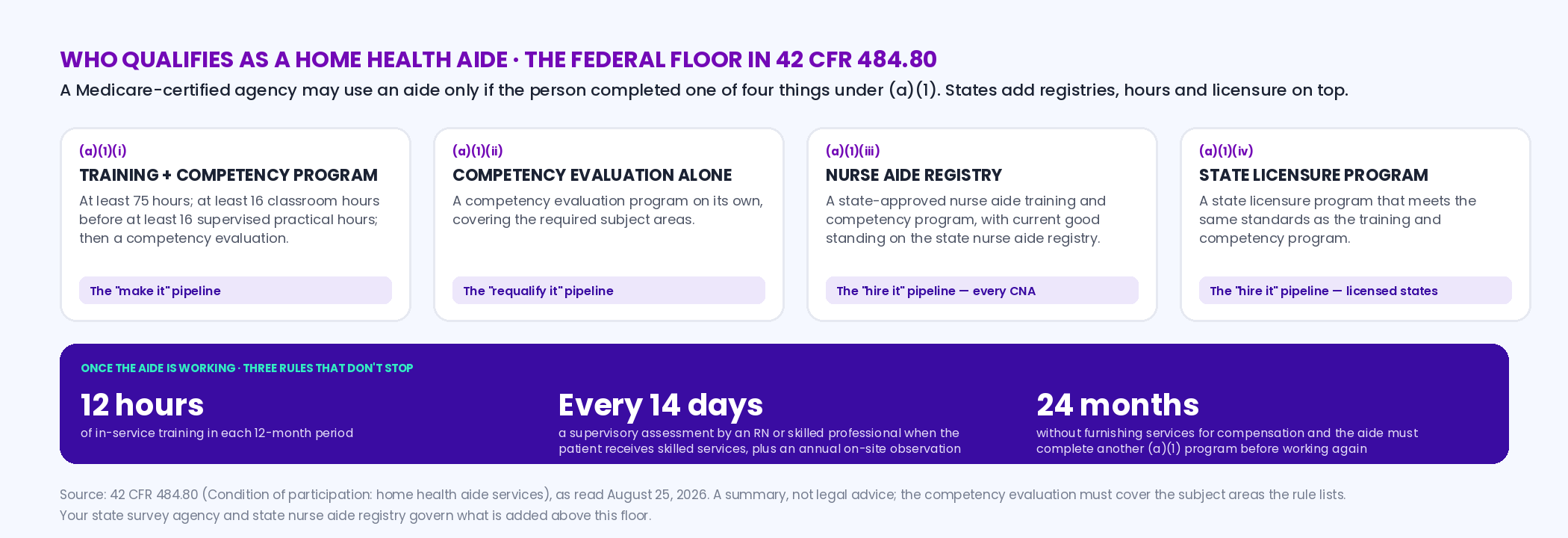
Under the Medicare Conditions of Participation, a home health agency may use an aide only if the person has completed one of four things (42 CFR 484.80(a)(1)): a training and competency evaluation program; a competency evaluation program on its own; a state-approved nurse aide training and competency program, with current good standing on the state nurse aide registry; or a state licensure program that meets the same standards. The training, where it applies, must total at least 75 hours, with at least 16 hours of classroom instruction preceding at least 16 hours of supervised practical training. Every aide must pass a competency evaluation before furnishing services. Once working, an aide must receive at least 12 hours of in-service training in each 12-month period; where the patient is receiving skilled services, a registered nurse or other skilled professional must complete a supervisory assessment of the aide's services no less often than every 14 days, plus an annual on-site observation. And an aide who has gone 24 consecutive months without furnishing services for compensation must complete another qualifying program before providing services again. States add their own registries, hours, and licensure on top; the federal floor is what every Medicare-certified agency shares.
Interactive
Qualification checker — does this applicant count as an HHA, and what would it take?
Nothing is stored or sent — this runs in your browser. Pick the applicant in front of you; the answer follows 42 CFR 484.80(a)(1) and is not legal advice. Your state may require more.
Based on 42 CFR 484.80(a)(1) and (b)–(d) as read August 25, 2026. The competency evaluation must cover the required subject areas; states may impose additional training hours, registries or licensure. Verify with your state survey agency and the state nurse aide registry before the first visit. Nothing here is a cost.
The market you're recruiting in
BLS counts 4,677,100 home health and personal care aides (2025), projects about 760,500 openings a year through 2035 on 18% growth, and puts median pay at $35,800 a year or $17.21 an hour (May 2025); 51% work in individual and family services and 23% for home healthcare services. On the Medicare side, MedPAC's March 2026 report counts over 12,000 home health agencies certified to participate in Medicare, serving about 2.7 million fee-for-service beneficiaries across 8.3 million 30-day periods in 2024, on $16.0 billion of FFS spending. And the workforce moves: Activated Insights' 2025 benchmarking report put caregiver turnover at 75%. The recruiting consequence of those numbers together is that the credentialed pool is small relative to the demand, it is shared with every skilled nursing facility (a CNA on the registry qualifies for both), and three in four of the people in it will change employers this year — which is why the credential, not the job, should organize the recruiting.
Three pipelines, one credential
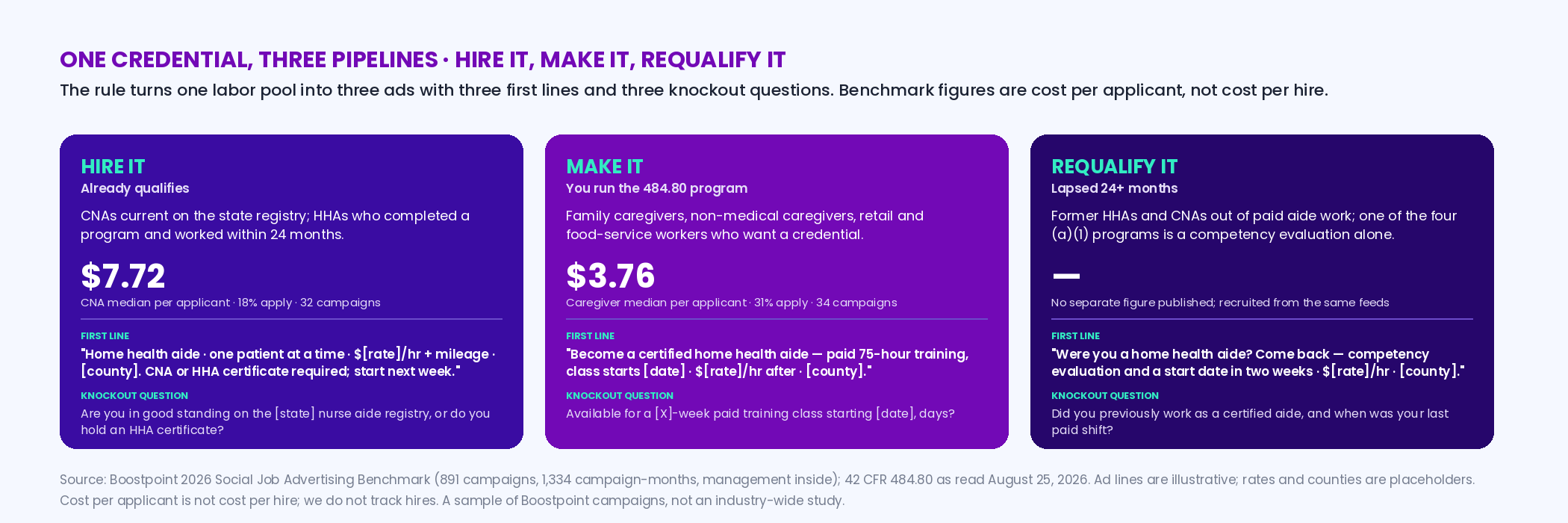
Hire it. The fastest pipeline is people who already qualify: CNAs in good standing on the state registry and aides who completed a program elsewhere and have worked since. They are also the most contested — a CNA is the person every skilled nursing facility and hospital in the county is recruiting, and our benchmark shows the price: CNA campaigns ran at a median $7.72 per applicant (18% apply rate, 32 campaigns) against $3.76 for caregivers (31%, 34 campaigns). The ad for this pipeline sells what home health has that a facility doesn't — one patient at a time, a car instead of a hall, a schedule built around the aide — and names the credential so the applicant self-selects. Make it. The largest pool by far is the 51% of aides in individual and family services and the caregivers with no formal training, and a Medicare-certified agency that runs its own 484.80 program can recruit from it: the ad sells the paid 75 hours and the credential the person leaves with, and the first line says "we train and certify." The cost of this pipeline is the program — an instructor, a classroom, sixteen supervised hours per aide — and the reward is a pool three times cheaper to reach and loyal to the agency that certified them. Requalify it. The pipeline nobody runs: former aides who left for retail or a family reason and have been out for 24 consecutive months. The rule doesn't send them back to 75 hours; it requires "another program as specified in (a)(1)," and one of those four is a competency evaluation alone. An agency that offers a competency evaluation and a start date reaches experienced people with a two-week path back.
| Pipeline | Who | Credential step before first visit | Benchmark pool figure | First line of the ad | Knockout question |
|---|---|---|---|---|---|
| Hire it | CNAs current on the registry; HHAs who completed a program and have worked within 24 months | Registry check or program certificate; your competency evaluation if required by policy | CNA $7.72 median per applicant, 18% apply (32 campaigns) | "Home health aide · one patient at a time · $[rate]/hr + mileage · [county]. CNA or HHA certificate required; start next week." | "Are you currently listed in good standing on the [state] nurse aide registry, or do you hold an HHA certificate?" |
| Make it | Family caregivers, non-medical caregivers, retail and food-service workers who want a credential | Your 484.80 program: at least 75 hours, 16 classroom before 16 supervised practical, competency evaluation | Caregiver $3.76 median per applicant, 31% apply (34 campaigns) | "Become a certified home health aide — paid 75-hour training, class starts [date] · $[rate]/hr after · [county]." | "Available for a [X]-week paid training class starting [date], days?" |
| Requalify it | Former HHAs out of paid aide work for 24+ consecutive months | Another qualifying program under (a)(1) — a competency evaluation program is one of the four | No separate figure published; recruited from the same feeds as the other two | "Were you a home health aide? Come back — competency evaluation and a start date in two weeks · $[rate]/hr · [county]." | "Did you previously work as a certified home health aide or CNA, and when was your last paid shift?" |
Interactive
Pipeline mix planner — how many aides each pipeline has to produce, and what the training program has to carry
Nothing is stored or sent — this runs in your browser. Enter aides needed a month and the share you expect to hire already credentialed; the rest is the make-it pipeline, sized as cohorts.
Arithmetic on your inputs. Program hours are the federal minimum under 42 CFR 484.80(b); states may require more. No cost is computed: applicants per hire and per trainee are yours, and cost per applicant is not cost per hire.
What the credential does to the ad and the form
A home health aide ad has to do one thing a caregiver ad doesn't: say which pipeline it's for. "Now hiring home health aides" reaches the credentialed and the uncredentialed alike, and the uncredentialed either apply and fail the registry check or don't apply because they assume they can't. Run the pipelines as separate ads with separate first lines — the credential-required ad, the we-train-and-certify ad, the come-back ad — and the knockout question on each form does the sorting: registry status, training availability, or last paid shift. The rest is the caregiver rulebook, which the earlier campaign-level analysis explains: application completion in the home care setting ran 21.6%, caregiver completion 31.3% and CNA 17.4%, and the difference is the form. Name, phone, the one knockout question, submit; the competency evaluation and the background check come after the offer, not before the tap. For the ad itself, the specifics an aide compares are the same ones on where to find caregivers — rate, mileage, hours, one patient at a time — and the agency-side channel that produces both pools is the one in our data: home care campaigns ran at $8.40 per applicant in that analysis, and caregiver campaigns at a median $3.76 in the 2026 benchmark.
Keeping the credential after the hire
Two of the rule's requirements are retention tools if you treat them that way. The 12 hours of in-service training each year is a fixed cost that most agencies deliver as a compliance chore; delivered as paid, scheduled skill days with a certificate at the end, it is the only structured contact many aides have with the agency all year. The 14-day supervisory assessment for aides on skilled cases is a nurse visit that can be a check-in or an audit, and aides know which. Against a 75% turnover rate, both are cheap. The turnover arithmetic itself — what a departure costs and how to read your own rate — is on caregiver turnover; the CNA version of the squeeze between facilities and home care is on CNA recruitment and the agency-versus-direct math on CNA staffing; budgets for the home care campaign are on home care agency recruiting; and the posting itself is the caregiver job description. A dated training-class open house — enrollment, registry checks, and the first classroom hours in one visit — is the event-driven structure that ran at a median $8.02 per applicant in the benchmark; the mechanics are on open house hiring events.
The caregiver pool is large and cheap to reach; the HHA credential is a 75-hour door. Own the door — hire through it, build it, and reopen it for the people who let it close.
Frequently asked questions
What qualifies someone as a home health aide under Medicare rules?
Under 42 CFR 484.80(a)(1), one of four things: a training and competency evaluation program (at least 75 hours, with at least 16 classroom hours before at least 16 supervised practical hours, plus a competency evaluation); a competency evaluation program alone; a state-approved nurse aide program with current good standing on the state nurse aide registry; or a state licensure program meeting the same standards. States may require more.
Can a CNA work as a home health aide?
Under the federal rule, a person who completed a state-approved nurse aide training and competency program and is currently in good standing on the state nurse aide registry qualifies. That makes every registered CNA a home health aide candidate — and every home health agency a competitor of the skilled nursing facilities recruiting the same registry. In our benchmark CNA applicants ran $7.72 median against $3.76 for caregivers.
How do you recruit home health aides?
By pipeline, with a separate ad for each: a credential-required ad for CNAs and working HHAs, a we-train-and-certify ad for caregivers and career-changers if you run a 484.80 program, and a come-back ad for former aides who lapsed. Each form asks one knockout question — registry status, class availability, or last paid shift — and nothing else before the offer. Reach them where working aides are: referrals, social feeds on a phone, and a dated training-class open house.
How long is home health aide training?
The federal minimum is 75 hours of combined classroom and supervised practical training, with at least 16 hours of classroom preceding at least 16 hours of supervised practical training, followed by a competency evaluation (42 CFR 484.80). Many states require more hours or their own certificate; check your state before advertising the program's length.
What happens if a home health aide stops working for two years?
If 24 consecutive months pass without the aide furnishing services for compensation, the aide must complete another qualifying program under 484.80(a)(1) before providing services again. One of the four qualifying programs is a competency evaluation on its own, which is why lapsed aides are a recruiting pipeline: experienced people with a short path back.
What ongoing requirements apply to home health aides?
At least 12 hours of in-service training in each 12-month period; for aides serving patients under skilled services, a supervisory assessment by a registered nurse or other skilled professional at least every 14 days, plus an annual on-site observation of each aide. Delivered well, both double as retention touchpoints against the sector's 75% turnover (Activated Insights, 2025).
What is the difference between a home health aide and a caregiver?
A caregiver or personal care aide provides non-medical help and, federally, needs no set training; a home health aide working for a Medicare-certified agency must meet 42 CFR 484.80 — the 75-hour program or registry standing, the competency evaluation, in-service hours and nurse supervision. BLS counts both together (4,677,100 jobs, median $17.21 an hour); the credential is the line between the two pools you recruit from.
What does it cost to recruit home health aides?
We publish no HHA-specific figure. In the 2026 benchmark, caregiver and home care applicants ran a median $3.76 (31% apply rate, 34 campaigns) and CNA applicants $7.72 (18%, 32 campaigns); an earlier analysis put home care campaigns at $8.40 per applicant with 21.6% completion. Which pool the ad buys from depends on the pipeline. Cost per applicant is not cost per hire.
How do you hire in-home caregivers?
Run the three pipelines above as three separate ads rather than one: already-credentialed aides, people with informal or family caregiving experience who need the training, and career changers from adjacent frontline work. They respond to different messages and convert at different rates, and a single ad aimed at all three reaches none of them well. Then make the credential path explicit in the ad — who pays for the training, how long it takes, and whether they are paid during it.
What makes hiring in-home caregivers different from facility hiring?
The job is solo and the territory is the schedule. A caregiver in a facility has colleagues down the hall; a caregiver in a client's home is alone with the client, driving between visits, and the difference that decides whether someone takes the job is usually the geography and the hours rather than the rate. Postings that state the area, the visit pattern and whether mileage is paid consistently outperform postings that lead with compassion language.
How do I check the home health aide registry before hiring?
Start with your state’s nurse aide registry, which every state must keep under 42 CFR 483.156 and which may also list home health aides who passed a state-approved competency evaluation. Confirm the person is listed in good standing, and read any finding of abuse, neglect or misappropriation of property, which the registry must record. Current good standing on that registry is one of the four ways an aide qualifies under 42 CFR 484.80. Some states keep a separate home care worker registry, so ask your state survey agency, and run an OIG exclusion check too.
What is the cost per hire in home health?
There is no honest single figure, because cost per hire is built from your own numbers. The advertising part is your cost per applicant divided by your applicant-to-hire rate. Boostpoint's 2026 Social Job Advertising Benchmark measures only the first of those: the Caregiver / home care family ran a median $3.76 per applicant and the CNA / nursing assistant family $7.72, campaign. Your ATS supplies the hire rate. Then add what home health carries that most employers do not: background checks, the competency evaluation, orientation, and for the train-your-own pipeline the 75-hour program under 42 CFR 484.80, plus recruiter and scheduler time. Our cost per hire calculator adds those lines up on your own figures. Cost per applicant is not cost per hire.
Run the three pipelines as three ads
We'll write the credential-required, we-train, and come-back campaigns with a one-question form behind each, run them where working aides are, and show you the home health and home care campaigns closest to yours.
Book a DemoBoostpoint figures come from the 2026 Social Job Advertising Benchmark — 891 campaigns and 1,334 campaign-months: caregiver / home care median cost per applicant $3.76, middle 50% $2.99–$5.83, blended $3.87, 31% apply rate, 34 campaigns; CNA / nursing assistant $7.72, 18%, 32; event-driven $8.02, 21%. Earlier campaign-level analysis (different methodology): home care setting $8.40 per applicant and 21.6% completion; caregiver completion 31.3%, CNA 17.4%. No home-health-aide-specific figure is published. Regulatory text is 42 CFR 484.80 as read August 25, 2026, summarized, not legal advice; workforce figures are BLS's, MedPAC's (March 2026 report, chapter 8) and Activated Insights', attributed in place. Customers are named with permission; the pipeline framing, ad lines and planner are Boostpoint's practice, not measured results. Cost per applicant is not cost per hire; we do not track hires and publish no cost-per-hire figure. A sample of Boostpoint campaigns, not an industry-wide study.