
CNA Staffing: Agency vs. Direct Hiring, With the Arithmetic Nobody Prints
CNA staffing through an agency costs what the bill rate says; hiring CNAs directly costs what the wage, the credential, and the recruiting add up to. The two published anchors: BLS puts the median nursing assistant wage at $18.96 an hour, and Minnesota caps what a nursing facility may be charged for an agency CNA at $43.83 — 2.31 times the median wage, before holidays. On the direct side, Boostpoint's 2026 Social Job Advertising Benchmark puts a CNA applicant at a median $7.72, with the applicants-per-hire ratio yours to supply. This page shows both routes, the fees in between, and when each one is right.
Source: Boostpoint 2026 Social Job Advertising Benchmark — 891 Boostpoint-managed campaigns on Meta (1,334 campaign-months), 2026; costs are what advertisers paid for advertising only.
A note on who's writing this
Boostpoint runs social media job ads for skilled nursing, senior living, hospitals, and home care employers. The direct route on this page is what we sell, and the agency route is what we compete with for the same budget, so read the comparison knowing that. Two commitments in exchange: every agency figure here is a published legal cap, a wage statistic, or a fee range attributed to its source — never an estimate of what a particular agency charges — and every direct-route figure is our own benchmark, labeled, with the one number we don't have said out loud: we publish cost per applicant, not cost per hire, because we don't track hires. How to recruit CNAs — the ad, the squeeze between hospitals and home care — is on CNA recruitment; this page is the money.
What a CNA is, and why the credential matters to the cost
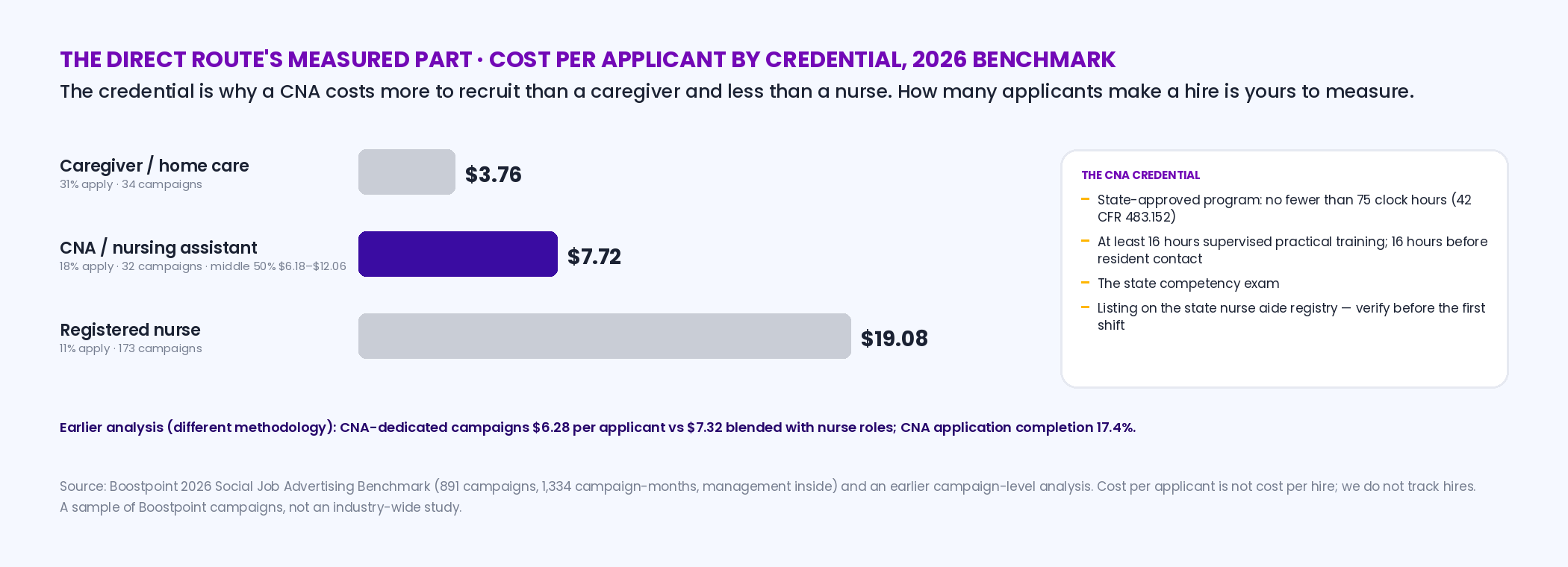
BLS's Occupational Outlook Handbook counts 1,441,500 nursing assistant jobs in 2024 (1,495,400 with orderlies), projects 2% growth through 2034 with about 211,800 openings a year, and puts median pay at $39,530 a year or $18.96 an hour in May 2024, from under $31,390 at the tenth percentile to over $50,140 at the ninetieth. Skilled nursing facilities employ 35% of nursing assistants and hospitals 33%; nights, weekends, and holidays are part of the job. The credential is the recruiting fact: a CNA must complete a state-approved program — federal rules set the floor at no fewer than 75 clock hours, including at least 16 hours of supervised practical training (42 CFR 483.152) — pass the state competency exam, and be listed on the state registry. That credential is why a CNA costs more to recruit than a caregiver (our benchmark: $7.72 against $3.76 per applicant) and less than a nurse ($19.08), and it is also why an agency can bill what it bills: the registry is finite in any county.
The case for the agency first
A per diem agency exists for the shift you cannot cover tonight, and a facility with no bench of its own should keep a contract open. AHCA puts CNA turnover in skilled nursing at 42.3%, the highest of any tracked position; at that rate a 40-aide facility replaces roughly seventeen aides a year, and some of those gaps land on a Saturday. The agency carries the credentialing, the payroll, the workers' comp, and the no-show risk, and bills a rate that includes all of it. For a census spike, a survey week, a unit reopening, or a facility whose own recruiting takes six weeks to produce a start, the bill rate is the price of coverage that exists. The honest boundary is the one the arithmetic below draws: an agency is priced per shift for coverage, and it becomes expensive at exactly the point where the shifts are predictable — the standing pattern of nights, weekends, and vacancies that a facility could have staffed itself. The float-pool version of that argument is on PRN staffing.
What the agency bills: the two states that publish a ceiling
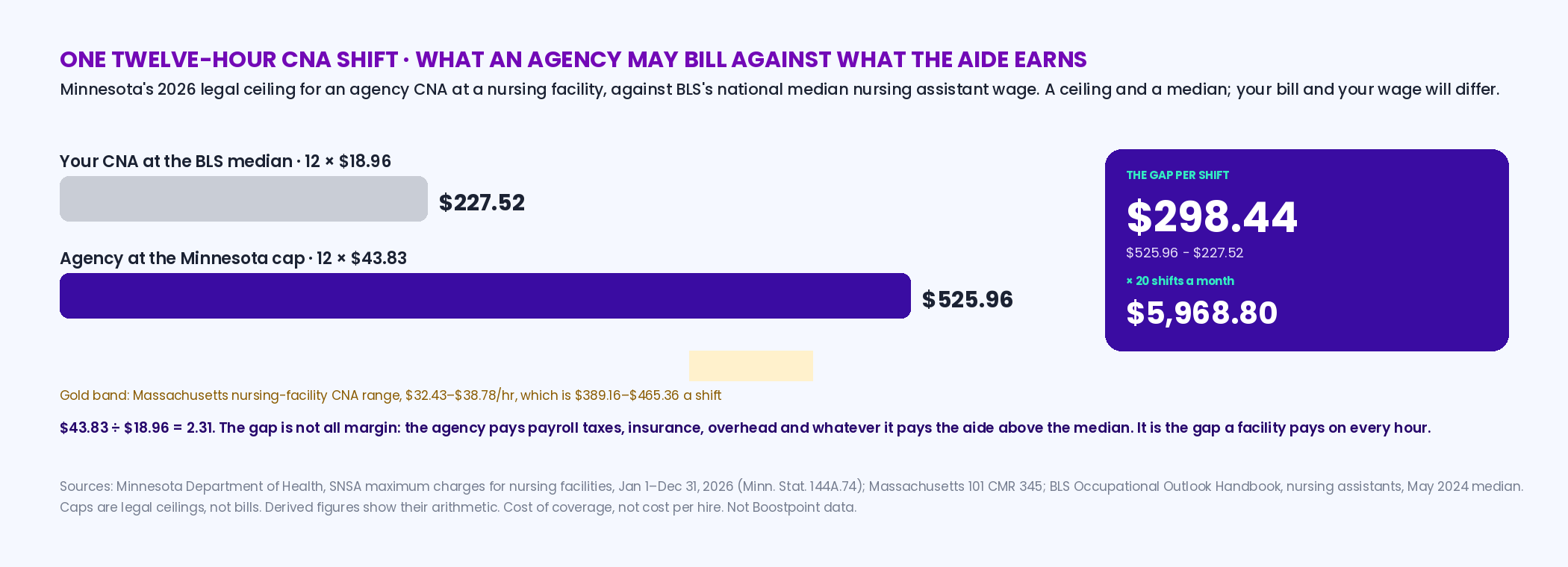
Most agency rates are private. Two states publish legal maximums for nursing facilities, and they are the best public evidence of what CNA staffing through an agency costs. Minnesota's Department of Health caps the charge for an agency CNA at a nursing facility at $43.83 an hour for 2026, and $76.26 on a holiday, under Minn. Stat. 144A.74. Massachusetts, under 101 CMR 345, sets nursing-facility CNA rates by region and shift from $32.43 to $38.78 an hour (weekday days $32.43 to $37.22). Against BLS's national median wage of $18.96, the Minnesota cap is $43.83 ÷ $18.96 = 2.31 times what the median aide earns. The gap is not all margin — it covers the agency's payroll taxes, insurance, overhead, and whatever it pays the aide above the median to take the shift — but it is the gap a facility pays on every hour, and it is the number to hold in mind for the rest of this page. Both caps are ceilings, not bills; your quote will be below them or the contract is illegal in those states. The full cap tables and the nurse-side version are on nurse staffing agency costs.
| Figure | Amount | What it is | Source |
|---|---|---|---|
| Median nursing assistant wage | $18.96 / hr ($39,530 / yr) | National median, May 2024; lowest tenth under $31,390, highest tenth over $50,140 | BLS Occupational Outlook Handbook |
| Minnesota agency CNA maximum, nursing facility | $43.83 / hr · holiday $76.26 | Legal ceiling on what an agency may charge, calendar 2026 | Minnesota Department of Health, Minn. Stat. 144A.74 |
| Massachusetts agency CNA rates, nursing facility | $32.43–$38.78 / hr by region and shift | Regulated maximum rates; weekday days $32.43–$37.22 | Massachusetts 101 CMR 345 |
| Cap ÷ median wage | 2.31× | $43.83 ÷ $18.96 — arithmetic, not a markup claim; the agency pays taxes, insurance, overhead and a premium out of the gap | Derived |
| Twelve-hour shift, cap vs median wage | $525.96 vs $227.52 → $298.44 | 12 × $43.83 and 12 × $18.96; the difference per shift at the ceiling | Derived |
| Twenty agency shifts a month at that gap | $5,968.80 | 20 × $298.44 — the monthly premium if every shift billed at the Minnesota cap and paid at the national median | Derived, assumptions stated |
Interactive
Shift-cost comparer — your agency bill rate against your own CNA, fully loaded
Nothing is stored or sent — this runs in your browser. Defaults: the Minnesota 2026 cap, the BLS median wage, and BLS's 30.1% benefits share of private-industry compensation (ECEC, March 2026). Replace all four with yours.
Cost of coverage, not cost per hire. The direct figure is wages grossed up for your benefits share and excludes training hours, the registry and exam fees, overtime, and the empty shifts while you recruit — which the agency's rate covers. Overtime past 40 hours is straight time here. Sources: MN Department of Health (2026 SNSA maximum), BLS OOH (May 2024 wage), BLS ECEC (March 2026). Your inputs, your arithmetic.
Three fee types, decoded
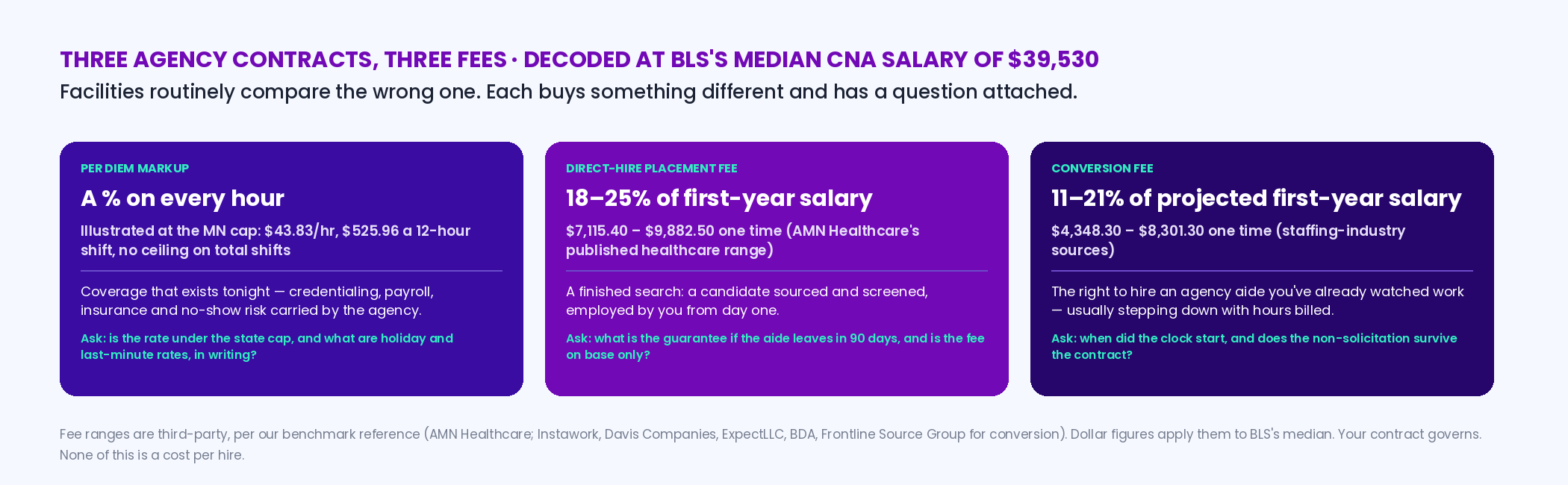
"Agency" is three different contracts, and facilities routinely compare the wrong one. A per diem or temp markup is the bill rate above — a percentage on every hour, with no ceiling on total shifts. A direct-hire placement fee is a one-time percentage of first-year salary for a candidate the agency found and you employ from day one; AMN Healthcare's published range for healthcare direct hire is 18–25%, which on BLS's median CNA salary of $39,530 is $7,115.40 to $9,882.50 per hire. A conversion fee is what you pay to take an agency aide onto your own payroll, usually a percentage that steps down with hours already billed; the reference range across staffing sources is 11–21% of projected first-year salary, or $4,348.30 to $8,301.30 at that median. Each buys something different — coverage, a finished search, or a person you've already watched work — and each has a question attached: what happens to the fee if the aide leaves in ninety days, whether the agency's aides are barred from applying to you directly, and whether the conversion clock starts at the first shift.
Interactive
Fee decoder — what each contract costs at your wage, and what to ask before signing
Nothing is stored or sent — this runs in your browser. Enter your CNA's annual salary; the ranges are the published third-party ranges, applied.
Fee ranges: healthcare direct hire 18–25% (AMN Healthcare); conversion 11–21% of projected first-year salary (staffing-industry sources per our benchmark reference). The per diem figure is your bill rate × your hours — a bill, not a markup claim. None of this is a cost per hire, and your contract terms govern.
The direct route: what recruiting a CNA yourself involves
Hiring directly means paying the wage and carrying everything the agency carried — the credential check against the state registry, onboarding, the empty shifts while you recruit — plus the recruiting itself. That last cost is the one we measure. In the 2026 benchmark, CNA and nursing assistant campaigns produced applicants at a median $7.72 (middle 50% $6.18–$12.06; blended $8.17) with an 18% apply rate across 32 campaigns. An earlier campaign-level analysis (different methodology) found the same thing our CNA recruitment page argues: campaigns dedicated to the CNA role ran at $6.28 per applicant against $7.32 for campaigns that blended CNAs with nurses, because a single ad can state the pay, the shift, and the ratio that a CNA compares. Application completion for CNAs ran 17.4% in that analysis — better than an RN's 12.4%, worse than a caregiver's 31.3%, and entirely a function of the form. What we can't give you is the number the agency comparison wants: how many applicants become a hire depends on your interview show rate, your offer acceptance, and your registry check, and it is different at every facility. So the direct route is stated the honest way — a cost per applicant you can verify, multiplied by an applicants-per-hire ratio you own — and it is never stated as a cost per hire.
Which route, when
| Situation | Route | Why | The number that decides it |
|---|---|---|---|
| A call-out tonight, no bench | Per diem agency | Coverage that exists beats coverage that's cheaper | The bill rate — and whether a contract is already signed |
| Survey week, census spike, unit reopening | Per diem agency for the surge; direct for what's left after | Priced for surges; expensive once the surge is a pattern | How many of the shifts recur next month |
| A standing pattern of open shifts | Direct — a PRN pool plus a full-time pipeline | At the Minnesota cap the gap is $298.44 a shift; predictable shifts are the ones you could have staffed | Gap per shift × shifts a month, from the comparer above |
| One hard-to-fill full-time role, no recruiting capacity | Direct-hire placement fee, or a first campaign | A one-time 18–25% fee against a campaign you'd have to run yourself | $7,115.40–$9,882.50 at the median salary vs your applicants-per-hire ratio × $7.72 |
| An agency aide you want to keep | Conversion fee | You've watched the work; the fee is the finder's price | 11–21% of first-year salary, and where the clock started |
| Forty-plus CNAs on payroll and 42.3% turnover | Direct, always-on | Seventeen replacements a year is a system, not an event | Applicants a month needed vs the median campaign-month's 20 |
Two related pages complete the picture. If the role you're actually filling is a home care aide or caregiver rather than a certified CNA, the credential and the cost are different, and the comparison is on caregiver staffing agency costs. For the cross-role view of healthcare agency fees against direct recruiting, see healthcare staffing costs. And the posting itself — duties, the certification line, pay — is the CNA job description.
An agency is priced for the shift you can't cover. A predictable shift is one you could have staffed — and the gap on every hour is the budget for doing it.
Frequently asked questions
How much does CNA staffing through an agency cost?
Most agency rates are private, so the best public evidence is the two states that cap them. Minnesota limits what a nursing facility may be charged for an agency CNA to $43.83 an hour in 2026 ($76.26 on holidays); Massachusetts sets nursing-facility CNA rates of $32.43 to $38.78 by region and shift. Against BLS's median nursing assistant wage of $18.96, the Minnesota cap is 2.31 times the wage. Your quote should sit below the cap in those states; elsewhere, ask for the bill rate in writing and compare it to your loaded wage.
Is it cheaper to hire CNAs directly or use a staffing agency?
Per shift, direct is cheaper once the CNA exists: at the Minnesota cap a twelve-hour agency shift bills $525.96 against $227.52 in wages at the BLS median, a $298.44 gap, or $5,968.80 across twenty shifts a month. What direct adds is the recruiting, credentialing and vacancy cost the agency's rate includes. Direct wins for predictable, recurring shifts and standing turnover; the agency wins for tonight's call-out and short surges.
What does it cost to recruit a CNA?
In our 2026 benchmark, CNA and nursing assistant campaigns produced applicants at a median $7.72 (middle 50% $6.18–$12.06; 18% apply rate; 32 campaigns). An earlier analysis found campaigns dedicated to the CNA role ran at $6.28 per applicant against $7.32 when blended with nurse roles. How many applicants make a hire is yours to measure; cost per applicant is not cost per hire.
What is a direct-hire placement fee for a CNA?
A one-time fee, usually a percentage of first-year salary, for a candidate the agency found and you employ from day one. AMN Healthcare's published healthcare range is 18–25%, which on BLS's median CNA salary of $39,530 is $7,115.40 to $9,882.50 per hire. Ask what happens to the fee if the aide leaves within ninety days.
What is a temp-to-perm conversion fee?
What you pay to move an agency aide onto your own payroll — typically a percentage of projected first-year salary that steps down with hours already billed. Staffing-industry sources put the range at 11–21%, or $4,348.30 to $8,301.30 at the median CNA salary. Ask when the clock starts and whether the aide is barred from applying to you directly.
How do you hire CNAs fast?
From a bench you already built: a PRN pool sized to your call-out rate, a dated hiring day with registry checks done on site, and a one-minute application. In our benchmark, campaigns built around a date ran at $8.02 per applicant with a 21% apply rate against $14.45 for a single-role posting. For tonight, the agency; for next month, the pipeline. The how-to is on our CNA recruitment page.
What certification does a CNA need?
A state-approved nurse aide training program — federal rules require no fewer than 75 clock hours, including at least 16 hours of supervised practical training (42 CFR 483.152) — a passing score on the state competency exam, and listing on the state nurse aide registry. States may require more hours. Verify the registry before the first shift whether you hire directly or through an agency.
Why is CNA turnover so high?
AHCA puts CNA turnover in skilled nursing at 42.3%, the highest of any tracked position. Structurally, a certified CNA is qualified for every caregiver job in the market, many with easier schedules, while hospitals pull the same people upward with better pay. The staffing consequence is that a 40-aide facility replaces roughly seventeen aides a year, which is why the direct route has to be always-on rather than a posting per vacancy.
See what the gap on every hour would buy you
We'll run the CNA campaign and the PRN-pool campaign with a one-minute application behind them, report cost per applicant, and show you the skilled nursing and senior living campaigns closest to yours.
Book a DemoBoostpoint figures come from the 2026 Social Job Advertising Benchmark — 891 campaigns and 1,334 campaign-months: CNA / nursing assistant median cost per applicant $7.72, middle 50% $6.18–$12.06, blended $8.17, 18% apply rate, 32 campaigns; caregiver / home care $3.76, 31%; registered nurse $19.08, 11%; event-driven $8.02, 21%; single-role $14.45, 18%. Earlier campaign-level analysis (different methodology): CNA dedicated campaigns $6.28 vs blended $7.32; application completion caregiver 31.3%, CNA 17.4%, RN 12.4%. Third-party figures are BLS's (Occupational Outlook Handbook, May 2024 wages; Employer Costs for Employee Compensation, March 2026), the Minnesota Department of Health's (2026 SNSA maximum charges, Minn. Stat. 144A.74), Massachusetts 101 CMR 345, 42 CFR 483.152, AHCA's, and AMN Healthcare's and staffing-industry sources' published fee ranges, attributed in place; derived figures show their arithmetic and assumptions. Agency caps are legal ceilings, not bills, and the cap-to-wage ratio is arithmetic, not a markup claim. Cost per applicant is not cost per hire; we do not track hires and publish no cost-per-hire figure — the calculators produce cost of coverage and fee amounts on your inputs. A sample of Boostpoint campaigns, not an industry-wide study.