
Employer guideUpdated September 2026
Employer of Record Cost: Per-Employee Pricing, Fees and What Is Included
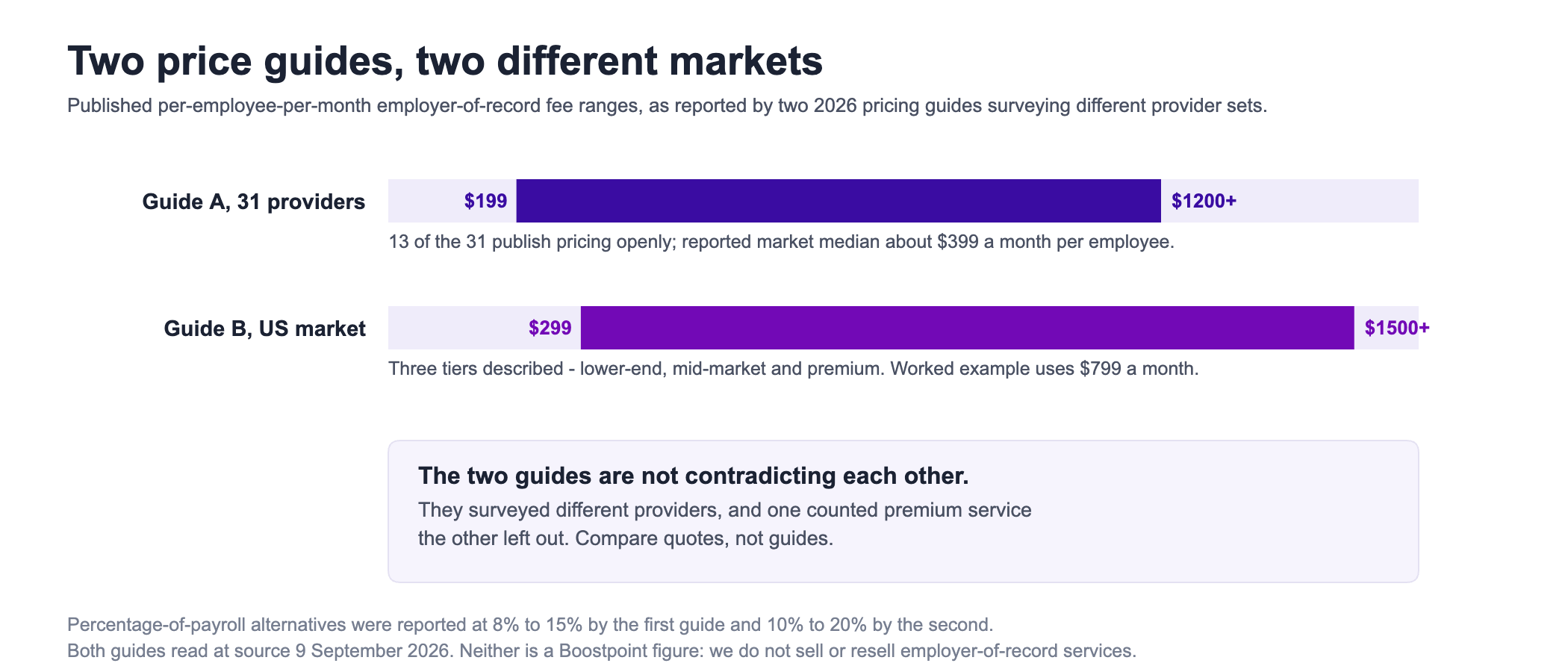
Published employer-of-record fees run from about $199 to $1,500 or more per employee per month depending on which pricing guide you read, with one 2026 survey of 31 providers reporting a market median near $399 a month. The alternative model, a percentage of gross salary, is reported at 8% to 20%. Neither range is the answer to your question, because the two models cross over at a specific salary — and on frontline wages they cross low enough that the choice usually goes one way.
What you are actually buying
An employer of record legally employs someone on your behalf in a jurisdiction where you have no entity. The person does your work and reports to your managers; the EOR is their employer of record for payroll, tax, benefits and employment law. The reason to use one is almost always the same: you want to hire in a state or country where setting up an entity, registering for payroll tax and buying workers' compensation would cost more and take longer than the hire is worth.
That framing matters for cost, because it tells you what the fee is competing against. The alternative to an EOR is not "a cheaper EOR". It is registering as an employer in that jurisdiction yourself, which has its own fees, its own filing obligations and its own ongoing administration. Price the EOR against that, not against a spreadsheet of other providers.
The two pricing models
| Model | How it is charged | Reported range | Behaves like |
|---|---|---|---|
| Per employee per month | A flat monthly amount for each person on the arrangement, regardless of pay | $199 to $1,200 or more in one 2026 survey of 31 providers, with a reported median near $399; $299 to $1,500 or more in a second 2026 US guide | A fixed cost. Cheap on senior salaries, expensive on frontline ones. |
| Percentage of gross salary | A percentage of what the employee is paid | 8% to 15% in the first guide, 10% to 20% in the second | A variable cost. Cheap on low wages, and it grows every time you give a raise. |
Where the two models cross over
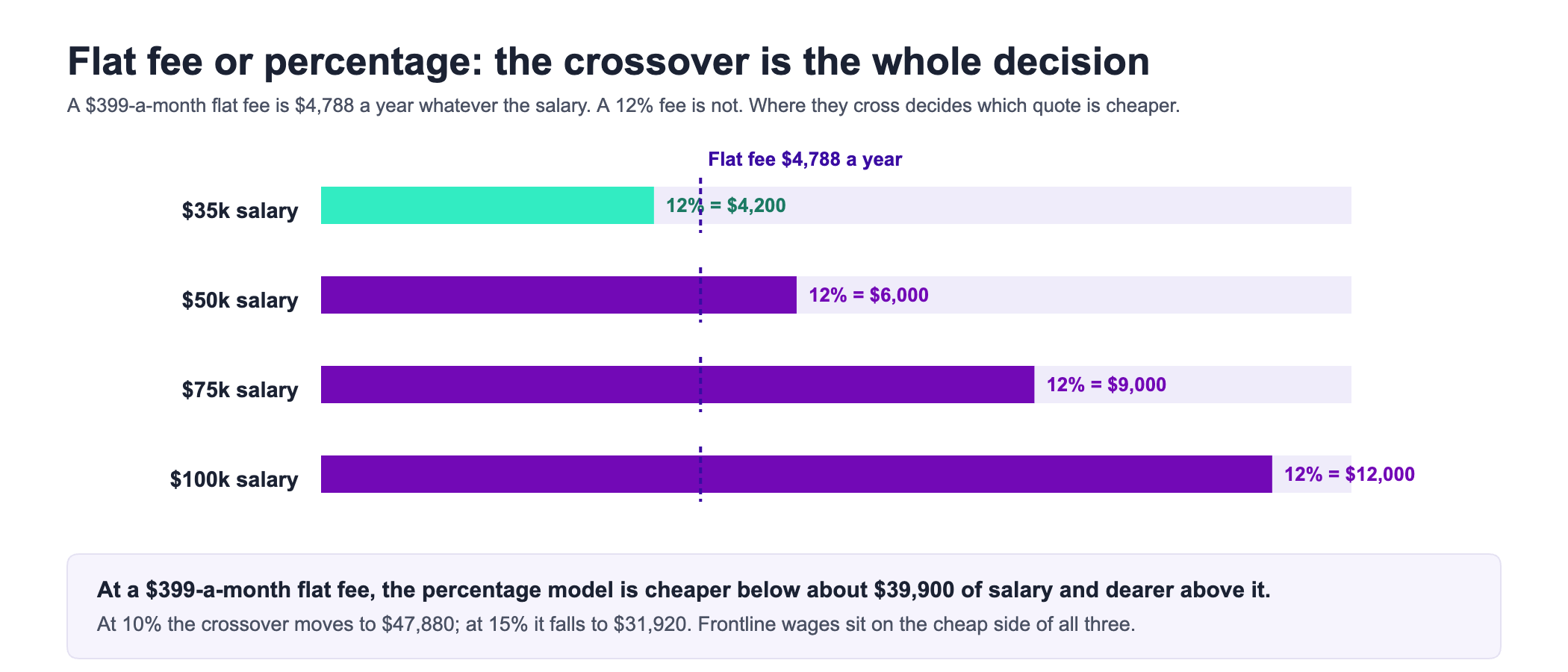
This is the only piece of arithmetic on the page that decides anything. A flat fee is a horizontal line; a percentage is a sloping one; they cross once. Below the crossing salary the percentage is cheaper and above it the flat fee is.
At the reported $399-a-month median, the flat fee is $4,788 a year. Against a 12% rate, the two are equal at a salary of $39,900. Against 10% the crossover is $47,880; against 15% it is $31,920. Frontline wages — a $35,000 warehouse role, a $37,440 driver seat — sit below the 10% and 12% crossings but above the 15% one, so on hourly work a percentage quote wins only toward the low end of the reported range, while a flat quote usually wins on salaried professional work.
What is inside the fee, and what is pass-through
The single most common quoting error is comparing a fee to an invoice. The fee is the provider's charge for the service. The invoice also carries costs you would pay under any arrangement, and those are not the provider's margin.
| Inside the fee | Pass-through on the invoice |
|---|---|
| Payroll processing and pay runs | The employee's gross wages |
| Federal and state tax filings | Employer payroll taxes — Social Security, Medicare, federal and state unemployment |
| Employment law compliance in the jurisdiction | Workers' compensation premium |
| Benefits enrollment and administration | Benefit premiums themselves |
| Contract drafting and onboarding | Statutory leave, holiday pay and mandated contributions |
| Ongoing HR support and record keeping | Any allowances or reimbursements you agreed |
If a quote is expressed as an all-in monthly number, ask which of the right-hand column it contains before comparing it to a fee-only quote from someone else. The right-hand column is the larger half of the invoice on almost every arrangement, and it is the half that does not vary much between providers. Our page on PEO cost makes the same distinction for the domestic equivalent, and the same test works here.
The fees that are not the fee
Both 2026 guides flag the same set of add-ons, and both make the same point about them: they are individually small and collectively material.
- Setup or onboarding, per hire. Reported at $0 to $500 in one survey and at "several hundred to a few thousand dollars" in the other.
- A refundable security deposit. Commonly one to two months of the total cost — salary, employer burden and fee together, not just the fee.
- Off-cycle payroll runs. $50 to $250 each, which matters if your business runs corrections or final pay outside the normal cycle.
- Termination and offboarding. $250 to $1,000 per employee in one survey; the other reports the charge exists but not the amount.
- Currency conversion margin, on any arrangement that pays in a currency other than the one you fund from.
EOR, PEO and staffing agency: which one you are pricing
These three get quoted against each other and they are not substitutes. The difference is who employs the person and what you are actually buying.
| Employer of record | PEO | Staffing agency | |
|---|---|---|---|
| Who employs the worker | The EOR, in a jurisdiction where you have no entity | You, with the PEO as co-employer | The agency, and the worker is on assignment to you |
| Do you need your own entity? | No — that is the point of it | Yes | No |
| Who found the person | You did | You did | The agency did |
| How it is priced | Per employee per month, or a percentage of salary | A percentage of payroll, or per employee per month | A markup on the pay rate, or a placement fee |
| Typical reason to use it | Hiring across a border you have not crossed as an employer | Buying HR infrastructure and benefits leverage at home | Buying recruiting and flexible headcount |
The practical consequence for a frontline employer: an EOR does not solve a recruiting problem. It solves a legal-entity problem. If the difficulty is finding people rather than employing them, an EOR fee buys you nothing you need, and the markup structures that do cover recruiting are on staffing agency markup.
When an EOR is worth it, and when it is not
- Worth it: one or two hires in a state or country where you have no entity and no immediate plan to build one; a fixed-term project team; testing a market before committing to registration; taking on a specific person who will not relocate.
- Worth it: speed. Registering as an employer in a new jurisdiction takes weeks to months; an EOR arrangement takes days, and that difference has its own value if a seat is costing you money every day it is open.
- Not worth it: volume hourly hiring in a state where you already operate. You have the entity, the payroll registration and the workers' compensation policy; the fee buys nothing.
- Not worth it: as a way to avoid classifying someone correctly. An EOR employs people properly, which is the opposite of a shortcut, and it will decline arrangements that look like disguised contracting.
- Reconsider at scale: at some headcount in one jurisdiction, the annual fee exceeds what registering an entity and running payroll yourself would cost. Ask for that number in the quote, because the provider knows it.
Four questions that make two quotes comparable
Ask every provider the same four things and the comparison does itself. Is the price a flat monthly fee or a percentage of salary, and at what salary do the two cross? What exactly is inside the fee, and which of wages, employer taxes, workers' compensation and benefit premiums appear separately? What are the setup, off-cycle payroll, termination and currency charges, in dollars? And what deposit is held, on what basis, and when is it returned? Everything else in a proposal is description.
Employer of record cost for one frontline employee, worked
Take one hourly employee at $18.00 an hour, 40 hours a week, 52 weeks: $37,440 a year in wages. This is the annual EOR fee under each model at the figures above. It is the fee only; wages, employer payroll taxes, workers' compensation and benefit premiums come on top under every model.
| Model | Rate | Annual fee |
|---|---|---|
| Per employee per month | $399 a month (reported median) | $399 × 12 = $4,788 |
| Percentage of salary | 10% | 10% × $37,440 = $3,744 |
| Percentage of salary | 12% | 12% × $37,440 = $4,492.80 |
| Percentage of salary | 15% | 15% × $37,440 = $5,616 |
At this wage a 10% or 12% quote comes in under the $399 flat fee and a 15% quote comes in over it, which matches the crossover salaries above: $47,880 at 10%, $39,900 at 12% and $31,920 at 15%. Add the one-time charges (setup, deposit, termination) before you compare two totals.
Frequently asked questions
How much does an employer of record cost?
Published ranges run from about $199 to $1,500 or more per employee per month, and one 2026 survey of 31 providers reports a market median near $399 a month. The alternative model, a percentage of gross salary, is reported at 8% to 20%. Both figures cover the service fee only: wages, employer payroll taxes, workers' compensation and benefit premiums are pass-through costs that appear separately on the invoice.
What is EOR pricing based on?
One of two things. A per-employee-per-month model charges a flat amount for each person on the arrangement regardless of what they are paid. A percentage model charges a share of gross salary, so the fee rises with every pay increase. The two cross at a specific salary — about $39,900 where a $399-a-month flat fee meets a 12% rate — and which side of that crossing your roles sit on decides which quote is cheaper.
What are EOR fees?
The EOR fee is the provider's charge for employing someone on your behalf: payroll processing, tax filings, employment-law compliance, benefits administration, contracting and onboarding, and ongoing HR support. It is not the whole invoice. Wages, employer payroll taxes, workers' compensation premium and benefit premiums are pass-through, and on most arrangements they are the larger half of what you pay each month.
What is the EOR cost per employee per month?
Between roughly $199 and $1,200 a month in one 2026 survey of 31 providers, with a reported median near $399, and between $299 and $1,500 or more in a second 2026 US guide that included premium service tiers. The two guides surveyed different provider sets rather than disagreeing about the market. Only 13 of the 31 providers in the first survey publish pricing openly, so most real numbers come from a quote.
Is a flat fee or a percentage of salary cheaper?
It depends entirely on the salary. Below the crossing point the percentage is cheaper; above it the flat fee is. At a $399-a-month flat fee, a 12% rate crosses at $39,900 of salary, a 10% rate at $47,880 and a 15% rate at $31,920. A $37,440 full-time hourly wage sits below the 10% and 12% crossings but above the 15% one, so on hourly work a percentage quote wins only toward the low end of the range, and a flat quote usually wins on salaried professional work.
What hidden fees do EOR providers charge?
The recurring ones reported in 2026 pricing surveys are setup or onboarding at $0 to $500 per hire, a refundable security deposit of one to two months of total cost, off-cycle payroll runs at $50 to $250 each, termination or offboarding at $250 to $1,000 per employee, and a currency conversion margin where the pay currency differs from your funding currency. One survey puts the combined effect at 5% to 15% of program cost a year.
What is the difference between an EOR and a staffing agency?
Who found the person. A staffing agency recruits the worker and assigns them to you, and its markup covers that recruiting as well as the employment. An employer of record employs someone you already found, in a jurisdiction where you have no entity, and charges only for the employment. If your problem is finding people, an EOR fee buys nothing that solves it.
Is an EOR cheaper than setting up an entity?
For a small number of people, almost always, because entity registration, payroll tax registration, a workers' compensation policy and ongoing filings carry both cost and elapsed time. At some headcount in one jurisdiction the annual fees exceed doing it yourself, and that crossover is worth asking the provider to compute in the proposal. Speed is the other half of the answer: an EOR arrangement takes days where registration takes weeks or months.
The domestic equivalent of this comparison, where you already have an entity and are buying HR infrastructure instead, is on PEO cost; the outsourced-recruiting comparison is on RPO cost.
If the problem is finding people, not employing them
Tell us the roles you are filling and the markets you are filling them in, and we will show you what an applicant costs there.
Book a Demo