
CNA Interview Questions
Federal rules already settle most of what a CNA interview is usually spent on: the training hours, the competency evaluation, the registry check and the deadline for finishing it. That frees the interview for the two things no rule can tell you — whether this person can carry the assignment you actually have on the floor, and whether they will still be here in six months. Ask about the last real shift, the ratio, and what would keep them, and verify the certification separately.
What this page covers
Questions to ask a certified nursing assistant, what a strong answer contains, and which answers sound like problems and are not. It assumes you are hiring for a long-term care or senior living setting and that you already have a written CNA job description. The general employer-side interview method — structure, scoring anchors, the screener handoff — lives on our interview questions to ask candidates guide, and this page does not repeat it.
We are a recruitment advertising company, so our measured data covers what it costs to get a CNA to complete an application, not what happens in the interview. Everything here about the interview itself is a working pattern, and everything about the federal rules is quoted from the Code of Federal Regulations with the section number attached. None of it is legal advice, and state requirements sit on top of the federal ones.
What the rules already establish, before you ask anything
A surprising share of CNA interview time goes on questions the regulation has already answered. Knowing the five facts below changes what you ask, and it changes what you can offer a candidate whose certification is not quite in order.
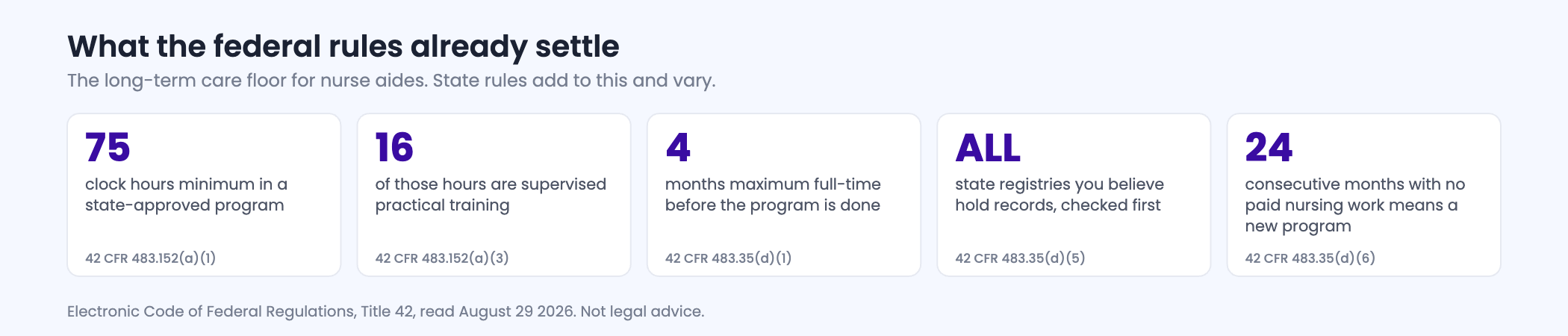
| Rule | What it says | Citation |
|---|---|---|
| Training hours | A state-approved program must consist of no less than 75 clock hours, including at least 16 hours of supervised practical training | 42 CFR 483.152(a)(1), (a)(3) |
| The four-month rule | A facility must not use any individual as a nurse aide for more than four months on a full-time basis unless that individual is competent and has completed an approved program | 42 CFR 483.35(d)(1) |
| Agency and per diem too | The same requirement applies to temporary, per diem, leased and any non-permanent basis | 42 CFR 483.35(d)(2) |
| Registry check | Before allowing an individual to serve as a nurse aide, the facility must seek information from every state registry it believes will hold information on that person | 42 CFR 483.35(d)(5) |
| The 24-month lapse | If 24 consecutive months have passed with no nursing or nursing-related services for pay since the last completed program, the person must complete a new program | 42 CFR 483.35(d)(6) |
| After you hire | A performance review at least once every 12 months, and in-service training of no less than 12 hours per year, including dementia management and resident abuse prevention | 42 CFR 483.35(d)(7), 483.95(g) |
Source: Electronic Code of Federal Regulations, Title 42, read August 29 2026 (eCFR displaying Title 42 up to date as of August 27 2026; Title 42 last amended August 13 2026). Federal long-term care requirements only. State rules add to these and vary. Not legal advice.
Two of those rules are worth reading twice. The four-month rule means you can hire someone whose competency evaluation is not finished, put them to work, and give them a real deadline — which is a hiring lever most facilities never use. The 24-month rule means a candidate who left the field during the pandemic and has been driving a delivery van since may need a whole new program rather than a renewal, and finding that out in the interview rather than in week three is worth the ninety seconds it takes to ask.
Eight questions worth the time
Ask these in this order, of every candidate. The first four are about the work as it actually happens; the last four are about whether the job you have is the job they want.
1. “How many residents did you have on your last shift, and what time did you start?”
The assignment size is the single most useful number in the conversation, and it is the one candidates almost never volunteer. Someone who ran fourteen residents on days is being asked something different from someone who ran twenty-six on nights. A strong answer comes back with a number and a shape — how many were total-care, who else was on the hall, whether they had a shower list. If the number they name is far below what you are about to hand them, say so in the interview rather than discovering it in week two.
2. “Two call lights go on at once and one is a resident who has fallen before. Talk me through the next five minutes.”
This is the one situational question that earns its place. It is not a trick and there is no single right answer; what you are listening for is whether the person triages out loud, whether anyone else appears in the story, and whether they say the word “nurse”. The best answers usually involve going to the higher-risk room, putting eyes on the other resident on the way, and telling the charge nurse. An answer that has the candidate handling everything alone is not heroic, it is a fall report waiting to happen.
3. “Talk me through the last transfer you did. What did you use, and who was with you?”
Transfers are where aides get hurt, and how someone describes one tells you what they were taught and what their last employer tolerated. Listen for the equipment named, whether a second person was involved when the care plan called for one, and whether they mention checking the plan at all. A candidate who says they have done two-person transfers alone because the floor was short is telling you something true about their last building and something you need to be explicit about in yours.
4. “When do you chart, and what happens if you run out of time?”
Documentation is the quiet reason CNAs get written up and, in a survey, the reason a good building looks bad on paper. Asking when rather than whether gets an honest answer. Charting at the end of the shift, from memory, is the normal answer and not a red flag on its own; what matters is what they do when the shift runs over and whether anyone has ever shown them the difference between what has to be recorded in the moment and what can wait.
5. “What is your certification status today, and when does it renew?”
Ask for the state, the status and the renewal date, in that order. Then ask the follow-up that most employers skip: has there been any period since you finished your program when you were not doing nursing or nursing-related work for pay? That question exists because of the 24-month rule, and it is the difference between an aide who needs a renewal and one who needs a whole new program. You still verify against the registry afterwards — that is required, not optional — but the interview is where you find out whether verification is going to be simple. The registry steps themselves are on our CNA verification page.
6. “Which shift do you actually want, not which one you would take?”
Candidates apply for the shift that is posted and take the shift that is offered, and then leave when the one they wanted opens up somewhere else. Asking the question this way gives you the real answer early. If what they want is nights and you have days, you have learned something useful; if what they want is a fixed schedule and yours rotates, that is worth knowing before you have invested in orientation.
7. “What made you leave the last building?”
Asked plainly, without a follow-up face, this question gets an honest answer more often than not, and the answers cluster: the ratio, the schedule changing every week, a manager who did not answer the phone, pay, or the commute. Every one of those is either something you can be honest about or something you can beat. What you are not listening for is loyalty. Tenure in this field is short for structural reasons, and treating a two-year work history spread over three buildings as a character flaw will cost you good aides.
8. “What would have to be true for you to still be here next summer?”
Ask it about a specific date rather than in the abstract. The answers are your own retention risks, in the candidate's words, and they are almost always things you control: a consistent hall, a schedule posted far enough ahead to plan childcare, being told when the assignment changes rather than finding out at handover, and someone who says thank you. Write the answer down, because it is also the list of promises you should not make if you cannot keep them.
Four months is a deadline, not a disqualification. A candidate mid-certification is a hire you can make today if you are willing to say so in the interview.
Answers that sound like problems and are not
CNA hiring has a particular set of false negatives, and screening them out is how good buildings end up short-staffed while insisting they cannot find anyone.
- Short tenure across several buildings. This is the shape of the field, not a shape of the person. Ask what changed each time; the pattern in the answers is more informative than the count.
- A gap in the work history. Worth one question, because of the 24-month rule, and no more. The rule is a paperwork consequence, not a judgment.
- Coming from home care rather than a facility. Different pace, different documentation, often more autonomy. It is a training conversation, not a rejection.
- Being blunt about pay. A candidate who leads with the rate is doing arithmetic, and you would too. It is also the cheapest objection to answer honestly.
- A quiet or nervous interview. The job is done at the bedside, not across a desk, and interview fluency is a rehearsed skill that most aides have had no reason to practice.
Read the answer
What that answer actually tells you
Pick a question, then pick the answer closest to what you heard. You get the read, the risk, and the follow-up question to ask next.
Certification status: what to do with each answer
The certification conversation has five realistic outcomes, and only one of them is a straightforward no. Knowing which one you are in tells you what to verify, what you can offer, and whether the person can be on the floor next week or next month.
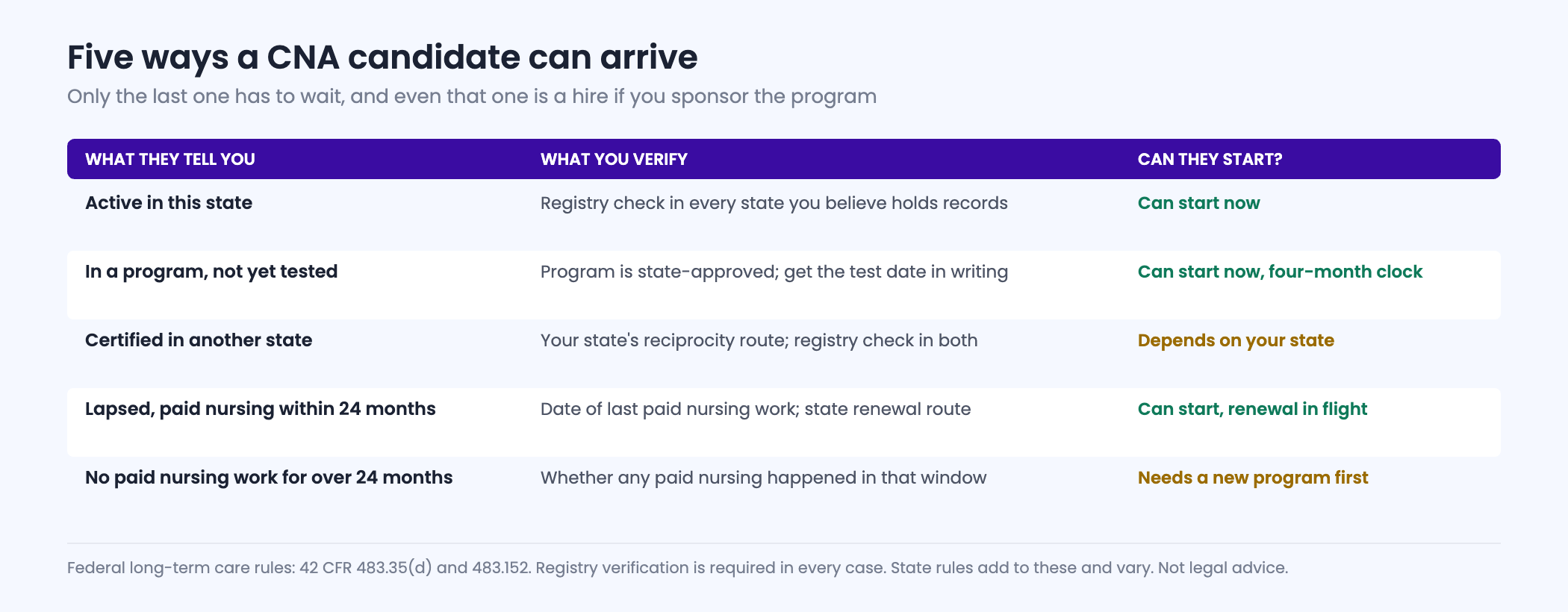
Status decoder
Where does this candidate actually stand?
Choose what the candidate told you. The decoder returns what to verify, what the federal rules require, and what you can offer them in the interview.
Federal long-term care rules only. Your state adds requirements and may differ on reciprocity and renewal. Not legal advice.
You are interviewing against everyone else who needs a CNA
The reason interview speed matters more in this role than in most is that CNA candidates are not scarce in the way that, say, therapists are — they are simply being interviewed by three other buildings the same week. Our advertising data shows the shape of it: a CNA application is one of the cheaper healthcare applications to generate, and the people generating them are not short of options.
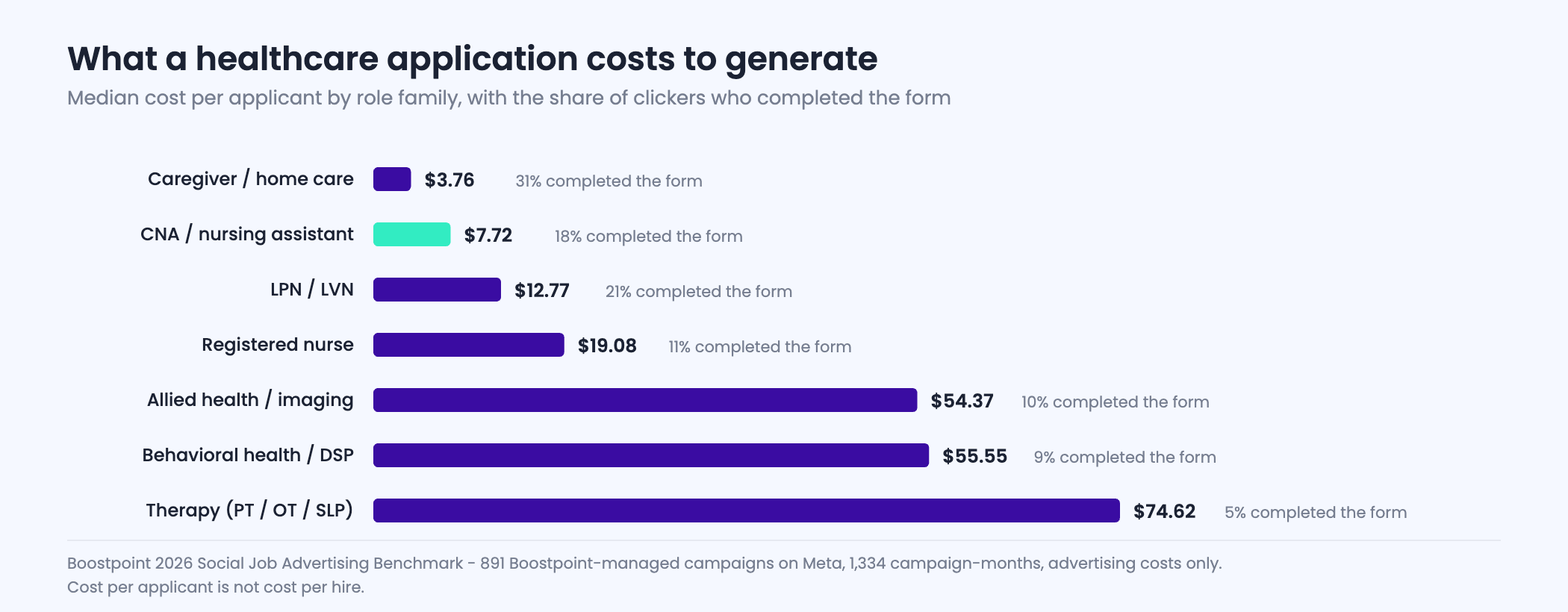
| Role family | Median | Middle 50% | Apply rate | Campaigns |
|---|---|---|---|---|
| Caregiver / home care | $3.76 | $2.99 – $5.83 | 31% | 34 |
| CNA / nursing assistant | $7.72 | $6.18 – $12.06 | 18% | 32 |
| LPN / LVN | $12.77 | $7.53 – $21.46 | 21% | 57 |
| Registered nurse | $19.08 | $12.76 – $34.84 | 11% | 173 |
| Allied health / imaging | $54.37 | $10.27 – $106.51 | 10% | 23 |
| Behavioral health / DSP | $55.55 | $18.36 – $334.56 | 9% | 19 |
| Therapy (PT / OT / SLP) | $74.62 | $44.85 – $171.40 | 5% | 39 |
Source: Boostpoint 2026 Social Job Advertising Benchmark — 891 Boostpoint-managed campaigns on Meta (1,334 campaign-months), 2026; advertising costs only. Apply rate is the share of clickers who completed the form. Campaigns counts campaign-months. Cost per applicant is not cost per hire, and nothing on this page derives one from the other.
The wider Healthcare and Senior Living sector runs a $15.42 median cost per applicant with a 16% apply rate across 553 campaign-months, at a $25.18 cost per thousand impressions — the most expensive impressions of any sector we measure. What that combination says about interviewing is simple: getting the CNA to your calendar has already cost something, and every day between the interview and a decision is a day one of the other three buildings can close.
If you are getting CNA applications and not filling the role, the constraint is not reach. It is somewhere in the seventy-two hours after the interview.
What to say, not just what to ask
Three sentences in the interview are worth more than any question on this page. Say what the assignment actually is — the hall, the number, the shower schedule — because the candidate will find out on day one anyway and the honest version buys you a hire who is not surprised. Say what you will do about the certification if theirs is mid-flight, including whether you pay for it, because that is the sentence that most often wins someone who has two other offers. And say when you will call, then call earlier.
Everything else is retention, and retention for aides is mostly schedule. A consistent hall, a schedule posted far enough ahead to arrange childcare, and being told before the assignment changes are worth more than a wage increase you cannot sustain. If you want the numbers on why the first ninety days decide most of it, that is a separate page, and it is the one to read before you write your onboarding plan.
Nursing assistant interview questions: the same job, two names
"CNA" and "nursing assistant" are the same role, and which one a candidate uses tells you something before the interview starts. CNA is the certification; nursing assistant is the job. Someone who says nursing assistant is often newer to the field, working in a setting that does not use the acronym, or has the training but not yet the state certification — and in a market short of 203,300 openings a year, that third group is worth an interview rather than an auto-rejection.
The Bureau of Labor Statistics publishes the occupation as nursing assistants: 1,505,900 employed, a median of $42,260 a year or $20.13 an hour, and roughly 203,300 openings every year across the decade. Median pay varies by setting far more than most candidates realize — government $47,050, skilled nursing $43,000, hospitals $42,310, assisted living $39,490, home health $38,040 — a spread of about $4.30 an hour, which is the whole negotiating range of the occupation and the single most useful thing to know before you interview.
What a strong answer sounds like, in one line each: on a difficult resident, they describe what they did before they escalated; on a short-staffed shift, they describe how they decided what to skip; on why they left the last job, they name a schedule or a ratio rather than a person. All three are asking the same underlying question — whether this person makes decisions under pressure or waits to be told.
Frequently asked questions
What questions should I ask a CNA in an interview?
Start with the assignment they actually carried on their last shift and the time they started, then a two-call-lights triage question, a transfer question, and a documentation question. Follow with certification status and renewal, which shift they genuinely want, why they left the last building, and what would have to be true for them to still be there in a year.
Can I hire a CNA whose certification is not finished?
Under the federal long-term care rules a facility must not use an individual as a nurse aide for more than four months on a full-time basis unless that person is competent and has completed a state-approved training and competency evaluation program. That gives you a genuine window to hire someone mid-certification, provided the deadline is real and you have said so in writing. State rules add requirements, so check yours.
Do I have to check a nurse aide registry before someone starts?
Yes. The federal rule requires that before allowing an individual to serve as a nurse aide, a facility seek information from every state registry it believes will include information on that individual. It is a required step, not a background-check preference, and it applies to agency and per diem staff as well as permanent employees.
What if a candidate has been out of the field for a few years?
Ask specifically whether there has been a continuous period of 24 consecutive months since their last completed program during which they did no nursing or nursing-related work for pay. If there has, the federal rule requires them to complete a new training and competency evaluation program rather than simply renewing. It is a paperwork consequence, not a reason to end the conversation.
Is short tenure a red flag for a CNA?
Rarely. Tenure in direct care is short for structural reasons, and a work history spread across several buildings usually reflects schedules, ratios and commutes rather than the person. Ask what changed each time; the pattern in those answers is far more useful than the number of employers.
What should I tell a CNA candidate during the interview?
The real assignment, in numbers. What you will do about certification if theirs is unfinished, including whether you pay. And exactly when you will make a decision. Frontline candidates are usually in two or three processes at once, so a specific commitment on timing, kept, is a competitive advantage that costs nothing.
How much does it cost to get a CNA to apply?
Across our benchmark the CNA and nursing assistant family runs a median of $7.72 per completed application, with the middle half between $6.18 and $12.06 and an 18% apply rate. That is a cost per applicant, not a cost per hire, and what happens after the application lives in your own records rather than in advertising data.
How many training hours does a CNA need?
A state-approved nurse aide training and competency evaluation program must consist of no less than 75 clock hours, including at least 16 hours of supervised practical training in which the trainee performs tasks under the direct supervision of a registered nurse or licensed practical nurse. Many states require more than the federal minimum.
What are good nursing assistant interview questions?
The ones that ask for a specific past incident rather than a hypothetical: what they did before escalating a difficult resident, how they decided what to skip on a short-staffed shift, and why they left their last role. Strong answers name a decision and its reasoning; weak answers describe a policy. The wording matters less than whether the question can be answered with a story.
Is a nursing assistant the same as a CNA?
Yes, with one distinction that matters at the interview. CNA is the certification; nursing assistant is the job. Candidates who describe themselves as nursing assistants are sometimes trained but not yet certified, or work in a setting that does not use the acronym. With roughly 203,300 openings a year in the occupation, screening that group out automatically is usually a mistake.
What should you pay a nursing assistant?
BLS puts the median at $42,260 a year, or $20.13 an hour, but the setting moves it more than experience does: government $47,050, skilled nursing $43,000, hospitals $42,310, assisted living $39,490 and home health $38,040. That is a spread of about $4.30 an hour, and it is the range candidates are comparing you against.
Getting CNAs to the interview in the first place
If you have a good interview process and an empty calendar, the problem is upstream. That part we measure.
Federal requirements quoted from the Electronic Code of Federal Regulations, Title 42, read August 29 2026: 42 CFR 483.152(a)(1) and (a)(3) on the 75 clock hours and 16 supervised practical hours; 42 CFR 483.35(d)(1) and (d)(2) on the four-month rule and its application to non-permanent staff; 42 CFR 483.35(d)(5) on registry verification; 42 CFR 483.35(d)(6) on the 24-consecutive-month retraining rule; 42 CFR 483.35(d)(7) and 42 CFR 483.95(g) on annual performance review and no less than 12 hours of in-service training per year. The eCFR page displayed Title 42 as up to date as of August 27 2026, last amended August 13 2026. These are federal long-term care requirements only; state rules add to them and vary, and nothing here is legal advice. Advertising figures: Boostpoint 2026 Social Job Advertising Benchmark — 891 Boostpoint-managed campaigns on Meta across 1,334 campaign-months in 2026, advertising costs only. Healthcare role families used on this page: caregiver and home care $3.76 median at a 31% apply rate, CNA $7.72 with a middle half of $6.18 to $12.06 at 18%, LPN and LVN $12.77 at 21%, registered nurse $19.08 at 11%, allied health and imaging $54.37 at 10%, behavioral health and DSP $55.55 at 9%, therapy $74.62 at 5%. Healthcare and Senior Living sector $15.42 median, 16% apply rate, $25.18 cost per thousand impressions, 553 campaign-months. Cost per applicant is not cost per hire, and no cost per hire is derived from it anywhere on this page. Assignment sizes, question wording, the eight-question order and the interview advice are Boostpoint's working patterns rather than measured values, and are labeled as such. Last updated August 2026.