
Job Fair Booth Ideas: 24 Things That Start Conversations, and Three That Waste the Table
A job fair booth has one job: to turn people walking past into conversations, and conversations into a next step with a date on it. Almost everything that goes wrong at a booth is a throughput problem dressed up as a creative one — not enough people stopping, or too many stopping and nobody free to talk to them. The ideas below are ordered by the moment they act on, from the brief you give your two staffers before the doors open to the text you send that afternoon.
A note on who's writing this, and where this page stops
Boostpoint sells social recruitment advertising, which is one of the things employers do instead of a job fair, so the bias here is worth stating plainly. This page does not argue about whether to attend. That argument — whose crowd you are standing in, and what a table costs per applicant on your own numbers — belongs to our job fair alternatives page, which has the calculator for it. This page assumes you have already paid for the table and starts from there. Everything below is operational advice from running events and campaigns; where a number appears, it is one already published in our benchmark and it is labeled.
The booth is a throughput problem before it is a creative one
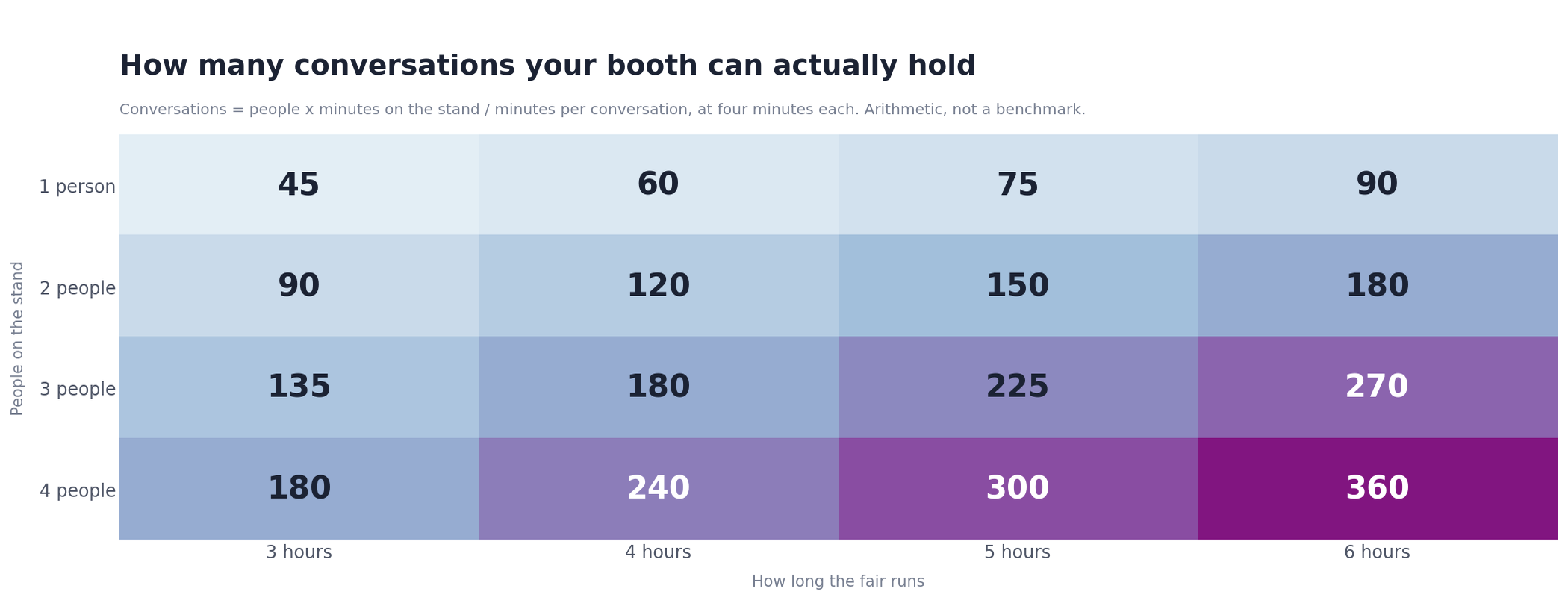
Two people on a stand for four hours, at four minutes a conversation, can hold about 120 conversations in a day. That is the ceiling. No banner, no giveaway and no idea on this page raises it. What the ideas do is decide how many of those 120 conversations are with people who could actually take the job, and how many end with a named next step instead of a business card.
Work out your own ceiling first, because it changes every other answer. If the ceiling is 60 conversations, a giveaway that draws 300 people is actively harmful: it fills the queue with people who came for the water bottle while the forklift driver walks past because nobody is free.
Before the doors open
- A ten-minute brief before doors open. Agree three things out loud: the opening question, the pay line, and who writes down details. Most booths never do this, and it is the difference between two people running one process and two people running two.
- Two people, never one, never four. One gets trapped in a single long conversation and the stand goes dark. Four read as a group that does not want to be interrupted. Two is the number that keeps one person always free.
- Staff the booth with someone who does the job. A recruiter can answer questions about the process. A crew lead, a charge nurse or a driver can answer the question people actually have, which is what the day is like. Pair them.
- A second-language sign and a bilingual staffer. Where the floor runs two languages, so should the table. It is noticed immediately, and it is noticed by the people you are most likely to be under-reaching.
- A one-page "what happens next" handout. Not a brochure — the five steps from today to a start date, with a realistic date on each. People keep it because it answers a question nobody else at the fair answered.
- A shuttle or route map for the site. Transport is a common reason a good applicant quietly does not convert. Put the route, the drive time and the parking situation on the table and settle it in the conversation.
What is on the table
- A shift board, not a job board. Print the actual open shifts — days, hours, start times — with pay beside each. People stop at specifics. "Now hiring, all positions" is a sign people have learned to walk past.
- Put the pay range on the tablecloth. It is the first question everyone asks and the one most booths make people work for. Answering it before it is asked changes who stops, which is the entire point.
- A QR code that lands on a two-question form. The single highest-leverage object on the table, and the one most often wasted by pointing it at a careers homepage. It has to open a form, and the form has to be two questions long.
- A "text us" number on a sign at eye height. Catches the people who will not stop but will save a number. Eye height, not table height — people read signs at the level they are already looking.
- Photos of the actual site, not stock. Candidates are deciding where they will spend forty hours a week. Show them the room, the truck, the ward, the floor. Stock photography reads as a company that would rather you did not see it.
- A "why we stayed" wall in employees' handwriting. Ask your crew for one line each and put them up unedited. It costs a marker and an hour and reads as true in a way a printed values statement never does.
How the stand is set up
- Stand in front of the table, not behind it. The table is a barrier and standing behind it is the default posture of every booth in the room. One person in front of it is the cheapest change on this page.
- A chair placed side-on, not across a table. Two chairs facing each other across a table is an interview. Two chairs beside each other is a conversation, and people say more in the second one.
- Bring one piece of the actual work. A tool, a sample, a device, a tray. It gives a shy candidate something to point at instead of having to open with a question about themselves.
- Something for the person waiting to talk. A clipboard question, the shift board, cold water. People leave queues whose end they cannot see, and at a fair the queue is three deep at most.
- A screen showing the roles filling in real time. Scarcity that happens to be true. Only run it if the numbers on it are genuinely live — a counter everyone can tell is decorative costs you more than it earns.
- Put the person who signs the offer on the stand. An offer made in the room by the person who can actually make it does not need a follow-up approval chain, and the approval chain is where fair candidates are lost.
The conversation, and what follows it
- One question that starts every conversation. "What are you doing now?" beats "can I tell you about us?" It takes the pressure off both people and it tells you within ten seconds whether this is a conversation worth four minutes.
- A tablet showing next week's interview slots. Booking a named time, on a named day, with a named person converts far better than "we'll be in touch" — which everyone at the fair has already heard four times.
- Interview here, now, behind the table. Needs a third person and two chairs out of the traffic flow, but it ends the funnel on the day. Our on-the-spot hiring page covers how to run it without it becoming a bottleneck.
- Write one line on every capture, on the spot. "Forklift, 2nd shift, can start Monday" is what makes the follow-up call worth making. A name and a phone number on their own become a cold list by Thursday.
- Text everyone the same afternoon. A fair is a shared audience — every employer in that hall met the same people. Whoever reaches them first while the day is still fresh gets the conversation.
- Walk the room in the last hour. Attendance thins, half the stands are packing up, and the people still there are the ones still looking. Leave one person at the table and go to them.
Two is the working minimum.
Doors open to doors closed.
Four is typical for frontline roles.
0 of the 24 ideas fit that stand and suit more conversations:
The shortlist is Boostpoint's judgment of fit, not a measured ranking — we have no data on individual booth tactics and do not pretend to. The capacity figure is your own arithmetic: people multiplied by minutes, divided by minutes per conversation.
Three ideas that waste the table
The giveaway as the strategy. Swag is a fine reason to pause and a poor reason to stop: it attracts everyone equally, and your capacity is finite. A bottle handed to someone who will never apply costs the four minutes you needed for the person behind them.
The laptop pointed at your ATS. A full application, standing up, on a shared laptop, in a noisy hall is the highest-friction thing you can ask for. Take two answers at the table and finish the rest later.
The brochure. Printed company overviews are read in the parking lot, if at all. The one-page "what happens next" is the sheet people keep, because it is about them.
What the table returns, and where that arithmetic lives
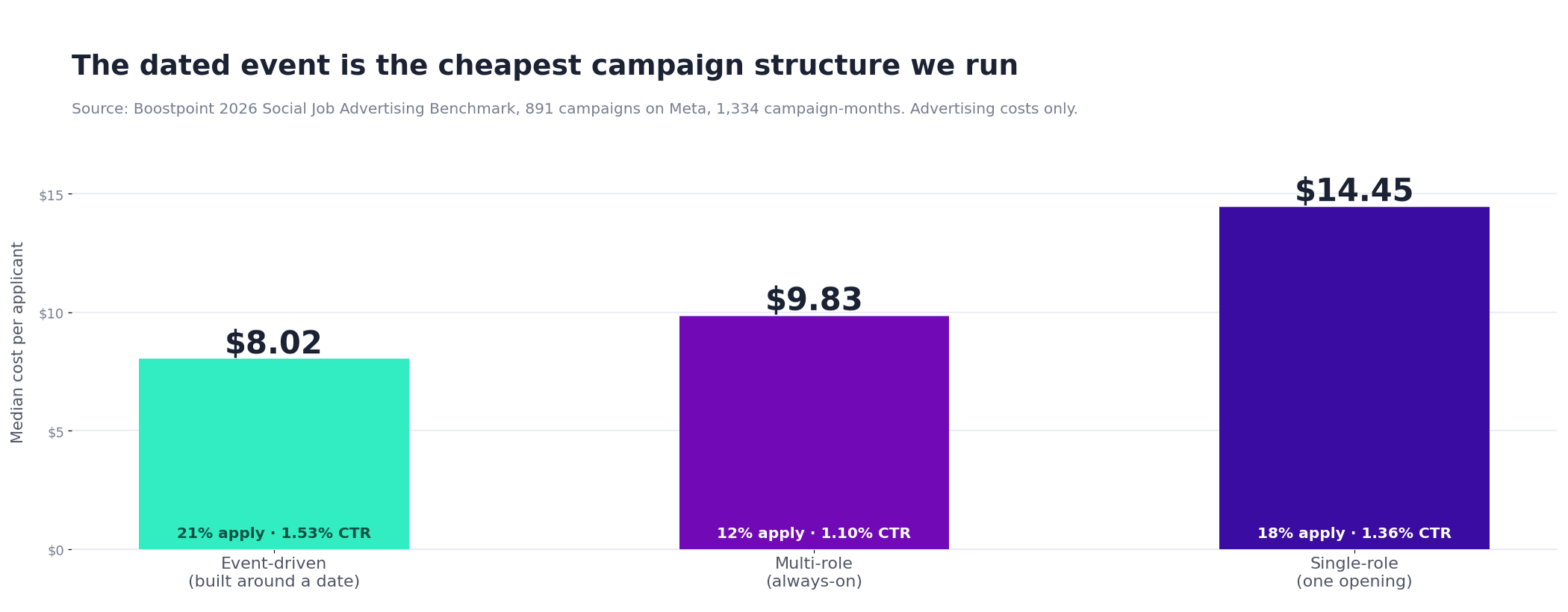
Booth ideas improve the conversion of a crowd somebody else assembled. That is the honest ceiling on this page, and the reason our own data covers the other route. In Boostpoint's 2026 Social Job Advertising Benchmark, the median campaign cost $13.88 per applicant, with the middle half of campaigns between $6.48 and $29.74, advertising costs only. Role moves it most: customer service and administrative roles ran a $2.71 median, warehouse and production roles $9.83 and CDL truck drivers $26.86.
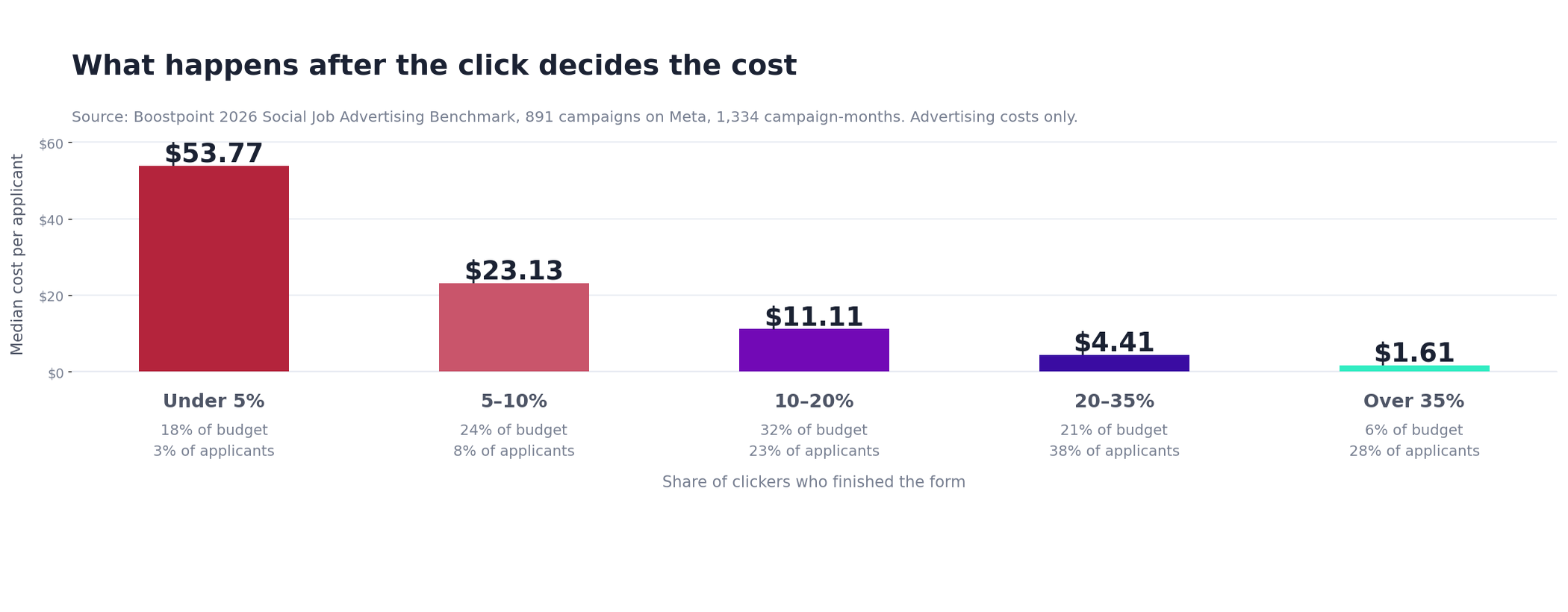
The figure worth carrying back to the booth is not the dollar amount. It is the finding underneath it: what happens after the click explains about 70% of why one campaign costs more than another, against 18% for what the auction charges. The booth version is exact — what happens after someone stops decides your day, and almost nothing about the banner does.
One thing a booth genuinely does that an ad cannot: it puts you in front of people you are not allowed to target. US employment ads on Meta run under the Special Ad Category rules, which remove age, gender and detailed targeting and restrict location targeting. A fair's crowd is assembled by the organizer, so it reaches people no ad audience of yours would have picked out. That is a real argument for attending — and it is an argument about the crowd, not about the booth.
Career fair booth ideas, ranked by what they return
Career fair and job fair booths are the same problem under two names, and most booth ideas fail the same test: they attract people to the table without moving anyone toward an application. Ranked by what they actually return:
| Idea | What it costs | What it returns |
|---|---|---|
| A QR code that opens a two-question application | Nothing | The highest-return object on the table. Everything else exists to get someone to scan it |
| Someone who does the job standing at the table | One shift of cover | More than any recruiter. Candidates ask them the real questions |
| Interviewing on the spot in a chair behind the table | A third person | Converts interest before it cools. The single biggest lift available |
| Pay and shift printed large enough to read from the aisle | A sign | Pre-qualifies the aisle and stops you spending ten minutes on someone who wants days |
| The actual equipment — a tool, a scanner, a piece of the truck | Transport | Stops people who recognize it, which is exactly the crowd you want |
| Branded pens, bags and stress balls | Real money | Traffic with no intent. The classic career fair booth mistake |
| A prize draw for a gift card | Real money | A list of people who wanted a gift card |
The pattern is that ideas which create a conversation with someone who could do the job beat ideas which create traffic. A booth that talks to eleven qualified people and books six interviews outperforms one that collects ninety entries in a bowl, and it is cheaper.
Job fair tips for recruiters
How to recruit at a job fair comes down to three windows: the week before, the table itself, and the next morning. Most of the result is decided outside the four hours in the hall.
- The week before: tell people you will be there. Text past applicants and runners-up with your table number and the roles you are hiring for, and run a small local ad naming the fair, the date and the pay. People who come to see you specifically are the best conversations of the day. Our guide on how to promote a hiring event covers the timing.
- At the table: ask the one question that screens. The license-or-schedule question that actually disqualifies (“Can you work weekends?”, “Do you have a class A CDL?”) goes first. Everything else waits for the interview.
- At the table: book, do not collect. A named interview slot beats a stack of resumes. Bring the calendar.
- The next morning: follow up before anyone else does. Every employer in the hall met the same people. Text everyone you spoke to by the next morning at the latest, with the next step and a time.
- A week later: count it. Conversations, applications, interviews held and hires. The ratio decides whether the next fair is worth the table fee.
Frequently asked questions
What should you put on a job fair booth table?
The shift board with pay beside each shift, a QR code that opens a two-question form, a "text us" number at eye height, photos of the actual worksite, and a one-page sheet setting out what happens between today and a start date. A brochure and a laptop pointed at your applicant tracking system are the two items most often present and least often useful.
How many people should staff a job fair booth?
Two, in almost every case. One person gets caught in a single long conversation and the stand effectively closes; four look like a group that does not want to be interrupted. The pair that works best is a recruiter who knows the process and someone who actually does the job — a crew lead, a driver, a charge nurse — because the questions candidates most want answered are about the work, not the hiring.
How do you attract people to your booth at a career fair?
Specifics, at a distance, at eye height. Pay and shift on the sign will stop more of the right people than any giveaway, because they answer the two questions everyone in the hall is carrying. Then stand in front of the table rather than behind it. The table is a barrier, and one person on the near side of it is the cheapest change available to you.
How do you stand out at a job fair as an employer?
Answer the two questions everyone in the hall is carrying before they reach your table. Print pay and shift large enough to read from the aisle, bring someone who actually does the job, and stand in front of the table rather than behind it. Let people apply from their phone in two questions, book named interview slots on the spot instead of collecting resumes, and text everyone you met the same afternoon, before the other employers in the hall follow up.
Are giveaways worth it at a job fair?
As a reason to pause, yes. As a strategy, no. A booth's capacity is finite — two staff over four hours at four minutes a conversation is roughly 120 conversations — and a giveaway attracts everyone equally, so it fills that capacity with people who were never going to apply. If you run one, tie it to a conversation rather than handing it out to the room.
How many conversations can one booth actually have?
Multiply the people on the stand by the minutes the fair runs, then divide by minutes per conversation. Two people, four hours, four minutes each is about 120. That ceiling is the most useful planning number you have, because it tells you whether your problem is attracting more people or converting the ones already stopping — and those two problems have opposite solutions.
What should you do after a job fair?
Text everyone the same afternoon. A fair is a shared audience: every employer in the hall met the same people, and the first credible follow-up gets the conversation. Send it while the day is still fresh, reference the one line you wrote at the table — the role, the shift, the start date they mentioned — and offer a specific interview time rather than asking them to call you.
Should you interview at the booth?
If you have a third person and two chairs out of the traffic flow, yes — ending the funnel on the day is the strongest thing a fair can do for you. Without that, it backfires: one interview occupies your only free staffer for fifteen minutes while the queue disperses. The middle path is booking a named slot for the following week on a tablet at the table.
Is a job fair booth better than running ads?
They do different jobs. The fair puts you in front of a crowd the organizer assembled, including people no ad audience of yours would have selected — which matters because US employment ads run under Special Ad Category rules that remove age, gender and detailed targeting. Ads let you build and repeat an audience on your own schedule. Our job fair alternatives page has the cost comparison.
How should employers prepare for a career fair?
Decide before the doors open what a successful table looks like in numbers — conversations, completed applications, interviews booked — and staff for that rather than for foot traffic. Bring the two things that convert: a way to apply on the spot from a phone, and someone with the authority to schedule an interview there and then. Everything else on the table is decoration, and the giveaways attract people who want the giveaway.
Is a career fair worth it for employers?
It depends entirely on what you do in the twenty-four hours afterward. A career fair produces a list of warm names; the cost per hire is decided by how quickly someone calls that list. Employers who leave the badges in a drawer until the following week get almost nothing, and then conclude that career fairs do not work. Run the arithmetic against your normal cost per applicant before booking the next one.
What are good career fair booth ideas?
Ranked by return: a QR code opening a two-question application, someone who actually does the job standing at the table, interviewing on the spot, and pay and shift printed large enough to read from the aisle. Bringing a real piece of equipment works because it stops people who recognize it. Branded giveaways and prize draws generate traffic without intent and are the most common way to spend a booth budget badly.
What are the best job fair tips for recruiters?
Promote your attendance the week before to past applicants and locally, ask the one screening question that actually disqualifies at the table, book named interview slots instead of collecting resumes, text everyone you met by the next morning, and count conversations, applications, interviews and hires afterward.
Filling the room, not just the table
The ideas above raise the conversion of a crowd somebody else brought. If you would rather bring your own — a dated event, your roles, your radius — we build it, run it, and report what each applicant cost: cost per applicant, not cost per hire.
Book a Demo Are job fairs worth it?
Benchmark figures: Boostpoint 2026 Social Job Advertising Benchmark — 891 Boostpoint-managed campaigns on Meta across 1,334 campaign-months in 2026, advertising costs only; all-roles median $13.88, middle half $6.48 to $29.74; role medians $2.71 customer service and administrative, $9.83 warehouse and production, $26.86 CDL truck driver; apply-rate bands $53.77, $23.13, $11.11, $4.41 and $1.61. Cost per applicant is not cost per hire, and no cost per hire is derived from it anywhere on this page. Conversation-capacity figures are arithmetic on the reader's own inputs, not benchmarks. Meta Special Ad Category rules read from Meta's published advertising policies. Booth tactics are operational judgment; we hold no measured data on individual booth ideas and none is implied. Last updated October 5, 2026.