
Healthcare Job Ad Templates: Caregiver, CNA and Nurse Ads That Pass Special Ad Category and Pay Transparency
A healthcare job ad on Meta has to clear two rules before it can work: the Special Ad Category, which strips age, gender and ZIP targeting and puts the burden of reaching the right person on the words, and the pay-transparency laws that by the end of 2026 require a pay range in postings in fourteen states and the District of Columbia. The templates below — caregiver, CNA, LPN, RN — are written to both, with the rate, the shift and the one thing you offer that the competitor doesn't in the first line, and a one-question form behind them. In Boostpoint's data, what happens after the click explains 70% of cost variation; the template is mostly about that.
Source: Boostpoint 2026 Social Job Advertising Benchmark — 891 Boostpoint-managed campaigns on Meta (1,334 campaign-months), 2026; costs are what advertisers paid for advertising only.
A note on who's writing this
Boostpoint writes and runs social media job ads for home care agencies, senior living communities and health systems, so these templates are what we sell, in copy-paste form. They are ad templates, not job descriptions: the duties, requirements and pay sections of a posting are on caregiver job description and CNA job description, and this page doesn't repeat them. The compliance notes summarize Meta's published policy and the pay-transparency statutes as two employment-law firms describe them; we are not lawyers and this is not legal advice, and the laws change every few months — check your state before you post. Every figure of ours is a cost per applicant, never a cost per hire.
The two rules every template obeys
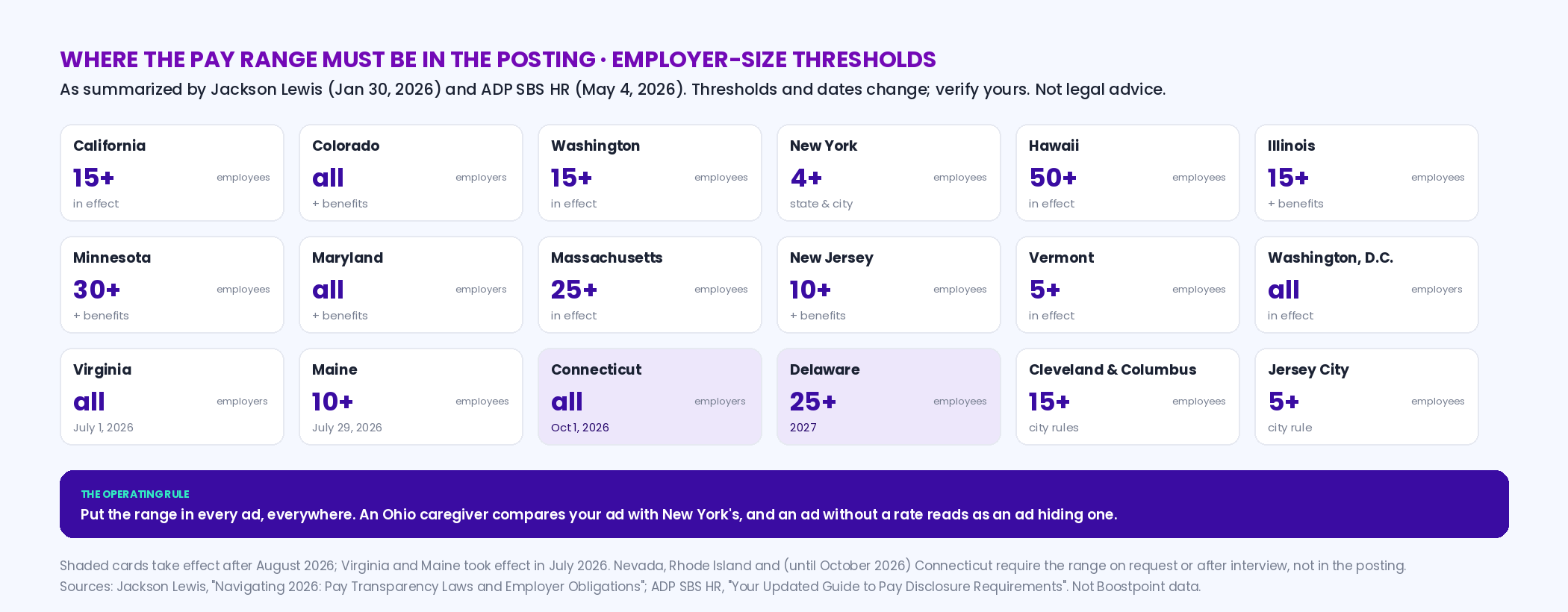
Special Ad Category. Any ad that promotes or links to a job is an employment ad on Meta, and in the United States it must be declared as one. Once it is, the audience is fixed at ages 18 through 65+, all genders, and locations no finer than a city with an expanded 15-mile radius — no ZIP codes, no lookalike audiences, no excluding anyone. The consequence for the copy is that the words do the targeting: "CNA" in the first line reaches CNAs, "$[rate]/hr" reaches people comparing rates, "nights" reaches night people. The consequence for compliance is older than Meta — the Age Discrimination in Employment Act makes it unlawful to publish a job ad "indicating any preference, limitation, specification, or discrimination" based on age, so "recent graduate," "young and energetic" and "digital native" are out of the ad whatever the platform. The full policy is on Meta Special Ad Category, explained. Pay transparency. A growing list of states requires the pay range in the posting itself, not on request: California, Colorado, Washington, New York, Hawaii, Illinois, Minnesota, Maryland, Massachusetts, New Jersey and Vermont already, the District of Columbia, Virginia from July 1, 2026, Maine from July 29, 2026, Connecticut from October 1, 2026, Delaware in 2027, plus cities including New York City, Jersey City, Cleveland and Columbus — with employer-size thresholds from one employee to fifty. Several also require a description of benefits. The practical rule is simpler than the map: put the range in every ad, everywhere, because a caregiver in Ohio compares your ad against the ones from New York, and an ad without a rate reads as an ad hiding one.
| Jurisdiction | Applies to employers with | What the posting must show | In effect | Source |
|---|---|---|---|---|
| California | 15+ employees | Pay scale | Yes | Jackson Lewis (Jan 30, 2026); ADP (May 4, 2026) |
| Colorado | All employers | Rate or range, plus compensation and benefits | Yes | Jackson Lewis; ADP |
| Washington | 15+ employees | Wage scale or salary range | Yes | Jackson Lewis; ADP |
| New York (state and city) | 4+ employees | Minimum and maximum salary or hourly wage | Yes | Jackson Lewis; ADP |
| Hawaii | 50+ employees | Hourly rate or salary range | Yes | Jackson Lewis; ADP |
| Illinois | 15+ employees | Pay scale and benefits | Yes | Jackson Lewis; ADP |
| Minnesota | 30+ employees | Minimum and maximum range, and benefits | Yes | Jackson Lewis; ADP |
| Maryland | All employers | Wage range and benefits, public and internal postings | Yes (Oct 1, 2024) | Jackson Lewis; ADP |
| Massachusetts | 25+ employees | Pay range | Yes | Jackson Lewis; ADP |
| New Jersey | 10+ employees (Jersey City: 5+) | Hourly wage or salary range, and benefits | Yes | Jackson Lewis; ADP |
| Vermont | 5+ employees | Compensation or range | Yes | Jackson Lewis; ADP |
| District of Columbia | All employers | Minimum and maximum projected pay; healthcare benefits before interview | Yes (June 30, 2024) | Jackson Lewis; ADP |
| Virginia | All employers | The position's wage | July 1, 2026 | ADP |
| Maine | 10+ employees | Prospective pay range | July 29, 2026 | ADP |
| Connecticut | All employers | Wages or wage range in advertisements (currently on request) | Oct 1, 2026 | ADP; Jackson Lewis (on request) |
| Delaware | 25+ employees | Pay range and benefits | 2027 | Jackson Lewis (26+, Sept 26, 2027); ADP (25+, fall 2027) |
| Cleveland and Columbus, Ohio | 15+ employees | Salary range | Yes | ADP; Jackson Lewis lists Cincinnati and Toledo too |
Why the first line and the form matter more than the rest
Across 891 campaigns, what happens after the click — whether the person who tapped the ad finishes applying — explained 70% of the variation in cost per applicant, against 30% for click-through rate and 18% for what the auction charged. The apply-rate bands show the size of it: campaigns converting under 5% of clicks paid a median $53.77 per applicant, 5–10% paid $23.13, 10–20% paid $11.11, 20–35% paid $4.41, and over 35% paid $1.61. Put together, 41% of all budget ran in campaigns converting under 10% and returned 11% of the applicants. The templates below therefore spend their effort in two places. The first line carries the credential, the rate range and the shift, so that the person who taps is the person who qualifies and wants the hours — a CNA ad that says "CNA · $[low]–$[high]/hr · nights" is read by CNAs who work nights and skipped by everyone else, which is the targeting the Special Ad Category took away. And the form asks one question. In the earlier campaign-level analysis, application completion fell with the credential — caregiver 31.3%, CNA 17.4%, LPN 18.4%, RN 12.4% — and the ads that held completion up were the ones whose form was name, phone, one knockout question, submit, with the license check and the résumé after the offer.
| Role | Median cost per applicant | Middle 50% | Apply rate | Campaigns | Completion, earlier analysis |
|---|---|---|---|---|---|
| Caregiver / home care | $3.76 | $2.99 – $5.83 | 31% | 34 | 31.3% |
| CNA / nursing assistant | $7.72 | $6.18 – $12.06 | 18% | 32 | 17.4% |
| LPN / LVN | $12.77 | $7.53 – $21.46 | 21% | 57 | 18.4% |
| Registered nurse | $19.08 | $12.76 – $34.84 | 11% | 173 | 12.4% |
Source: Boostpoint 2026 Social Job Advertising Benchmark — 891 Boostpoint-managed campaigns on Meta (1,334 campaign-months), 2026; costs are what advertisers paid for advertising only.
The templates
Each card is one Meta ad — primary text, headline, description — plus the one-question form and a short posting block for a job board or careers page. Meta's Ads Guide recommends 50 to 150 characters of primary text and a 27-character headline for the Facebook feed; the templates fit. Brackets are yours to fill; nothing in brackets is a number we assert. The differentiator line is the part to change most: it is whatever you have that the employer down the street doesn't, and if you can't name one, that is the finding, not a copy problem.
Caregiver / home care aide
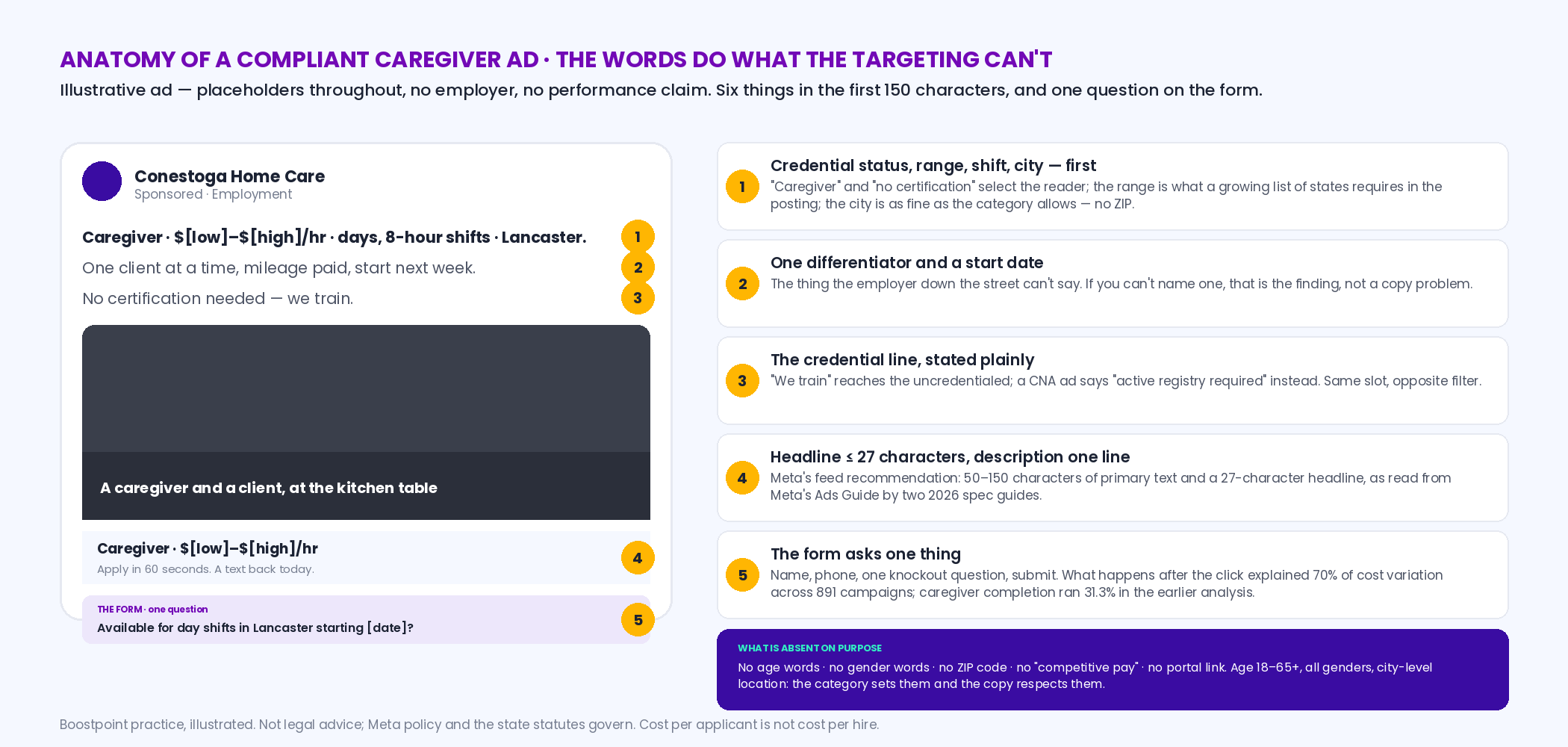
Benchmark $3.76 · 31% applyCaregiver · $[low]–$[high]/hr · [days/nights], [X]-hour shifts · [City]. One client at a time, mileage paid, start next week. No certification needed — we train.
Credential status ("no certification needed"), range, shift, city, one differentiator, start date. No age or gender words; city, not ZIP.
Caregiver · $[low]–$[high]/hr
Apply in 60 seconds. A text back today.
Are you available for [days/nights] shifts in [City] starting [date]?
Caregiver — [City], [State]
$[low]–$[high] per hour, paid weekly · [benefits, in one line]
[Days/nights], [X]-hour shifts; one client at a time; mileage reimbursed.
No certification required; paid training provided. Must be 18+ with a valid driver's license and reliable transportation. Background check after offer.
Apply: [link] — name and phone only; we call within one business day.
"18+" is the legal minimum, not a preference, and is allowed; "must have reliable transportation" is a job requirement, not a demographic one.
CNA / nursing assistant
Benchmark $7.72 · 18% applyCNA · $[low]–$[high]/hr + $[X]/hr [shift] differential · [City]. [Setting], [ratio] residents per aide, self-scheduling. Active [State] registry required.
Credential named so non-CNAs skip it; the differential is a number, not "differentials available"; ratio is the differentiator a facility can state.
CNA · $[low]–$[high]/hr [shift]
Name, phone, registry number. That's the form.
Are you currently listed in good standing on the [State] nurse aide registry?
Certified Nursing Assistant — [Setting], [City], [State]
$[low]–$[high] per hour + $[X] [shift] differential · [benefits, in one line]
[Shift pattern], [ratio] residents per aide, self-scheduling from your phone.
Current [State] nurse aide registry listing in good standing required. Registry verified after offer; no résumé needed.
Apply: [link] — three fields, under a minute.
Say what the registry check is and when it happens; CNA completion ran 17.4% in the earlier analysis, and the portal is where it falls.
LPN / LVN
Benchmark $12.77 · 21% applyLPN · $[low]–$[high]/hr · [shift], [X]-hour shifts · [City]. [Setting], [patients] per nurse, charge RN on every shift. [State] LPN license required.
The support structure ("charge RN on every shift") is the differentiator LPNs compare; license named to filter.
LPN · $[low]–$[high]/hr
License number and phone. We call within the hour.
Do you hold a current [State] LPN/LVN license, and which shift are you looking for?
Licensed Practical Nurse — [Setting], [City], [State]
$[low]–$[high] per hour · [benefits, in one line] · [sign-on or shift bonus, if real]
[Shift pattern]; [patients] per nurse; charge RN on every shift.
Current [State] LPN/LVN license required; verified after offer.
Apply: [link] — license number and phone.
A bonus goes in only if it exists and pays on the stated schedule; several states require benefits to be described, so the one-line benefits field is not optional there.
Registered nurse
Benchmark $19.08 · 11% applyRN · [Unit] · $[low]–$[high]/hr + $[X]/hr nights · [City]. [Ratio] on [unit], self-scheduling, no mandatory OT. [State] or compact license required.
Unit and ratio in the first line — RNs read the unit before the rate. "No mandatory OT" only if it is policy.
RN · [Unit] · $[low]–$[high]/hr
License, phone, unit. Recruiter calls today.
Do you hold a current [State] or compact RN license, and which unit and shift are you looking for?
Registered Nurse — [Unit], [Facility], [City], [State]
$[low]–$[high] per hour + $[X] night differential · [benefits, in one line]
[Ratio] on [unit]; self-scheduling; [weekend commitment, stated plainly].
Current [State] or compact RN license required; [BLS/ACLS] within [X] days of hire.
Apply: [link] — license number, phone and preferred unit; the portal comes after the call.
RN completion ran 12.4% in the earlier analysis and hospital-setting completion 6.0%: the portal comes after the call, not before it.
Interactive
Template builder — fill the brackets, watch the character counts, copy the ad
Nothing is stored or sent — this runs in your browser. Pick the role and fill the fields; the primary text, headline, description and form question are assembled against Meta's feed recommendations (150 and 27 characters).
Assembled from your inputs. Character recommendations are Meta's Ads Guide for the Facebook feed, as read by two 2026 spec guides; other placements differ, and text past the recommendation is truncated behind "See more", not rejected. The rate you enter is yours — this page asserts no wage — and where a pay-transparency law applies it must be the range you will actually pay. Not legal advice.
Want these written for your roles and run for you? We show you the ads and what each applicant costs on a 30-minute call.
Have us write mineWhat fails, and why
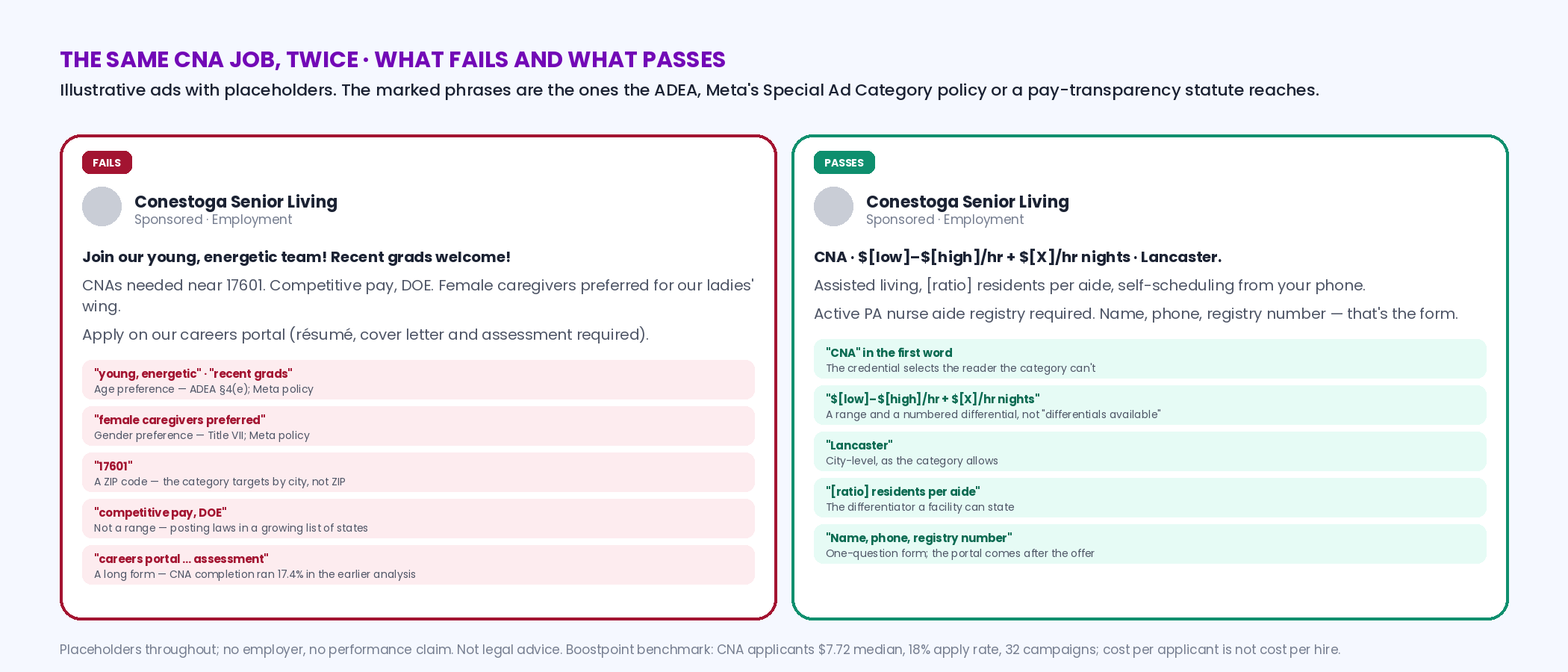
The ads that get rejected or quietly underperform fail in the same handful of ways. Age words: "recent grad," "young," "energetic," "digital native," "mature," "retirees welcome" — the last two are age preferences too, and the ADEA cuts both ways. Gender words: "waitress," "he will," "female caregiver preferred," even when a client requests it; the staffing decision may have its own legal analysis, but the ad can't carry it. Location words: a ZIP code in the copy isn't a policy violation, but it signals to the reader that the job is somewhere specific, and to Meta's reviewers that the advertiser is trying to do with words what the category forbids with targeting — use the city and the neighborhood name. Pay words: "competitive pay," "DOE," "up to $[X]" where the law wants a range, and a range so wide it is not one; several statutes require a good-faith range. And form words: a link to a portal that asks for a résumé, a cover letter, an assessment and a login before the applicant has spoken to anyone — which is where CNA completion goes from the caregiver's 31.3% to 17.4%.
Interactive
Ad language check — paste your draft, see what the rules reach
Nothing is stored or sent — this runs in your browser. A pattern check for age and gender words, ZIP codes, missing pay ranges and missing credentials. It catches phrases, not intent, and clearing it is not legal review.
Patterns: age preference (ADEA §4(e); Meta policy), gender preference (Title VII; Meta policy), ZIP codes (Meta location targeting is city-level in the Special Ad Category), pay language that is not a range (state posting laws), and a missing credential or shift in the first line (targeting by words). Illustrative and incomplete; your state's statute and counsel govern.
Where to run them, and what they cost to run
The templates are written for the phone feed, where a caregiver or a CNA between shifts sees them; the channel guide is on where to find caregivers, the CNA-specific version on CNA recruitment, and the full nursing cost picture — RN, LPN and CNA by setting — on RN, LPN and CNA recruiting cost. The figures in the role table above are what those campaigns cost per applicant with campaign management inside, from caregivers at a median $3.76 to RNs at $19.08; the template does not change the auction, it changes who taps and who finishes, which is the 70%.
The category took away the targeting; the statute took away the mystery rate. Put the credential, the range and the shift in the first line and let the words do what the settings used to. The same order works for licensed roles outside nursing; our dental hygienist job description puts the license, the rate and the schedule ahead of the duty list.
The ad brings them in; the interview decides. Our caregiver interview questions page covers what to ask a caregiver and what a strong answer actually contains.
Healthcare recruitment ads for allied health, therapy and behavioral health roles
The four templates above cover the nursing and caregiving roles most healthcare employers advertise every month. Healthcare recruitment ads for licensed allied health, therapy and behavioral health roles use the same structure, but they start from a harder position: in Boostpoint's 2026 benchmark, far fewer people who click one of these ads finish the application.
| Role family | Median cost per applicant | Middle 50% of campaigns | Apply rate |
|---|---|---|---|
| Allied health / imaging | $54.37 | $10.27 to $106.51 | 10% |
| Behavioral health / DSP | $55.55 | $18.36 to $334.56 | 9% |
| Therapy (PT / OT / SLP) | $74.62 | $44.85 to $171.40 | 5% |
Source: Boostpoint 2026 Social Job Advertising Benchmark, 891 Boostpoint-managed campaigns on Meta (1,334 campaign-months); costs are what advertisers paid, advertising only. Cost per applicant is not cost per hire.
Those apply rates sit in the benchmark's most expensive bands: campaigns converting under 5% of clicks paid a median $53.77 per applicant, and campaigns converting 5 to 10% paid $23.13, against $11.11 at 10 to 20%. So for these roles the form deserves more work than the headline. Three adjustments to the templates:
- Name the credential and the setting in the first line. For a therapist or technologist the setting (outpatient, home health, school, hospital) is part of the job itself, so put it next to the rate and the city, the way the RN template leads with the unit.
- Keep the form to name, phone and one credential question. Ask for the license or certification number, the résumé and references after the first call, not before it.
- Put your real differentiator in the description line, such as schedule, caseload or supervision, rather than leaving it in a careers-site job description the candidate may never open.
The Special Ad Category rules are the same for every healthcare role, so the words still do the targeting (see Meta's Special Ad Category). For role-specific channels, see how to recruit physical therapist assistants, how to hire RBTs and therapy staffing.
Frequently asked questions
What should a caregiver job posting template include?
In the first line: the job in the applicant's words, the pay range, the shift and the city, and whether a certification is needed. Then one differentiator (one client at a time, mileage, paid training), a start date, and a form that asks one question. The duties-and-requirements job description is a separate document; ours is on the caregiver job description page.
How do you write a caregiver job ad for Facebook or Instagram?
Declare it as an employment ad in the Special Ad Category, keep the primary text near Meta's recommended 50–150 characters with a 27-character headline, and put the credential status, rate range, shift and city in the first words, because age, gender and ZIP targeting are unavailable and the copy has to do the selecting. Link to a form with name, phone and one knockout question, not a portal.
Do you have to include pay in a job posting?
In a growing list of jurisdictions, yes — California, Colorado, Washington, New York, Hawaii, Illinois, Minnesota, Maryland, Massachusetts, New Jersey, Vermont and the District of Columbia already, with Virginia and Maine in 2026, Connecticut from October 2026 and Delaware in 2027, at employer-size thresholds from one employee to fifty (Jackson Lewis, January 2026; ADP, May 2026). Whatever your state says, an ad without a range competes with ads that have one.
What can't a healthcare job ad say under the Special Ad Category?
Nothing that expresses a preference by age, gender or other protected class — "recent grad," "young and energetic," "mature," "female caregiver preferred" — and the ad can't be targeted by age, gender or ZIP code. Age is fixed 18 through 65+, all genders are included, and location is city-level with an expanded 15-mile radius. The ADEA separately makes age-preference language in any job ad unlawful.
What is a good CNA job ad example?
"CNA · $[low]–$[high]/hr + $[X]/hr night differential · [City]. [Setting], [ratio] residents per aide, self-scheduling. Active [State] registry required." — with a headline of "CNA · $[low]–$[high]/hr nights" and a form that asks for name, phone and registry status. The credential in the first words filters the audience the category can't.
What should a nurse job posting template say first?
The unit, then the range, then the shift and differential, then the ratio and the scheduling policy, then the license required. RNs read the unit before the rate. In our benchmark RN campaigns ran a median $19.08 per applicant with an 11% apply rate across 173 campaigns, and RN application completion ran 12.4% in the earlier analysis — the form is where the nurse ad is won or lost.
Why does the application form matter so much?
Because what happens after the click explained 70% of the variation in cost per applicant across 891 campaigns. Campaigns converting under 5% of clicks paid a median $53.77 per applicant; over 35%, $1.61. A form with name, phone and one knockout question — with the license check and résumé after the offer — is the largest lever the template controls.
Can I use these templates on Indeed or a careers page?
Yes — the posting block in each card is written for that, and the pay-transparency rules apply there too. Keep the range, the shift and the credential at the top, describe benefits in a line where your state requires it, and keep the application short even on a job board, since the same completion arithmetic applies.
What are healthcare recruitment ads?
Paid ads that promote open healthcare jobs, on Facebook, Instagram, job boards or other channels, written to get a qualified caregiver, CNA, nurse or therapist to apply. On Meta they must run in the Employment special ad category, so they can't be targeted by age, gender or ZIP code, and the first line of the ad has to name the credential, pay range, shift and city to reach the right people. The templates on this page are built that way.
How much do healthcare recruitment ads cost?
It depends on the role far more than on the platform. In Boostpoint's 2026 Social Job Advertising Benchmark, median cost per applicant was $3.76 for the Caregiver / home care family, $7.72 for CNA / nursing assistant, $12.77 for LPN / LVN, $19.08 for registered nurse, $54.37 for allied health / imaging, $55.55 for behavioral health / DSP and $74.62 for therapy (PT / OT / SLP). Those are costs per applicant, not costs per hire, and the apply rate explains most of the difference.
Have us write and run them
We'll build the caregiver, CNA and nurse ads from these templates with your rates and your differentiators, declare and run them correctly, put a one-question form behind each, and show you the healthcare campaigns closest to yours.
Book a Demo


Boostpoint figures come from the 2026 Social Job Advertising Benchmark — 891 campaigns and 1,334 campaign-months: caregiver / home care median cost per applicant $3.76, middle 50% $2.99–$5.83, 31% apply rate, 34 campaigns; CNA $7.72, $6.18–$12.06, 18%, 32; LPN / LVN $12.77, $7.53–$21.46, 21%, 57; registered nurse $19.08, $12.76–$34.84, 11%, 173; applicant conversion explained 70% of cost variation, click-through rate 30%, CPM 18%; apply-rate bands under 5% $53.77, 5–10% $23.13, 10–20% $11.11, 20–35% $4.41, over 35% $1.61; 41% of budget in campaigns converting under 10% returned 11% of applicants. Earlier campaign-level analysis (different methodology): completion caregiver 31.3%, CNA 17.4%, LPN 18.4%, RN 12.4%, hospital setting 6.0%. Meta policy is summarized from Meta's published Special Ad Category help pages; feed character recommendations are Meta's Ads Guide as read by two 2026 spec guides; pay-transparency law is summarized from Jackson Lewis (January 30, 2026) and ADP SBS HR (May 4, 2026), read August 25, 2026 — none of it legal advice, and thresholds and dates change. Templates are Boostpoint's practice with placeholders; no wage is asserted. Cost per applicant is not cost per hire; we do not track hires and publish no cost-per-hire figure. A sample of Boostpoint campaigns, not an industry-wide study.