
Owner Operator and CDL Grad Recruiting: The Two Drivers Your Ad Isn't Written For
Most driver ads are written for the middle — a company driver with two years and a clean MVR. Owner-operators and CDL grads sit at the two ends and read opposite things: owner-ops read the numbers (rate per mile, fuel surcharge, deadhead, and how they compare with ATRI's $2.336-per-mile 2025 industry cost), and grads read the path (who finishes their training, and how the 1–2-year insurance gate gets cleared). In Boostpoint's 2026 Social Job Advertising Benchmark, CDL driver campaigns ran a $26.86 median cost per applicant; the ad, not the platform, decides which end of the market answers.
A note on who's writing this
Boostpoint runs social recruitment advertising for fleets, carriers, and rural co-ops, so this page favors the channel we sell — and it shows our own numbers, including that CDL drivers are the most expensive frontline applicants we reach. The advertising figures come from the CDL truck driver campaigns in our 2026 Social Job Advertising Benchmark and the earlier trucking analysis on our truck driver recruiting pillar. Every dollar figure about owner-operator economics or lease-purchase outcomes is third-party — the American Transportation Research Institute (ATRI), the FMCSA Truck Leasing Task Force, and Congress's own bill tracking — because we don't run trucks and won't pretend to know what one costs. If your question is fees, our truck driver recruiting agency cost page has them; if it's which boards to post on, see the best trucking and CDL job boards.
Why one driver ad reaches neither end
A driver ad that says "competitive CPM, great home time, 2 years experience required" is invisible to both groups. The owner-operator skims past "competitive" because she has a spreadsheet and needs a number to put in it. The CDL grad stops at "2 years required" because he has three weeks. Both were reachable — in our earlier trucking analysis, drivers clicked at a 1.62% click-through rate and completed applications at 16.8% — and both left without applying, and you paid for the click either way.
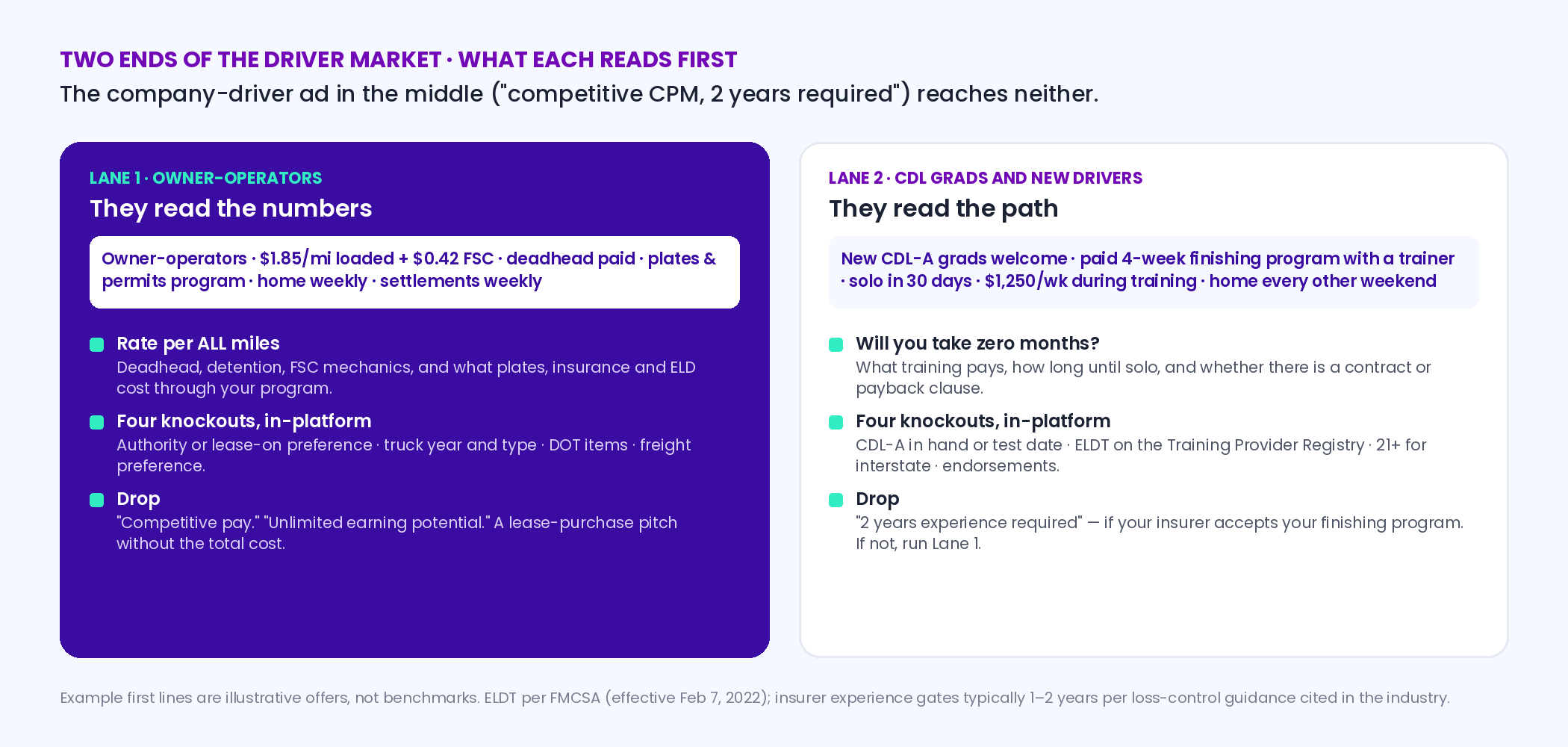
Here is what each reads first, side by side. The left lane is a working set of the facts an owner-operator's decision runs on; the right is the path a grad needs to see. Neither is a job description — the CDL driver job description template is on its own page.
- First line
- Owner-operators · $1.85/mi loaded + $0.42 FSC · deadhead paid · plates & permits program · home weekly · settlements weekly
- What they compute before they tap
- Rate per all miles, not per loaded mile: deadhead, detention, fuel surcharge mechanics, and what plates, insurance, and ELD cost through your program. Missing any one of these reads as "hiding something."
- Knockouts that belong on the form
- Own authority or leased-on preference; truck year and equipment type; DOT-required items (MVR, medical card); freight preference. Four questions, in-platform.
- What to drop
- "Competitive pay." "Unlimited earning potential." Any lease-purchase pitch that leads with a low weekly payment and not the total cost.
- First line
- New CDL-A grads welcome · paid 4-week finishing program with a trainer · solo in 30 days · $1,250/wk during training · home every other weekend
- What they compute before they tap
- Whether you'll take them at zero months, what training pays, how long until solo, and whether there's a contract or a payback clause. Those four answers are the ad.
- Knockouts that belong on the form
- CDL-A in hand or test date; ELDT completed (Training Provider Registry); age 21+ for interstate; endorsements. Not "years of experience" — that is the field that removes the entire pool.
- What to drop
- "2 years experience required" if you have a finishing program and an insurer who accepts it. If you don't, don't run the grad ad — run the other lane.
Owner-operators: the rate translator
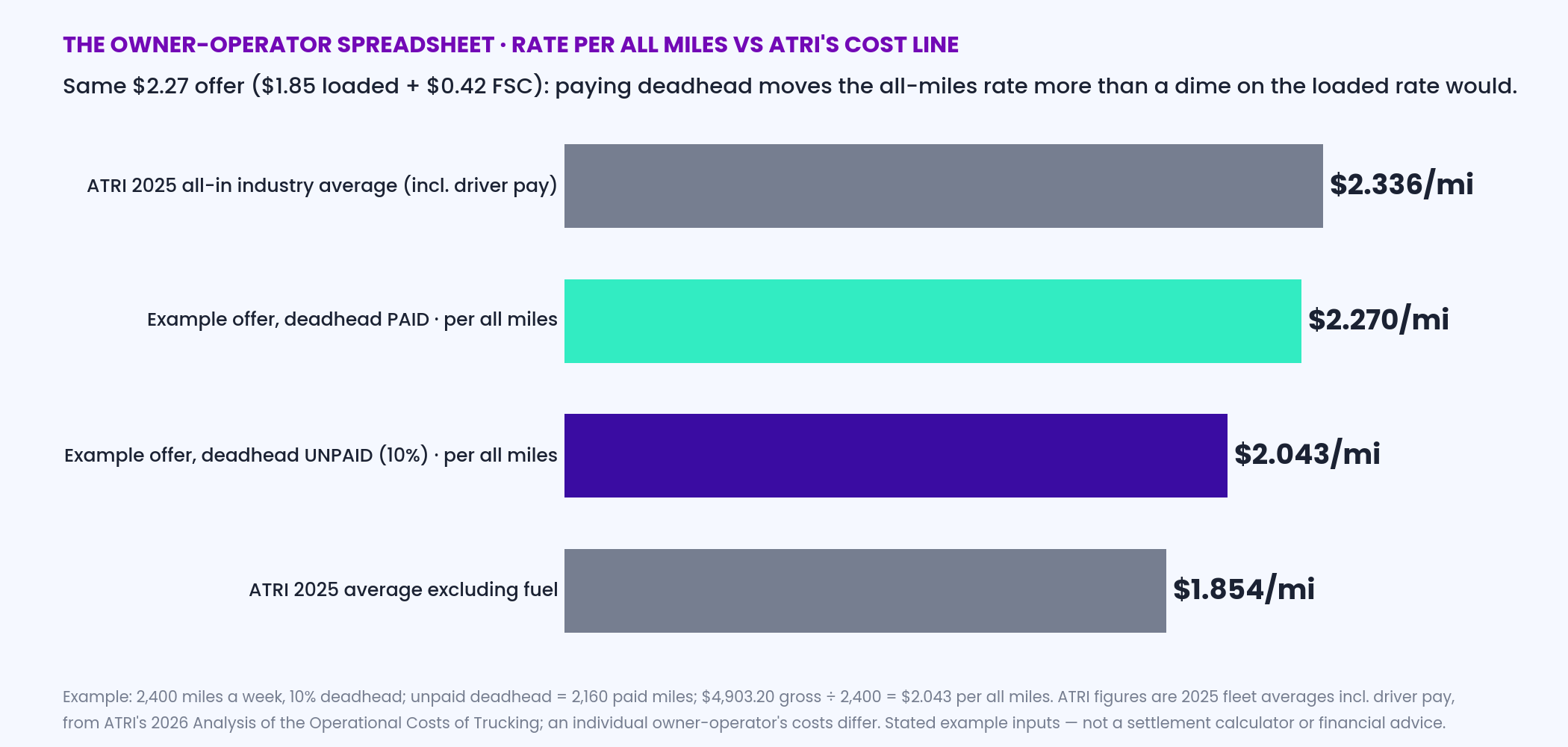
Owner-operators are running a business against a cost line, and the best public estimate of that line is ATRI's annual Operational Costs of Trucking. The 2026 edition, covering 2025, puts the industry-average cost of operating a truck at $2.336 per mile — $1.854 per mile excluding fuel — up 3.4% on the year, with truckload and refrigerated carriers' operating margins "below 1.0%" and flatbed at an operating loss. Those are fleet averages that include driver wages and benefits, so an owner-operator's own take-home is what is left after the truck's share of that line. The point for your ad is simpler: an owner-operator reads your rate as a rate per all miles, deadhead included, and compares it with a number like ATRI's. The translator does the arithmetic your applicant is doing in her head.
Nothing is stored or sent — this runs in your browser. Weekly gross = (loaded rate + FSC) × paid miles; rate per all miles = weekly gross ÷ total miles driven.
2,160 paid miles × $2.27
what the owner-operator writes in the spreadsheet
per mile against $2.336 all-in
Illustrative arithmetic from stated inputs. ATRI's $2.336 (all-in) and $1.854 (excluding fuel) per-mile figures are 2025 industry averages for fleets, including driver wages and benefits, from the 2026 Operational Costs of Trucking report; an individual owner-operator's costs differ, and this is not a settlement calculator or financial advice. It exists so the number in your ad survives the applicant's spreadsheet.
Lease-purchase recruiting: what we will and won't run
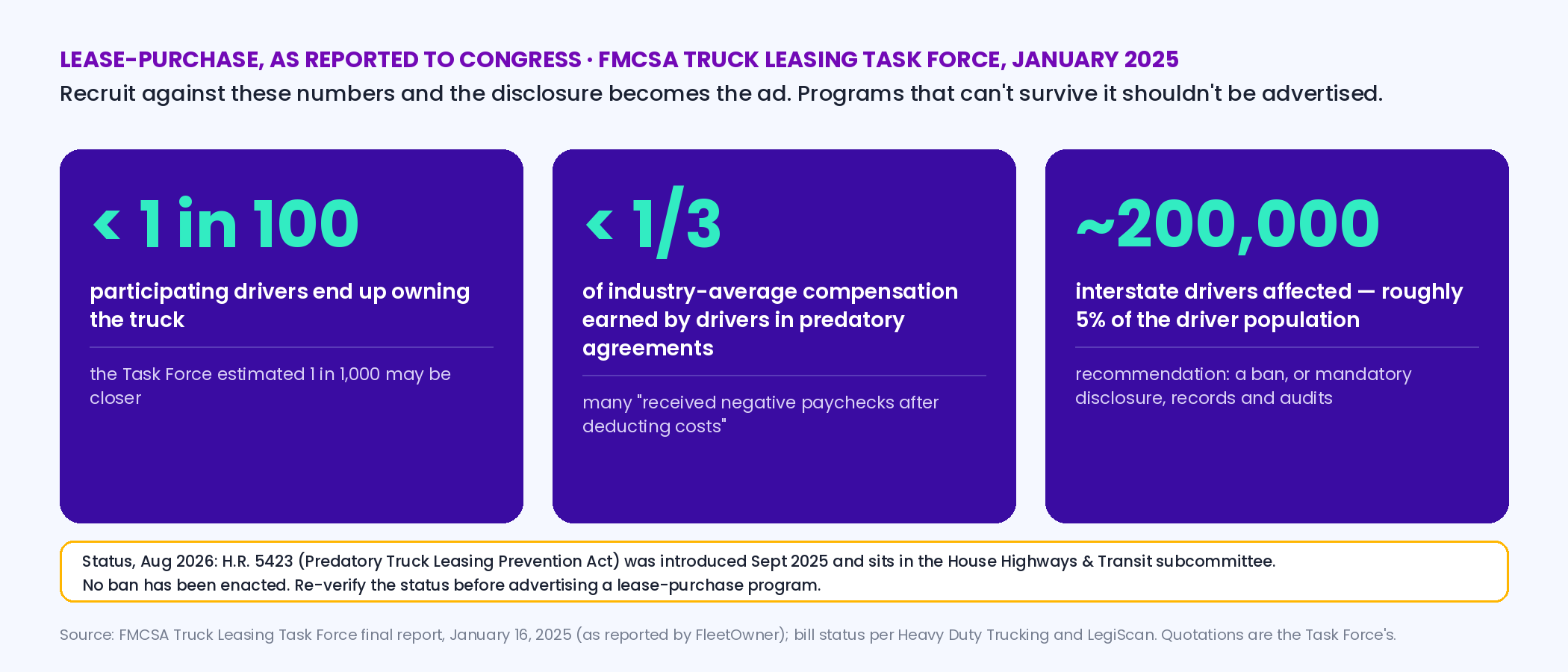
"Lease purchase recruiting" is a real search, so here is the honest state of it. In January 2025 the FMCSA's Truck Leasing Task Force — created by Congress in the 2021 infrastructure law — reported that "less than one in 100 participating drivers end up owning the truck," that drivers in predatory agreements earned "less than one-third of the industry's average compensation," that an estimated 200,000 interstate drivers were affected, and that many "received negative paychecks after deducting costs from take-home pay." Its recommendation was a ban, and where a ban isn't enacted, mandatory record-keeping, full disclosure of financing and operating terms, and audits. A bill to do that — the Predatory Truck Leasing Prevention Act, H.R. 5423 — was introduced in September 2025 and, as of this writing, sits in the House Highways and Transit subcommittee with no further action recorded. Nothing has been banned yet; everything has been named.
Our position is practical rather than moral. We will run lease-purchase ads that show the total cost of the truck, the weekly payment, the term, what happens at the end, and the rate — the disclosures the Task Force asked for — because an ad like that recruits the drivers who will still be there in a year. We won't run one that leads with "be your own boss, $0 down" and hides the rest, because it recruits the drivers the Task Force counted, and they leave in a settlement or two, taking your ad spend with them. If your program can't survive its own disclosure, that is the finding, not the ad.
CDL grads: the path is the ad
Since February 7, 2022, anyone getting a Class A or Class B CDL for the first time, upgrading B to A, or adding a school bus, passenger, or hazmat endorsement has had to complete Entry-Level Driver Training from a provider listed on FMCSA's Training Provider Registry. That means every grad you meet has the same federal floor of theory and behind-the-wheel training, and the registry is a knockout you can verify. What ELDT doesn't give them is the thing your insurer wants: verifiable commercial driving experience. Loss-control guidance cited in the industry — for example, Great American Insurance Group's, as summarized by the CDL staffing firm GoDrivers360 — typically looks for one to two years, with school miles and simulator hours not counting. That gate, not the grad, is why "2 years required" is on every ad, and the only way through it is a finishing program your insurer has signed off on.
So the grad ad is a description of that path: paid finishing program, named length, trainer in the seat, pay during training, days to solo, and whether there's a contract or a payback clause. Grads have been told by every school that "everyone hires new drivers" and by every ad that nobody does; the fleet that says exactly how it bridges the gap gets the applications. Turnover is the risk on this lane — our truck driver turnover page covers what an early exit costs and what keeps first-year drivers — so the ad should be honest about the first 90 days rather than the best week.
The case for a driver-recruiting agency or lead vendor, made fairly
Driver-recruiting firms and pay-per-lead vendors have three honest uses. When you are opening a terminal in a market where you have no brand and no referral network, a firm with a local driver file is faster than any campaign. When your recruiting desk is one person who also handles orientation, buying screened leads is buying hours. And for owner-operators specifically, a broker who already knows which independents run your lanes can produce three real conversations in a week. Those are worth paying for, and the fee models — per lead, per hire, per month — are laid out with third-party figures on our truck driver recruiting agency cost page.
Where it weakens is durability. Leads sold to you are sold to others; a driver file the vendor built stays the vendor's; and the ad that reaches an owner-operator with a number she can check is the same ad you could have run. Our CDL driver recruiting costs by channel page puts the channels side by side. The rest of this page is the owned-pipeline version for the two lanes.
What driver applicants cost on social — both lanes
CDL drivers are the most expensive frontline applicants in our 2026 benchmark: across 59 campaigns, a $26.86 median cost per applicant, a middle half of $17.00–$42.31, a $24.24 blended average, an 8% apply rate, and a 0.88% click-through rate. The wider Transportation & Logistics sector — 184 campaigns including non-CDL roles — ran a $13.34 median. Two earlier findings from our trucking analysis are the ones that matter for these lanes. First, 64.6% of driver applicants were aged 55 and over, and they were the cheapest to acquire — consistent with BLS's median age of 57 for heavy and tractor-trailer drivers. Employment ads can't target by age, so that is who answers a plain, numbers-first ad; it is also where the owner-operators are. Second, rural is possible: co-op campaigns in North Dakota and South Dakota for CHS, and for Insight FS and Mid Kansas Co-Op, ran about three times the blended cost — but at a CPM of $14.87 against $40.32 and a frequency of 5.4 against 2.3. The claim is that rural drivers are reachable, not that they are cheaper.
| Metric | CDL truck driver | Transportation & Logistics (sector) | All 891 campaigns |
|---|---|---|---|
| Median cost per applicant | $26.86 | $13.34 | $13.88 |
| Middle 50% of campaigns | $17.00 – $42.31 | $5.26 – $25.17 | $6.48 – $29.74 |
| Blended (volume-weighted) average | $24.24 | $10.28 | $8.02 |
| Apply rate (click to completed application) | 8% | 13% | — |
| Click-through rate / CPM | 0.88% CTR | $14.82 CPM | — |
| Campaigns in sample | 59 | 184 | 891 |
One structural finding applies to grads in particular. Benchmark-wide, event-driven campaigns — a dated orientation, a hiring day, a finishing-program start date — ran an $8.02 median cost per applicant against $14.45 for single-role always-on campaigns. That is the whole benchmark, not drivers alone, so don't budget a driver event at $8.02; do notice that a grad ad naturally has a date in it ("next finishing class starts October 6"), and dated ads are the cheapest structure we track.
The playbook, in order of impact
- 1. Run two ads, not one. Same account, same targeting, opposite first lines: the numbers for owner-operators, the path for grads. The middle-market driver ad can keep running; it just isn't reaching these two.
- 2. Owner-ops: state rate, FSC, and deadhead in the first line, and make it survive the translator. If the all-miles rate lands below ATRI's ex-fuel average, fix the deadhead policy before you spend on reach.
- 3. Grads: replace "2 years required" with the finishing program. Length, trainer, pay during training, days to solo, contract terms. If you don't have a program your insurer accepts, don't run this lane.
- 4. Lease-purchase: disclose or don't advertise. Total cost, payment, term, end-of-term, rate. The Task Force's numbers are public; drivers have read them.
- 5. Four knockouts, in-platform, no résumé. Drivers convert at 8% in our benchmark — the second-lowest apply rate we track — so every extra field is expensive. Lane 1: authority/lease preference, truck, DOT items, freight. Lane 2: CDL status, ELDT registry, 21+, endorsements.
- 6. Put a date in the grad ad. "Next finishing class starts [date]" turns an always-on ad into an event-driven one, the cheapest structure benchmark-wide.
- 7. Call within the hour, from a recruiter who can quote the rate. Owner-operators are talking to two other carriers; grads are talking to five. The first callback that answers the spreadsheet question wins.
The math for a fleet that needs six drivers
Say you need 6 drivers this quarter across both lanes and plan on 10 applicants per hire — a stated assumption; use your own ratio — so 60 applicants. At the CDL median, 60 × $26.86 = $1,611.60. At the blended rate, 60 × $24.24 = $1,454.40. At the cheap end of the middle half, 60 × $17.00 = $1,020.00; at the expensive end, 60 × $42.31 = $2,538.60. For a sense of what structure is worth, the same 60 applicants at the benchmark-wide event-driven median would be 60 × $8.02 = $481.20 — a ceiling on what a dated grad campaign could look like, not a forecast for it. Cost per applicant is not cost per hire; the six hires depend on your ratio, your finishing program, and your first-90-day retention.
Owner-operators and CDL grads are not hard to reach — they are hard to write for. One ad carries the numbers, the other carries the path, and the lease-purchase ad carries its disclosures or doesn't run.
Hiring for the yard as well as the road? Our free equipment operator job description covers the machine side, including where a CDL is genuinely required and where it is only listed.
Frequently asked questions
How do you recruit owner-operators?
Lead with the numbers an owner-operator will put in a spreadsheet: loaded rate per mile, fuel surcharge and how it's calculated, whether deadhead and detention are paid, the plates, permits, insurance, and ELD program, settlement cadence, and home time. Reach them in social feeds, where working independents are, with a four-question in-platform form (authority or lease-on preference, truck, DOT items, freight) and a recruiter who calls within the hour able to quote the rate. Owner-operators compare your rate per all miles with public cost figures such as ATRI's $2.336-per-mile 2025 industry average; an ad that hides the rate reads as hiding a bad one.
What should an owner operator recruiting ad include?
In the first line: loaded rate per mile, fuel surcharge per mile, deadhead policy, plates and permits program, settlement schedule, and home time — for example, "Owner-operators · $1.85/mi loaded + $0.42 FSC · deadhead paid · plates & permits program · home weekly · settlements weekly." Then the freight and lanes, the equipment you run, and what the program costs. Leave out "competitive pay," "unlimited earning potential," and any lease-purchase pitch that shows the weekly payment without the total cost and term.
How do you recruit CDL grads and new drivers?
Describe the path instead of the requirement: a paid finishing program with a named length, a trainer in the seat, pay during training, days to solo, home time, and whether there is a contract or payback clause. Screen on CDL status or test date, ELDT completion on FMCSA's Training Provider Registry, age 21 or over for interstate, and endorsements — not years of experience. Put the next class start date in the ad; benchmark-wide, event-driven campaigns ran an $8.02 median cost per applicant against $14.45 for always-on single-role campaigns.
Can we hire drivers straight out of CDL school?
Only if your insurer accepts it. Since February 7, 2022, every first-time Class A or B CDL holder has completed federal Entry-Level Driver Training through a registered provider, but insurers' loss-control guidance typically looks for one to two years of verifiable commercial driving experience, and school miles and simulator hours don't count. Fleets that hire grads do it through a finishing program the insurer has approved — trainer-supervised weeks before solo — and the ad has to describe that program, because it is the only thing that gets a grad past the experience gate.
Is lease-purchase recruiting still allowed in 2026?
Yes, though it is under scrutiny. The FMCSA Truck Leasing Task Force reported to Congress in January 2025 that fewer than one in 100 participating drivers end up owning the truck, that drivers in predatory agreements earned less than a third of industry-average compensation, and that roughly 200,000 drivers were affected; it recommended a ban, or failing that, mandatory disclosure, record-keeping, and audits. The Predatory Truck Leasing Prevention Act (H.R. 5423) was introduced in September 2025 and, as of this writing, remains in subcommittee. Programs that disclose total cost, payment, term, end-of-term outcome, and rate can be advertised honestly; programs that can't survive that disclosure shouldn't be advertised at all. Verify the current status before running the campaign.
What does it cost to recruit truck drivers on social?
In our 2026 benchmark, CDL driver campaigns ran a $26.86 median cost per applicant across 59 campaigns, with the middle half between $17.00 and $42.31, a $24.24 blended average, an 8% apply rate, and a 0.88% click-through rate — the most expensive frontline applicants we reach. Our earlier trucking analysis put the blended cost at $13.57 with most campaigns between $8 and $24, on a different methodology; the benchmark is canonical. Cost per applicant is not cost per hire; at a stated planning ratio of 10 applicants per hire, six hires is 60 applicants and $1,611.60 at the median.
Why are most of our driver applicants over 55?
Because that is who drives trucks and who answers plain ads. In our trucking analysis, 64.6% of driver applicants were 55 or older and they were the cheapest to acquire, which lines up with BLS's median age of 57 for heavy and tractor-trailer drivers. Employment ads on Meta run under the Special Ad Category with no age targeting, so the skew is organic response, not targeting. For owner-operator recruiting that is the pool you want; for grads, the finishing-program ad is what shifts the mix younger, not a targeting setting you don't have.
Where do you find owner-operators?
Working, on the road, and on their phones between loads — which is why social feeds outperform job boards for this group. Independent drivers rarely search job boards, but they scroll, and an ad with a rate, an FSC, and a deadhead policy in the first line gets tapped. Secondary channels are your own leased-on operators' referrals, truck-stop and terminal presence, and owner-operator brokers who know your lanes, with fees covered on our agency cost page. Rural markets are reachable: co-op campaigns for CHS, Insight FS, and Mid Kansas Co-Op ran at about three times our blended cost but at a $14.87 CPM against $40.32.
How do you hire owner-operators?
Recruiting gets the conversation; hiring an owner-operator who leases onto your authority is a contract. Federal leasing rules at 49 CFR 376.12 require a written lease signed by both parties that clearly states the compensation, gives the carrier exclusive possession and responsibility for the equipment for the lease term, lists every charge-back that will be deducted from the owner-operator's pay and any escrow amount, and provides for payment within 15 days after the delivery documents are submitted; on percentage pay, the owner-operator gets a copy of the rated freight bill. Put the rate, fuel surcharge and deadhead policy in the ad, share the lease terms before orientation so the numbers can be checked, and run your normal driver qualification steps. This is general information, not legal advice.
See what owner-operator and grad ads cost fleets like yours
We'll show you the CDL campaigns closest to yours across 891 real campaigns — and the two first lines that reach the ends of the market your driver ad is missing.
Book a DemoAdvertising figures come from the CDL truck driver role family, the Transportation & Logistics sector, and the campaign-structure cut of the 2026 Social Job Advertising Benchmark — 891 campaigns and 1,334 campaign-months overall: CDL $26.86 median cost per applicant, $17.00–$42.31 middle 50%, $24.24 blended (volume-weighted) average, 8% apply rate, 0.88% click-through rate, 59 campaigns; sector $13.34 median, $5.26–$25.17 middle 50%, $10.28 blended, 13% apply rate, $14.82 CPM, 184 campaigns; event-driven $8.02 median vs single-role $14.45 (benchmark-wide, 78 and 1,210 campaigns); benchmark-wide $13.88 median, $6.48–$29.74 middle 50%, $8.02 blended. The 1.62% click-through rate, 16.8% click-to-apply, $13.57 blended cost with an $8–$24 typical range, 64.6% share of applicants aged 55+, and the rural co-op comparison (about three times the blended cost, $14.87 vs $40.32 CPM, 5.4 vs 2.3 frequency; CHS, Insight FS, Mid Kansas Co-Op) come from an earlier campaign-level trucking analysis with a different date range; where they conflict with the benchmark, the benchmark is canonical. No seasonal claims are made for CDL campaigns. The six-hire example uses a stated 10-applicants-per-hire planning assumption to be replaced with your own ATS ratio ($1,611.60, $1,454.40, $1,020.00, $2,538.60, and $481.20 resolve exactly from 60 applicants at $26.86, $24.24, $17.00, $42.31, and $8.02). The rate translator computes weekly gross as (loaded rate + FSC) × paid miles and rate per all miles as gross ÷ total miles from whatever you enter; its defaults ($1.85 + $0.42 = $2.27 per paid mile, 2,400 miles, 10% unpaid deadhead → 2,160 paid miles, $4,903.20 gross, $2.043 per all miles, −$0.293 against $2.336; $5,448.00 and $2.27 with deadhead paid) are stated example inputs, not a settlement calculator. Cost per applicant is not cost per hire; we do not track hires and publish no cost-per-hire figure. Third-party figures: $2.336 per mile all-in and $1.854 excluding fuel (2025 data, +3.4%), sector operating margins, and the unseated-truck figure from ATRI's 2026 Analysis of the Operational Costs of Trucking (news release); Truck Leasing Task Force findings (fewer than one in 100 owning the truck, less than one-third of average compensation, about 200,000 drivers affected, negative paychecks, ban recommendation) from the FMCSA TLTF final report of January 16, 2025, as reported by FleetOwner; H.R. 5423 introduction (September 2025) and subcommittee status from Heavy Duty Trucking and LegiScan; Entry-Level Driver Training scope and the February 7, 2022 date and Training Provider Registry from FMCSA; insurer experience expectations (one to two years; school miles not counted) from GoDrivers360's summary of Great American Insurance Group loss-control guidance; median driver age 57 from BLS. Lease-purchase law is changing — verify the current status before advertising a program. This is a sample of Boostpoint campaigns, not an industry-wide study.
Hiring for the yard as well as the road? Our free crane operator job description template covers duties, pay and the OSHA certification and employer-evaluation requirements.