
Employer guideUpdated September 2026
Cost of Vacancy Calculator: What an Open Frontline Seat Costs Per Day
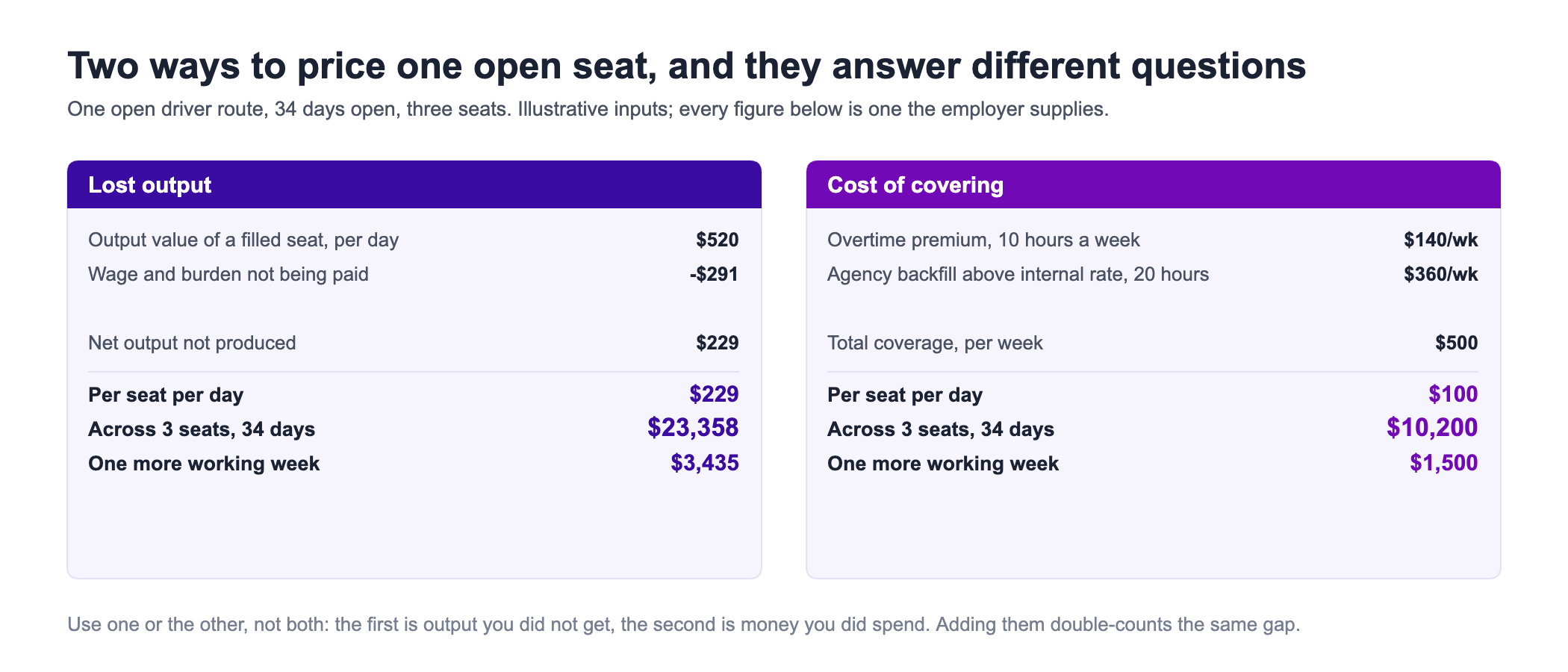
An open seat costs you something every single day it stays open, and on frontline work the daily figure is usually larger than the entire cost of filling it. On the worked example below, one open route costs $229 a day in output that is not produced, or $100 a day in overtime and agency cover — and thirty-four days across three seats is $23,358 or $10,200 depending on which question you are answering. The calculator gives you both, plus the cost of one more week, which is the number that actually changes decisions.
What cost of vacancy is, and the two formulas in use
Cost of vacancy is what an unfilled position costs the business per day it stays unfilled. Two formulas are in circulation and they are not interchangeable, because they measure different things.
The revenue or output method
Cost per day = the value one filled seat produces in a day − the wage and burden you are not paying while it is empty
This is what the vacancy costs in production. It is the right formula when the seat generates measurable output: a route that does not run, a line that runs short, a chair that bills nothing. Subtracting the unpaid wage matters — a vacancy is not free of savings, and a figure that ignores them will be laughed out of a finance meeting.
The cost or coverage method
Cost per day = (overtime premium + agency backfill above your internal rate) ÷ working days
This is what the vacancy costs in cash. It is the right formula when the work still gets done — somebody covers it — and the cost shows up as overtime and agency invoices rather than as lost production. Under the Fair Labor Standards Act, hours over forty in a workweek are paid at not less than one and a half times the regular rate, so the extra cost of covering with overtime is the half-time premium, not the whole hour.
Use one or the other. They are two answers to two questions, and adding them together double-counts the same gap: if the work got done on overtime, the output was not lost, and if the output was lost, you did not pay for cover.
Cost of vacancy calculator
The three ways an open seat costs money
Whatever formula you use, the money leaves through one of three doors, and knowing which one it is tells you what to do about it.
- Lost output. The route does not run, the shift runs short, the bed is not staffed, the machine is idle. This is the largest of the three where it applies, and the hardest to get on a report, because nothing was invoiced. It is also the one your operations leader can price in about ninety seconds if you ask them what a filled seat is worth in a day.
- Overtime. Somebody covers, and the incremental cost is the half-time premium over forty hours. Ten hours a week of cover on a $28.00 base rate is $140 a week, which sounds small until it runs for two months across three seats. Overtime also has a second cost that no calculator captures: it is one of the more reliable predictors of the next resignation.
- Agency backfill. The gap gets filled at a bill rate rather than a wage. The incremental cost is the spread — the bill rate less what you would have paid internally — and on frontline work that spread is commonly 25% to 100% of the pay rate. We take that apart on staffing agency markup.
How long seats stay open, and why we will not publish a benchmark
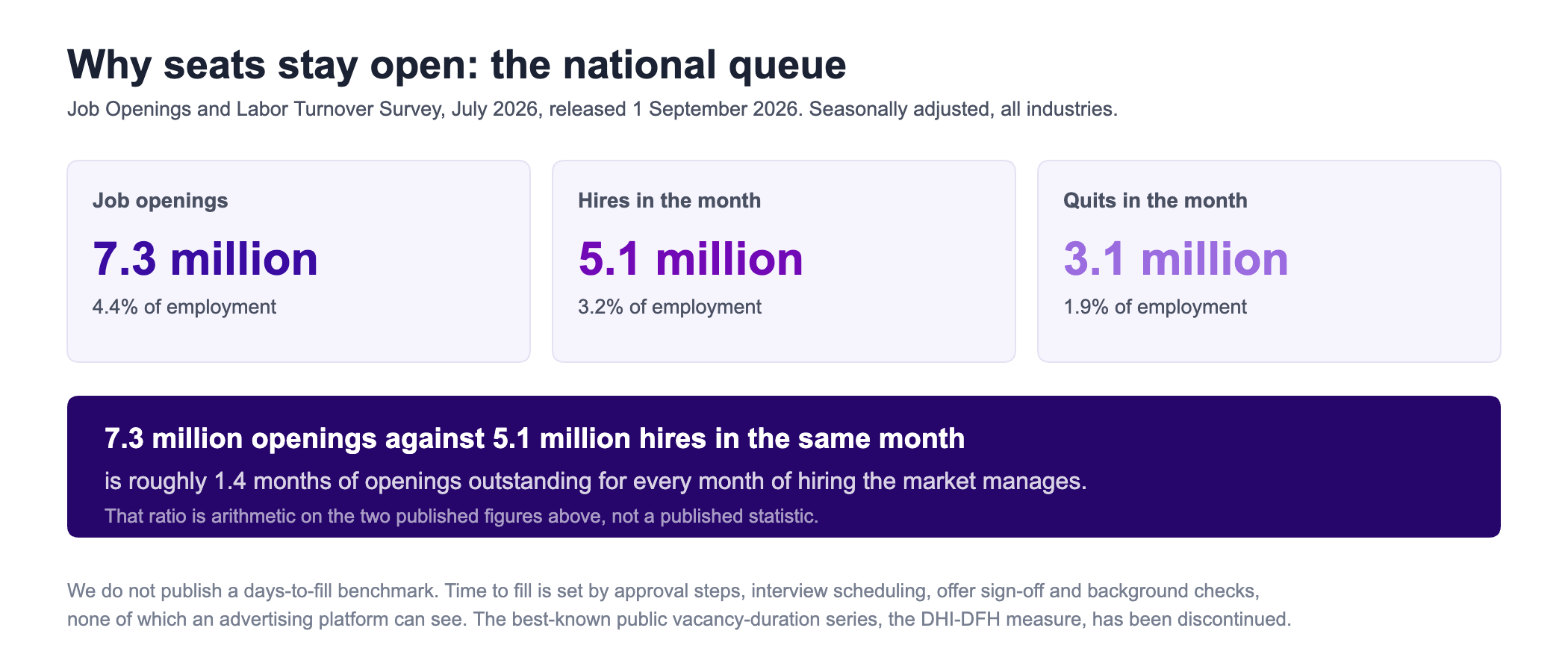
The honest answer is that we do not know how long your seats stay open, and neither does anybody selling you a days-to-fill benchmark. Time to fill is decided by approval steps, interview scheduling, offer sign-off and background checks as much as by candidate flow, and none of those are visible to an advertising platform. The best-known public vacancy-duration series, the DHI-DFH Mean Vacancy Duration Measure, has been discontinued, which removed the one figure a reader could have checked independently.
What you can check is the market the vacancy sits in. In July 2026 there were 7.3 million job openings across the economy, a 4.4% rate, against 5.1 million hires in the month at 3.2% and 3.1 million quits at 1.9%. Openings running about 1.4 times monthly hires is a queue, and it is the reason a seat that used to fill in two weeks now takes longer without anything in your process having changed.
When the number justifies ad spend
This is the point of the calculation. A cost of vacancy converts a hiring delay into a daily rate, and once you have a daily rate the advertising decision stops being a matter of taste.
Take the worked example: one open route costing $229 a day in lost output. Across 891 managed campaigns in our 2026 benchmark, the median campaign cost $13.88 per applicant, and CDL driver campaigns specifically ran a $26.86 median. At that rate, a day of vacancy funds roughly eight and a half driver applicants. If eight applicants would not fill the seat, two days of vacancy funds seventeen, and three funds twenty-five. The question is not whether the advertising is expensive; it is whether the seat is worth more open or filled.
Two cautions. The first is that spending more on advertising only shortens time to fill if candidate flow is what is holding the seat open — if the delay is an approval step or an interview scheduling backlog, more applicants make the queue longer, not shorter. The second is that a cost of vacancy is a rate, not a budget: it tells you the ceiling on what a day of delay is worth, and the sensible spend is usually far below that ceiling.
The one-more-week question
Total cost of vacancy is a number that makes people wince and then do nothing, because the money is already spent. The cost of one more week is the number that changes behavior, because it is a decision still in front of you: approve the overtime, raise the rate, widen the radius, or accept the week. That is why the calculator reports it separately.
Before costing a seat it is worth checking whether the shortfall is structural at all. Understaffing gives a three-number test and compares your quit rate against your own sector’s published rate.
Frequently asked questions
What is the cost of vacancy?
The cost of vacancy is what an unfilled position costs the business for each day it stays unfilled. It is measured one of two ways: the output a filled seat would have produced less the wage you are not paying, or the cash you are spending on overtime and agency cover to keep the work moving. On the frontline example on this page, one open route costs $229 a day in lost output or $100 a day in coverage.
How do you calculate cost of vacancy?
Pick a method. For the output method: take the value one filled seat produces in a working day, subtract the daily wage and burden you are not paying while it is empty, and multiply by days open and by the number of open seats. For the coverage method: add the overtime premium and the agency backfill above your own hourly rate, then divide by working days. Do not add the two together, because they price the same gap twice.
What is the cost of an unfilled position?
It depends entirely on what the seat produces and on whether the work stops or somebody absorbs it. There is no credible universal figure, and any single dollar amount offered as one is a guess dressed as research. What is universal is the structure: lost output, overtime premium, agency backfill, minus the wage you are not paying. Fill those four from your own records and the answer is yours in about ten minutes.
What does an open position cost per day?
Divide whichever total you calculated by the days the seat has been open. On the example here, three open routes over thirty-four days cost $23,358 in lost output, which is $229 per seat per day. The per-day figure is the more useful one: it converts a hiring delay into a rate you can compare directly against the cost of doing something about it.
What is the cost of slow hiring?
The cost of vacancy multiplied by the extra days. If an average seat takes ten days longer than it needs to and costs $229 a day, slow hiring costs $2,290 per hire, every hire. At fifty hires a year that is $114,500, which is usually far more than the entire recruiting budget. This is why time to fill is worth attacking even when cost per hire looks healthy.
How long do frontline roles stay open?
We do not publish a benchmark, because time to fill is set by approval steps, interview scheduling, offer sign-off and background checks that no advertising platform can see, and the best-known public vacancy-duration series has been discontinued. What you can check is the market: in July 2026 there were 7.3 million job openings against 5.1 million hires in the month, a ratio of about 1.4 that explains why seats sit longer than they used to.
Is cost of vacancy the same as turnover cost?
No, but one contains the other. Turnover cost is what a departure costs in total, commonly 16% to 33% of the leaver's annual pay, and vacancy is one component of it alongside separation, replacement and training. Cost of vacancy is the daily rate for the gap alone, and it applies to any open seat, including a new headcount that has never been filled by anybody.
How do you present cost of vacancy to finance?
Lead with the daily rate and the source of each input, not with the total. Say which method you used, show the wage you subtracted, and quote the cost of one more week rather than the cost so far, because the first is a decision and the second is history. Expect to be asked whether the output was genuinely lost or absorbed by overtime; have the answer ready, because using both methods at once is the fastest way to lose the room.
Two neighbors: what a departure costs in total is on the turnover cost calculator, and what the person costs once the seat is filled is on the employee cost calculator.
Price the advertising against the vacancy
Tell us the roles you are filling and the markets you are filling them in, and we will show you what an applicant costs there before you commit a budget.
Book a Demo