
Caregiver Turnover: What It Actually Costs and What Reduces It
Median caregiver turnover ran about 75% in 2024, and nearly four out of five caregivers who leave do so within their first 100 days. Each departure costs an estimated $2,600 to $5,000. Meanwhile, generating a caregiver applicant costs $3.47. The math says the constraint was never your recruiting budget.
See what caregiver hiring costs in your service area →
The number that should change how you budget
Home care operators talk about turnover as a retention problem and recruiting as a separate line item. The data suggests they're the same problem, and that most agencies are solving it from the wrong end. It's the through-line in all of our healthcare recruiting data.
Here are the three figures side by side:
| Measure | Figure | Source |
|---|---|---|
| Median caregiver turnover, 2024 | ~75% | Industry benchmarking, down from a peak near 79% |
| Departures within first 100 days | Nearly 4 in 5 | Industry benchmarking |
| Cost of one caregiver departure | $2,600–$5,000 | Recruitment and training estimates |
| Cost to generate one caregiver applicant | $3.47 | Boostpoint campaigns, 2025–26 |
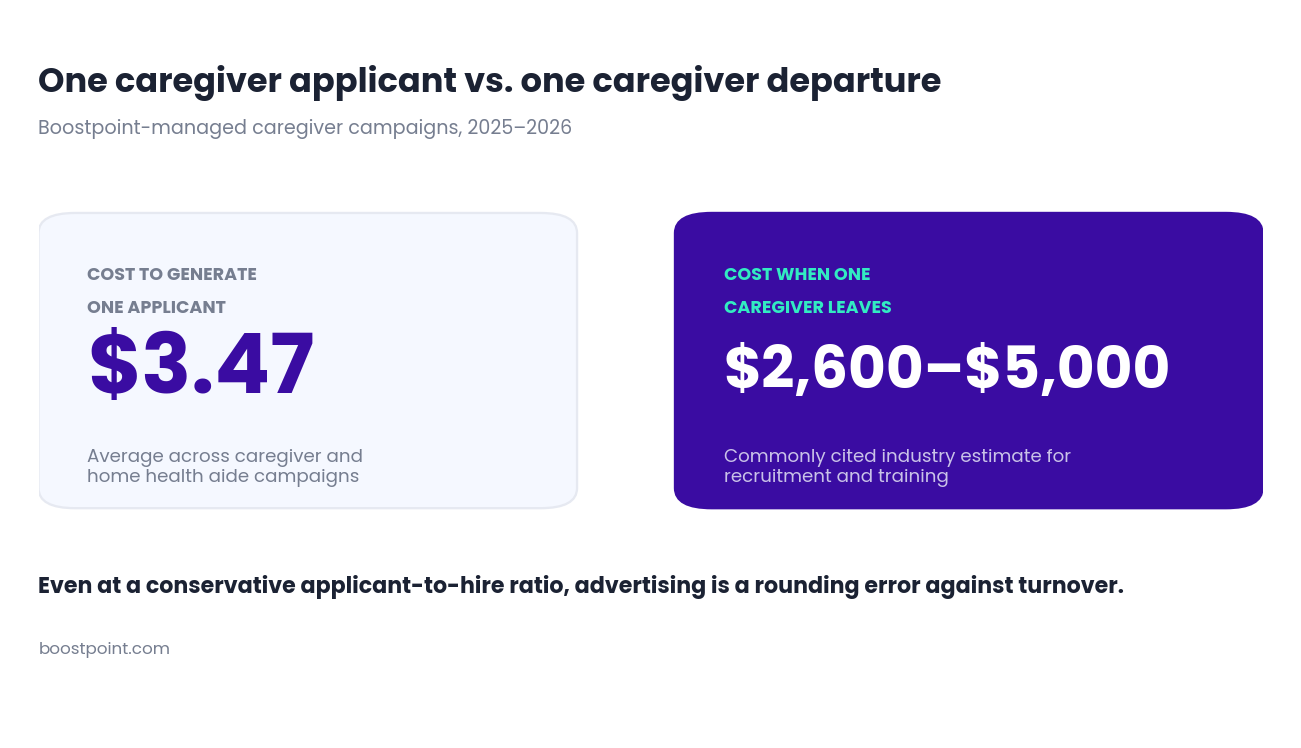
Even at a conservative applicant-to-hire ratio, the advertising cost of replacing a caregiver is a rounding error against the cost of losing one. An agency losing twenty caregivers a year is absorbing somewhere between $52,000 and $100,000 in turnover cost. The advertising required to generate applicants for those twenty roles is a fraction of that — see what it costs to recruit a caregiver for the full breakdown.
Which raises an uncomfortable question: if replacing a caregiver is cheap to advertise for and expensive to actually do, why do so many agencies run permanently short?
Why turnover happens in the first 100 days
The 100-day concentration is the most important detail in caregiver turnover data, and it's usually skipped over.
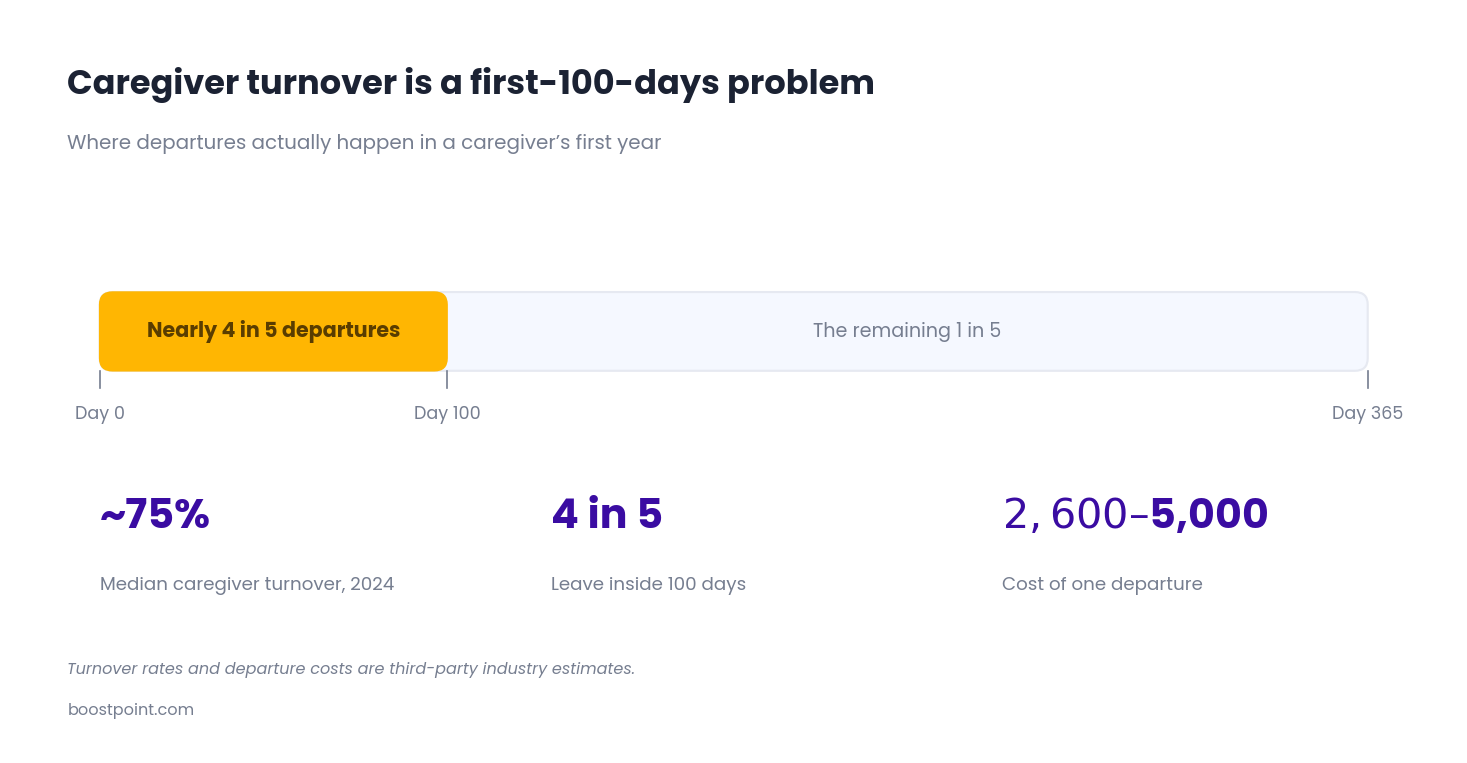
If most departures happened at eighteen months, you'd be looking at a career-progression problem — pay bands, advancement, burnout. Some of that is real. But when four in five departures happen inside the first fourteen weeks, you're looking at something much more specific: people are taking jobs that don't fit their lives, and finding out quickly.
The usual culprits are unglamorous:
- Shift mismatch. They accepted days and got weekends. Or the schedule they were promised was never actually available.
- Travel and drive time. The client is thirty-five minutes each way, unpaid, on a four-hour visit. That math stops working in week three.
- Hours volatility. They were told 30 hours and got 18 in a slow month.
- Expectation gap on the work itself. Personal care, transfers, or client behaviors that weren't discussed before day one.
None of those are retention failures in the usual sense. They're hiring failures that surface later — and every one of them is knowable before an offer is made.
Where recruiting becomes a retention lever
This is the connection most agencies miss.
If shift mismatch and travel distance are leading causes of early departure, then asking about shift availability and travel radius at the point of application isn't a recruiting efficiency measure. It's a retention measure that happens to run through your recruiting channel.
In our campaigns, caregiver applications include a short set of knockout questions before submission — typically availability by shift, reliable transportation, willingness to travel a stated distance, and any experience minimums. The applicants who reach a scheduler have already self-selected against the four failure modes above.
The tradeoff is real and worth naming. Every question you add filters more people out before submission, which raises cost per applicant. In our data, caregiver campaigns average $3.47 per applicant with a 31.3% application completion rate — the highest of any healthcare role we run, precisely because the forms are short. Add six more questions and both numbers move against you.
The right setting depends on your scheduler capacity:
- Short on scheduler time? Screen harder. Pay more per applicant, review fewer, lose fewer in week three.
- Have capacity to train and onboard? Screen lighter, cast wider, absorb more screening work yourself.
Most agencies have never made this an explicit decision. It's a dial, and you're holding it whether or not you know it.
The second lever: speed
Caregivers apply to several agencies in one sitting, usually from a phone, usually on a break. The agency that responds within minutes is talking to someone who is still thinking about working. The agency that calls back in two days is calling someone who already started somewhere else.
This matters more in home care than almost any other frontline sector, because the roles are close substitutes. If three agencies in your market pay within a dollar of each other, response speed is the differentiator — not your benefits page.
Automated SMS on application submission is the practical fix. It doesn't replace a real conversation; it holds the candidate's attention until you can have one.
A useful diagnostic: measure your median time from application to first human contact, in minutes. Most agencies who measure it for the first time are surprised.
What the applicant pool actually looks like
One more piece of the retention picture, because it contradicts a widely repeated claim.
Industry commentary frequently describes the direct care workforce as young — one widely cited article states that home care direct care workers are typically under 35, excluding registered nurses. In our healthcare campaigns, roughly half of applicants were aged 45 to 64, and those brackets were the least expensive applicants we acquired. Applicants aged 18 to 24 made up 3.3% of applications. The full picture is in our cost per applicant by clinical role data.
We didn't select for this. Employment ads in the United States run under Meta's Special Ad Category, which removes age targeting entirely — this is organic response.
The retention implication is worth thinking about. A 52-year-old applying for caregiver work in her own community, with her own transportation and a settled life, is a very different retention profile than a 22-year-old treating it as a stopgap. If your applicant flow currently skews young, that may say more about where you're advertising than about who's willing to do the work.
What actually reduces caregiver turnover
Ranked by what we see move the needle, and honest about what recruiting can and can't fix.
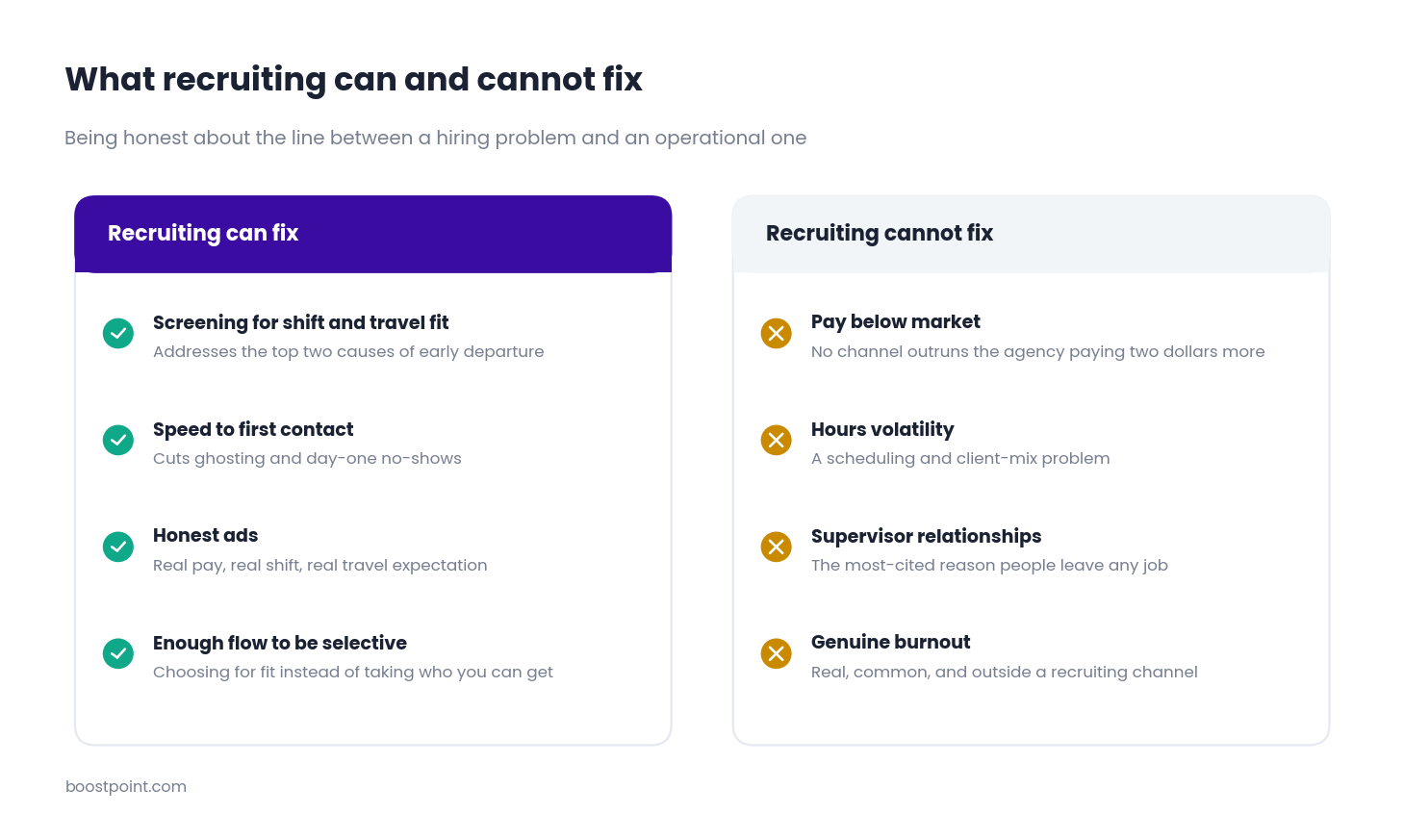
Things recruiting can fix
- Screening for shift and travel fit before the offer. Directly addresses the top two causes of early departure.
- Speed to first contact. Reduces the ghosting and no-show-on-day-one problem that inflates apparent turnover.
- Honest ads. An ad that states the real pay range, the real shift and the real travel expectation produces fewer applicants and better retention. Overstating any of the three buys you a hire and a 60-day departure.
- Enough flow to be selective. Agencies hiring from a pool of three applicants take who they can get. Agencies hiring from thirty can choose for fit.
Things recruiting cannot fix
- Pay below market. If the agency across town pays two dollars more, no channel outruns that. Fix the offer first.
- Hours volatility. Caregivers leave for guaranteed hours. That's a scheduling and client-mix problem.
- Supervisor relationships. The most-cited reason people leave any job. Advertising has nothing to say about it.
- Genuine burnout. Real, common in this workforce, and outside what a recruiting channel can address.
We'd rather say that plainly than imply advertising solves retention. It solves flow and fit. Those matter, and they're a meaningful share of the 100-day problem — but they're not the whole of it.
Frequently asked questions
What is the average caregiver turnover rate?
Median caregiver turnover ran approximately 75% in 2024, down from a recent peak near 79%. In skilled nursing, CNA turnover was reported at 42.3% in the most recent AHCA data — the highest of any position tracked.
How much does caregiver turnover cost?
Industry estimates put the cost of a single caregiver departure between $2,600 and $5,000, covering recruitment, training, lost productivity and coverage. An agency losing twenty caregivers a year is absorbing roughly $52,000 to $100,000.
Why do caregivers leave so quickly?
Nearly four in five departures happen within the first 100 days, which points at fit rather than career progression. The common causes are shift mismatch, unpaid travel time, hours volatility, and expectations about the work that weren't set before day one.
Can better recruiting actually reduce turnover?
Partly. Screening for shift availability and travel radius at the point of application directly addresses two of the leading causes of early departure. It won't fix pay below market, hours volatility, or supervisor relationships — those are operational problems, not recruiting ones.
Does screening harder cost more?
Yes, and that's the tradeoff to manage deliberately. Every knockout question filters more applicants out before submission, raising cost per applicant while lowering the screening burden on your scheduler. Our caregiver campaigns average $3.47 per applicant with a 31.3% completion rate — both figures move if you lengthen the form.
How fast do we need to respond to applicants?
Minutes, not days. Caregivers apply to several agencies in one sitting and the roles are close substitutes. Measure your median time from application to first human contact — most agencies find it's the cheapest improvement available.
Is it cheaper to retain or to recruit?
Retention, by a wide margin — a departure costs $2,600 to $5,000 while a caregiver applicant costs $3.47. But the two aren't alternatives. Better hiring fit is one of the more controllable inputs to retention, which is why the channels you recruit through affect who stays.
Are caregiver applicants mostly young?
Not in our data. Roughly half of healthcare applicants were aged 45 to 64, and they were the least expensive to reach. Applicants 18 to 24 were 3.3% of applications. Employment ads can't target by age, so this reflects who chose to respond.
See what caregiver hiring costs in your area
Book a 20-minute call and we'll walk through cost per applicant, screening setup and follow-up speed for your service area.
Book a Free DemoBoostpoint figures come from caregiver and home health aide campaigns run between January 2025 and mid-2026, drawn from a wider set of 478 healthcare campaigns across 30 employers representing 24,712 applications. Costs are what advertisers paid, inclusive of campaign management, and cover advertising only. Turnover rates and departure costs are industry estimates from third-party benchmarking and are cited as such. This is a sample of Boostpoint campaigns, not an industry-wide study.
Related: Healthcare Recruiting · How Much Does It Cost to Recruit a Caregiver? · What It Costs to Recruit an RN vs LPN vs CNA