
Instagram Recruiting: How to Run Job Ads on Instagram for Frontline Roles (2026)
Instagram recruiting means running job ads in Instagram's Feed, Stories, and Reels through Meta Ads Manager — the same campaign that runs on Facebook, on a screen where half of US adults and eight in ten adults under 30 spend time (Pew, 2025). The same employment Special Ad Category rules apply: no age, gender, or ZIP targeting, so the ad and the form do the screening. Boostpoint's 891-campaign 2026 Social Job Advertising Benchmark runs across Facebook and Instagram placements together at a median of $13.88 per applicant; we don't publish Instagram-only costs, and this page explains why you shouldn't trust anyone who does.
Source: Boostpoint 2026 Social Job Advertising Benchmark — 891 Boostpoint-managed campaigns on Meta (1,334 campaign-months), 2026; costs are what advertisers paid for advertising only.
A note on who's writing this
Boostpoint runs social media job advertising for frontline, healthcare, trades, and driving employers, and Instagram is one of the placements every campaign we build can run in. So this is a vendor's guide, and the honest part first: we can't tell you what an Instagram applicant costs, because our campaigns run across Facebook and Instagram placements together and Meta's delivery system decides where each impression goes. Any figure we published for Instagram alone would be an attribution guess dressed as data. Everything on this page about who is on Instagram comes from Pew Research Center's 2025 survey; everything about how ads run there comes from Meta's own help center, read on August 25, 2026; the cost figures are cross-placement numbers from the 2026 Social Job Advertising Benchmark, with the methodology at the bottom.
Who is actually on Instagram, and who isn't
The case for recruiting on Instagram is a reach case, and it is specific. Pew's 2025 survey of US adults found 50% use Instagram, against 71% for Facebook, 37% for TikTok, and 84% for YouTube. The age shape is what matters for hiring: "eight-in-ten adults ages 18 to 29 say they use Instagram," falling to 19% of adults 65 and older, while Facebook's heaviest age band is 30 to 49, at 80%. Women use Instagram more than men, 55% to 44%. So Instagram is where the entry-level, first-job, and career-change pool is — retail, food service, warehouse, CNA and caregiver roles that skew young — and it is not where the 55-year-old CDL driver is. In an earlier analysis of our trucking campaigns, 64.6% of applicants were 55 or older; those applicants were reached on Facebook, and they would not have been reached on Instagram at any budget.
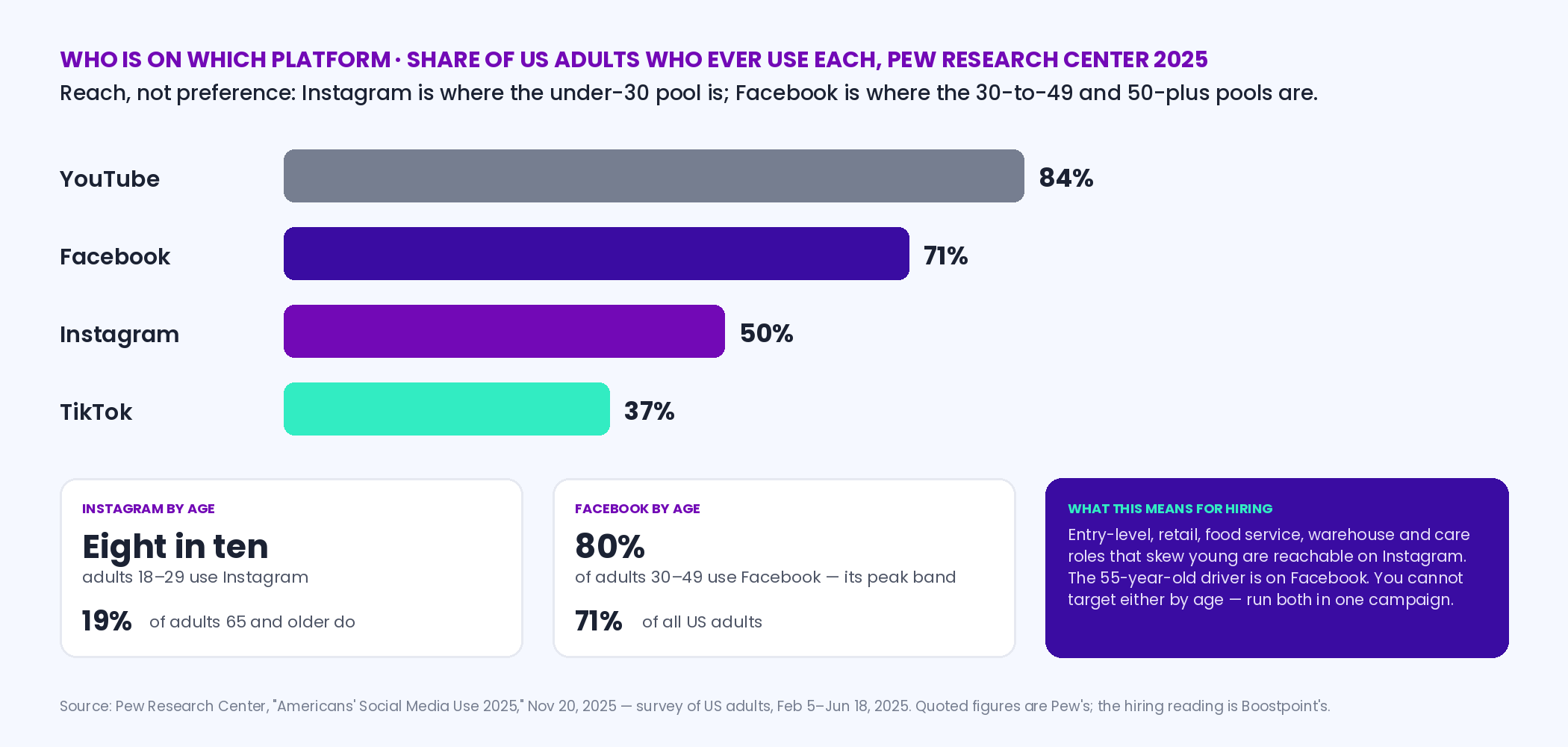
Two cautions before you act on that. First, you cannot target by age or gender in an employment ad on Instagram or anywhere else on Meta — the Special Ad Category fixes age at 18 through 65+ and requires all genders — so the demographics above tell you who is reachable, not who to select. Second, "on Instagram" and "will apply for a job on Instagram" are different populations. What we can say from running the campaigns is that people apply where the form is easy, and the form is the same one-minute instant form on both apps — described in full on social media job advertising.
How Instagram job ads actually run
There is no separate Instagram recruiting product. Instagram ads are built in Meta Ads Manager (our Facebook ads for recruiting guide walks through the campaign build), in the same campaign as Facebook ads, and placed by the same delivery system. Meta's placement list for Instagram, as of August 2026, is Feed, profile feed, Explore home, Stories, and Reels, and Meta's stated recommendation is Advantage+ placements — letting the system choose across Facebook, Instagram, Messenger, and Threads — with the note that "adding more placements does not increase the cost of your ad." For recruiting that recommendation is right in practice: a single campaign with the employment category declared, one instant form, and vertical creative that works in Stories and Reels will run wherever the auction finds applicants cheapest, which on a given week may be Instagram and on the next may be Facebook. Turning Instagram off to "focus on Facebook" removes reach without removing cost; turning Facebook off to "be on Instagram" cuts out the 30-to-49 band that fills most frontline shifts.
Apply in 60 seconds
Feed
Scrolled with the thumb; the caption's first line and the on-image text are what get read.
Prepare
A 4:5 image or video with pay, shift, and site in the top third; caption repeats them.
Stories
Full-screen, vertical, gone in seconds; tapped through fast, so the number has to be on frame one.
Prepare
9:16 vertical; text high in the frame away from the profile bar; one line, one tap.
Reels
Sound on or off, watched in a loop; the format TikTok made default and Meta adopted.
Prepare
9–15 seconds, captions burned in, a real employee, the pay spoken in the first two seconds.
Explore
A tile in a grid of recommendations; people are browsing, not searching, so the still has to read at thumbnail size.
Prepare
The same creative; make sure the wage is legible when the image is 120 pixels wide.
Note what is missing from those cards: a cost per placement. We don't have one we would stand behind. Meta reports impressions and results by placement inside Ads Manager, but with Advantage+ placements the system is optimizing across them, and the cheap-looking placement is often cheap because the expensive one did the first impression. Read placement reports as a diagnostic, not a price list.
The rules are the same on Instagram
People sometimes assume the employment restrictions are a Facebook thing. They are a Meta thing. Any employment ad from a US advertiser, or reaching people in the US, Canada, or certain parts of Europe, must be declared in the employment Special Ad Category, and the declaration applies to every placement in the campaign, Instagram included: age fixed to 18 through 65+, all genders, no ZIP-code targeting, no location exclusions, city audiences widened to a 15-mile radius, lookalike audiences unavailable. Meta's help center, read August 25, 2026, is quoted in full on our Special Ad Category page. The practical consequence is identical on both apps: you screen with the ad's first line and with two or three knockout questions in the instant form — a current license, availability for the shift, a legal minimum age where regulation sets one — not with the audience.
What to put in a 12-second Instagram recruiting Reel
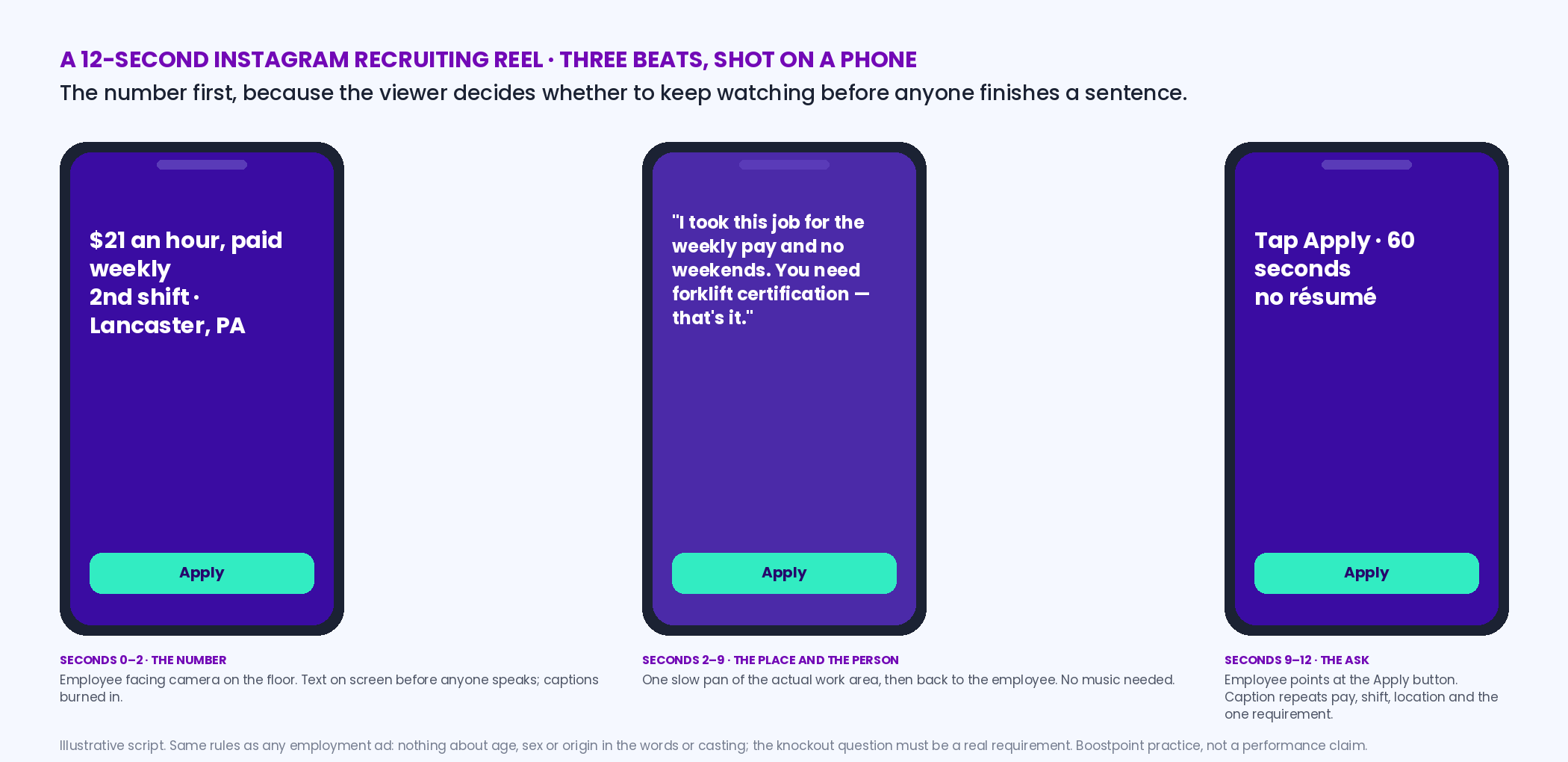
The Reels and Stories placements are where Instagram differs from Facebook in practice: vertical, fast, mostly watched with the sound off, and scrolled past in under two seconds if the first frame doesn't earn the third. The recruiting Reels that get completed applications are not employer-brand films. They are a phone, a real employee, and three beats.
Nothing is stored or sent — this runs in your browser. Fill in the job and read the storyboard back; then shoot it on a phone.
Beat 1 · seconds 0–2 · the number
Shot: employee facing camera on the floor, not in an office. Text on screen before anyone speaks.
Beat 2 · seconds 2–9 · the place and the person
Shot: one slow pan of the actual work area, then back to the employee. No music required.
Beat 3 · seconds 9–12 · the ask
Shot: employee points at the bottom of the frame where the Apply button sits.
Knockout question in the form:
Burn the captions in — most Instagram viewing is muted. Shoot three or four variants with a different employee or opening line; Meta's delivery rotates toward the one getting completions, and creative fatigues. Same rules as any employment ad: nothing about age, sex, or origin in the words or the casting choices, and the knockout question must be a real requirement of the job.
Why Instagram creative wears out, and what our data says to do about it
Reels and Stories are consumed fast and repeatedly, which means the same person sees your ad more often than they would a Feed post, and that shows up in the one benchmark finding that applies to placement strategy without naming a placement. Across 1,334 campaign-months, median cost per applicant was $11.48 when a campaign's monthly frequency — average impressions per person — sat between 1.5 and 2.0, $13.39 at 2.0–2.5, $18.76 at 3.0–4.0, and $26.78 above 4.0, while click-through rate fell from 1.69% to 0.94% across that range. A third of all budget, 33%, ran above a frequency of 3.0. Above a frequency of 4.0 the median cost per applicant, $26.78, is 2.33 times the $11.48 at 1.5–2.0 — and that is before anyone calls the creative tired.
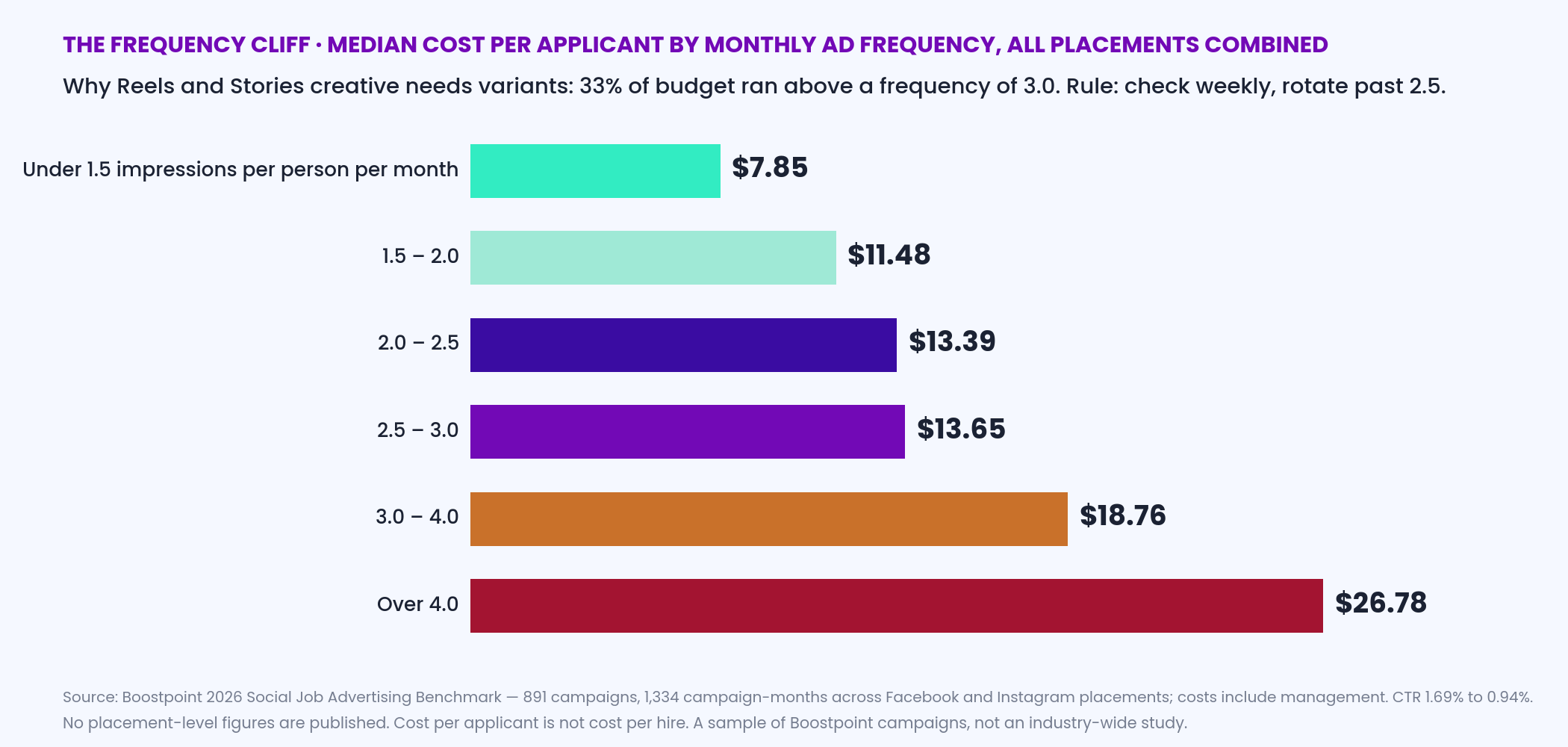
The operating rule that follows is simple and mostly ignored: check frequency weekly, and when it passes 2.5, swap in a variant — a different employee, a different first line, the same offer — rather than raising the budget. That is why the storyboard builder above asks for one employee and one reason; shoot it three times with three people and you have a month of rotation. And if a campaign's cost is high at low frequency, the problem isn't the creative or the placement at all: applicant conversion explains 70% of cost variation in our data, and a campaign converting under 5% of clicks costs $53.77 per applicant against $1.61 over 35%. Fix the form before you reshoot the Reel. Role-by-role figures are on our frontline hiring benchmarks.
Organic recruiting on Instagram: what it's for
An employer's own Instagram account is worth keeping alive for one reason: it is the first thing an applicant checks after seeing the ad. A profile with real photos of the floor, the crew, and the parking lot, posted in the last month, converts a click into an application; a profile with a logo and a 2023 holiday party does the opposite. What organic Instagram does not do at any useful scale is generate applicants on its own — reach without paid distribution goes to people who already follow you, and the people you need to hire don't. Post monthly for credibility, hire with ads, and put the ads in the same account so the profile people tap through to is the one you maintain.
Instagram vs Facebook vs TikTok for recruiting
| TikTok | |||
|---|---|---|---|
| US adults who use it (Pew, 2025) | 50%; eight in ten of those 18–29; 19% of 65+ | 71%; peaks at 80% among 30–49 | 37%; concentrated under 35 |
| Where the ad is built | Meta Ads Manager, same campaign as Facebook | Meta Ads Manager | TikTok Ads Manager, a separate campaign and budget |
| Employment-ad restrictions | Meta Special Ad Category: no age, gender, ZIP; 15-mile radius | Same | Restricted employment category; no age or gender targeting |
| The application | Instant form inside the app | Instant form inside the app | Native instant form inside the app |
| Creative that fits | Vertical Reels and Stories; the same 4:5 Feed asset | Feed image or video; Reels growing | Vertical video only, 9–15 seconds |
| Roles it earns its place for | Entry-level, retail, food service, warehouse, CNA and caregiver; anything skewing under 30 | Everything frontline; the only place the 50-plus driver and tradesperson reliably are | Younger, lower-credential, apprentice and first-job roles |
| Published cost | Cross-placement only: $13.88 median, $8.02 blended per applicant across 891 campaigns; we publish no per-placement figure | Not published by Boostpoint | |
Instagram is not a different recruiting strategy. It is the same campaign, the same rules, and the same form on a vertical screen where the under-30 pool actually is — and the number goes in the first two seconds.
How to post a job on Instagram
There are two ways to post a job on Instagram, and they reach different people. A post from your own account reaches the people who already follow it. A paid job ad reaches people in your hiring area who have never heard of you. Most employers need the second and should do the first as well, because the profile is what an applicant checks after seeing the ad.
Posting the job from your account (free)
- Make the first frame the job. The role, the pay, the shift and the town as large text on the image or the first two seconds of a Reel. The caption repeats them in its first line.
- Put the application link where it can be tapped. Instagram lets you add a website to your profile and add a link sticker to a Story. Point both at a short mobile application, and say "link in profile" in the caption.
- Post it more than once. A feed post, a Reel with a current employee, and a Story on the days you most need applicants.
- Ask staff to share it. Their followers are local and more likely to include someone who would take the job.
Posting the job as an ad (paid)
- Build it in Meta Ads Manager, not from the app, with the Employment special ad category declared. That fixes age at 18 through 65+, removes gender and ZIP code targeting, and sets a 15-mile minimum radius (see the Special Ad Category guide).
- Keep Instagram and Facebook placements in the same campaign so one budget reaches both the under-30 pool on Instagram and the older pool on Facebook.
- Send the tap to an instant form inside the app: name, phone, and two or three knockout questions the job truly requires.
- Supply two shapes of creative: vertical 9:16 for Stories and Reels, and 4:5 for Feed and Explore.
- Check frequency weekly and rotate a new variant when it passes 2.5, as set out above.
The application decides what the ad costs more than the placement does: in Boostpoint's 2026 Social Job Advertising Benchmark, the apply experience explained 70% of the difference in cost per applicant between campaigns. The same two routes on Facebook are compared in how to post a job on Facebook.
Frequently asked questions
Is Instagram good for recruiting?
For roles that skew young, yes, as a placement inside a Meta campaign rather than a channel on its own. Pew's 2025 survey found 50% of US adults use Instagram and eight in ten adults aged 18 to 29 do, against 19% of those 65 and older. That makes it the reach play for entry-level retail, food service, warehouse, CNA, and caregiver roles. It is not where the 50-plus CDL driver or tradesperson is; Facebook, used by 71% of adults and 80% of 30-to-49-year-olds, is. Most employers should run both in one campaign and let Meta's delivery choose.
How do Instagram job ads work?
They are built in Meta Ads Manager, in the same campaign as Facebook ads, with the employment Special Ad Category declared and a lead objective that uses Meta's instant form inside the app. Meta's Instagram placements are Feed, profile feed, Explore, Stories, and Reels; Meta recommends Advantage+ placements across its apps and states that adding placements does not increase the cost of an ad. Vertical 9:16 creative covers Stories and Reels; a 4:5 asset covers Feed and Explore.
Can you target job ads by age or location on Instagram?
No, and not on Facebook either. Employment ads from US advertisers or reaching the US, Canada, or certain parts of Europe must be declared in Meta's employment Special Ad Category, which fixes age at 18 through 65+, requires all genders, removes ZIP-code targeting and location exclusions, widens city audiences to a 15-mile radius, and removes lookalike audiences. Screening happens in the ad's first line and in knockout questions in the form — a current license, shift availability, a legal minimum age where regulation sets one.
How much does Instagram recruiting cost?
We don't publish an Instagram-only figure, and we'd be wary of anyone who does. Our 2026 benchmark — 891 campaigns, 1,334 campaign-months, all running across Facebook and Instagram placements together with campaign — shows a median cost per applicant of $13.88 and a volume-weighted average of $8.02, on a median monthly budget of $334. Meta's delivery system decides which placement serves each impression, so a per-placement cost is an attribution guess. Cost per applicant is not cost per hire.
What makes a good Instagram recruiting Reel?
Three beats in about twelve seconds, shot vertically on a phone with captions burned in. Seconds 0–2: the pay, shift, and town as on-screen text, spoken by a real employee on the floor. Seconds 2–9: one pan of the actual work area and one sentence on why they took the job, plus the single hard requirement. Seconds 9–12: the ask — tap apply, sixty seconds, no résumé. Shoot three or four variants so you can rotate when frequency passes 2.5; in our data cost per applicant rises from $13.39 at a frequency of 2.0–2.5 to $18.76 at 3.0–4.0.
Should we recruit on Instagram organically or with ads?
Both, for different jobs. Organic posts keep the profile credible for the applicant who taps through from an ad — real photos of the crew and the site, posted in the last month. They don't generate applicants at scale because unpaid reach goes to existing followers, who are mostly not the people you need to hire. Run the ads from the same account you maintain, so the profile people land on is the one that looks like a real workplace.
Instagram or TikTok for recruiting?
Instagram comes free with a Meta campaign; TikTok is a separate platform, campaign, and budget. Pew's 2025 numbers put Instagram at 50% of US adults and TikTok at 37%, both concentrated under 35. Start with Meta, with Instagram placements on, because one campaign covers both the under-30 pool on Instagram and the 30-to-49 pool on Facebook. Add TikTok when you are hiring first-job and apprentice roles at volume and have vertical video to spare; our TikTok recruiting guide covers its rules and format.
Why does the same Instagram ad get more expensive over a month?
Frequency. Reels and Stories show the same ad to the same person repeatedly, and across 1,334 campaign-months in our benchmark the median cost per applicant was $11.48 at a monthly frequency of 1.5–2.0, $18.76 at 3.0–4.0, and $26.78 above 4.0, with click-through rate falling from 1.69% to 0.94%. A third of all budget ran above 3.0. Check frequency weekly and rotate a creative variant when it passes 2.5 instead of raising the budget.
How do I advertise a job on Instagram?
Through Meta Ads Manager rather than the Instagram app. Instagram recruitment ads are built in the same place as Facebook ones and can run across both at once, which is usually what you want. You choose Instagram placements, set a location subject to the employment advertising rules described above, and point the ad at a lead form or your own application page. The route to avoid is boosting an existing post from the app, which gives up both the targeting and the form that make the ad worth running.
How do you recruit on Instagram?
Two routes, and only one scales. Paid: build the ad in Meta Ads Manager, choose Instagram placements, and point it at a form; that is how to post a job ad on Instagram in a way that reaches people who do not follow you. Organic: post the work itself, in Reels and Stories, and accept that the reach is your existing following. For frontline hiring the paid route does the work and the organic account makes it believable when someone checks.
Do Boostpoint job ads run on Instagram?
Yes. Boostpoint Attract campaigns run on Facebook and Instagram together, in Instagram's Feed, Stories and Reels placements, inside one employment Special Ad Category campaign with the same one-minute instant form on both apps. Meta's delivery system decides where each impression goes, so Boostpoint publishes cross-placement figures only: across the 891 campaigns in its 2026 Social Job Advertising Benchmark, the median cost per applicant was $13.88. It publishes no Instagram-only cost.
Put your job on the screen your applicants are actually looking at
We build one campaign that runs across Facebook and Instagram with the form inside the app — and we'll show you the campaigns closest to your roles from 891 real ones.
Book a DemoBoostpoint figures come from the 2026 Social Job Advertising Benchmark — 891 campaigns and 1,334 campaign-months, run across Facebook and Instagram placements together: $13.88 median cost per applicant, $8.02 volume-weighted average, $334 median monthly campaign budget; median cost per applicant by monthly frequency ($7.85 under 1.5, $11.48 at 1.5–2.0, $13.39 at 2.0–2.5, $13.65 at 2.5–3.0, $18.76 at 3.0–4.0, $26.78 above 4.0; 33% of budget above 3.0; click-through rate 1.69% to 0.94% across the range); applicant conversion explaining 70% of cost variation, click-through rate 30%, CPM 18%; $53.77 per applicant under a 5% apply rate and $1.61 above 35%. We publish no placement-level cost figures; the CDL age finding (64.6% of applicants aged 55+) comes from an earlier campaign-level analysis and uses a different methodology. Cost per applicant is not cost per hire; we do not track hires and publish no cost-per-hire figure. Platform reach figures are from Pew Research Center, "Americans' Social Media Use 2025," November 20, 2025 (survey of US adults, February 5–June 18, 2025). Placement descriptions and the statement that adding placements does not increase an ad's cost are from Meta Business Help Center, "About ad placements across Meta technologies," read August 25, 2026; employment Special Ad Category rules from Meta's help center the same day. Platforms change their products without notice; re-verify before budgeting. This is a sample of Boostpoint campaigns, not an industry-wide study.