
Recruiting Caregivers and CNAs on Facebook: What the Numbers Actually Show
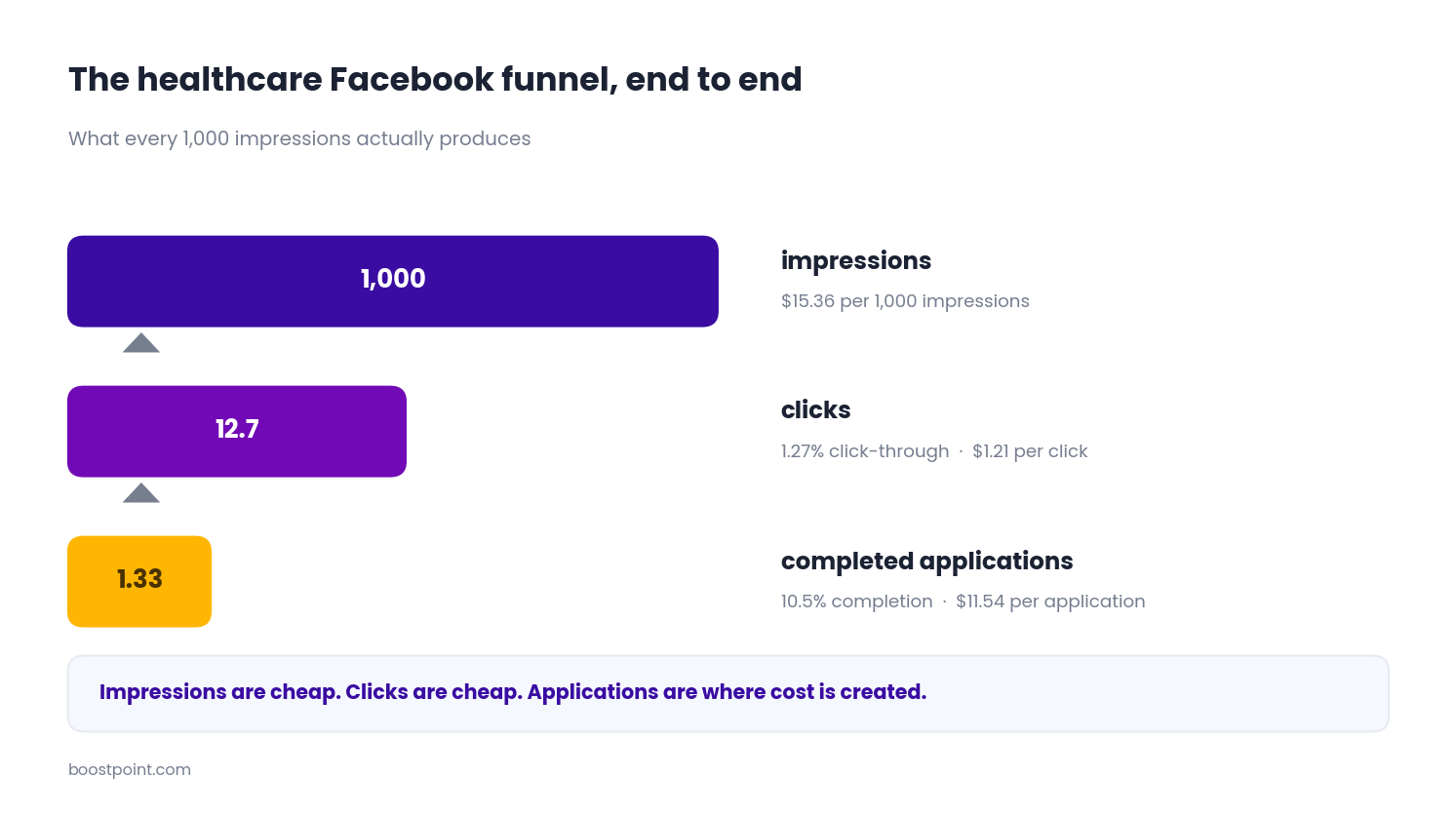
Across 478 healthcare campaigns on Meta platforms, every 1,000 impressions produced about 12.7 clicks and 1.33 completed applications, at a media cost of $15.36. This page breaks that funnel apart by role — and shows why an RN applicant costs $15.93 while a caregiver costs $3.47, when the click prices are almost the same.
See what your open roles cost to fill →
The funnel, end to end
Most healthcare recruiting content about Facebook stops at "reach passive candidates." Here is the actual arithmetic from 18.5 million impressions and 24,712 applications:
| Stage | Healthcare average |
|---|---|
| Cost per 1,000 impressions | $15.36 |
| Click-through rate | 1.27% |
| Cost per click | $1.21 |
| Click-to-application rate | 10.5% |
| Cost per completed application | $11.54 |
| Average frequency | 2.46 |
| Cost per 1,000 people reached | $37.82 |
Read down that list and the shape of the channel becomes clear: impressions are cheap, clicks are cheap, and applications are where cost is created. Only about one in ten people who click go on to submit. That single conversion step accounts for most of what you pay per applicant.
Which means the biggest lever in Facebook healthcare recruiting isn't targeting, budget or creative. It's the application.
The same funnel, broken out by role
This is the table that explains almost everything about cost differences between clinical roles. For the wider picture, see our cost per applicant by clinical role breakdown.
| Role | CTR | Cost per click | Completion rate | Cost per applicant |
|---|---|---|---|---|
| Caregiver / HHA | 2.35% | $1.09 | 31.3% | $3.47 |
| CNA / nurse aide | 1.01% | $1.19 | 17.4% | $6.82 |
| LPN / LVN | 1.01% | $2.23 | 18.4% | $12.14 |
| RN / registered nurse | 1.13% | $1.97 | 12.4% | $15.93 |
Two things jump out.
Caregivers click at more than twice the rate of clinical staff. A 2.35% click-through rate against roughly 1% for CNAs, LPNs and RNs. The eligible population is larger, the barrier to considering the role is lower, and the ad speaks to more of the people who see it.
But the cost gap isn't mostly about clicks. A CNA click costs $1.19 and an RN click costs $1.97 — a 65% difference. Yet a CNA applicant costs $6.82 and an RN applicant costs $15.93, a 134% difference. The rest of that gap is created at the application step, where CNAs complete at 17.4% and RNs at 12.4%.
What that means in practice: the RN example
Work the arithmetic and you get an unusually concrete conclusion.
Cost per applicant is simply cost per click divided by completion rate. For RN roles: $1.97 ÷ 12.4% = $15.93.
Hold the click price constant — same targeting, same budget, same creative — and move completion:
| RN completion rate | Resulting cost per applicant |
|---|---|
| 12.4% (current average) | $15.93 |
| 17.4% (CNA level) | $11.35 |
| 20% | $9.85 |
| 25% | $7.88 |
| 31.3% (caregiver level) | $6.30 |
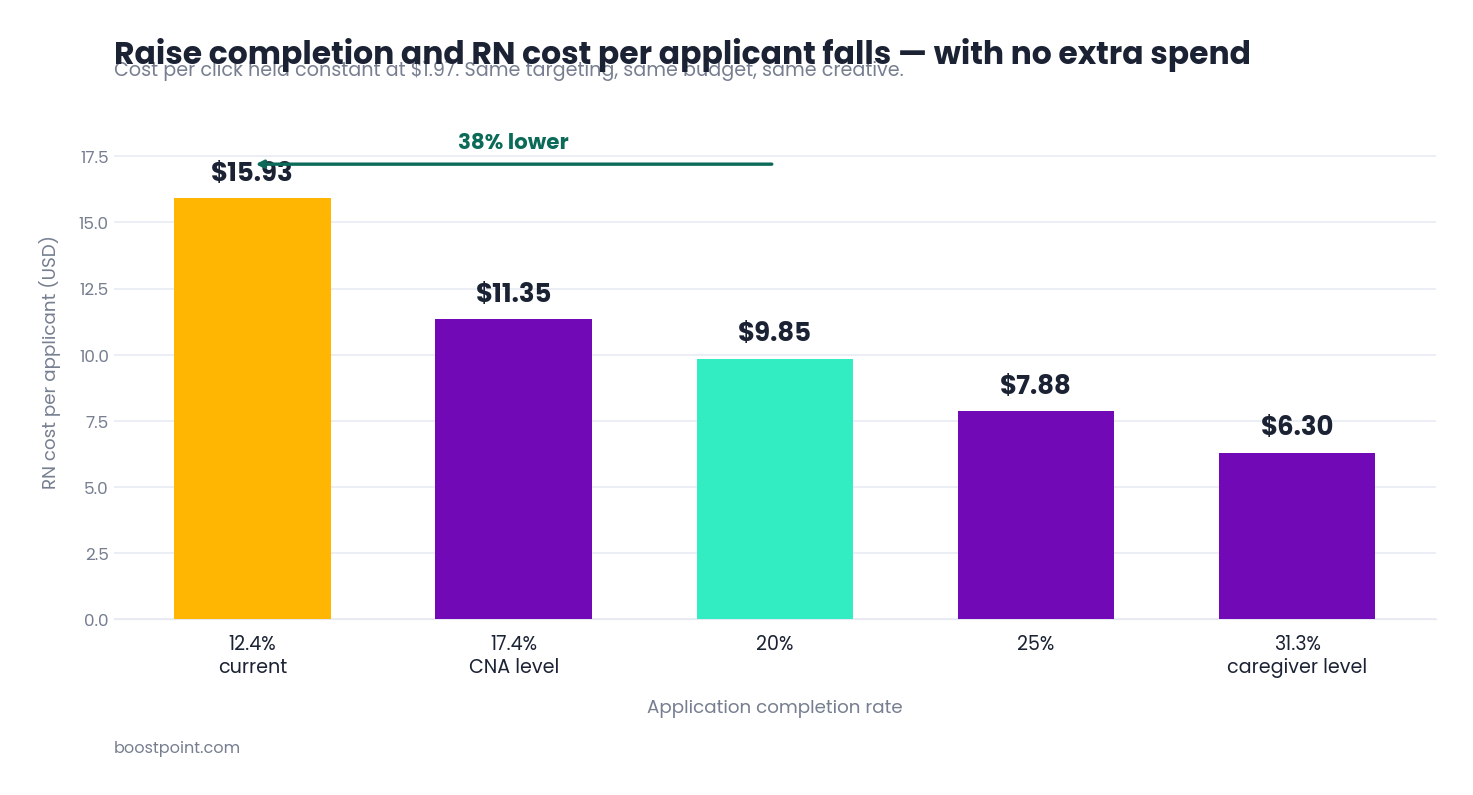
Raising RN application completion from 12% to 20% would cut cost per applicant by about 38% — with no change in ad spend, targeting or creative.
We're not claiming every RN application can reach caregiver-level completion; clinical candidates are more selective and more often employed. But the gap between 12% and 20% is almost entirely form design, and it's free to close.
Why clinical applications lose people
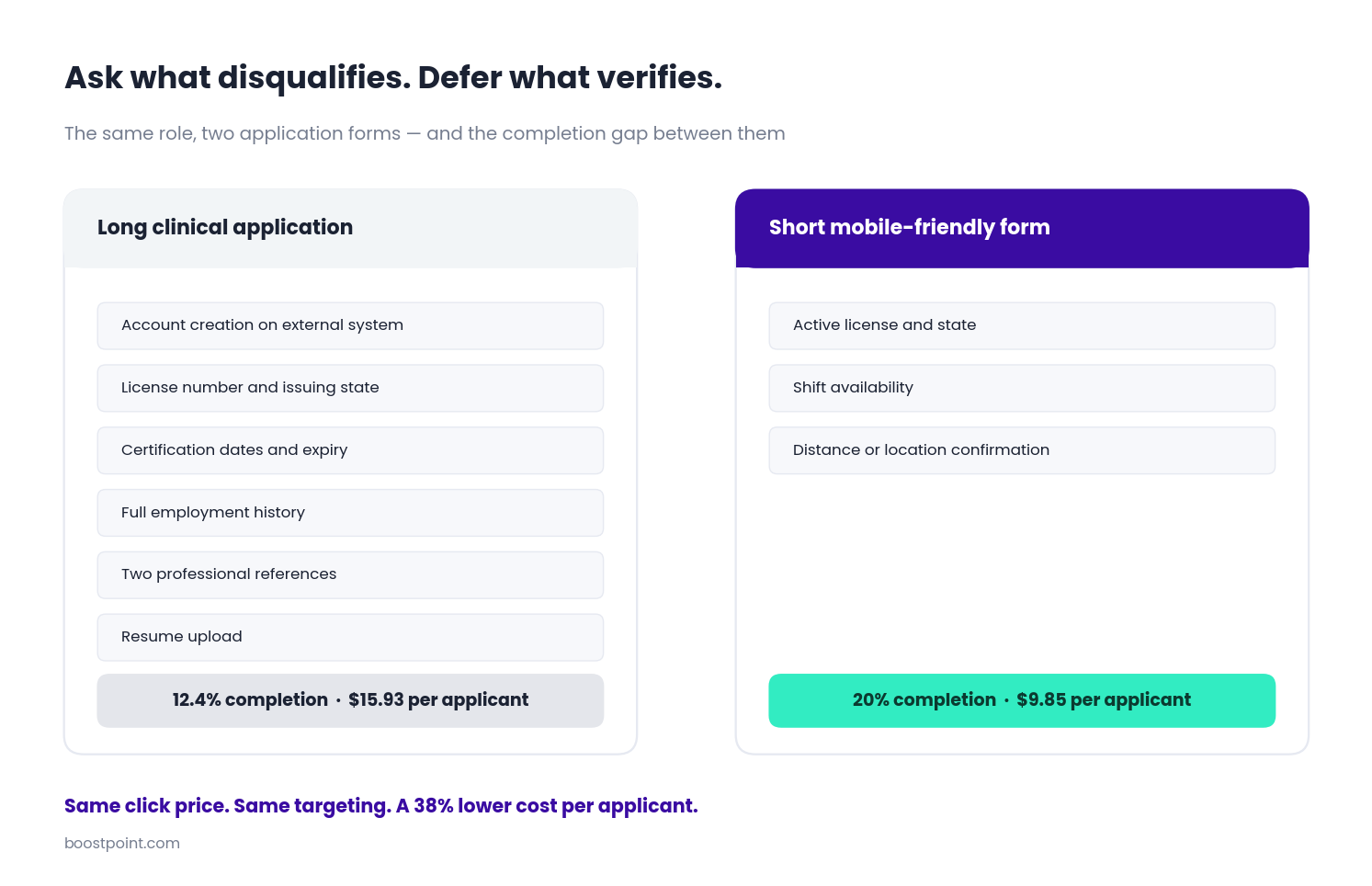
The healthcare applications that convert worst share a pattern. They ask, before submission:
- License number and issuing state
- Certification dates and expiry
- Full employment history
- Two or three professional references with contact details
- A resume upload
- Account creation on an external system before any of the above
Every one of those is a legitimate thing to know. None of them needs to be known before you have a name and a phone number.
Remember the context: someone is tapping an ad on a phone, on a break, possibly on hospital wifi that doesn't work. A resume upload in that setting is not a small ask — most people don't have a current resume on their phone at all.
The fix is to ask what disqualifies, and defer what verifies. For most clinical roles that's three or four questions: active license and state, shift availability, and a distance or location confirmation. Credentials get verified after contact, the way they always did.
How targeting actually works — and why most people get it wrong
This is the single most misunderstood constraint in healthcare social recruiting, and it's why self-managed campaigns tend to underperform.
Employment ads in the United States run under Meta's Special Ad Category. To prevent discrimination in hiring, it removes detailed audience targeting: you cannot target by age or gender, detailed demographic and interest options are unavailable, and location targeting has a minimum radius. Every advertiser operates under the same rules — this isn't a platform tier you can buy your way out of.
So you cannot build an audience of "CNAs with two years of experience who can work nights."
What happens instead is that qualification moves to two places:
- The creative and the offer. An ad that states the shift, the pay and the certification requirement does most of the qualifying before anyone clicks. This is why caregiver ads convert differently than RN ads — the ad itself is doing the sorting.
- The application form. Knockout questions filter the rest, after the click and before the recruiter.
Teams who don't know this spend weeks trying to narrow their audience, conclude the targeting is broken, and abandon the channel. The targeting isn't broken. It's constrained by design, and performance comes from the two levers above.
What the audience looks like when you can't target it
Because age and gender targeting are unavailable, the response profile is organic — which makes it genuinely informative:
| Age | Share of applicants | Cost per applicant |
|---|---|---|
| 18–24 | 3.3% | $13.00 |
| 25–34 | 10.5% | $14.25 |
| 35–44 | 17.8% | $12.36 |
| 45–54 | 24.5% | $10.70 |
| 55–64 | 25.8% | $10.42 |
| 65+ | 18.1% | $11.60 |
Roughly half of applicants were 45 to 64, and they cost less than any younger group. Roughly 80% were women. Both figures track the actual composition of the direct care workforce rather than skewing away from it.
Practical setup that follows from the data
Creative
- Video over static for frontline roles. Short, vertical, shot on a phone is fine.
- Pay, shift and location in the first two lines — before mission or culture.
- Refresh before fatigue. A single ad running unchanged for months is the most common reason campaigns look good for three weeks and then flatten.
- Real footage of your team beats stock. If you don't have any, creative can be produced from the job description — it isn't a prerequisite to launching.
Application
- Capture in-platform rather than clicking out to an ATS. Every redirect costs completions.
- Three or four knockout questions. No resume upload, no references, no account creation before submission.
- Test it on a phone on a slow connection, the way an applicant will actually do it.
Follow-up
- Automated SMS on submission. Candidates apply to several employers in one sitting.
- Measure median time to first human contact in minutes. Usually the largest single lever available.
Measurement
- Track cost per applicant by role, not blended. A caregiver and an RN differ by 4.6x.
- Track completion rate as a first-class metric. Under 10% means your form is the problem.
- Give campaigns three weeks before judging. The first two are a learning period.
Everything above sits inside a wider set of caregiver recruitment strategies if you're building a plan rather than fixing a campaign.
Frequently asked questions
Does Facebook work for recruiting caregivers and CNAs?
Yes. Across 478 healthcare campaigns we saw a 1.27% click-through rate and a $11.54 average cost per completed application. Caregiver roles performed best, at a 2.35% click-through rate and $3.47 per applicant.
How much does it cost to advertise healthcare jobs on Facebook?
In our campaigns, $15.36 per thousand impressions, $1.21 per click and $11.54 per completed application on average. Cost per applicant varies widely by role — $3.47 for caregivers up to $15.93 for RNs.
Can we target nurses by license or experience on Facebook?
No. Employment ads run under Meta's Special Ad Category, which removes detailed audience targeting to prevent discrimination in hiring. Qualification happens through the ad creative and through knockout questions in the application instead.
Why do RN applicants cost more than CNA applicants?
Partly higher click costs — $1.97 against $1.19 — but mostly lower application completion: 12.4% for RNs against 17.4% for CNAs. Clinical applications tend to be longer, and length is the main driver of the gap.
How can we lower our cost per applicant without spending more?
Raise application completion. Cost per applicant is cost per click divided by completion rate, so moving RN completion from 12% to 20% would cut cost per applicant from $15.93 to about $9.85 with no change to spend, targeting or creative.
Should we send applicants to our ATS or capture the application in Facebook?
Capture in-platform where possible. Every redirect and every account-creation step costs completions, and completion is where most of your cost per applicant is created.
Do we need to make our own videos?
No. Ad creative including video can be produced from the job description and refreshed before it fatigues. Your own footage helps if you have it, but it isn't required to launch.
How long before a campaign produces applicants?
Usually within days, though the first two weeks are a learning period while the platform calibrates. Judging performance on fewer than three weeks of data typically leads to the wrong conclusion.
See what your open roles cost to fill
Book a 20-minute call and we'll walk through the funnel for your specific roles, shifts and markets.
Book a Free DemoFigures come from 478 Boostpoint-managed healthcare recruitment campaigns across 30 employers, January 2025 through mid-2026, representing 18,553,441 impressions, 7,536,576 people reached and 24,712 applications on Meta platforms. Costs are what advertisers paid, inclusive of campaign management, and cover advertising only. Role-level figures are drawn from campaigns where the role was identifiable. This is a sample of Boostpoint campaigns, not an industry-wide study.
Related: Healthcare Recruiting · What It Costs to Recruit an RN vs LPN vs CNA · Caregiver Recruitment Strategies