
Retention Bonus
A retention bonus is named in the federal wage regulations almost word for word: bonuses announced to employees to induce them “to remain with the firm” are part of the regular rate, and so are bonuses “contingent upon the employee's continuing in employment until the time the payment is to be made.” That is one cost people miss. The larger one is that most of the money goes to people who were staying anyway — at the all-industry quit rate, roughly 78 of every 100 eligible employees would still be there in twelve months without any bonus at all.
What a retention bonus is, and what the regulation calls it
A retention bonus is a payment offered to employees who stay through a defined date. It shows up around acquisitions and system migrations, around the end of a large project, ahead of a busy season, and wherever a group of people all know at once that the ground is moving under them.
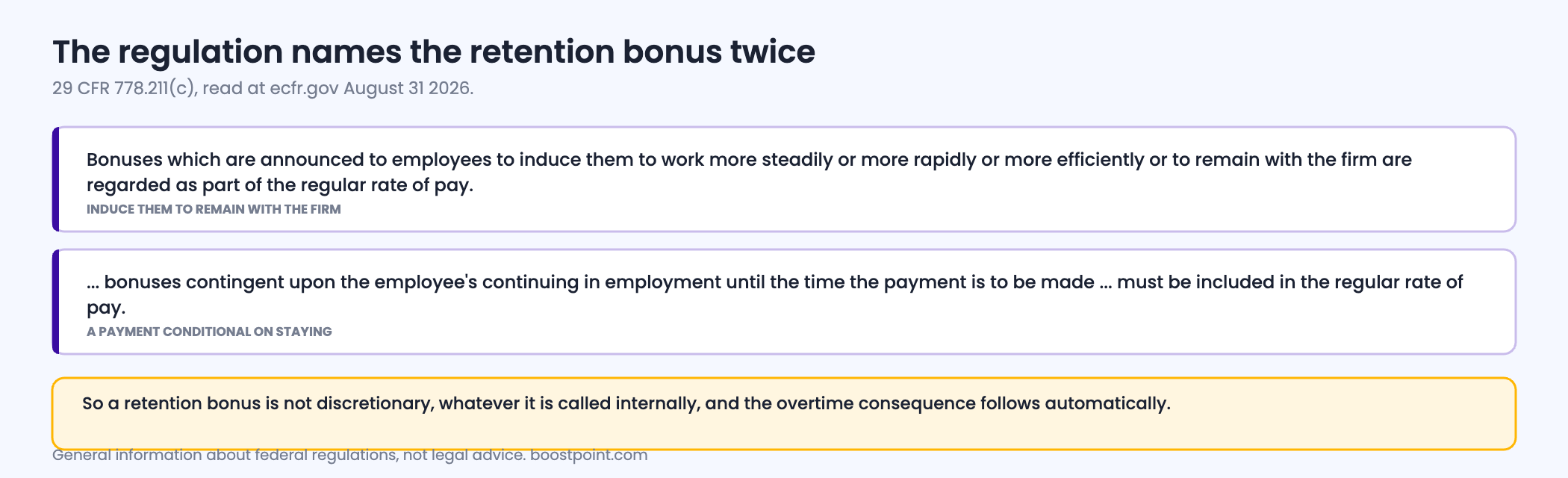
Federal regulations address it directly. Bonuses “announced to employees to induce them to work more steadily or more rapidly or more efficiently or to remain with the firm are regarded as part of the regular rate of pay,” and the same paragraph names “bonuses contingent upon the employee's continuing in employment until the time the payment is to be made” as belonging in the same category. They “must be included in the regular rate of pay.”
A retention bonus is therefore not discretionary, whatever it is called internally. The narrow exclusion in the rules is for a payment nobody was promised, decided close to the moment it is paid, and a retention bonus is the opposite of that by design.
The part almost nobody prices: you are paying the stayers
A retention bonus is paid to everyone in the eligible group who reaches the date. Most of them were going to reach it. That is not a criticism of the instrument, it is the arithmetic of any across-the-board payment, and it is the number worth having before the budget goes to a board.
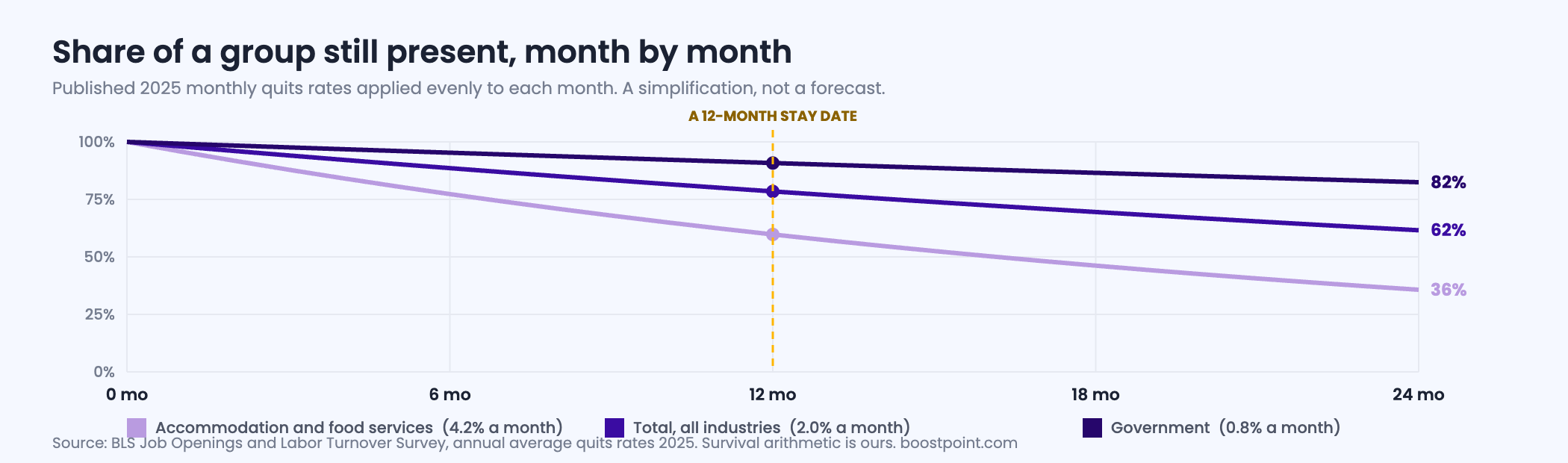
Apply the published monthly quit rate to a group and the picture is stark. At the all-industry rate of 2.0% a month, about 78 of every 100 eligible people are still there twelve months later without any bonus at all. Offer a hundred people $5,000 each and roughly $392,000 of the $500,000 is going to employees who were on track to stay.
The rate makes the difference. In accommodation and food services, where quits run 4.2% a month, only about 60 in 100 make it to a twelve-month date, so a much larger share of the payment is genuinely at risk. In government, at 0.8% a month, more than 90 in 100 are still there and the bonus is almost entirely a transfer.
The stayer share
How much of the payout is going to people who were staying
Set the group, the payment and the date, and pick the industry closest to your workforce.
Applies the published monthly quits rate evenly and independently to each month, which is a simplification rather than a forecast. It gives the scale of the stayer share, not a prediction about your own group.
What the employee actually receives
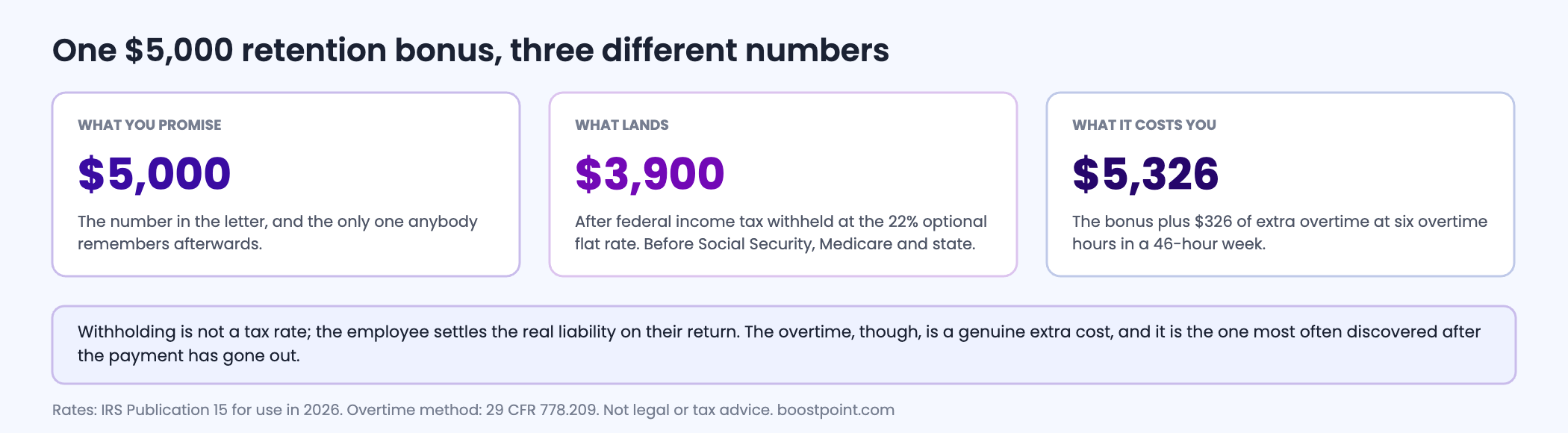
A retention bonus is supplemental wages. Where an employer uses the optional flat rate method, federal income tax is withheld at 22%, and supplemental wages above $1 million in a calendar year carry a mandatory 37% rate on the excess.
The important word is withholding. That 22% is not a tax rate and it is not the employee's final liability, which is settled on their return like any other income. It is, however, what they see, and a $5,000 bonus that lands as $3,900 before Social Security, Medicare and any state withholding does not feel like $5,000 to the person receiving it.
That gap matters for design rather than for compliance. A payment intended to feel significant needs to be sized against what arrives in the account, not against the number in the letter, and telling people the withholding rate in advance costs nothing and prevents a predictable disappointment.
Two sides of the same payment
What lands, and what it costs you
Federal supplemental withholding on one side, the regular-rate consequence on the other.
Federal income tax withholding only, using the optional flat rate method; Social Security, Medicare and state withholding are not included. General information, not tax advice. The overtime figure applies the regulation's method to a consistent overtime pattern.
It goes into the regular rate as well
Because a retention bonus is non-discretionary, the overtime consequence applies exactly as it does to a sign-on bonus. The bonus is apportioned back over the workweeks of the period it covers, and for each week containing overtime the employer owes an additional amount equal to one-half of the bonus's hourly rate for that week multiplied by the overtime hours worked.
The shortcut is the same too, and it is worth carrying around: the total extra equals half the bonus multiplied by the overtime share of hours worked. Six overtime hours in a forty-six hour week is 6.52% of the bonus, and the number of weeks the bonus is spread across makes no difference at all.
For an exempt employee the question does not arise, though the classification is worth confirming rather than assuming. For a non-exempt group of any size it is a real line, and it is often discovered after the fact.
Where retention bonuses genuinely work
A known end date with a known cliff. An acquisition closing, a plant winding down, a system being retired: everybody can see the date, everybody is being called by recruiters because of it, and the business needs specific people present through a specific window. This is the case the instrument was built for.
A small, identified group. The stayer-share arithmetic gets much better when the eligible list is the twelve people who actually hold the knowledge rather than everyone in the department. Narrowing the list is a direct way to raise the share of the payment that is doing work.
Where the alternative is agency cover. If losing the person means buying the same hours back at a premium, the comparison is against that premium rather than against zero, and the bonus can be straightforwardly cheaper.
Where they do not
As a general answer to turnover. Departures concentrate early in tenure wherever they are measured by length of service, and a retention bonus is usually offered to established staff, which is to say to the population least likely to leave. It aims money at the safest part of the distribution. What the tenure evidence supports instead is set out on employee retention strategies.
When the date creates its own cliff. A bonus that vests on a fixed date gives everyone a shared reason to reconsider on the day after it lands. Where the underlying job has not changed, that is a deferral rather than a solution, and the deferral has been paid for.
When the problem is the work. A retention bonus does not change the schedule, the staffing ratio, the equipment or the supervisor. Where those are the reasons people are leaving, the payment buys time to fix them and nothing else, which is a legitimate use only if the fixing actually happens.
Designing one that is not just a transfer
Narrow the eligible list until you can name every person on it and say what breaks if they leave. Set the date against a business event rather than a round number of months. Consider two smaller payments at different dates rather than one at a cliff, which spreads the reconsideration moment. Write the repayment terms with counsel, because clawbacks and final-paycheck deductions are governed by state law and vary considerably. Tell people the withholding rate before they see the deposit. And decide in advance what happens to the payment if the person's role changes or the business event slips, because both are more likely than not.
One more, which costs nothing: put the retention money next to what it would cost to advertise the same role and fill it. Across 891 Boostpoint-managed campaigns on Meta, the median registered nurse campaign returned applications at $19.08 each. That is not a substitution — cost per applicant is not cost per hire, and nothing on this page derives one from the other — but the orders of magnitude belong in the same conversation.
Sign-on and retention: the same rule, different timing
The two payments are treated identically under the wage rules. Both are promised in advance, both fail the discretionary test, both enter the regular rate, and both carry the same overtime arithmetic. What differs is where in the employment relationship they sit, and therefore what they can plausibly buy.
A sign-on bonus buys a start date, at the point where the employer knows least about the person. A retention bonus buys a leaving date, at the point where the employer knows most. The second is the better-informed decision, and it is also the one most likely to be paid to people who had already decided to stay.
Retention pay is four instruments, and only one of them is a bonus
“Retention pay” is the category; the retention bonus is one item in it. The other three get chosen far less deliberately, usually because someone in payroll already knows how to run them, and they behave very differently on cost, on timing and on what they buy.
| Instrument | Who gets paid | When it lands | What it actually buys |
|---|---|---|---|
| Retention or stay bonus | Everyone eligible who reaches the date | Once, on a date you set | A specific date covered — a season, a contract, an integration |
| Shift differential | Only the people who work the hard hours | Every pay period, ongoing | Coverage of the shifts nobody wants, not tenure |
| Longevity or step pay | Everyone, on a tenure schedule | At each anniversary or step | A reason to reach the next step; nothing before the first one |
| Base-rate increase | Everyone in the grade, immediately | Every pay period, permanently | Position against the local market, which is what most applicants compare |
Two of the four are permanent commitments and two are not, and that is usually the decision. A stay bonus ends. A shift differential and a step schedule end when you withdraw them, which in practice means they do not end. A base-rate increase is permanent and compounds into overtime, into every future raise calculated as a percentage, and into the number a competitor has to beat.
The overtime point applies more widely than most people expect. The regular rate on which overtime is calculated is defined to include all remuneration for employment, with a short list of exclusions, so a shift differential and a longevity payment go into it in the same way the retention bonus does, as covered above. An instrument that looks cheaper per head is not cheaper if it lands on the hours that are already at time-and-a-half.
The practical order: fix the base rate if you are below the local market, because nothing else survives that. Use a shift differential when the problem is a specific shift rather than the job. Use a stay bonus when there is a real date — peak season, a plant move, a contract you have to staff through. Use longevity pay when the departures cluster after the first year, not before it.
And the reason retention pay of any kind gets budgeted at all is what it is being compared against. Voluntary departures are running below their 2019 level in every frontline sector in the table below, so the baseline is better than the coverage suggests — but the volumes are still large enough to move a labor budget.
| Sector | 2026 (Jan–Jul average) | 2019 |
|---|---|---|
| Accommodation and food services | 49 | 58 |
| Retail trade | 36 | 40 |
| All industries | 24 | 28 |
| Health care and social assistance | 22 | 24 |
| Construction | 20 | 28 |
| Manufacturing | 16 | 20 |
Source: BLS Job Openings and Labor Turnover Survey, seasonally adjusted monthly quits rate, averaged and annualized by Boostpoint. Annualizing a monthly rate overstates headcount turnover slightly, because one seat can turn over more than once in a year; the ranking and the direction of travel are the usable part.
Every one of those sectors quits at a lower rate in 2026 than it did in 2019 — construction by eight departures per hundred, accommodation and food by nine. If retention spending is being justified by “turnover is worse than ever”, the published rate does not support it. Justify it against your own number instead, and against the specific date or shift you need covered.
Attendance bonuses
An attendance bonus pays hourly staff for showing up as scheduled: a perfect attendance bonus for a pay period or quarter with no absences or late arrivals, or a points-based bonus that pays out below a set number of attendance points. They are the retention-pay instrument aimed at a costly daily problem in shift work, the uncovered shift.
The overtime point made above applies to them directly. 29 CFR 778.211(c): “Most attendance bonuses … are in this category; in such circumstances they must be included in the regular rate of pay.” An attendance bonus is announced in advance and paid when the condition is met, so it is not discretionary.
What that does to the paycheck
An associate earns $18.00 an hour, works 45 hours and earns a $40 weekly perfect attendance bonus. The regular rate is ($18.00 × 45 + $40) ÷ 45 = about $18.89. The overtime premium on 5 hours is half of that, times 5: about $47.22, against $45.00 without the bonus. The bonus raises that week’s overtime cost by about $2.22 — small, but missed on every paycheck it becomes a back-pay claim. Quarterly bonuses are allocated back across the weeks they cover.
Two design cautions. First, decide how protected absences count before you launch: the FMLA regulation at 29 CFR 825.215(c)(2) addresses perfect-attendance bonuses specifically, and state paid sick leave laws often bar counting protected sick time against an employee. Second, keep the condition simple enough that an employee can tell on Friday whether they earned it. A bonus nobody can predict changes nobody’s behavior.
Frequently asked questions
Is a retention bonus included in overtime pay?
Yes. The federal regulations state that bonuses announced to induce employees to remain with the firm are regarded as part of the regular rate of pay, and name bonuses contingent on continuing in employment until the payment date in the same category. The extra owed is half the bonus multiplied by the overtime share of hours worked.
How much of a retention bonus is taxed?
Withholding is not the same as tax. Where the employer uses the optional flat rate method, federal income tax is withheld from supplemental wages at 22%, rising to a mandatory 37% on amounts above $1 million in a calendar year. The employee's actual liability is settled on their return, and Social Security, Medicare and state withholding apply separately.
How much should a retention bonus be?
There is no published benchmark we can verify and any single percentage offered as one has been invented. The defensible way to size it is against what the departure would actually cost you, including any premium cover you would have to buy, and against what lands in the employee's account after withholding rather than the number in the letter.
Do retention bonuses actually work?
They can hold specific people through a specific window, which is what they were built for. As a general answer to turnover they are poorly aimed, because departures concentrate early in tenure while retention bonuses are usually offered to established staff. At the all-industry quit rate, about 78 of every 100 eligible employees would still be there in twelve months without one.
Can we require repayment if someone leaves early?
Repayment clauses are common but they are governed by state law rather than the federal wage rules quoted here, and enforceability and permitted deductions from a final paycheck vary considerably. It is the part of any bonus program most worth reviewing with an attorney, and it does not change how the payment is treated for overtime while the person is employed.
Is a retention bonus discretionary?
No, not as the regulations define discretionary. The exclusion requires the employer to keep discretion over both whether the payment is made and how much it is, until close to the end of the period. Announcing a bonus for staying until a named date gives up that discretion at the moment of the announcement.
What happens the day after the bonus vests?
That is the known weakness of a single-date structure: everyone eligible has the same reason to reconsider on the same day. Splitting the payment across two dates spreads the moment, and tying the date to a business event rather than a round number of months makes the reconsideration less synchronized.
Should we offer a retention bonus or fix the job?
Both, in that order, if the money allows it. A bonus buys time; it does not change the schedule, the staffing ratio or the supervisor. Used to hold a group through a defined window while the underlying work is repaired, it is doing something. Used as the repair, it defers the problem at full price.
What is retention pay?
Retention pay is any compensation used to keep people rather than to attract them. It covers four different instruments: a retention or stay bonus paid once on a date you set, a shift differential paid every period to the people working the hard hours, longevity or step pay on a tenure schedule, and a permanent increase to the base rate. They differ on who gets paid, whether the commitment ends, and what they buy — a bonus buys a date, a differential buys a shift, a base increase buys market position.
Is retention pay included in overtime calculations?
Generally yes. The regular rate used to calculate overtime is defined to include all remuneration for employment apart from a short statutory list of exclusions, so shift differentials, longevity payments and non-discretionary retention bonuses all raise the rate at which overtime hours are paid. This is not legal advice and the exclusions matter, but the planning point is that an instrument aimed at people who already work overtime costs more than its face value.
Is an attendance bonus included in overtime pay?
Usually yes. Under 29 CFR 778.211(c), most attendance bonuses are non-discretionary and must be included in the regular rate of pay, which raises the overtime rate for the weeks the bonus covers.
What is a perfect attendance bonus?
A bonus paid to hourly employees who have no absences or late arrivals in a set period, such as a pay period or a quarter. Decide in advance how legally protected absences, such as FMLA leave or state paid sick leave, are treated, and include the bonus in the regular rate for overtime.
If the retention money is spent, the hiring still has to happen
A bonus holds a date. Filling what leaves anyway is the part we measure.
Wage and hour rules: quoted from the U.S. Code of Federal Regulations, title 29, part 778, subpart C, read at ecfr.gov on August 31, 2026 — section 778.211 on discretionary bonuses and section 778.209 on the method of inclusion. The phrases “announced to employees to induce them to work more steadily or more rapidly or more efficiently or to remain with the firm are regarded as part of the regular rate of pay”, “bonuses contingent upon the employee's continuing in employment until the time the payment is to be made” and “must be included in the regular rate of pay” are quoted from section 778.211(c). Withholding rates: IRS Publication 15, Employer's Tax Guide, for use in 2026, and Publication 15-T, read at irs.gov on August 31, 2026 — the 22% optional flat rate on supplemental wages and the 37% mandatory rate on supplemental wages above $1 million in a calendar year. This page is general information about federal rules and is not legal or tax advice; state law imposes additional requirements, particularly on repayment clauses and paycheck deductions, and Social Security, Medicare and state withholding are not covered here. Quit rates: U.S. Bureau of Labor Statistics, Job Openings and Labor Turnover Survey, annual average quits rates by industry for 2025, not seasonally adjusted, read August 29, 2026 — all industries 2.0%, accommodation and food services 4.2%, government 0.8%. The stayer-share arithmetic applies the published monthly quits rate evenly and independently to each month, which is our simplification and not a survey output or a forecast. The overtime shortcut, that the total extra equals half the bonus times the overtime share of hours, is our arithmetic on the method in section 778.209. Advertising figures: Boostpoint 2026 Social Job Advertising Benchmark — 891 Boostpoint-managed campaigns on Meta across 1,334 campaign-months in 2026, advertising costs only; registered nurse median $19.08. Cost per applicant is not cost per hire, and no cost per hire is derived from it anywhere on this page. No benchmark for typical retention bonus size is published here because we could not verify one. Last updated August 2026.