
Sign-On Bonus
A sign-on bonus promised at hire is not discretionary under federal wage rules, which means it goes into the regular rate and raises the overtime you owe for every week of the period it covers. The extra is half the bonus multiplied by the overtime share of hours worked: on a $3,000 bonus for someone working eight hours of overtime a week, that is $250 nobody budgeted. This page sets out the rule, the arithmetic and what it means for the offer you are about to make.
What a sign-on bonus is, and the part that gets missed
A sign-on bonus is money offered to a candidate for accepting a job, usually paid on the start date or split across a first period of employment. It is used where a role is hard to fill, where a competitor is bidding for the same people, or where a start date needs to be pulled forward. Hospital nursing is the clearest example, where the vacancy rate and the time to fill are both published: see nurse turnover rate.
The part employers routinely miss is that it is a wage payment with wage consequences. Because it was promised before the person started, federal rules treat it as part of what the employee earns rather than as a gift, and that classification changes the overtime calculation for the whole period the bonus covers.
None of this makes sign-on bonuses a bad idea. It makes the advertised number smaller than the real one, and the gap is predictable enough to budget for.
The rule: promised at hire means it is in the regular rate
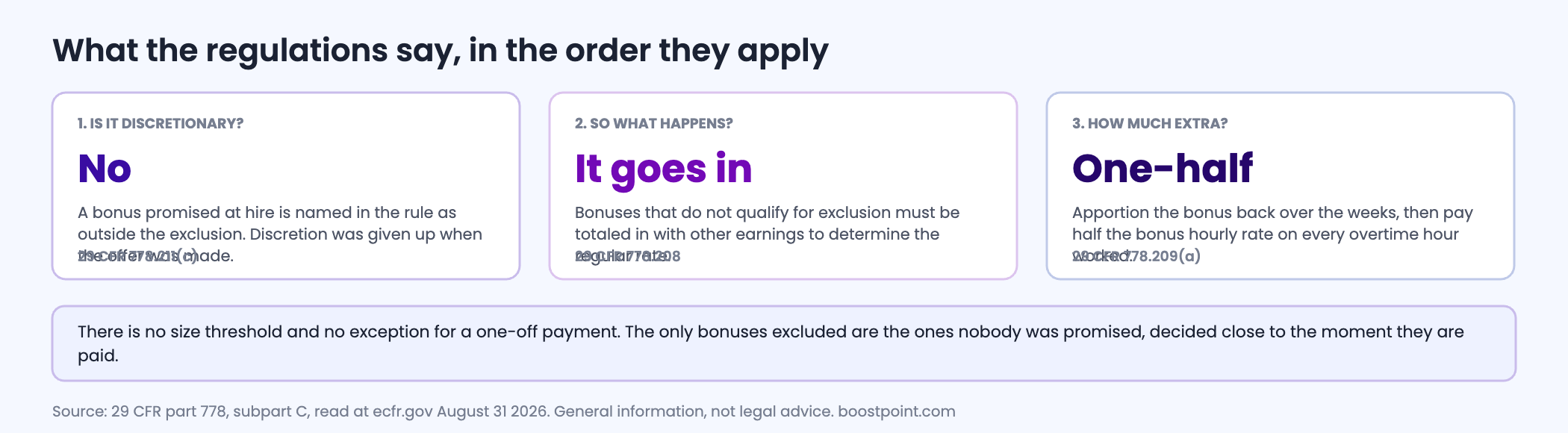
Federal regulations let an employer exclude a bonus from the regular rate only when it is genuinely discretionary. The regulation is specific about what that requires: the employer must retain discretion “both as to the fact of payment and as to the amount until a time quite close to the end of the period,” and the employee must have no contractual right to any amount.
A bonus offered in a job advertisement or an offer letter fails that test on its face. The regulation names the case directly, describing “any bonus which is promised to employees upon hiring or which is the result of collective bargaining” as outside the exclusion, and it ends the paragraph plainly: such bonuses “must be included in the regular rate of pay.”
A companion section says what follows. Bonuses that do not qualify for exclusion “must be totaled in with other earnings to determine the regular rate on which overtime pay must be based.” There is no size threshold and no exception for one-off payments.
Is your bonus discretionary? Almost certainly not
The card below runs the common shapes of bonus against the regulation's own test. It is general information rather than advice on your situation, and a wage and hour attorney is the right person to confirm any particular arrangement.
Classification
Which side of the line is this payment on?
Pick the shape that matches what you are offering.
General information based on the text of the federal regulations, not legal advice. State law can impose additional requirements.
The pattern is consistent. Anything announced in advance to induce someone to take a job, work harder, or stay longer is treated as part of the regular rate. The narrow exclusion for genuinely discretionary payments is designed for the bonus nobody was expecting, decided close to the moment it is paid.
How the arithmetic actually works
When a bonus covers a period longer than one workweek, the regulation says it “must be apportioned back over the workweeks of the period during which it may be said to have been earned.” For each week in which overtime was worked, the employer then owes an additional amount “equal to one-half of the hourly rate of pay allocable to the bonus for that week multiplied by the number of statutory overtime hours worked during the week.”
Where the bonus cannot sensibly be tied to particular weeks, the regulation permits two assumptions: that an equal amount of the bonus was earned each week, or that an equal amount was earned each hour. Most sign-on bonuses take the first.
Work an example. A $3,000 bonus earned across a twenty-six week period, for someone working forty-eight hours a week, allocates $115.38 to each week. Divided across the forty-eight hours, that is $2.40 an hour of extra regular rate. Half of that, applied to the eight overtime hours, is $9.62 a week, and across twenty-six weeks the employer owes $250.
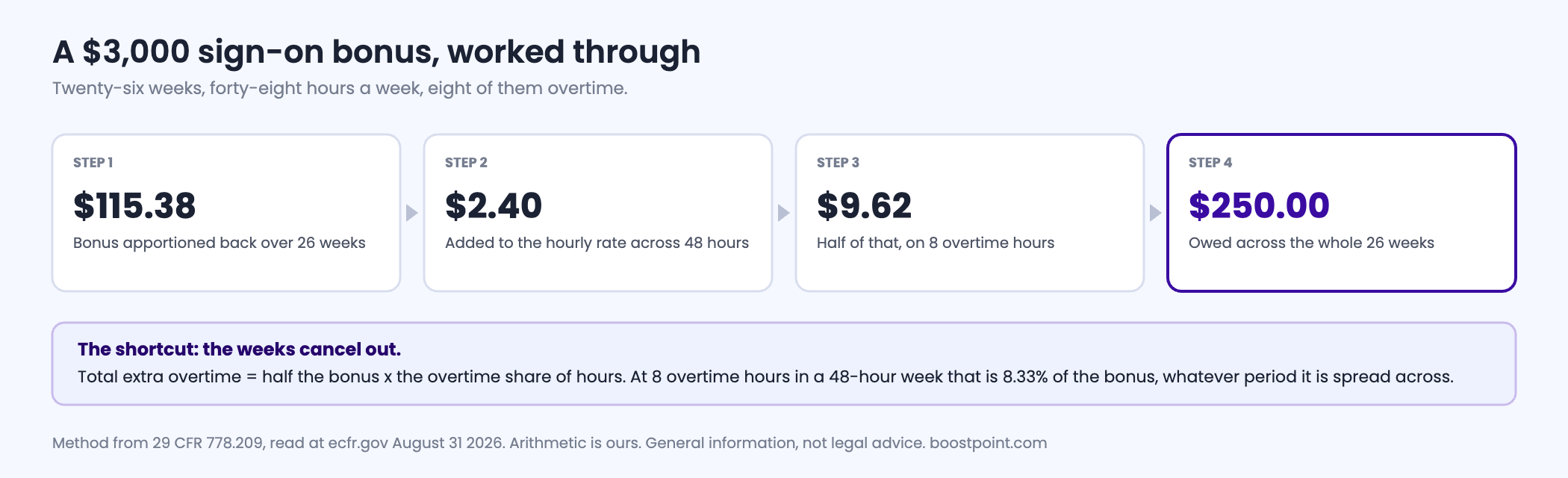
There is a shortcut worth knowing, because it makes the exposure predictable before anyone opens a spreadsheet. The number of weeks cancels out entirely, and the total extra overtime is simply half the bonus multiplied by the overtime share of hours worked. At eight overtime hours in a forty-eight hour week, that share is one sixth, so the extra is 8.33% of the bonus, whatever period the bonus is spread across.
Work out your own exposure
Put your own bonus and your own overtime pattern in and the calculator applies the regulation's method, showing each step so it can be checked against the text.
Overtime effect
What the bonus adds to overtime
Assumes an equal amount of the bonus is earned each week, which is the first of the two methods the regulation permits.
Assumes a forty-hour statutory workweek and a consistent overtime pattern. Real weeks vary and the calculation is done week by week; this is the shape of the exposure, not a payroll output.
The regular rate is only half the arithmetic. How many overtime hours it gets multiplied by is set by the shift pattern and, in four states, by a daily rule rather than a weekly one; our page on overtime laws by state works through what each pattern generates.
Structuring the payment, and what each structure changes
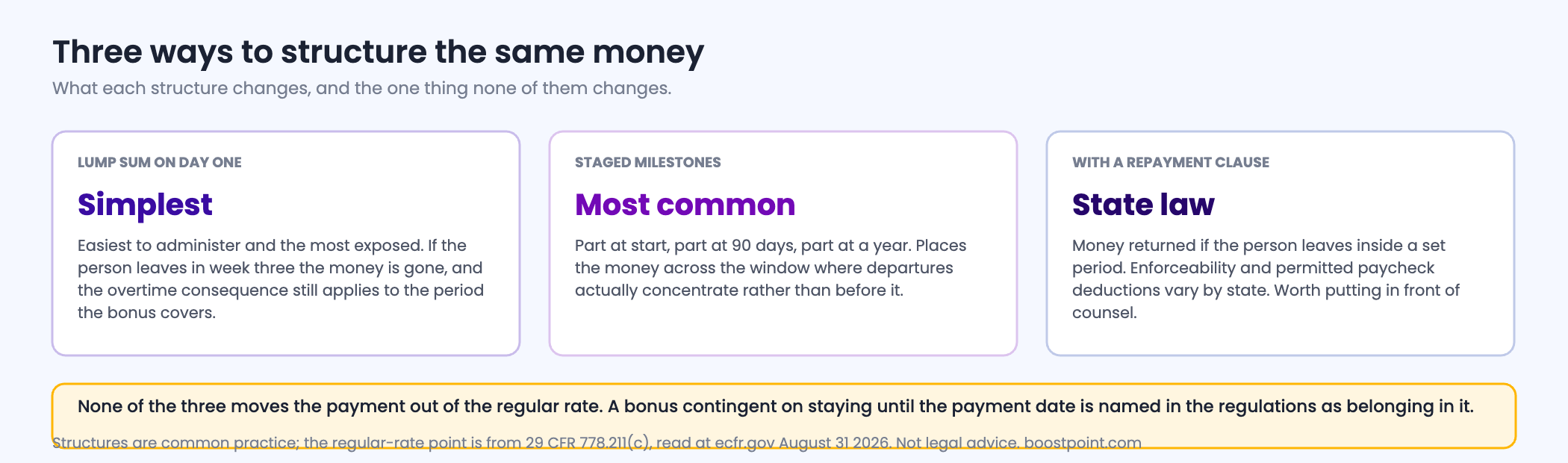
Paying it all on day one is the simplest to administer and the most exposed. The person can leave in week three and the money is gone, and the overtime consequence still applies to the period the bonus is treated as covering.
Splitting it across milestones — part at start, part at ninety days, part at a year — is the most common shape in frontline and healthcare hiring, and it aligns the payment with the period where departures concentrate. It does not make the payment discretionary. A bonus contingent on the employee staying until the payment date is named in the regulations as belonging in the regular rate, which is also why a retention bonus is treated the same way.
Adding a repayment clause, where the employee returns some or all of the bonus if they leave inside a set period, is common and is governed by state law rather than by the federal rules quoted here. Enforceability, permitted deductions from a final paycheck, and notice requirements all vary by state, and this is the part of a bonus program most worth putting in front of counsel.
One thing worth saying plainly: a clawback changes what happens when someone leaves. It does not change the classification of the payment while they are employed, and it does not remove the overtime consequence.
When a sign-on bonus is the wrong tool
A sign-on bonus is a one-time payment that buys a start date. It does not change the schedule, the pay rate, the commute or the supervisor, which are the things that decide whether someone is still there in six months. Where the underlying problem is early attrition, a bonus can make it worse by pulling in people who were bidding on the bonus rather than on the job.
The tenure evidence is unforgiving here. Departures concentrate early wherever they are measured by length of service, so money paid at the start is money paid before the risk period rather than through it. That argues for milestone structures over lump sums, and for spending on the conditions before spending on the inducement. What the evidence does and does not support on that side is set out on employee retention strategies.
It is also worth checking that the role is genuinely hard to fill rather than badly advertised. A bonus is an expensive way to compensate for a job advertisement that does not state the pay, the schedule or the location.
What the alternative costs
Advertising and bonuses are not substitutes, but they are drawn from the same recruiting budget, and the orders of magnitude are worth having in front of you. Across 891 Boostpoint-managed campaigns on Meta, the median registered nurse campaign returned applications at $19.08 each, and campaign structure moved the figure more than anything else: a dated hiring event ran a median $8.02 per applicant against $14.45 for advertising a single role at a time.
Set a four-figure sign-on bonus against those numbers and the comparison is stark. That is not an argument that advertising replaces a bonus, and it is emphatically not a cost per hire — cost per applicant is not cost per hire, and nothing on this page derives one from the other. It is an argument for knowing what the cheaper lever costs before pulling the expensive one.
Frequently asked questions
Does a sign-on bonus have to be included in overtime pay?
Yes, in almost every case. Federal regulations exclude only genuinely discretionary bonuses from the regular rate, and a bonus promised at hire fails that test because the employer has already given up discretion over whether it is paid and how much it is. The regulation names hiring bonuses specifically and says they must be included in the regular rate of pay.
How much extra overtime does a sign-on bonus create?
Half the bonus multiplied by the overtime share of hours worked. For someone working eight overtime hours in a forty-eight hour week, that is 8.33% of the bonus. On a $3,000 bonus it is $250, and the figure does not depend on how many weeks the bonus is spread across.
What makes a bonus discretionary?
The employer has to keep discretion over both the fact of payment and the amount until close to the end of the period, and the employee must have no contractual right to any of it. The regulation gives the example of an employer who announces in January that a bonus will be paid in June, and says discretion has been abandoned at that point.
Can we make a sign-on bonus repayable if the person leaves?
Repayment clauses are common, but they are governed by state law rather than by the federal wage rules described here, and enforceability and permitted paycheck deductions vary considerably. It is the part of a bonus program most worth reviewing with an attorney, and it does not change how the payment is treated for overtime while the person is employed.
Is it better to pay a sign-on bonus in one lump or in stages?
Staged payments tied to milestones are the more common structure in frontline and healthcare hiring, because they place the money across the period when departures actually happen rather than before it. Staging does not make the payment discretionary; a bonus contingent on staying until the payment date is named in the regulations as part of the regular rate.
Do sign-on bonuses actually reduce turnover?
We have not measured that and we are not going to assert a number. What is measurable is where departures sit, and they concentrate in the first year of employment, which is an argument for staging payments across that window rather than paying everything at the start. A bonus does not change the schedule, the pay rate or the supervisor.
Does the rule apply to salaried employees?
The regular rate calculation matters only for employees who are entitled to overtime. For an employee properly classified as exempt the overtime consequence does not arise, though the classification itself is worth confirming rather than assuming. This is general information and not advice on any particular arrangement.
How big should a sign-on bonus be?
There is no published benchmark we can verify, and any single figure offered as one has been invented. The useful framing is what the vacancy is costing while it stays open and what the cheaper levers cost first, including whether the job advertisement states the pay, the schedule and the location. Then add the overtime consequence, which is 8.33% of the bonus at a typical overtime pattern.
Before you raise the bonus, check the advertising
A bonus is the expensive lever. Filling the role in the first place is the part we measure.
Wage and hour rules: quoted from the U.S. Code of Federal Regulations, title 29, part 778, subpart C, read at ecfr.gov on August 31 2026 — section 778.208 on the inclusion of bonuses in the regular rate, section 778.209 on the method of inclusion, and section 778.211 on discretionary bonuses. The phrases “both as to the fact of payment and as to the amount until a time quite close to the end of the period”, “any bonus which is promised to employees upon hiring or which is the result of collective bargaining”, “must be included in the regular rate of pay”, “must be totaled in with other earnings to determine the regular rate on which overtime pay must be based”, “must be apportioned back over the workweeks of the period during which it may be said to have been earned” and “equal to one-half of the hourly rate of pay allocable to the bonus for that week multiplied by the number of statutory overtime hours worked during the week” are quoted from those sections. This page is general information about federal regulations and is not legal advice; state law imposes additional requirements, particularly on repayment clauses and paycheck deductions. Worked example: a $3,000 bonus apportioned equally across twenty-six weeks for an employee working forty-eight hours a week allocates $115.38 a week, or $2.40 an hour, producing $9.62 of additional overtime a week and $250 in total; the shortcut, that the total equals half the bonus times the overtime share of hours, is our arithmetic on the regulation's method and the weeks cancel out. Advertising figures: Boostpoint 2026 Social Job Advertising Benchmark — 891 Boostpoint-managed campaigns on Meta across 1,334 campaign-months in 2026, advertising costs only; registered nurse median $19.08, event-driven structure median $8.02, single-role structure median $14.45. Cost per applicant is not cost per hire, and no cost per hire is derived from it anywhere on this page. No benchmark for typical sign-on bonus size is published here because we could not verify one. Last updated August 2026.