
ATS Integrations for Hourly and Driver Hiring: What Integration Should Actually Do
Most vendors call a logo on a partner page an integration. For hourly and driver hiring, only three things matter: the applicant arrives in your ATS within minutes, the source field is populated automatically, and the status comes back. Without the second one, you cannot compute cost per hire at all.
A note on who's writing this
Boostpoint runs recruitment advertising and hands applicants to whatever system you already use, so we have an interest in you believing integration matters. Read this knowing that. What we can offer is the shape of the problem from our side of the handoff: our measurement stops at the moment an applicant leaves us, which is exactly why we publish cost per applicant and never cost per hire. This page is about the half we cannot see.
What vendors mean when they say “we integrate”
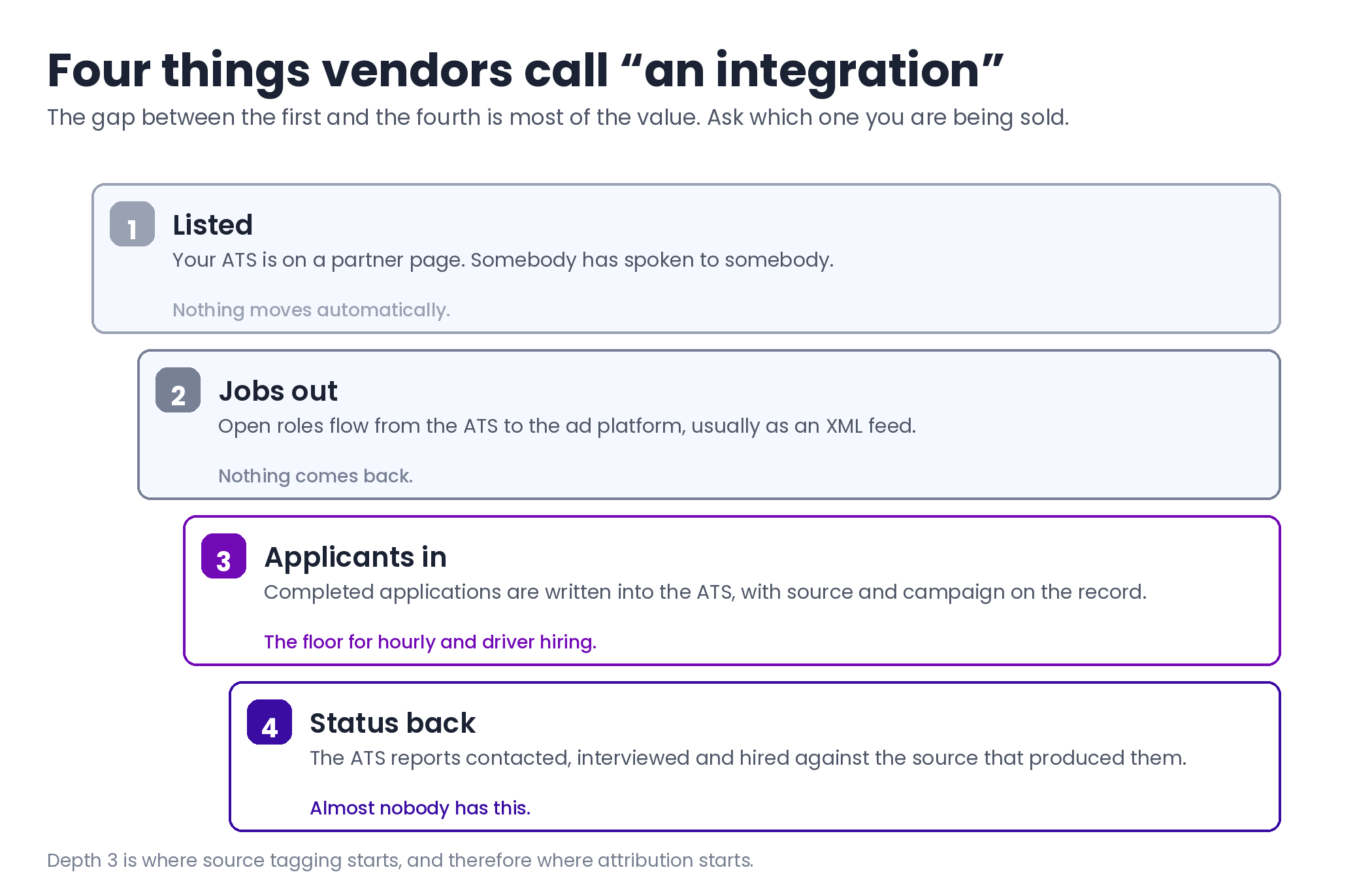
The word covers four very different things, and the gap between the first and the fourth is most of the value.
| Depth | What it means | What it does not do |
|---|---|---|
| 1. Listed | Your ATS appears on a partner page. Somebody has spoken to somebody. | Nothing moves automatically. This is a logo. |
| 2. Jobs out | Your open roles flow from the ATS to the advertising platform, usually as an XML feed, so you post once. | Nothing comes back. Applicants still land somewhere else and get copied over by hand. |
| 3. Applicants in | Completed applications are written into the ATS automatically, with the source and campaign recorded on the record. | Does not tell the advertising side what happened next. Hire data still lives only with you. |
| 4. Status back | The ATS reports outcomes — contacted, interviewed, hired — back against the source that produced them. | Nothing, once it works. It is also the depth almost nobody has. |
For hourly and driver hiring, depth 3 is the floor. A warehouse applicant who fills in a form at 11pm and gets contacted on Thursday is not a candidate any more, and a driver with a Class A license has three other offers by then.
Driver hiring stresses the handoff harder than any other frontline role, because the application a carrier actually needs is long — employment history going back years, endorsements, license detail — and nobody completes that on a phone at a truck stop in one sitting. The pattern that works is a short expression of interest captured where the driver already is, then the full application in the system built for it. That is two systems and one handoff, which is precisely the thing that has to be automatic.
The case for not integrating at all
Made properly, because for a lot of employers it is the right answer. If you hire eight people a year, a spreadsheet and an inbox beat any integration project. Integrations break quietly — a field gets renamed, a credential expires, a feed starts returning yesterday's jobs — and the failure mode is silent, which is worse than manual entry that is visibly late.
The threshold is roughly this: if one person can retype every applicant into the ATS the same day without it becoming somebody's afternoon, do that. Integration earns its setup cost when applicant volume makes same-day handling impossible, which for most frontline employers means continuous hiring across more than a handful of locations.
There is a second honest reason to wait. An integration built onto a hiring process nobody trusts just moves bad records faster. If your managers are already working from a group text rather than the ATS, fix that first — the integration will not make them open it.
Where the applicant actually goes, and why it decides your cost
Across 891 Boostpoint campaigns and 1,334 campaign-months, post-click conversion — the share of people who click and then finish an application — explains about 70% of the variation in cost per applicant. Click-through rate explains about 30% and CPM about 18%, each measured separately.
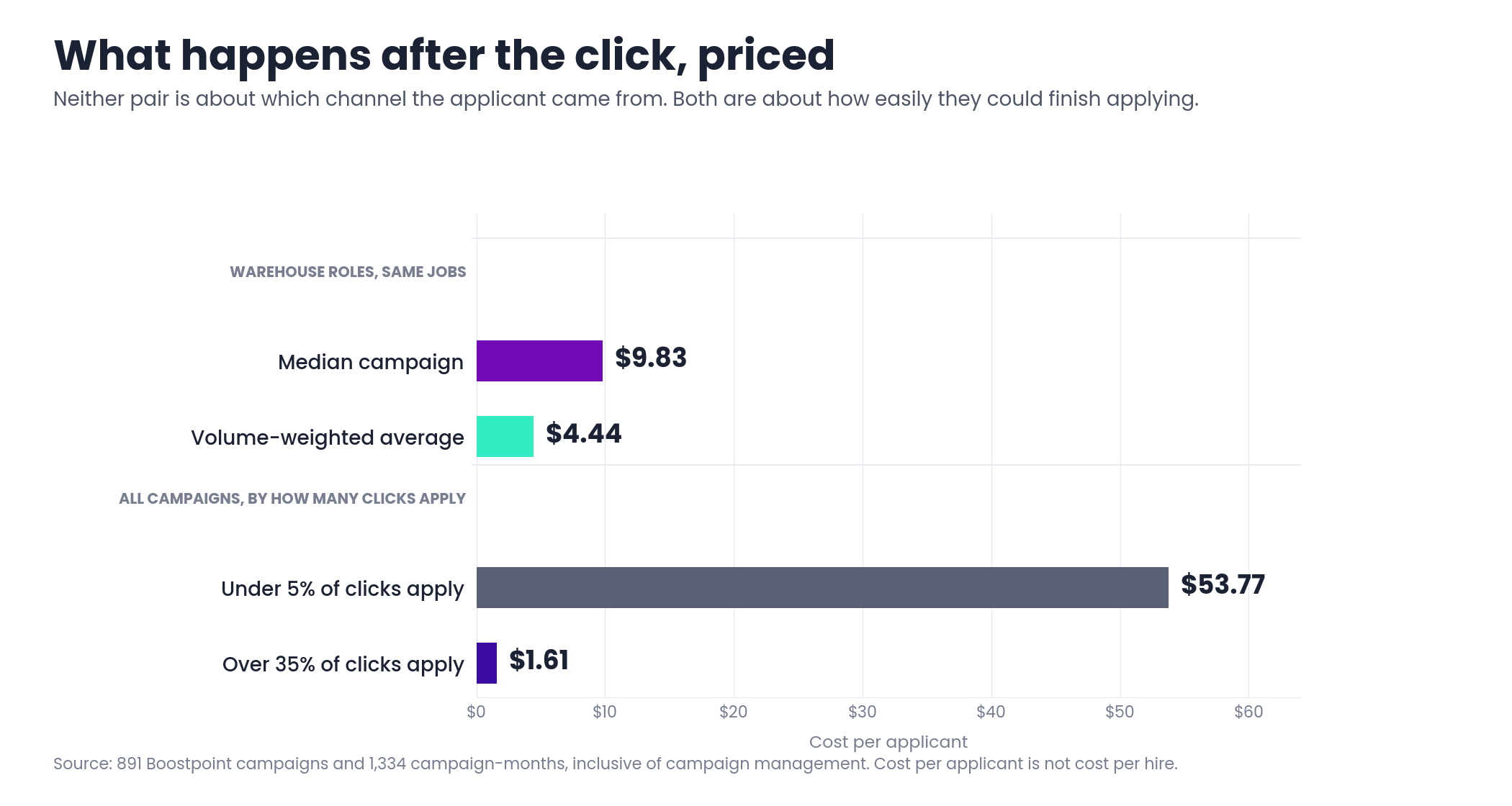
That is a statement about integration whether or not anyone calls it one, and it applies whether the click came from an ad, a general board or one of the niche boards. Every extra hop between the ad and the finished application is a place where the rate falls. In our warehouse campaigns, 17.2% of clicks become applications when the application happens in the platform the person was already in. The same warehouse roles run at a $9.83 median cost per applicant and a $4.44 volume-weighted average, and the distance between those two numbers is mostly this.
The bands are blunt. Campaigns converting under 5% of clicks average $53.77 per applicant. Above 35%, $1.61. A redirect to a login-walled careers portal is one of the cheapest ways to move a campaign from the second number toward the first.
What your ATS record looks like, with and without source tagging
This is the whole argument in one screen. The same hire, recorded two ways.
Cost per hire exists in exactly one place, and it is not the ad platform
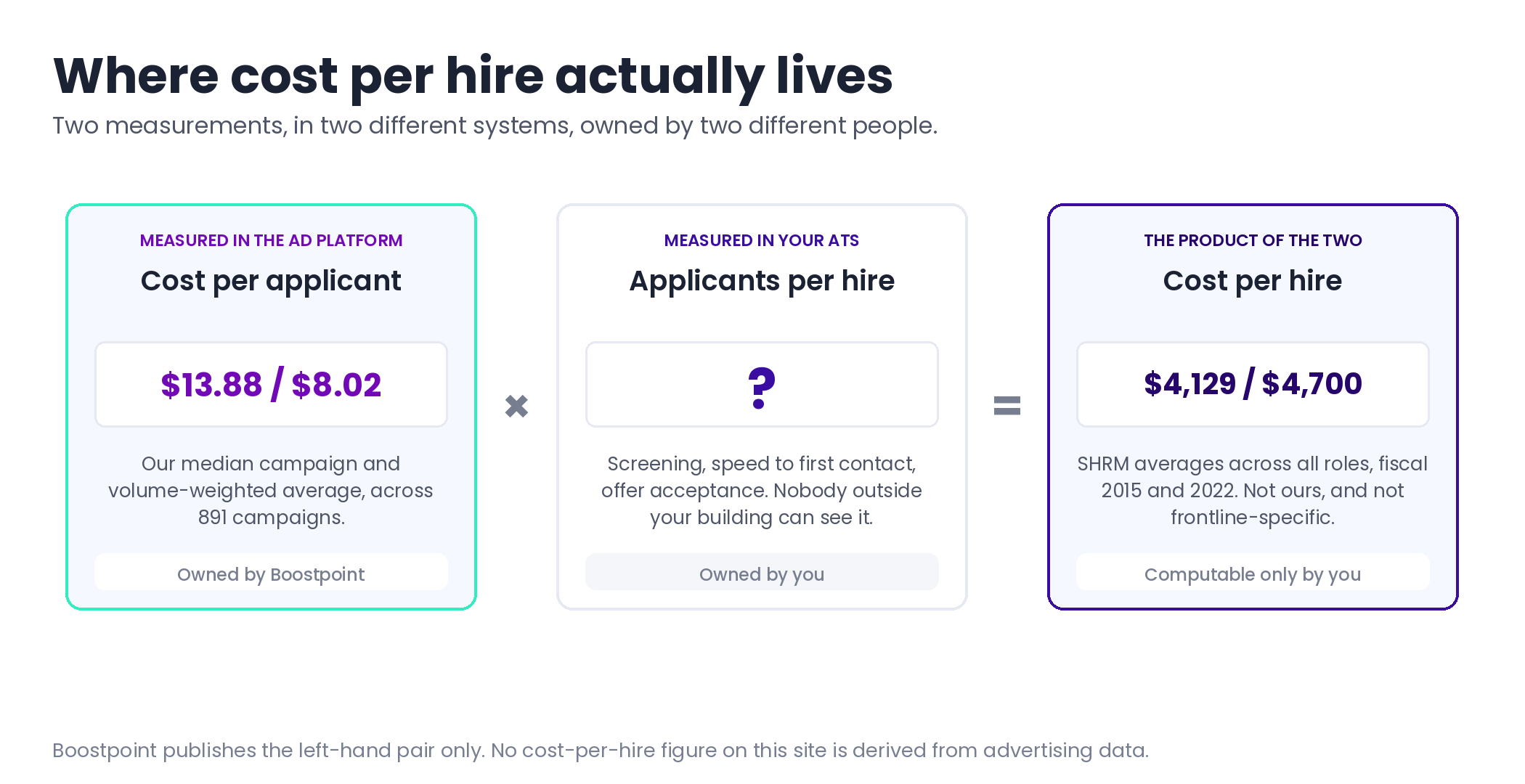
SHRM's most-quoted benchmark put average cost per hire at $4,129 in its Human Capital Benchmarking Report for fiscal 2015, and reported it at nearly $4,700 in 2022. Both are averages across every kind of role, and the 2022 piece notes that roughly 30% to 40% of recruitment cost is hard cost and the rest is soft — time, management attention, the vacancy itself.
Notice what that means. Advertising is a slice of the 30% to 40%. Everything else that decides your cost per hire happens inside your applicant tracking system: how fast someone is contacted, how many drop out at screening, how many offers are accepted. Cost per applicant is not cost per hire, and any vendor quoting you the second one from ad data is multiplying our number by a ratio only you can measure. Our overall median campaign is $13.88 per applicant and our volume-weighted average $8.02. What those become once your own ratio is applied is a number your ATS owns and we do not.
What to ask a vendor before you believe the word
- Which of the four depths is this? Ask them to name it. If the answer is a partner-page logo, that is depth 1 and it is fine — just do not budget as though it is depth 3.
- How does the source field get populated? Automatically, from the ad, or by whoever types the record. If it is typed, it will be blank within a month.
- How long from application submitted to visible in the ATS? Minutes is the answer for hourly and driver roles. Nightly batch is not.
- What happens when it breaks? Ask specifically: does anything alert, or does the queue simply go quiet? Silent failure is the normal failure.
- Can the applicant finish without leaving the platform they are on? Every redirect and every login wall is paid for in the apply rate.
- What does it cost to build and to keep? Setup, per-seat, per-application, and who pays when your ATS changes its API.
Our own answer, for the record: we integrate with a set of named ATS and CRM platforms listed on our integrations page, and where there is no direct integration we deliver applicants by the routes that system supports. We do not claim depth 4 with most systems, because most systems do not offer it.
An applicant your ATS records as “source: unknown” cost you exactly as much as the one it attributes. You just can't prove which half of your budget bought them.
Frequently asked questions
What is an ATS integration?
A connection between your applicant tracking system and another tool, at one of four depths: a partner listing, a job feed going out, completed applications coming in with their source recorded, or hiring outcomes reported back. Vendors use the same word for all four, so ask which one is on offer.
What is the best ATS for hourly hiring?
The one your managers will actually open on a phone. For hourly and driver roles the deciding features are speed to first contact, mobile completion without a login, and an automatically populated source field — not the length of the feature list.
Do I need an ATS integration at all?
Not if one person can retype every applicant into the system the same day without it becoming an afternoon's work. Integration earns its setup cost when volume makes same-day handling impossible, which usually means continuous hiring across more than a handful of locations.
Why does source tagging matter so much?
Because without it you cannot attribute a hire to a channel, and every reallocation decision after that is a guess. It is also the reason no advertising vendor can honestly quote a cost per hire — the hire is recorded in your system, not theirs.
Does sending applicants to my careers site hurt the apply rate?
Usually, yes. Post-click conversion explains about 70% of the variation in cost per applicant across 891 Boostpoint campaigns, and campaigns converting under 5% of clicks average $53.77 each against $1.61 above 35%. In our warehouse campaigns 17.2% of clicks become applications when the application happens in the platform the person is already in.
What is a realistic cost per hire for hourly roles?
We will not give you one from ad data. SHRM put the average across all roles at $4,129 for fiscal 2015 and nearly $4,700 in 2022. Cost per applicant is not cost per hire; multiply our cost per applicant by your own applicants-per-hire ratio, which only your ATS knows.
How fast should applicants appear in the ATS?
Minutes, for hourly and driver hiring. A warehouse applicant who applies at 11pm and is contacted on Thursday has usually taken something else, and a Class A driver will have other offers within a day.
What breaks in an ATS integration, and how would I know?
Renamed fields, expired credentials, and feeds that quietly serve stale jobs. The failure mode is silence rather than an error, so the question worth asking a vendor is not whether it breaks but whether anything alerts you when it does.
See what arrives, and where it lands
We will walk through how applicants reach your system, what gets tagged, and what our side can and cannot measure once they leave us.
Methodology and sources. Boostpoint figures come from 891 campaigns and 1,334 campaign-months. Cited: post-click conversion explaining about 70% of the variation in cost per applicant, click-through rate about 30% and CPM about 18%, each measured separately; warehouse roles at a $9.83 median and $4.44 volume-weighted average with 17.2% click-to-apply when the application happens in-platform; $53.77 per applicant below 5% post-click conversion and $1.61 above 35%; overall median $13.88 and volume-weighted average $8.02. Cost per applicant is not cost per hire — hires are recorded in your applicant tracking system, not in an ad platform, which is why no cost-per-hire figure is published here or anywhere else on this site. This is a sample of Boostpoint campaigns, not an industry-wide study. The applicant record in the interactive panel is illustrative and is not a real record. Third-party sources: SHRM’s Human Capital Benchmarking Report, reporting an average cost per hire of $4,129 for fiscal 2015 from a survey of 2,048 SHRM members; and SHRM’s “The Real Costs of Recruitment”, 11 April 2022, reporting average cost per hire of nearly $4,700 and attributing roughly 30% to 40% of recruitment cost to hard costs, the remainder to soft costs. See our full benchmark report, our integrations page, the ATS definition, the warehouse recruiting playbook and CDL recruiting.