
Employer guideUpdated September 2026
Final Paycheck Laws by State: Firing Someone Is a Payroll Event
In eight states a discharged employee must be paid immediately, at the moment the employment ends. In ten more the deadline is a fixed number of hours or days, ahead of the next payroll run. That is eighteen jurisdictions where letting somebody go starts a clock that expires before your next payday. In 21 the deadline is different depending on whether they quit or were fired, which makes a no-call no-show the hardest case in the book. And the penalty is not a flat fine: California charges up to 30 days of the employee’s wages, Massachusetts mandatory treble damages plus costs and attorney fees.
Four groups, and only one of them is comfortable
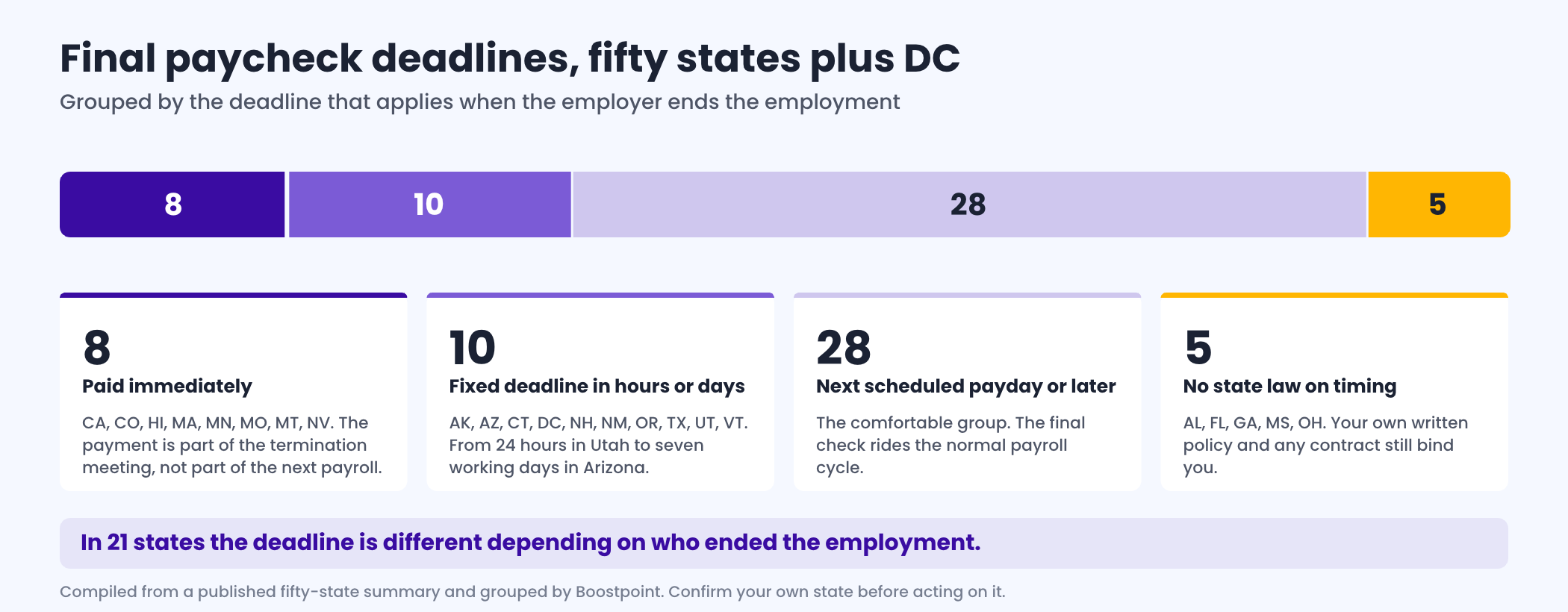
| Group | How many | What it means operationally |
|---|---|---|
| Immediately | 8 | California, Colorado, Hawaii, Massachusetts, Minnesota, Missouri, Montana, Nevada. The payment is part of the termination meeting, not part of the next payroll. |
| A fixed deadline in hours or days | 10 | Alaska, Arizona, Connecticut, the District of Columbia, New Hampshire, New Mexico, Oregon, Texas, Utah and Vermont. Ranges from 24 hours in Utah to seven working days in Arizona. |
| Next scheduled payday or later | 28 | The comfortable group: the final check rides the normal payroll cycle. |
| No state law on timing | 5 | Alabama, Florida, Georgia, Mississippi and Ohio for discharge. Your own policy and any contract still bind you. |
The one that decides everything else
In 21 states the deadline is different depending on who ended the employment. California pays a discharged employee immediately and gives an employee who quits without notice 72 hours. Colorado pays immediately on termination and on the next regular payday for a resignation. Which means the first question after any separation is not when do we pay but which of these two things just happened, and that question is answered by a manager, in the moment, usually with no one from HR present.
All fifty states and the District of Columbia
Two deadlines per row, because in twenty-one of them the two are not the same. The final column is the one to read first: where it says yes, the manager who runs the separation meeting is also the person who decides which deadline applies, and they usually decide it in the room.
| State | If you end it | If they quit | Group | Do they differ? |
|---|---|---|---|---|
| Alabama | No law | No law | No state law | No |
| Alaska | Within 3 working days | Next scheduled payday, at least 3 days after notice | Fixed deadline | Yes |
| Arizona | Within 7 working days or the next payday, whichever is first | Next scheduled payday | Fixed deadline | Yes |
| Arkansas | By the next regular payday | No law | Payday or later | Yes |
| California | Immediately | Within 72 hours, or immediately if 72 hours notice was given | Immediately | Yes |
| Colorado | Immediately | Next scheduled payday | Immediately | Yes |
| Connecticut | Next business day | Next scheduled payday | Fixed deadline | Yes |
| Delaware | Later of the next regular payday or 3 business days after the last day worked | Later of the next regular payday or 3 business days after the last day worked | Payday or later | No |
| District of Columbia | Next business day | Next payday or within 7 days, whichever is first | Fixed deadline | Yes |
| Florida | No law | No law | No state law | No |
| Georgia | No law | No law | No state law | No |
| Hawaii | Immediately, or the next business day where conditions prevent it | Next payday, or immediately if one pay period of notice was given | Immediately | Yes |
| Idaho | Next payday or within 10 days, whichever is first; 48 hours on written request | Next payday or within 10 days, whichever is first; 48 hours on written request | Payday or later | No |
| Illinois | Next scheduled payday | Next scheduled payday | Payday or later | No |
| Indiana | Next scheduled payday | Next payday, or 10 business days after demand where no address is known | Payday or later | Yes |
| Iowa | Next scheduled payday | Next scheduled payday | Payday or later | No |
| Kansas | Next scheduled payday | Next scheduled payday | Payday or later | No |
| Kentucky | Next payday or within 14 days, whichever is later | Next payday or within 14 days, whichever is later | Payday or later | No |
| Louisiana | Next payday or within 15 days, whichever is earlier | Next payday or within 15 days, whichever is earlier | Payday or later | No |
| Maine | No later than the next established payday | No later than the next established payday | Payday or later | No |
| Maryland | Next scheduled payday | Next scheduled payday | Payday or later | No |
| Massachusetts | Immediately | Next payday, or the following Saturday where there is no scheduled payday | Immediately | Yes |
| Michigan | The regularly scheduled payday for the period in which the termination occurs | The regularly scheduled payday for the period in which the termination occurs | Payday or later | No |
| Minnesota | Immediately on the employee's written demand (penalty if unpaid 24 hours after demand) | Next payday, or by day 20 where the payday is fewer than 5 days away | Immediately | Yes |
| Mississippi | No law | No law | No state law | No |
| Missouri | Immediately | No law | Immediately | Yes |
| Montana | Immediately, or the next payday or within 15 days where policy permits | Next payday or within 15 days, whichever is first | Immediately | Yes |
| Nebraska | Next payday or within 2 weeks, whichever is first | Next payday or within 2 weeks, whichever is first | Payday or later | No |
| Nevada | Immediately | Next payday or within 7 days, whichever is first | Immediately | Yes |
| New Hampshire | Within 72 hours, or the next payday if laid off | Next payday, or within 72 hours where notice was given | Fixed deadline | Yes |
| New Jersey | Next scheduled payday | Next scheduled payday | Payday or later | No |
| New Mexico | Within 5 days | Next scheduled payday | Fixed deadline | Yes |
| New York | Next scheduled payday | Next scheduled payday | Payday or later | No |
| North Carolina | Next scheduled payday | Next scheduled payday | Payday or later | No |
| North Dakota | Next scheduled payday | Next scheduled payday | Payday or later | No |
| Ohio | No law | First or fifteenth of the month, by wage period | No state law | No |
| Oklahoma | Next scheduled payday | Next scheduled payday | Payday or later | No |
| Oregon | By the end of the next business day | Immediately where 48 hours notice was given, otherwise within 5 days or the next payday | Fixed deadline | Yes |
| Pennsylvania | Next scheduled payday | Next scheduled payday | Payday or later | No |
| Rhode Island | Next scheduled payday | Next scheduled payday | Payday or later | No |
| South Carolina | Within 48 hours or the next payday, and not more than 30 days | Within 48 hours or the next payday, and not more than 30 days | Payday or later | No |
| South Dakota | Next payday, or when company property is returned | Next payday, or when company property is returned | Payday or later | No |
| Tennessee | Next payday or within 21 days, whichever is later | Next payday or within 21 days, whichever is later | Payday or later | No |
| Texas | Within 6 days | Next scheduled payday | Fixed deadline | Yes |
| Utah | Within 24 hours | Next scheduled payday | Fixed deadline | Yes |
| Vermont | Within 72 hours | Next payday, or the next Friday where none is scheduled | Fixed deadline | Yes |
| Virginia | Next scheduled payday | Next scheduled payday | Payday or later | No |
| Washington | Next scheduled payday | Next scheduled payday | Payday or later | No |
| West Virginia | On or before the next regular payday | On or before the next regular payday | Payday or later | No |
| Wisconsin | Next payday or within 1 month, whichever is first | Next scheduled payday | Payday or later | Yes |
| Wyoming | Next regular payday | Next regular payday | Payday or later | No |
Three states, read at source
California: immediately, and the penalty runs by the day
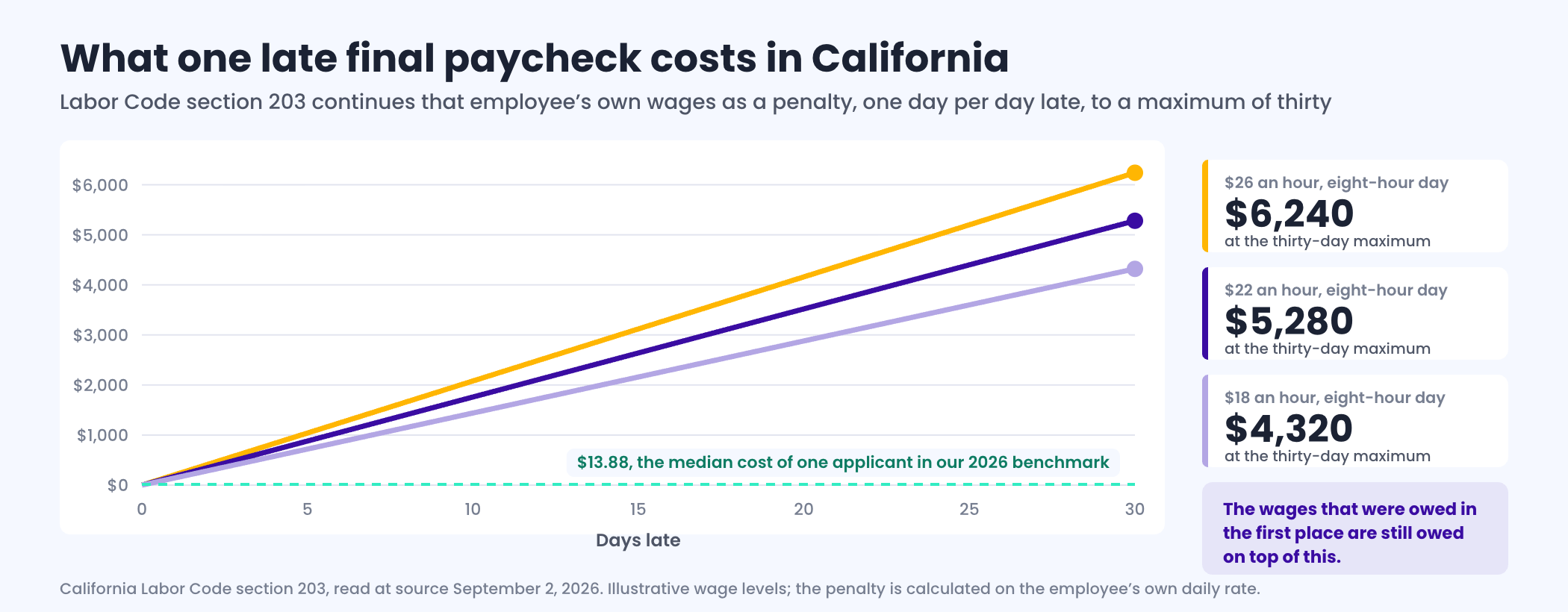
An employee who is discharged is paid at the time of termination. An employee who quits with at least 72 hours of notice is paid at the time of quitting; an employee who quits without notice is paid within 72 hours. The penalty for missing it is not a fine but the wage itself, continuing: under Labor Code section 203 the wages of the employee continue as a penalty from the due date at the same rate until paid, for a maximum of 30 days. A warehouse associate on $22 an hour working eight-hour days is roughly $176 a day, so a final check that is thirty days late costs about $5,280 on top of the wages that were owed anyway.
Massachusetts: the day of discharge, and damages are trebled
Under chapter 149 section 148, an employee discharged from employment is paid in full on the day of the discharge. An employee who leaves voluntarily is paid on the following regular pay day, or where there is none, on the following Saturday. Section 150 is the part that changes the arithmetic: an employee who prevails is entitled to mandatory treble damages as liquidated damages for any lost wages, together with costs and reasonable attorney fees. There is no cure period and no discretion in it.
Colorado: immediately, with one narrow allowance
When the employer ends the employment the employer must immediately pay all wages owed. Where the payroll unit is off site, delivery is required within 24 hours after its next regular workday starts. An employee who quits is paid by or on the next regular payday. If the employee has to chase it, a written demand starts a 14-day clock before penalties attach, which is the one place in these three states where an employer that moves quickly can still fix a miss.
Where this actually goes wrong
Not in the states with hard deadlines, where payroll has usually built a process. It goes wrong in the ambiguous separations: the no-call no-show that a manager treats as a quit and a labor commissioner later treats as a discharge, the “resigned in lieu of termination” that changes the deadline from the next payday to the same afternoon, and the multi-state employer that runs one process because it started in a next-payday state. In each case the wages were never in dispute. The deadline was.
Look up both deadlines for one state
What a missed deadline actually costs
The unhelpful way to think about this is as a compliance risk with a low probability of being caught. The useful way is as a per-event cost with a known formula, because in the states that matter the formula is public and the employee does not need a lawyer to start it. California runs the employee’s own daily wage forward for up to thirty days. Massachusetts multiplies the lost wages by three and adds the attorney fees. Neither cares whether the delay was a bank holiday, a manager who forgot to file the separation, or a payroll cutoff that fell on the wrong day.
Price your own exposure
The part we can measure, and the part we cannot
We have data on one end of this. Across the 891 campaigns in our 2026 social job advertising benchmark the median campaign delivered an applicant for $13.88, with customer service and admin roles at $2.71 and warehouse and production at $9.83. Set that against a thirty-day waiting time penalty on a single $22-an-hour employee and one late final check costs more than three hundred applicants. That comparison is worth making once and then leaving alone, because the two are not really substitutes: one is a marketing budget and the other is a payroll failure.
What we have no data on at all is how often employers miss the deadline, how many separations get classified wrongly in the room, or what any of it does to whether somebody comes back or tells other people not to apply. We are not going to estimate those. The adjacent question we have written about with our own numbers is what the separations themselves cost, in the turnover cost calculator and on first 90 days turnover, and the neighboring rule that catches the same employers on the same shifts is on overtime laws by state.
Related: Pay Frequency Laws by State.
State-by-state employer guides: every state’s breaks, overtime, final pay and hiring rules in one place: Alabama, Alaska, Arizona, Arkansas, California, Colorado, Connecticut, Delaware, D.C., Florida, Georgia, Hawaii, Idaho, Illinois, Indiana, Iowa, Kansas, Kentucky, Louisiana, Maine, Maryland, Massachusetts, Michigan, Minnesota, Mississippi, Missouri, Montana, Nebraska, Nevada, New Hampshire, New Jersey, New Mexico, New York, North Carolina, North Dakota, Ohio, Oklahoma, Oregon, Pennsylvania, Rhode Island, South Carolina, South Dakota, Tennessee, Texas, Utah, Vermont, Virginia, Washington, West Virginia, Wisconsin, Wyoming.
Frequently asked questions
How long does an employer have to give a final paycheck?
It depends on the state and on who ended the employment. Eight states require immediate payment when the employer discharges someone: California, Colorado, Hawaii, Massachusetts, Minnesota, Missouri, Montana and Nevada. Ten more set a fixed deadline measured in hours or days, from 24 hours in Utah to seven working days in Arizona. Twenty-eight allow the next scheduled payday or later, and five have no state law on the timing at all.
Is the deadline different if the employee quits?
In 21 states it is. California pays a discharged employee at the time of termination but gives an employee who quits without notice 72 hours. Colorado pays immediately on discharge and on the next regular payday for a resignation. Massachusetts pays on the day of discharge and on the following regular pay day for a voluntary departure. That makes the classification of the separation the first operational question, and it is usually answered by a manager rather than by payroll.
What is the penalty for a late final paycheck in California?
Labor Code section 203 continues the employee’s wages as a penalty from the due date at the same rate until paid, for a maximum of 30 days. It is calculated on that employee’s own daily rate rather than as a flat fine, so an associate on $22 an hour working eight-hour days accrues roughly $176 a day and about $5,280 across the full thirty. The wages that were owed in the first place are still owed on top of it.
What happens in Massachusetts if the final pay is late?
Chapter 149 section 148 requires an employee discharged from employment to be paid in full on the day of the discharge. Section 150 provides mandatory treble damages as liquidated damages for any lost wages, together with the costs of the litigation and reasonable attorney fees. The trebling is not discretionary, which means the exposure on a late check is three times the wage plus the cost of the other side’s lawyer.
Can an employer withhold a final paycheck until equipment is returned?
Generally no, and this is one of the most common mistakes. The deadline runs on the wages, not on the property. South Dakota is unusual in tying the timing to the return of company property. Most states treat the two as separate matters, so an employer that holds pay against an unreturned uniform or laptop can be late on the wage deadline while still having no lawful route to keep the money. Deductions are governed by their own rules and are narrower than employers expect.
Does unused vacation have to be paid out in the final check?
That is a separate question from the timing and the answer varies more. Some states treat accrued vacation as earned wages that must be paid at separation, some allow a written policy to govern it, and some are silent. Where it does count as wages, it counts for the deadline too, which means an employer that pays the hourly wages on time and the accrued balance two weeks later can still be late. Confirm this one with your own payroll provider.
What about a no-call no-show?
This is the hardest case in the 21 states where the two deadlines differ. A manager treats an absence as an abandonment and therefore a quit; a labor agency may later treat the employer’s decision to stop scheduling as a discharge. The safe operational answer is to write down what happened and when, and where the difference is material, to pay on the shorter of the two deadlines rather than argue about the classification afterwards.
What should a multi-state employer actually do about this?
Stop running one process. Employers that started in a next-payday state usually built a separation process around the payroll calendar and then carried it into states where the deadline is the same day. The practical fix is a two-line rule at the top of the separation checklist: which state, and who ended it. Everything else in the process can stay as it is, because the wages are rarely in dispute. The date is.
Which states require a separation notice when an employee leaves?
There is no federal separation notice, so it is state by state and often runs through the unemployment agency. California tells employers to “immediately give written notice to employees if they are fired, laid off, taking a leave of absence, or if their job status changes” (EDD). New York requires written notice of the exact termination date and benefit cancellation date within five working days (Labor Law 195(6)). Missouri corporations with seven or more employees must answer a written service-letter request within 45 days (RSMo 290.140). Check your state unemployment agency for its required form.
You cannot slow the separations down. You can stop them being a surprise.
Bring the roles you refill most often and the states you refill them in. We will show you what applicant flow costs in those markets, so the requisition opens on the day the separation happens rather than two weeks later.
Book a Demo