
Recruiting Automation Software: Which Automations Actually Move the Number
Recruiting automation is sold as time saved. That is a real benefit and it is not the same as a better hiring outcome. Sort the eight things vendors call automation by when in the funnel each one acts, and a pattern appears: almost all of them act after the application is submitted, while 70% of the variation in what an applicant costs is decided before that point. For hourly and frontline hiring, the automations worth paying for are the ones that act while the candidate is still answering.
A note on who's writing this
Boostpoint automates two of the eight things on this page — campaign management and text follow-up — and not the other six. We do not sell resume parsing, interview scheduling, offer generation or onboarding, and we are not an applicant tracking system. Read the ordering below with that in mind, and note where the page says plainly that we have no measurement.
Campaign figures come from our 2026 Social Job Advertising Benchmark — 891 Boostpoint-managed campaigns on Meta across 1,334 campaign-months — and are labeled where they appear. If you have not yet decided which category of product you need at all, start with recruiting software for small business.
The eight things vendors call recruiting automation
Every product in this category automates some subset of these. The column that matters is the third one: whether the automation acts before the application is submitted or after it.
| Automation | What it does without a human | Acts | What it can move |
|---|---|---|---|
| Job distribution | Pushes an opening to boards and feeds | Before | How many people see the job |
| Campaign management | Builds, budgets and adjusts the ads | Before | Reach, click-through and what the auction charges |
| Application pre-fill | Carries known details into the form | Before | The share of clicks that finish applying |
| Knockout screening | Asks qualifying questions in the form | Before | The mix of who reaches you, not the count |
| Text and email follow-up | Replies within seconds of submission | At the boundary | How many applicants are still answering |
| Resume parsing and scoring | Reads and ranks what arrived | After | How fast a human sorts the pile |
| Interview scheduling | Offers slots and books them | After | Days between interest and interview |
| Offer and onboarding | Generates documents, collects paperwork | After | Days between yes and day one |
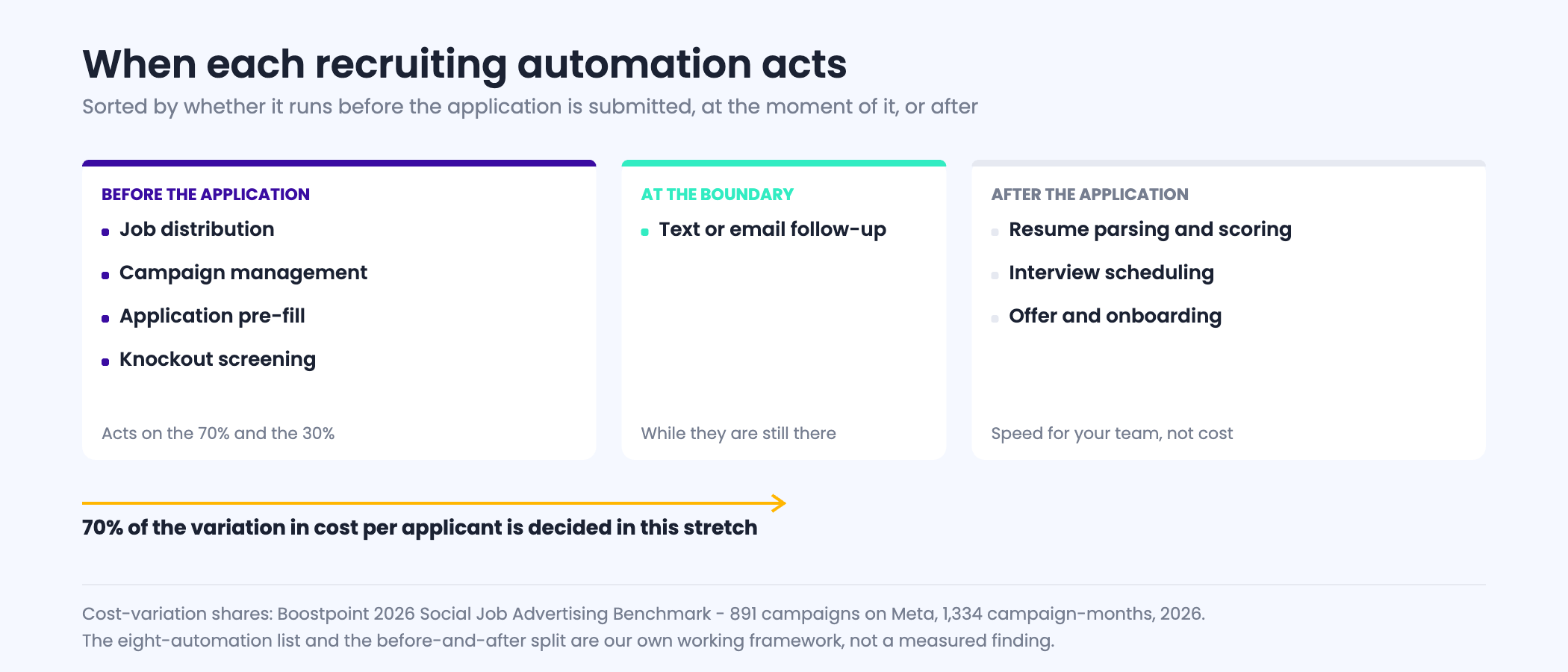
Read a typical "best recruiting automation software" list and the products are graded on parsing, scoring and scheduling — the bottom three rows. Those are genuinely useful when the constraint is a human sorting a large pile. They are also the automations that can do nothing at all about the size of the pile.
What the measured data actually says
Across 891 Boostpoint-managed campaigns, cost per applicant varies for three reasons, and they do not carry equal weight. What happens after the click — whether a person who arrived at the form finished it — explains 70% of the variation. Click-through explains 30%. What the ad auction charges explains 18%.
| Input | Which automations act on it | Share of variation explained |
|---|---|---|
| Applicant conversion after the click | Application pre-fill; form design | 70% |
| Click-through rate | Campaign management; job distribution | 30% |
| Cost per 1,000 impressions | Campaign management | 18% |
Source: Boostpoint 2026 Social Job Advertising Benchmark — 891 Boostpoint-managed campaigns on Meta (1,334 campaign-months), 2026; advertising costs only. The mapping from each input to the automations that act on it is our own, not a measured finding. Cost per applicant is not cost per hire, and nothing on this page derives one from the other.
The practical version: campaign-months converting under 5% of clicks into applications paid a median of $53.77 an applicant; those converting above 35% paid $1.61. Every automation that shortens the form, carries details forward or removes a step acts on that spread. Every automation that ranks resumes acts after it has already been paid.
Automation that acts after the application makes your team faster. Automation that acts before it makes your advertising cheaper. Both are worth having; only one of them changes the bill.
Audit what you have automated
Tick what already runs without a human at your organization. The audit sorts them by when they act and tells you whether anything you own touches the part of the funnel where the cost is decided. What the layer costs, by pricing model rather than by vendor, is on recruiting software pricing.
Interactive
Automation audit — what you have, and where it acts
Nothing is stored or sent — this runs in your browser. Tick everything that currently happens without someone doing it by hand.
The before-and-after split is a description of when each automation runs, not a ranking of vendors. The 70%, 30% and 18% figures are published benchmark values for what explains cost-per-applicant variation; attributing each one to particular automations is our own reading and not a measured result. No cost per hire is produced anywhere here.
The automation with no substitute, and the honest gap
A frontline candidate applies from a phone, often during a break, often to several employers in the same sitting. The window in which that person is still actively answering is measured in hours. Automated follow-up exists because no team is staffed across the whole week, and a reply that arrives on Monday morning to an application submitted on Saturday afternoon is competing with everyone who replied on Saturday afternoon.
Here is the honest limit. Our measurement stops at the submitted application. We can see what it costs to get an interested person to raise their hand. We cannot see what happened after your recruiters picked it up, which means we have no measured relationship between response time and hires, and we are not going to publish one. Vendors quoting a percentage lift from faster replies are not quoting us.
What we can do is the arithmetic on your own coverage, which needs no claim about outcomes at all.
Interactive
Coverage check — how much of the week nobody is answering
Nothing is stored or sent. This is arithmetic on your own numbers. It makes no claim about how many of these applicants you would have hired, because we have not measured that.
Assumes applications arrive evenly across the week, which they do not — evenings and weekends run heavier for hourly roles, so treat the uncovered figure as a floor rather than an estimate. Staffed hours are days multiplied by hours a day; the uncovered share is the remainder of the 168-hour week. Nothing here is a conversion rate, a hire, or a cost per hire.
For employers hiring the same frontline roles every week, high volume hiring software sets out how automation fits into the whole stack, from applicant supply to the ATS.
What to automate first, if you are starting from nothing
In the order the evidence supports, rather than the order the category is usually sold in.
- First, the application itself. Anything that shortens the form or carries details forward acts on the input that explains 70% of cost variation. It is also usually the cheapest thing on this list to change.
- Second, the reply. Automated text or email at submission is the only automation that runs while the candidate is still in the sitting they applied in. We cannot measure its effect on hires and we still would not run without it. What to look for in a tool that does it is on our text recruiting software page.
- Third, the campaign. Budget, audience and creative rotation handled on a rule rather than on someone remembering. This acts on the 30% and the 18%.
- Fourth, scheduling. Once volume is real, self-service slot booking removes the phone tag that loses people between interest and interview.
- Last, parsing and scoring. Genuinely useful at volume, and useless below it. If a role gets twelve applicants a month, ranking them automatically saves nobody anything.
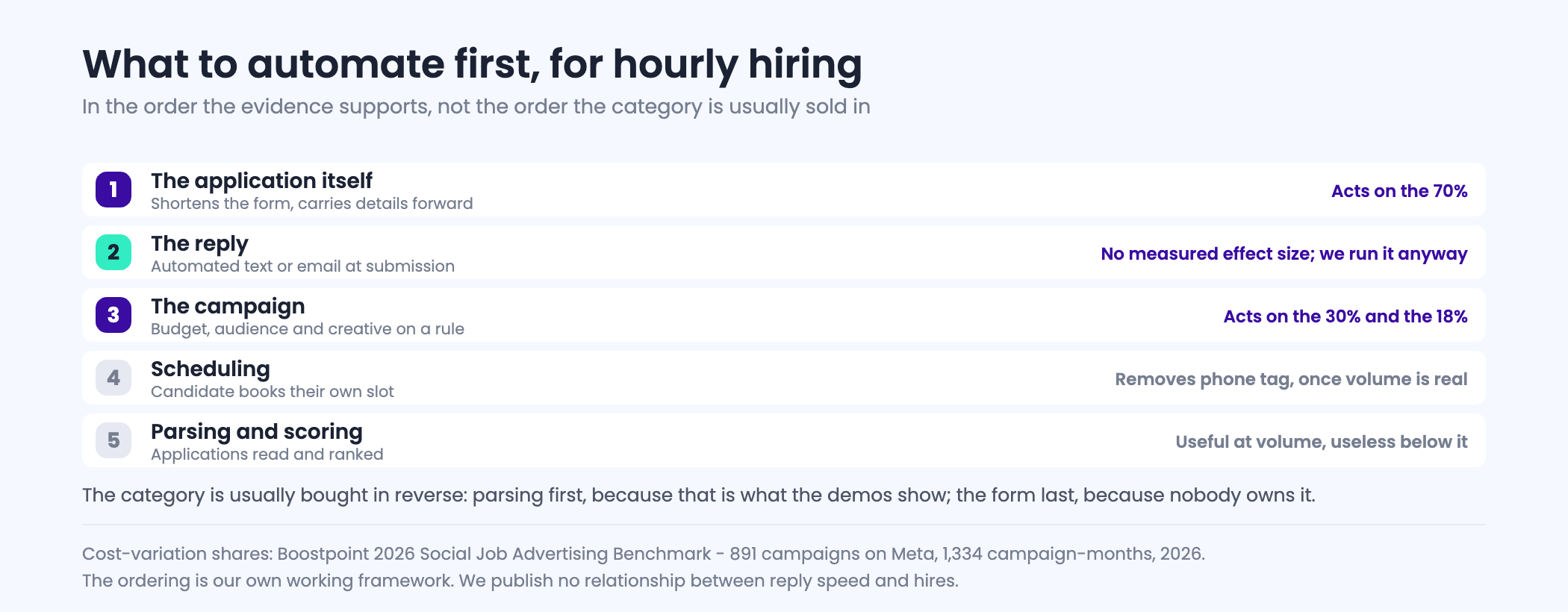
The reverse order is how the category is usually bought: parsing and scoring first, because that is what the demos show, and the form last, because nobody owns it.
Recruiting chatbots and automated interview scheduling: the two most oversold, and where each actually earns its keep
Two categories dominate the automation pitch and deserve separating, because one of them does something no human process can match and the other is frequently sold as more than it is.
Automated interview scheduling is the stronger of the two, and the reason is arithmetic rather than intelligence. The gap between an applicant applying and a human replying is where most frontline pipelines leak, and scheduling is usually the longest stage in that gap — not because anyone is slow, but because it is a back-and-forth across two calendars, often between a night-shift applicant and a day-shift manager who are rarely awake at the same time. Handing that to software removes a delay that is measured in days, and it does so without any judgment being delegated. If you automate one thing on this page, automate this.
Recruiting chatbots are the category to be more careful with, because the label covers three very different products. A scripted screener asks fixed knockout questions and routes accordingly — useful, unglamorous, and essentially a form with a conversational skin. A scheduling assistant is the product above wearing a chat interface. And a conversational agent answers open questions about the role in free text, which is the version people picture and the version that carries actual risk.
The risk with the third kind is specific and worth naming. An agent answering questions about pay, shifts, benefits or requirements is making statements the applicant will reasonably rely on, and if those answers drift from the advert or the offer letter you have created a problem that surfaces at acceptance stage. It is also a screening surface: anything that filters candidates has to filter on job-related criteria consistently, and “the bot decided” is not a defense anybody wants to make.
The workable position for most frontline employers is narrow and boring. Automate the scheduling. Use a chatbot as a fixed screener if your knockout criteria are genuinely objective and you can show the same questions went to everybody. Keep free-text answers about pay and conditions pointed back at the advert rather than generated fresh. And apply the rule that governs the rest of this page — automating a reply does not create an applicant, and a fast response to an empty pipeline is still an empty pipeline.
What automation will not do
It will not make a role competitive. If the pay, the shift pattern or the commute is wrong for the local market, automation delivers you the same result faster and at greater volume of effort.
It will not survive being pointed at the wrong audience. An automated campaign against a pool too small for its budget raises frequency, and above a monthly frequency of 4.0 the median campaign in our benchmark paid $26.78 an applicant against $13.39 in the 2.0 to 2.5 band. Automation without a rule that widens the audience simply arrives at the expensive answer without being asked.
And it does not produce a cost per hire. Advertising data stops at the submitted application; anything past that lives in your own system, and any vendor deriving a cost per hire from ad data is extrapolating.
Recruitment automation tools and platforms: what the category covers
A recruitment automation tool is anything that removes a human decision from a repeatable step in hiring. The label is attached to four different products, and the difference matters more than any feature comparison.
- Sourcing automation — finds and contacts candidates who have not applied. Built for white-collar and technical hiring; of limited use in frontline categories, where the candidate is not on a searchable professional profile.
- Application and screening automation — scores and routes completed applications, usually within minutes. This is where nearly all of the frontline value sits.
- Scheduling automation — lets a candidate pick an interview slot without the three-message exchange that loses them.
- Communication automation — reminders, confirmations and follow-ups, overwhelmingly by text for hourly roles.
A recruiting chatbot sits across the last three: it answers the questions a careers page does not, collects screening answers, and books the interview. For frontline hiring it earns its place mainly outside office hours, because a caregiver finishing an evening shift is applying at ten at night and a reply the next afternoon has already lost to whoever answered first.
The buying test is narrow. Automation that shortens the time between an application and a human response pays for itself in almost every frontline category. Automation that adds steps to the application does the opposite: applications taking over fifteen minutes converted at around 3.6% against 12.5% for those taking one to five. Before adding a tool, check what your current apply rate is — under 10% is a defect, and no platform fixes it.
Comparing the “best recruiting automation software” lists, and what they leave out
Search for the best recruiting automation software and you get ranked lists of products. The lists are not dishonest, but they compare things that are not comparable, because the products in them automate different parts of hiring and are bought by employers with different constraints. A scheduling tool and a campaign-management platform both appear at number three on somebody’s list, and only one of them will change your numbers.
A comparison that survives contact with a real hiring problem asks four questions of any product on any list.
| Question | Why it decides the purchase | What a weak answer sounds like |
|---|---|---|
| Which stage does it automate? | Sourcing, application, screening, communication and scheduling are five different bottlenecks. Automating a stage that is not slow saves nothing | “End-to-end hiring automation” |
| What does it remove — a decision, or a delay? | Removing delay is nearly always safe and nearly always valuable. Removing judgment is where automation causes damage | “It decides who to advance” |
| What is the measurable before-and-after? | Hours saved per week, time to first contact, apply rate, cost per applicant. If nothing is measured, the tool cannot be evaluated at renewal | “Recruiters love it” |
| What is it priced on? | Per seat punishes access, per message punishes follow-up, per employee scales with your headcount rather than your hiring | A quote with no unit named |
The second question is the one worth dwelling on. Across our benchmark, the variation in cost per applicant between campaigns is explained 70% by what happens after the click — the application itself — and 18% by what the ad auction charges. Automation that shortens the path from interest to a completed application, or from a completed application to a human reply, is operating on the part of the funnel where the money is. Automation that speeds up internal administration is worth doing for its own sake, but it will not move cost per applicant, and no list will tell you that.
“Recruiting management software” and the other names for this category
Recruiting management software, recruiting process software and recruiting scheduling software are three searches for three different products, and buyers use them interchangeably. Worth separating before a demo.
- Recruiting management software normally means the system of record — requisitions, candidates, stages, approvals and reporting. That is an applicant tracking system with a broader name, and it is where most organizations already have a product.
- Recruiting process software usually means workflow: who does what, in what order, with what approvals. Sometimes a feature of the ATS, sometimes a separate layer bolted on where the ATS is rigid.
- Recruiting scheduling software means one job — getting an interview into two calendars without six messages. It is the narrowest of the three and often the fastest payback, because the delay it removes is measured in days.
None of the three creates candidates. If your requisitions are open because too few people are applying, the purchase that changes the outcome is in the advertising layer, and management software will make a thin pipeline easier to look at rather than larger.
What is recruitment automation?
Recruitment automation is software doing the repeatable parts of hiring without a person starting each one: publishing and refreshing job ads, acknowledging and screening applications against fixed criteria, sending the first message, booking interviews against a calendar, and moving records between systems. It is not a system that decides who to hire. The useful line between the two is whether the step has a right answer that can be written down in advance — sending a text within a minute does, judging whether someone will stay two years does not.
The term is used loosely enough to be worth disambiguating. Automated recruiting usually means the same thing. Recruitment automation software is the product category. Recruiting automation inside an applicant tracking system usually means workflow rules and templated email, which is the narrowest version of it. What the rest of this page does is separate the eight things vendors sell under those names, and show which of them the measured data says actually changes a cost per applicant or a time to fill.
How to automate recruiting, in the order that pays back first
The ranking earlier on this page says what to automate first. This section is the build: how to automate recruiting for an hourly or frontline role one layer at a time, what each layer needs from you before it will work, and the single number that tells you it is working. Add a layer only when the one before it is running without anyone touching it.
| Step | What you set up | What it needs from you first | The number that says it works |
|---|---|---|---|
| 1. The application | A mobile form that opens inside the ad, pre-fills name and contact details, and asks only knockout questions | A decision on which three or four answers genuinely disqualify someone | Apply rate: completed applications divided by clicks |
| 2. The first reply | A text that goes out on submission, names your company and asks one question that moves things forward | Consent to text collected on the form, and a person who owns the replies | Share of applicants who reply to the first text |
| 3. The campaign | Ads that start and stop with the opening, budgets and creative rotation run on a rule | Your openings in one place, ideally a job feed | Cost per applicant, week on week |
| 4. Scheduling | Self-service interview booking for applicants who pass the knockouts | Real interview slots that a manager will actually honor | Interview attendance rate |
| 5. Parsing and scoring | Automatic sorting of what arrived | Enough volume that sorting by hand is the bottleneck | Hours a recruiter spends sorting each week |
Two rules keep the build honest. First, measure each layer before adding the next, because a stack switched on all at once cannot tell you which part helped. Second, automate delay, not decisions: the steps above remove waiting, while who to interview, who to hire and what to offer stay with a person. The first layer earns its place at the top because, in the Boostpoint 2026 Social Job Advertising Benchmark, the share of clickers who finish the application explained 70% of the variation in cost per applicant between campaigns.
If your openings already live in an applicant tracking system with an XML job feed, steps 1 and 3 can come from the same place: Boostpoint Programmatic 2.0 turns each job in the feed into its own Facebook and Instagram ad, starts and stops the ad with the feed, collects a quick-apply application with screening questions, and uploads the contact details, answers and a resume-formatted candidate summary to that job in your ATS. Step 2 is what text recruiting software does. Steps 4 and 5 belong to your ATS or a scheduling tool; our interview scheduling guide covers what to look for.
Frequently asked questions
Streamlining the hiring process: where the time actually goes
Employers who want to streamline hiring usually start by shortening the interview, which is almost never where the time is. Map a real hire from application to start date and the hours cluster in four gaps, three of which are waiting rather than working.
| Gap | What is happening | What removes it |
|---|---|---|
| Application to first contact | Nobody has looked at the inbox yet | An automatic text on arrival. This is the gap that loses candidates outright |
| First contact to interview | Trading times by phone and email | Two named slots, or a one-tap booking link |
| Interview to decision | Waiting for a second opinion or an approval | Score during the interview and decide the same day |
| Decision to start date | Paperwork, checks, onboarding scheduling | Verbal offer the same hour, written offer the same day, checks started in parallel |
Only the first two are worth automating, and in that order. Automating a stage that is already fast buys nothing; automating the first reply changes who is still available when you call. The scheduling mechanics are on interview scheduling, and the wider metric set on hiring metrics benchmarks.
What is a recruiting chatbot?
The term covers three different products. A scripted screener asks fixed knockout questions and routes candidates accordingly - effectively a form with a conversational interface. A scheduling assistant books interviews through a chat window. A conversational agent answers open questions about the role in free text, which is the version people usually picture and the one carrying real risk: its answers about pay, shifts or requirements are statements the applicant will rely on, and anything that filters candidates has to filter on job-related criteria consistently. For most frontline employers the workable use is the first two.
Is automated interview scheduling worth it?
It is usually the single highest-return automation in frontline hiring, and the reason is timing rather than cleverness. Scheduling is normally the longest stage between an application arriving and a human speaking to the candidate, because it is a back-and-forth across two calendars - frequently a night-shift applicant and a day-shift manager who are rarely available at the same moment. Automating it removes a delay measured in days without delegating any judgment about who to hire.
What is recruiting automation software?
Software that performs part of the hiring process without a person doing it by hand. In practice that covers eight distinct jobs, from distributing the opening and running the ads through to parsing resumes, booking interviews and generating offer paperwork. Different products automate different subsets, which is why the category is hard to compare.
Which recruiting automation is worth buying first?
For hourly and frontline roles, the ones that act before the application is submitted. Conversion after the click explains 70% of the variation in cost per applicant in our benchmark, so shortening the form or carrying details forward acts on the largest lever. Resume parsing acts after that cost has already been paid.
Does automated follow-up actually get more hires?
We do not know, and we will not claim it. Our measurement stops at the submitted application, so we have no measured relationship between response speed and hires. What we can say is that no team is staffed across the whole week, and applications arriving in uncovered hours wait by definition.
Is recruiting automation the same as an applicant tracking system?
No. An applicant tracking system is a database and a pipeline view; automation is the set of actions taken without a human. Most tracking systems automate some of the after-application list, and few of them touch anything before the application. The two categories overlap without being the same purchase.
Can automation reduce cost per applicant?
Only the automations acting before the application can. In our benchmark, campaign-months converting under 5% of clicks paid a median of $53.77 an applicant while those above 35% paid $1.61, and that spread is decided by the form and the ad rather than by anything downstream of them.
Do I need automation for a small hiring volume?
Parsing and scoring, no. Ranking twelve applicants automatically saves nobody anything, and the setup cost is real. Automated reply and a short application, yes: those act on every applicant regardless of volume, cost nothing extra per applicant to run, and sit on the part of the funnel where the published cost variation is decided.
What does automated campaign management change?
It acts on click-through and on what the auction charges, which explain 30% and 18% of cost variation respectively. Its most useful function is holding frequency down: above 4.0 the median campaign paid $26.78 an applicant against $13.39 in the 2.0 to 2.5 band, and a rule catches that before a person notices.
Will automation give me a cost per hire?
No, and no benchmark drawn from ad platform data can. Advertising measurement ends at the submitted application. What happened between that application and a start date lives in your applicant tracking system, and that is the single most valuable thing most employers could begin recording this year.
What is a recruitment automation tool?
Anything that removes a human decision from a repeatable hiring step. The category covers four different products: sourcing automation that contacts people who have not applied, application and screening automation that scores and routes completed applications, scheduling automation, and communication automation for reminders and follow-ups. For frontline hourly hiring, the second and fourth do nearly all the useful work.
Is a recruiting chatbot worth it for hourly hiring?
Mainly for coverage outside office hours. Frontline candidates apply in the evening and at weekends, and a reply the following afternoon has usually lost to whoever answered first. A chatbot that answers common questions, collects screening answers and books an interview slot converts that timing advantage; one that adds steps to the application itself works against you.
Does recruiting automation reduce cost per hire?
Only where it shortens the gap between application and human response. It does not fix a low apply rate, which explains 70% of the variation in cost per applicant between campaigns. Applications taking more than fifteen minutes converted at about 3.6% against 12.5% for one to five minutes, so any automation that lengthens the form raises cost rather than lowering it.
How do I streamline my hiring process?
Map a real hire and look for the four gaps: application to first contact, first contact to interview, interview to decision, and decision to start date. Three of the four are waiting rather than working, and the first one is where candidates are actually lost.
What part of hiring is worth automating first?
The first reply to an applicant, then interview scheduling. Automating a stage that is already fast buys nothing; automating the first reply changes whether the candidate is still available when you call.
How do I automate text messages to job applicants?
Trigger the first text from the application itself, so it goes out within seconds of submission rather than when someone checks the inbox. Collect consent to text on the application form, name your company in the first message, and ask one question that moves things forward, such as a time to talk. Then automate interview reminders, and use software that handles STOP replies and logs every message against the candidate’s record.
What is the best recruiting automation software?
It depends on which stage is slow, which is why ranked lists are a poor guide: they compare scheduling tools against campaign platforms as though they solve the same problem. Ask four things of any candidate product — which stage it automates, whether it removes a delay or a decision, what before-and-after it can measure, and what unit it is priced on. The best product is the one that automates your slowest stage and can prove it did.
What is recruiting management software?
Usually another name for the system of record: requisitions, candidates, stages, approvals and reporting. In practice it is an applicant tracking system described more broadly, which matters when comparing quotes — two vendors using different names for the same category will look like complementary purchases when they are alternatives.
Does recruiting automation lower cost per applicant?
Only the automation that touches the application or the immediate follow-up. In our benchmark, what happens after the click explains 70% of the variation in cost per applicant between campaigns and the ad auction explains 18%. Automating scheduling or approvals saves recruiter hours, which is worth doing, but it does not move the number that appears on the advertising invoice.
What is an automated recruitment system?
A set of tools that runs the repeatable steps of hiring without a person starting each one: publishing and adjusting job ads, collecting applications with knockout questions, sending the first text or email, offering interview slots, and moving records into the applicant tracking system. Most employers assemble one from two or three products rather than buying a single system, so the useful question is which of the eight automations on this page yours covers, and whether any of them act before the application is submitted.
How do you automate the hiring process?
In the order the evidence supports. Start with the application: a short mobile form with details carried forward and only knockout questions, because in the Boostpoint 2026 Social Job Advertising Benchmark the share of clickers who finish applying explains 70% of the variation in cost per applicant. Then automate the first reply, so every applicant gets a text within minutes. Then campaign management, then interview scheduling, and parsing and scoring last, once volume justifies it.
Which parts of the recruitment process can be automated?
Job distribution, campaign management, application pre-fill, knockout screening, text and email follow-up, resume parsing and scoring, interview scheduling, and offer and onboarding paperwork. The judgment steps (who to interview, who to hire, what to offer) are the ones to keep with a person; automation that removes delay is nearly always safe, and automation that removes a decision is where it causes damage.
The two we automate
We build and run the campaigns on a rule rather than on someone remembering, put the application on a one-minute mobile form, and reply by text the moment it is submitted. The other six on this page are somebody else's product, and we will say so on the call.
All campaign figures: Boostpoint 2026 Social Job Advertising Benchmark — 891 Boostpoint-managed campaigns on Meta across 1,334 campaign-months in 2026, advertising costs only, published August 12 2026 and read September 2 2026. Share of cost variation explained: applicant conversion after the click 70%, click-through rate 30%, cost per 1,000 impressions 18%. Apply-rate extremes: campaign-months converting under 5% of clicks paid a median of $53.77 per applicant; those above 35% paid $1.61. Frequency: above 4.0 the median was $26.78 against $13.39 in the 2.0 to 2.5 band. The eight-automation list, the before-and-after split and the mapping from each cost input to particular automations are our own working framework rather than measured findings, and are labeled as such throughout. We publish no relationship between response time and hires because our measurement ends at the submitted application; the coverage tool performs arithmetic on figures the reader supplies and asserts no outcome. Cost per applicant is not cost per hire, and no cost per hire is derived from it anywhere on this page. No vendor is named and no vendor price is quoted. Last updated September 2026.