
Employer guideUpdated September 2026
How Recruiting Software Is Priced: 5 Models Compared
The same employer — three recruiters, ten roles open at a time, 200 employees — would pay $2,880 a year on a per-seat model and $36,000 on a per-job-slot model, at published mid-range rates for both. That is a twelve-fold spread with no difference in the software. Which model you are quoted is a bigger decision than which product you choose, and it is the one nobody negotiates. This page explains the five models, what each costs, who each suits, and what to ask for on a quote. It ranks no vendors and recommends no product.
Why the model matters more than the price
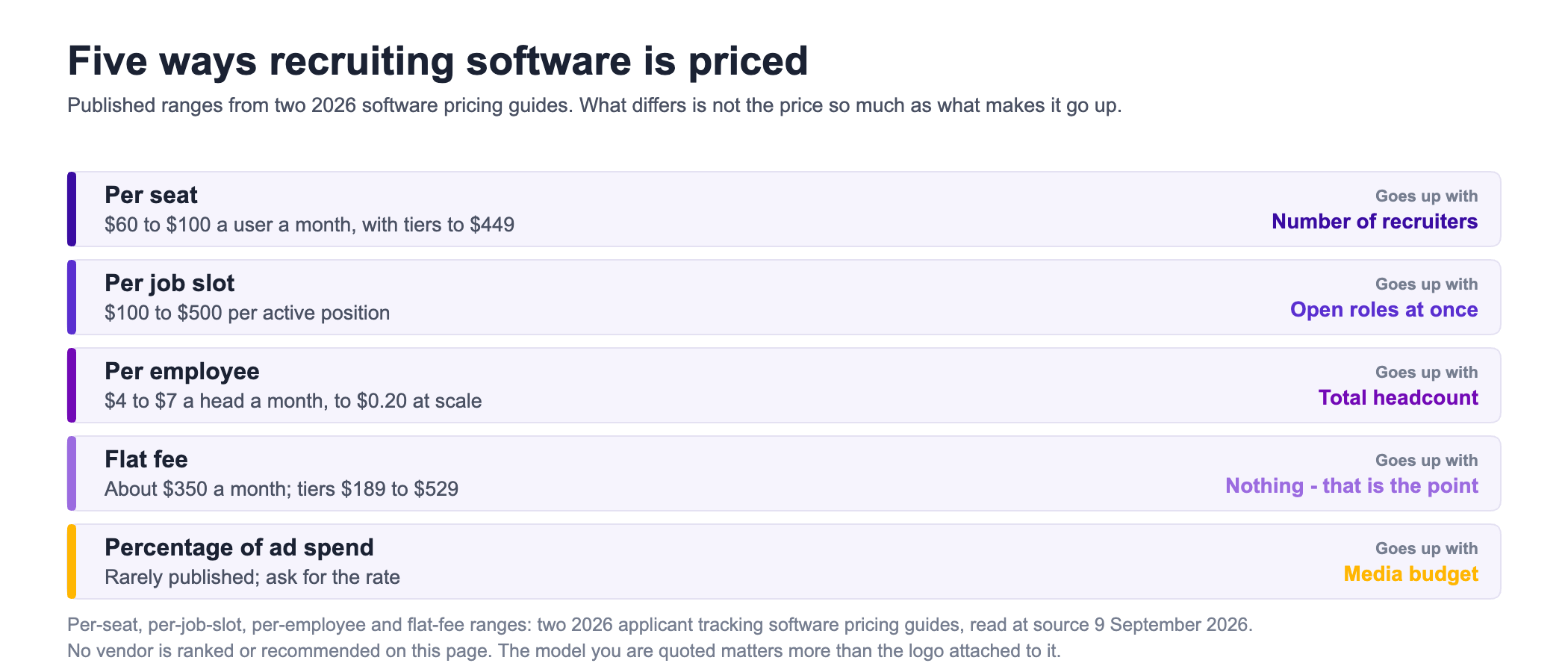
Every pricing model is a bet about what will grow. A per-seat price bets that your recruiting team will grow. A per-job-slot price bets that your open roles will. A per-employee price bets on headcount. Whoever wrote the quote chose the meter that runs fastest in your business, and the price on the front page is set to look competitive at your size today rather than your size in eighteen months.
So the useful question is not "how much is it". It is "what makes this go up, and how fast does that thing go up here". A frontline employer with two recruiters and forty open requisitions is a bargain on per seat and an expensive customer on per slot. A professional-services firm with eight recruiters and six open roles is the reverse.
Per seat
How it is priced: a monthly amount for each named user with a login. Published at $60 to $100 a user a month in one 2026 guide, with tiered products reaching $119 at entry level, $249 at mid-tier and $449 at the high end.
Who it suits: employers with a small, stable recruiting team and a lot of hiring. Cost is flat no matter how many roles you open.
Where it hurts: hiring managers. If they need access to review candidates and every login is billable, the price of involving them is a line item, and the usual result is that they are left out of the system and the process gets worse.
Ask on the quote: who counts as a user, whether view-only or hiring-manager access is free, and what happens to the rate when you add the fourth or tenth seat.
Per job slot
How it is priced: a monthly amount per active position, with the charge stopping when the role is filled and archived. Published at $100 to $500 per active position.
Who it suits: low-volume hiring with a handful of roles open at once, and any employer whose requisitions genuinely close.
Where it hurts: frontline volume hiring. Ten evergreen requisitions at $300 is $3,000 a month, and evergreen roles never archive, so the meter never stops. This is the model most likely to produce a bill that surprises a finance team.
Ask on the quote: what counts as an active slot, whether a role posted in three locations is one slot or three, and whether slots can be swapped mid-month.
Per employee
How it is priced: a monthly amount per person on your payroll, whether or not you are hiring. Published at $4 to $7 a head a month, falling to as low as $0.20 for very large organizations.
Who it suits: employers with steady headcount and unpredictable hiring, and anyone buying the software as part of a wider HR platform rather than for recruiting alone.
Where it hurts: seasonal and high-turnover employers, who pay for a headcount that peaks in the crunch and shrinks afterwards, and who often pay on the peak.
Ask on the quote: how headcount is counted and how often, whether seasonal and part-time staff count, and whether the count is a snapshot or an average.
Flat fee
How it is priced: one monthly amount, or a one-time license purchase, independent of seats, slots and headcount. Published at about $350 a month in one guide, and in tiers of roughly $189, $255 and $372 a month on average in another, with the top of the range at $529.
Who it suits: small and mid-sized employers who want a budget line that does not move, and anyone whose hiring volume is lumpy enough that a metered model is a gamble.
Where it hurts: at the tier boundaries, which is where flat pricing hides its meter. A flat fee is only flat inside the band you were sold.
Ask on the quote: what the tier limits are in seats, slots, headcount and stored candidates, and what the price becomes one step above each of them.
Percentage of ad spend
How it is priced: the software comes with the media, and the charge is a share of the advertising budget it manages. Rates are rarely published, which is the first thing to notice about the model.
Who it suits: employers who want the advertising run rather than the software operated, and whose alternative is hiring the skill in-house.
Where it hurts: the incentive runs the wrong way if the rate is a straight percentage with nothing else attached, because the vendor is paid more for spending more. That is a reason to ask what is measured, not a reason to reject the model.
Ask on the quote: the percentage in writing; whether the reported cost per applicant is before or after it; what the minimum monthly spend is; and what happens to the fee when you cut the budget. Boostpoint's own product is priced this way, as a subscription plus ad spend, and our prices are on pricing.
The same employer, five quotes
Take an employer with three recruiters, ten roles open at any one time, 200 employees and $18,322 of annual advertising. Price them on the published mid-range rate for each model and the answers are not close.
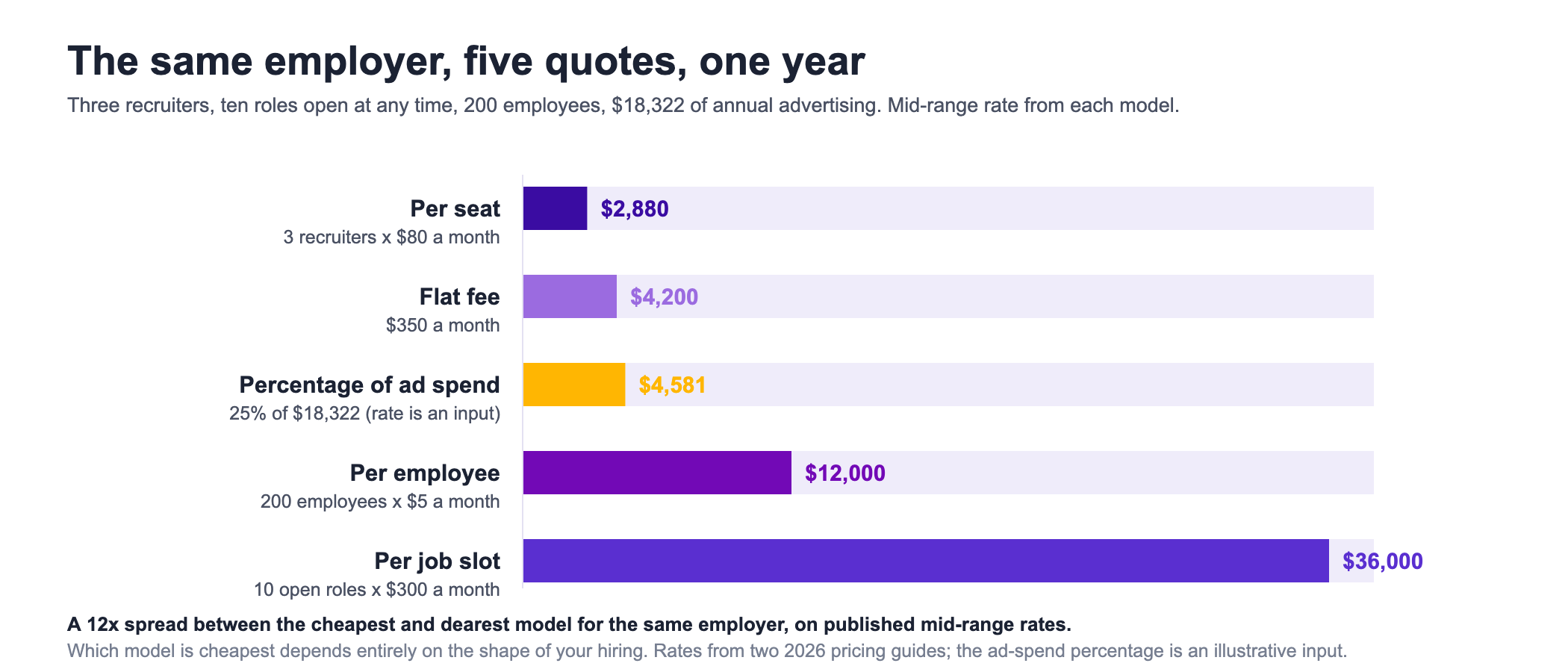
Reverse the inputs and the ranking reverses with them. Give the same employer eight recruiters and four open roles and per seat becomes the expensive option. The exercise takes five minutes and it is the only comparison that will hold once you have signed.
The costs that are not in the subscription
Both 2026 guides list the same additional charges, and neither publishes amounts for most of them, which tells you they are negotiated rather than listed.
- Implementation and setup, often a one-time charge sized to your complexity.
- Data migration from whatever you are leaving, which is the item most likely to be under-quoted.
- Training and onboarding for recruiters and hiring managers.
- Integration and API access, sometimes gated to a higher tier rather than priced separately.
- Premium support: named account management, service levels, out-of-hours cover.
- Per-candidate charges that flow through the platform — background checks and assessments are billed per check, not per seat.
Six questions that make two quotes comparable
What is the meter, and what makes it go up? What are the tier limits, and what is the price one step above each? Which charges are one-time and which recur? What is the contract term, and what is the price at renewal rather than in year one? What does it cost to get your data out? And what is included in the number you were shown — implementation, migration, training, integrations, support? A quote that answers those six can be compared with another one. A quote that does not, cannot, whatever the headline price says.
Where the software sits in the cost of hiring
Worth keeping in proportion. On a worked frontline recruiting budget of $96,122 for sixty hires, the applicant tracking system is about $4,800 a year — 5% of the program, against 27% for recruiter time and 19% for advertising. Software is rarely the line that decides your cost per hire, and a cheaper platform that makes the process slower will cost more than it saves. The lines that do decide it are ranked on how to reduce cost per hire.
Frequently asked questions
How much does recruiting software cost?
It depends which meter you are on. Published 2026 ranges are $60 to $100 a user a month for per-seat pricing, with tiers to $449; $100 to $500 per active position for per-job-slot pricing; $4 to $7 a head a month for per-employee pricing, falling to $0.20 at very large scale; and about $350 a month for a flat fee, with tiers from $189 to $529. One guide notes the overall span runs from free to six figures.
What are the recruiting software pricing models?
Five. Per seat, charged for each named user. Per job slot, charged for each active position. Per employee, charged on total headcount whether or not you are hiring. Flat fee, one amount inside a tier. And percentage of ad spend, where the software comes with the media and the charge is a share of the budget. Each one is a bet about which of your numbers will grow fastest.
How much does an applicant tracking system cost per user?
Between $60 and $100 a month per user on the range published in one 2026 guide. A second guide reports tiered per-user products averaging about $70 a month at entry level, $140 at mid-tier and $335 at the high end, with the top of the range at $449. The number that matters more than the rate is who counts as a user — whether hiring managers and view-only reviewers are billable decides the real total.
Which recruiting software pricing model is cheapest?
Whichever one's meter runs slowest in your business. For an employer with three recruiters, ten open roles, 200 employees and $18,322 of advertising, per seat comes to $2,880 a year and per job slot to $36,000 on published mid-range rates — a twelve-fold spread with no difference in the software. Reverse the counts and the ranking reverses. Price your own numbers through all five before comparing products.
Is per job slot pricing good for high-volume hiring?
Usually not. The model charges per active position and stops when a role is filled and archived, which suits low-volume hiring where requisitions genuinely close. Frontline employers run evergreen requisitions that never archive, so the meter never stops: ten open roles at $300 a month is $3,000 a month indefinitely. Ask specifically whether a role posted in several locations counts as one slot or several.
What hidden costs come with recruiting software?
Implementation and setup, data migration from your previous system, recruiter and hiring manager training, integration or API access that is sometimes gated to a higher tier, premium support and service levels, and per-candidate charges for background checks and assessments that flow through the platform. The 2026 guides name all of these and publish amounts for almost none of them, which means they are negotiated rather than listed.
Should recruiting software be priced on ad spend?
It is a legitimate model when what you are buying is the advertising run for you rather than the software operated by you. The thing to check is the incentive: a straight percentage pays the vendor more for spending more, so ask what is measured alongside it. Get the percentage in writing, ask whether reported cost per applicant is quoted before or after the fee, and ask what the minimum spend is.
How much of a recruiting budget should software be?
A small share. On a worked frontline budget of $96,122 for sixty hires, the applicant tracking system is about $4,800 a year, or 5% of the program, against 27% for recruiter time and 19% for advertising. That proportion is worth remembering during a procurement: a platform that saves a few thousand dollars and costs a recruiter an hour a day is not a saving at all.
Two neighbors: what the whole recruiting program costs is laid out on recruitment marketing budget, and the outsourced alternative to buying software and running it yourself is priced on RPO cost.
See what the advertising line actually returns
Tell us the roles you are filling and the markets you are filling them in, and we will show you what an applicant costs there.
Book a Demo