
Employer guideUpdated September 2026
How to Reduce Cost Per Hire: 9 Levers Ranked by What They Save
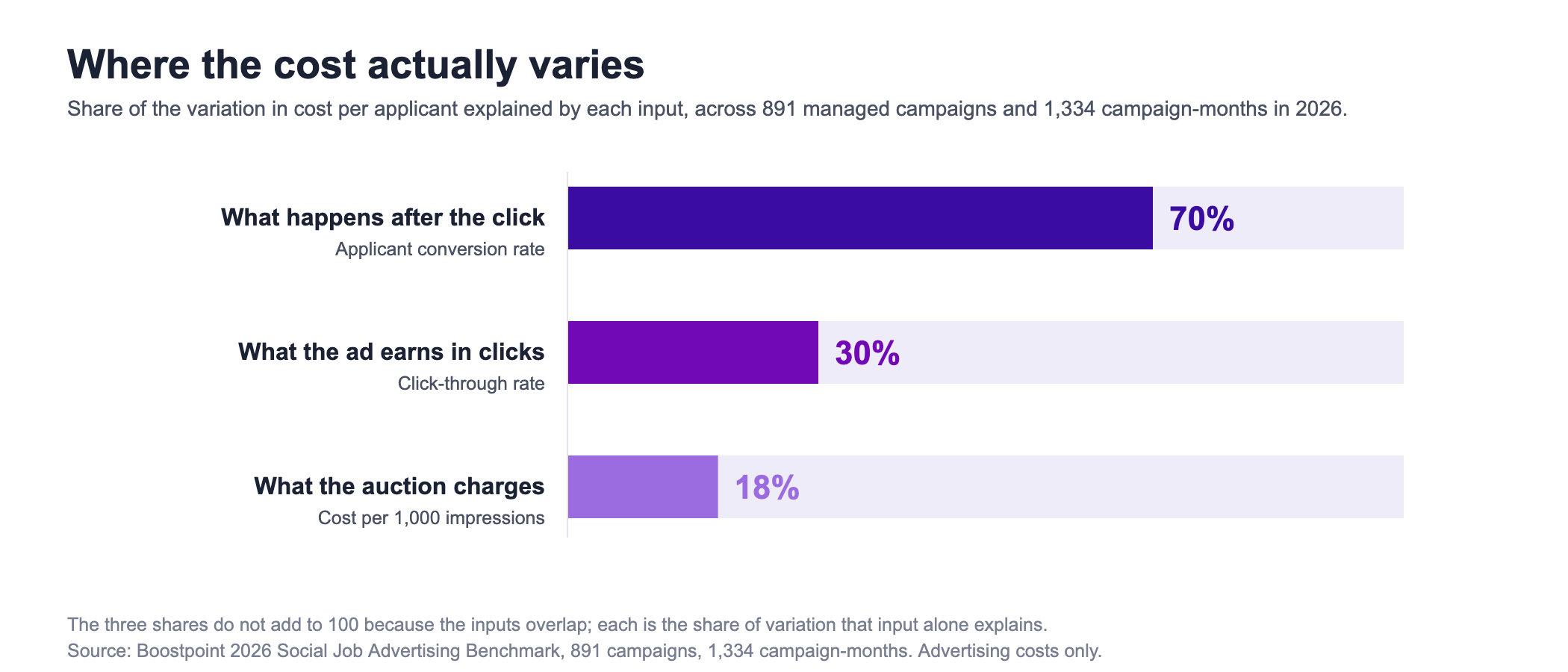
Most cost-per-hire reduction advice starts with the advertising, and the advertising is the wrong end. Across 891 managed campaigns in 2026, 70% of the variation in what an applicant costs is explained by what happens after the click — the application step — against 30% for click-through and 18% for what the ad auction charges. And advertising is only one line in a cost per hire: on a worked frontline budget it is 19% of the program, while recruiter time is 27%. The nine levers below are ranked by the size of the line they attack, not by how easy they are to talk about.
First, know which number you are trying to move
Cost per hire is total recruiting cost divided by hires. There are only two ways to move a ratio, and almost every article on this subject deals with just one of them.
- Make the numerator smaller. Spend less on advertising, agencies, referrals, screening, recruiter hours and tools. This is where the advice always goes.
- Make the denominator larger, or need it to be smaller. Convert more of the same spend into starts, or need fewer starts in the first place because fewer people left. This is where the money actually is.
The second route is missing from most lists because it is not a recruiting decision. It is a scheduling decision, a supervisor decision, an onboarding decision. It still shows up in your cost per hire, and it shows up bigger than anything on the advertising side.
The nine levers, ranked by what they save
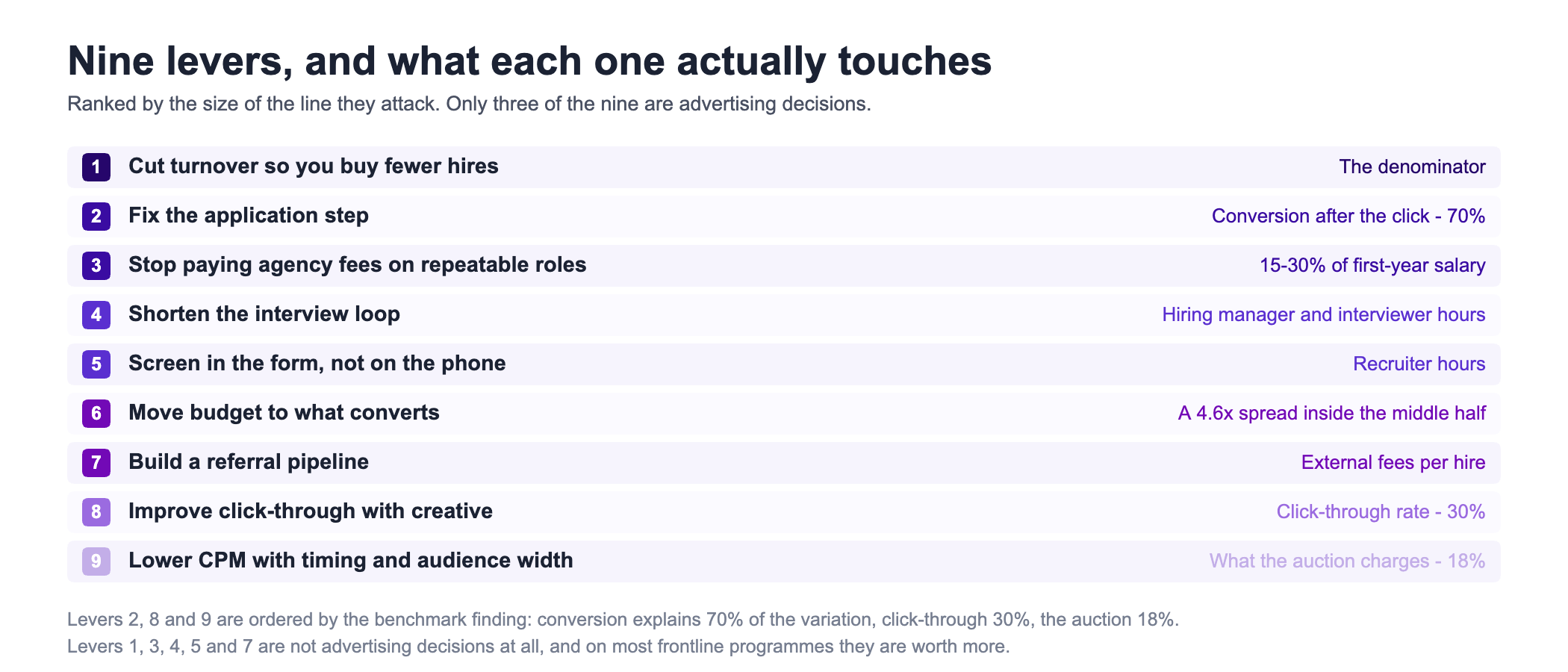
1. Cut turnover, so you buy fewer hires
Mechanism: every hire you do not have to make costs nothing. Turnover sets how many times a year you buy the same seat.
Size: the largest lever on this list by a wide margin. On a hundred roles at $18.00 an hour where one departure costs 20% of annual pay, taking turnover from 45% to 35% removes ten hires and about $74,880 of replacement cost a year.
What it costs: up to $748.80 per employee per year at break-even, which is more than most retention measures actually cost. The arithmetic is on the turnover cost calculator.
Catch: it only works if the measure changes why people leave, and on frontline work that is usually scheduling, the first ninety days, or one supervisor.
2. Fix the application step
Mechanism: the same click becomes a $5 applicant or a $40 applicant depending on the form behind it.
Size: conversion after the click explains 70% of the variation in cost per applicant across 891 campaigns — more than click-through and the ad auction combined. Apply rates in our data run from 5% on therapy roles to 31% on caregiver roles.
What it costs: hours, not media spend. Fewer fields, no account creation, mobile-first, and screening questions that route rather than reject silently.
Catch: a form that converts everybody sends unqualified applicants to your recruiters, which moves cost rather than removing it. Screen in the form; do not remove the screen.
3. Stop paying agency fees on roles you fill repeatedly
Mechanism: a placement fee is a one-time charge that recurs every time a repeatable role turns over.
Size: direct hire fees run 15% to 30% of first-year salary. On a $35,000 frontline role that is $5,250 to $10,500 per hire — several times the entire advertising cost of the same hire.
What it costs: building a pipeline you own, which takes a quarter or two before it is faster than a phone call to an agency.
Catch: agencies are worth paying for scarce, credentialed, one-off searches and for genuine surge cover. The fee structures are taken apart on staffing agency markup.
4. Shorten the interview loop
Mechanism: hiring manager and interviewer hours are a real cost at a loaded rate, and they are the line most often left out of a cost per hire entirely — which is exactly why cutting them is invisible until you count them.
Size: on a worked frontline budget, internal time is 27% of the program against 19% for advertising. Two interview rounds instead of three on sixty hires is dozens of manager hours a year.
What it costs: nothing, and it usually raises offer acceptance as well, because frontline candidates take the first credible offer.
Catch: shortening the loop is not the same as removing the screen. Cut rounds, not rigour.
5. Screen in the form, not on the phone
Mechanism: a knockout question inside the application costs nothing to ask and a screening call costs fifteen minutes of a recruiter's loaded hour.
Size: proportional to your unqualified rate. If a third of applicants fail a license, distance or shift-availability requirement that a form could have asked about, a third of your screening hours were avoidable.
What it costs: form build time, once.
Catch: screening questions lower the apply rate, which raises cost per applicant while lowering cost per qualified applicant. Judge them on the second number, not the first.
6. Move budget to what actually converts
Mechanism: the spread between campaigns is enormous, and most programs fund the expensive ones out of habit.
Size: in our 2026 benchmark the middle half of campaigns ran from $6.48 to $29.74 per applicant — a 4.6× spread on the same platform, in the same period. The cheapest tenth reached $2.91 and the most expensive tenth $66.45.
What it costs: reporting by campaign rather than in aggregate, which is a discipline rather than a purchase.
Catch: a cheap applicant on a role you do not need is not a saving. Reallocate within a role family, not across them.
7. Build a referral pipeline
Mechanism: a referral bonus is a fee you set rather than a fee you are quoted.
Size: a $500 referral bonus against a $5,250 agency fee on the same role is a tenth of the cost, and referral hires typically arrive pre-screened by someone with something at stake.
What it costs: the bonus, plus the administrative discipline to actually pay it on time, which is where most programs quietly die.
Catch: referrals scale with headcount, so they thin out exactly when you are growing fastest.
8. Improve click-through with better creative
Mechanism: a higher click-through rate buys more clicks for the same impressions.
Size: click-through explains 30% of the variation in cost per applicant — real, and less than half the weight of the application step. Click-through rates in our data range from 0.75% to 2.32% by role family.
What it costs: creative production, which is the most commonly over-bought item in recruitment marketing.
Catch: creative that lifts click-through on a form that does not convert makes the cost per applicant worse, because you now pay for more clicks that go nowhere.
9. Lower what the auction charges
Mechanism: widen the audience or the radius, and buy outside the crunch.
Size: cost per thousand impressions explains 18% of the variation, the smallest of the three advertising inputs. CPM by sector in our data runs from $14.74 to $29.04.
What it costs: planning ahead, which is free, and accepting a slightly wider audience, which is not always acceptable.
Catch: the auction is the lever everybody reaches for first because it is the one that looks like a price. It is the one that moves the answer least.
Cost-effective recruitment methods and strategies for a small team
The ranking above assumes you can pull any lever. Most frontline employers cannot: there is no dedicated recruiter, the hiring manager is also running a shift, and nobody has a quarter to build a pipeline. Here is the same list filtered for a team of one or two.
| If you have | Do this first | Why |
|---|---|---|
| An afternoon | Rebuild the application form | The largest advertising lever, costs no media spend, and the effect shows in the next campaign |
| A week | Cut an interview round and set a 24-hour response rule | Attacks the largest internal line and raises offer acceptance at the same time |
| A recurring role you fill more than four times a year | Stop using an agency for it | 15% to 30% of salary per hire, every hire, on work you already know how to do |
| A budget but no time | Move spend to the campaigns and role families that convert | A 4.6× spread inside the middle half of campaigns is free money for whoever measures it |
| A retention problem | Fix that instead | Every avoided departure is a hire you never pay for |
What does not belong on a cost-effective recruitment list, despite appearing on most of them: cutting the advertising budget outright, removing screening steps, and lengthening time to fill in exchange for a cheaper channel. The first two reduce cost per hire by reducing hires and hire quality. The third trades a recruiting line for an operations one, and the operations one is usually bigger — the daily arithmetic is on the cost of vacancy calculator.
The cheapest way to recruit is not a channel
Every genuinely cheap hire has the same two properties: somebody already wanted to work there, and nothing in the process made it hard for them to say so. That is why referrals and rehires beat every paid channel on cost, and why an employer with a reputation problem cannot advertise its way out of it at any price. Channel choice decides the top of the funnel. Everything after the click decides the cost.
What to measure while you do it
Cost per hire falls when you stop screening, and it falls again when you hire the first person who applies. So do not track it alone. Three numbers together tell you whether a reduction is real:
- Cost per hire, on a boundary you fix once and do not move — the formula is on cost per hire.
- Ninety-day retention, because a cheaper hire who leaves in six weeks cost you the replacement as well.
- Time to fill, because the cheapest channel is often the slowest and the slow days have their own price.
If all three move the right way, the saving is real. If cost per hire falls while either of the others worsens, you moved money rather than saved it. For where your figure sits against published averages, see average cost per hire by industry.
Frequently asked questions
How do you reduce cost per hire?
Attack the largest line, not the most visible one. In order: cut turnover so you buy fewer hires; fix the application step, which explains 70% of the variation in what an applicant costs; stop paying agency fees on roles you fill repeatedly, at 15% to 30% of first-year salary each time; shorten the interview loop; screen inside the form; and only then reallocate advertising budget, improve creative and widen the audience.
How can I reduce recruitment costs?
Start by counting them properly, because the line most often left out — hiring manager and interviewer hours — is usually the biggest one you control. On a worked frontline budget, internal time is 27% of the program and advertising is 19%. Cutting an interview round and rebuilding the application form together cost nothing and move both of those numbers, which is why they come before any conversation about media spend.
What are cost effective recruitment methods?
Referrals, rehires and an owned candidate pipeline are the cheapest sources of hire for roles you fill repeatedly, because they replace a fee you are quoted with a bonus you set — a $500 referral bonus against a $5,250 agency fee on a $35,000 role. Paid social advertising is the cheapest way to reach people who are not searching, at a $13.88 median cost per applicant in 2026. Job boards suit roles with genuine organic search demand.
What are cost effective recruitment strategies?
Three that survive contact with a small team. Fix the application step first, because it is the largest advertising lever and costs hours rather than media spend. Fix the interview loop second, because it attacks the largest internal line and raises offer acceptance at the same time. Then reallocate spend toward the campaigns that convert, where a 4.6-times spread between the quartiles is available to whoever measures by campaign rather than in aggregate.
What is the cheapest way to recruit?
Hiring someone who already wanted to work for you: a referral, a rehire or an internal move. Those cost a bonus rather than a fee, and they arrive pre-screened by someone with something at stake. Beyond that, the cheapest paid method is whichever one your own records show converting, which will not be the same as anybody else's. The cheapest list price and the cheapest hire are rarely the same channel.
Does reducing cost per hire hurt quality of hire?
It can, and the failure mode is predictable. Cost per hire falls whenever you screen less, interview less or hire faster, so a program optimized on that number alone will drift toward worse hires. Track it beside ninety-day retention and time to fill. If cost per hire falls while retention holds, the saving is real; if retention drops, you paid for the saving twice, because a replacement costs 16% to 33% of annual pay.
Which lever reduces cost per hire fastest?
The application form. It is the only lever that is entirely inside your control, costs no money, and acts on the input that explains 70% of the variation in cost per applicant. A rebuild takes an afternoon and the effect appears in the next campaign rather than the next quarter. Retention saves more in absolute terms, but it takes months to move and it is not a recruiting decision.
Should we cut recruitment advertising to reduce cost per hire?
Rarely, and never as a first move. On a worked frontline budget advertising is 19% of the recruiting program, so halving it saves under a tenth of the total while reducing the applicants the denominator depends on. Cutting advertising lowers spend and lowers hires, which often leaves cost per hire unchanged and time to fill worse. Fix what happens after the click first; the same budget then buys materially more.
Where your current figure sits against published benchmarks is on average cost per hire by industry; the retention side of lever one, which this page deliberately does not cover, is on employee retention strategies.
Start with the lever that moves 70% of it
Tell us the roles you are filling and where, and we will show you what an applicant costs there and where the campaign is losing them.
Book a Demo