
Call Center and Customer Service Recruiting: The Cheapest Frontline Role to Fill
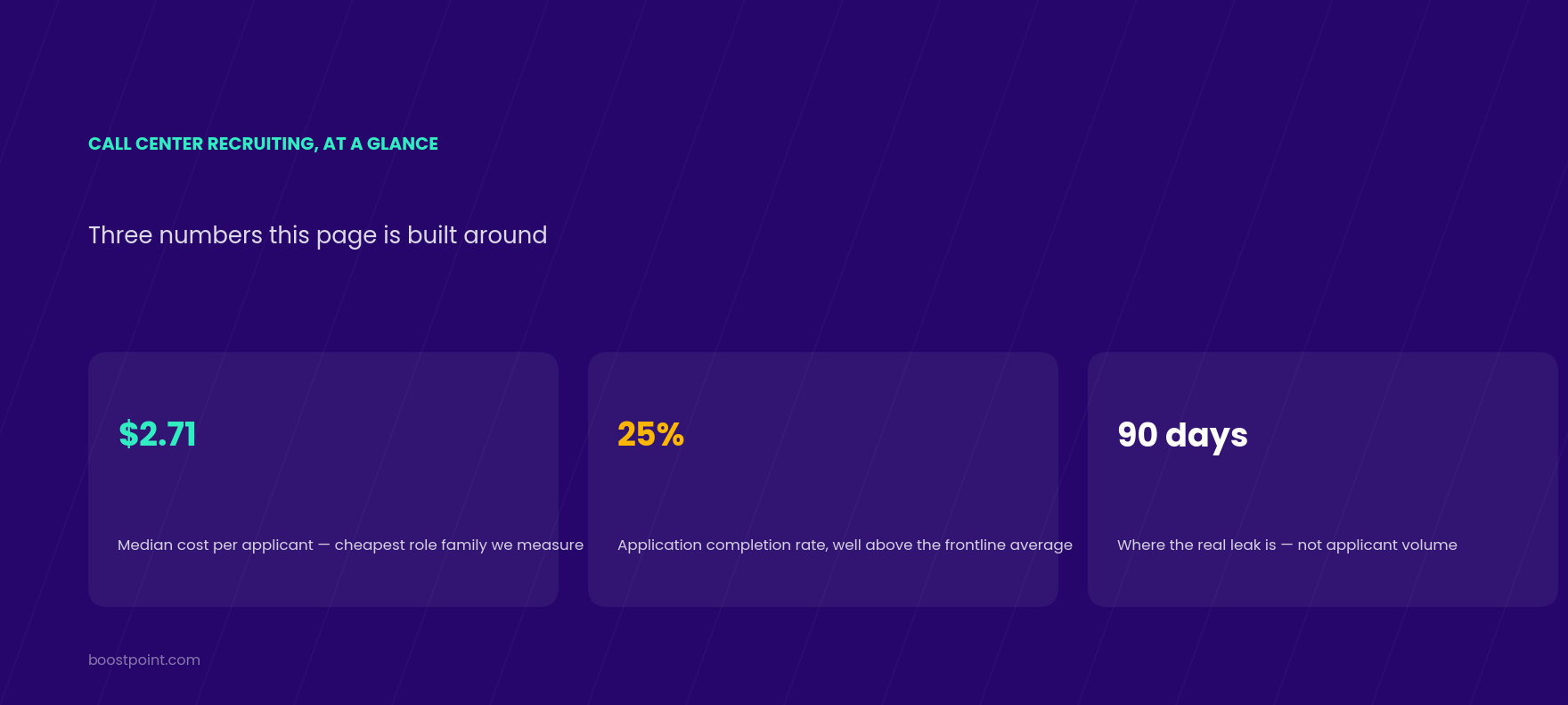
Customer service and call center applicants cost $2.71 at the median — the least expensive role family in Boostpoint's entire 891-campaign 2026 dataset. They also complete applications at 25% and click ads at 1.77%, both above the frontline average. The hard part of call center hiring has never been generating applicants. It's what happens after they start.
Source: Boostpoint 2026 Social Job Advertising Benchmark — 891 Boostpoint-managed campaigns on Meta (1,334 campaign-months), 2026; costs are what advertisers paid for advertising only.
This is the cheapest role we advertise
Across 891 social recruitment campaigns spanning healthcare, trucking, skilled trades, manufacturing and frontline operations, customer service and administrative roles came in cheaper than anything else we measured.
| Metric | Customer service / call center |
|---|---|
| Median cost per applicant | $2.71 |
| Middle 50% of campaigns | $2.14 – $7.47 |
| Volume-weighted average | $2.98 |
| Application completion rate | 25% |
| Click-through rate | 1.77% |
Source: Boostpoint 2026 Social Job Advertising Benchmark — 891 Boostpoint-managed campaigns on Meta (1,334 campaign-months), 2026; costs are what advertisers paid for advertising only.
For context on where that sits:
| Role family | Median cost per applicant |
|---|---|
| Customer service / admin | $2.71 |
| Caregiver / home care | $3.76 |
| CNA / nursing assistant | $7.72 |
| Warehouse / production | $9.83 |
| Registered nurse | $19.08 |
| CDL truck driver | $26.86 |
Source: Boostpoint 2026 Social Job Advertising Benchmark — 891 Boostpoint-managed campaigns on Meta (1,334 campaign-months), 2026; costs are what advertisers paid for advertising only.
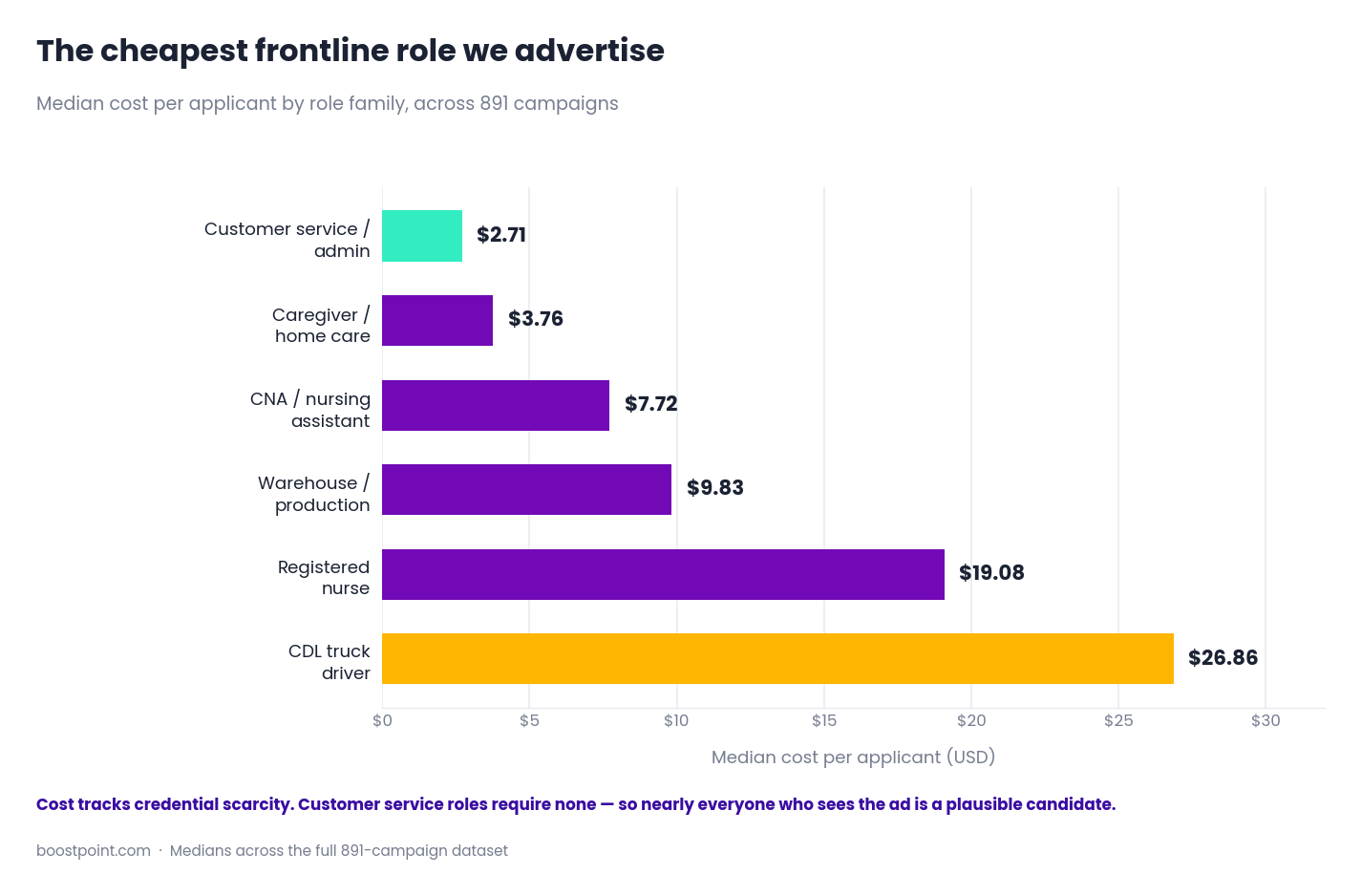
Costs are what advertisers paid. An applicant is a completed application, not a click. The full picture across every role family we track is in our published benchmark data.
Two things drive that number, and they compound.
The eligible population is enormous. Most call center and customer service roles require no license, no certification and no specific credential — which means nearly everyone who sees the ad is a plausible candidate. Cost tracks credential scarcity more than anything else, and here there's no scarcity at all. Retail hourly roles share that profile and most of the same economics — we cover them in retail recruitment strategies.
And the application converts unusually well. At 25%, one in four people who click go on to finish the form — against 11% for RN roles and 8% for CDL drivers. Applicants are typically at home, on a phone or laptop, with time. They're not on a roof or in a truck cab with two bars of signal.
If that somewhere else is attrition, be careful which figure you measure it against: the 30% to 45% band quoted across this category has no primary source, and BLS publishes no call center rate at all. Call center employee turnover shows what the federal data can bracket and how to build a number you can defend.
Which means your problem is somewhere else
If you run call center hiring, you already know applicant volume isn't the constraint. The constraint is that the funnel leaks in three places after the application, and none of them are fixed by more applicants.
No-shows at interview. High-volume roles with low barriers to entry attract people applying to several employers in one sitting. A share of them never intended to attend.
Day-one attrition. People accept, then don't start — often because a competing offer landed first, or the schedule turned out not to fit.
Early turnover. The first 90 days are where call center attrition concentrates, and the causes are usually schedule mismatch, an unrealistic picture of the work, or a training experience that didn't prepare people for the first live call.
None of that is a recruiting failure in the usual sense. They're hiring and onboarding failures that surface later — and cheap applicants make them easy to ignore, because the reflex is to just run more volume.
What actually helps, given that
Since applicant cost isn't your problem, the useful moves are the ones that improve who applies and who stays — not the ones that generate more.
Screen for schedule fit before anything else
The single most common cause of early call center attrition is a schedule that never worked. Evening shifts, weekend rotations, split coverage, mandatory overtime during peak.
Put it in the ad and in the knockout questions. Losing someone at the ad stage costs you $2.71. Losing them in week three costs you a training seat and a coverage gap. At these applicant prices, screening hard is close to free.
Be honest about the work in the ad
Metrics-driven environments, call monitoring, adherence targets, difficult customers. An ad that implies a relaxed office role and delivers a monitored queue buys you a hire and a 30-day departure.
The honest version produces fewer applicants. At $2.71 each, you can afford that trade many times over.
Use the cheap volume to be selective, not to fill faster
Most operations use low applicant cost to reduce spend. The better use is to keep spend flat and raise the bar — interview four people for a seat rather than one, and hire the one whose schedule and expectations actually match.
Filling faster with whoever answers is how you end up rehiring the same seat three times a year.
Run hiring events for cohorts
Call center hiring usually happens in classes, not one at a time — training runs on a schedule. That makes it well suited to event-driven campaigns.
In our data, event-driven campaigns produced the lowest median cost of any campaign structure — $8.02 per applicant at a 21% apply rate, against $14.45 for single-role campaigns. A date, a place and a reason to act outperforms an open-ended invitation to apply, and it maps naturally onto a training-class start date.
Respond within the hour
Applicants to entry-level roles apply broadly and accept quickly. The employer who calls back same-day is talking to someone still deciding. Two days later, they've started somewhere else.
Hiring at volume, and hiring a class
Call center staffing is rarely one seat. Most operations hire in cohorts tied to training start dates, and that changes what good looks like.
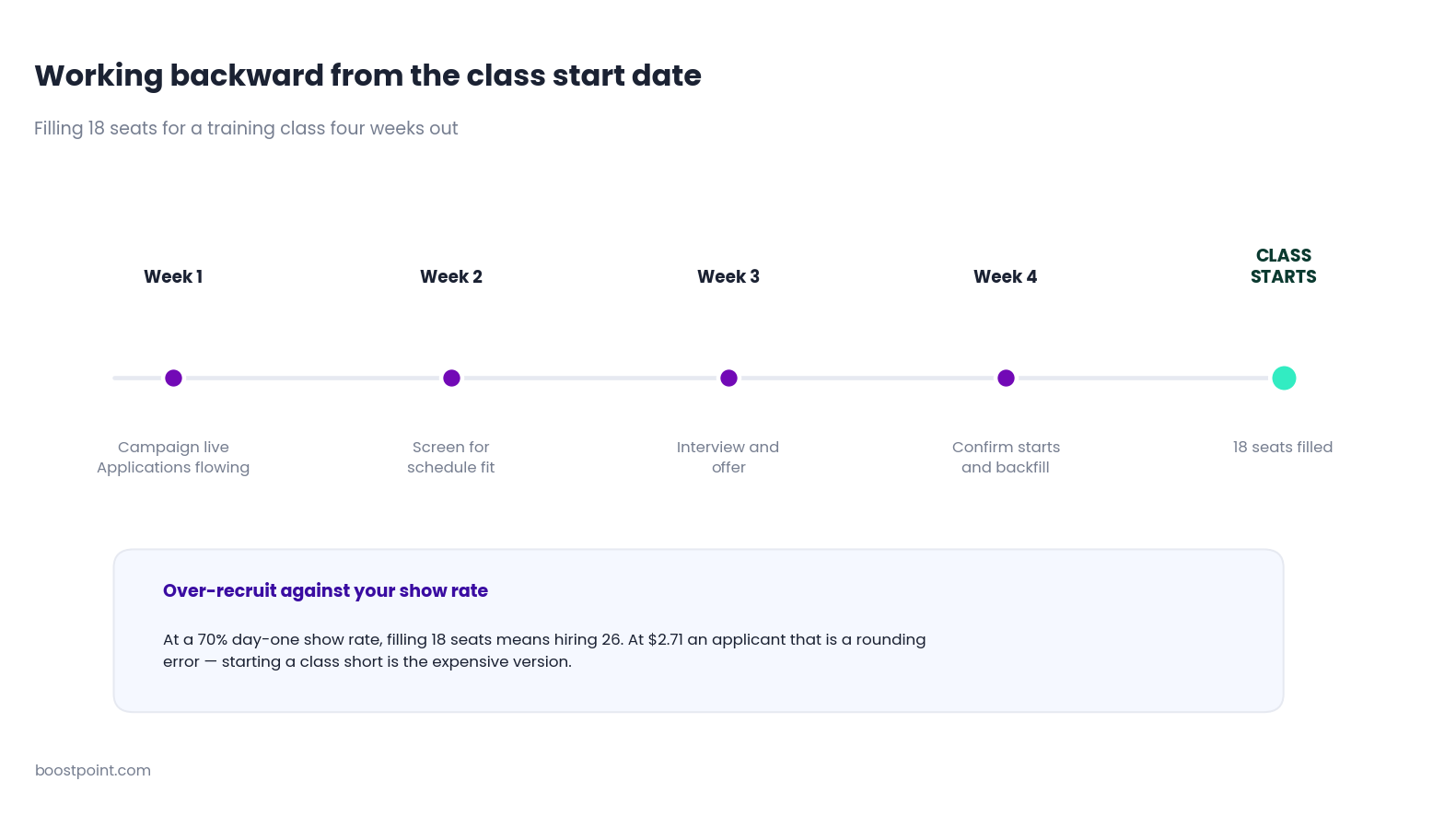
Work backward from the class date. If training starts in four weeks and you need eighteen seats filled, you need applications flowing by week one — campaigns produce applicants in days but hires in weeks, and screening and scheduling eat the middle.
Over-recruit deliberately. If your historical show-rate for day one is 70%, filling eighteen seats means hiring twenty-six. At $2.71 an applicant that's a rounding error; the expensive version is starting a class short.
Track cost per person who completes training, not cost per applicant. That's the number that reveals whether cheap volume is actually cheap. A $2.71 applicant who leaves in week two costs more than a $8 applicant who stays a year.
Worth knowing if you also hire for a sales floor: it draws on the same pool. Hiring sales reps and appointment setters works from customer service, retail and hospitality rather than from people who already call themselves salespeople.
Where these roles differ from the rest of the frontline
Worth naming, because generic frontline advice fits this category badly.
Remote and hybrid changes the geography. Many customer service roles no longer require a commute, which widens the addressable pool enormously and removes travel radius as a screening criterion. It also means you're competing with employers outside your market.
The candidate is at a keyboard. Unlike drivers, caregivers or crew, call center applicants are usually applying somewhere comfortable with time. You can ask a few more questions than you could of someone on a job site — though shorter still converts better.
Bilingual capability commands a premium. Where it's required, the eligible pool narrows sharply and applicant cost rises accordingly. Budget it as a separate role rather than blending it in.
When this isn't the right approach
- Specialized or technical support roles. Tier-three technical support, or roles requiring specific product certification, behave more like skilled positions — the qualified population is small and broad-reach advertising is the wrong tool.
- A single seat. The economics favor cohort hiring or continuous need. For one role, referrals are usually faster.
- When pay is below market. At $2.71 an applicant you'll generate plenty of volume and convert almost none of it, which is an expensive way to discover your rate is wrong.
- If nobody can work the applications same-day. Cheap applicants that go cold are still wasted budget.
How to hire call center agents and customer service representatives, step by step
The sections above explain why call center hiring leaks after the application. This is the sequence that plugs it, in order, for a cohort of agents or for customer service representatives hired one at a time. The pool is large: BLS Employment Projections 2025-35 count 2,666,000 customer service representatives in 2025, with about 289,500 openings a year and a May 2025 median wage of $44,770, even though employment is projected to fall 5.3 percent by 2035. Almost every one of those openings is a seat someone left.
- 1. Fix the schedule before the ad. Write down the exact shift pattern, weekend rotation and peak-season overtime for the class. It is the most common reason agents leave early, so it goes in the ad's first two lines.
- 2. Write the honest ad. Pay, schedule, on-site or remote, and one sentence on what the work is: inbound calls, metrics, monitoring. Name the training start date.
- 3. Screen with three questions. Availability for the stated shift, the location or home setup a remote role needs, and any language requirement. Nothing else before the call.
- 4. Call within the hour, then test the phone. The screening call is itself the first work sample: how the candidate sounds, listens and explains is most of what the job is.
- 5. Hire to the class, with a margin. Over-hire against your own day-one show rate, as the cohort section above sets out.
- 6. Measure through training. Count cost per person who completes training and reaches the floor, not cost per applicant.
Call center recruiting ideas that work on the leak, not the volume
- Run a hiring event tied to each class start date; dated event campaigns had the lowest median cost of any structure in Boostpoint's 2026 benchmark.
- Re-contact last class's silver medalists and anyone who applied but was never reached; see re-engaging past applicants.
- Pay a referral bonus at 90 days, not at hire, so it rewards people who stay.
- Advertise remote and on-site seats as separate campaigns with separate screening questions.
- Show a real workstation and a real team lead in the ad creative, not a stock headset photo.
On cost, the Customer service / admin family in Boostpoint's 2026 benchmark ran a $2.71 median per applicant with a 25% apply rate. The posting template is the customer service representative job description, and the interview is covered in call center interview questions.
Frequently asked questions
How much does it cost to recruit call center staff?
Customer service and call center applicants cost a median of $2.71 in our 2026 campaigns, with the middle 50% between $2.14 and $7.47. That's the least expensive role family in a dataset covering 891 campaigns across healthcare, trucking, trades, manufacturing and frontline operations.
Why are customer service applicants so cheap compared with other roles?
Two reasons. The eligible population is very large because most roles require no license or certification, and cost tracks credential scarcity more than anything else. And applications convert at 25% — people applying to these roles are usually at home with time, not on a job site with poor signal.
If applicants are cheap, why is call center hiring still hard?
Because the difficulty sits after the application. No-shows at interview, day-one attrition and early turnover are where call center hiring actually leaks, and more applicants doesn't fix any of them. Screening for schedule fit and being honest about the work in the ad do.
What's the biggest cause of early call center turnover?
Schedule mismatch, in our experience — evening shifts, weekend rotations and peak-season overtime that weren't clear when the person applied. Screening for availability at the point of application addresses it directly, and at $2.71 per applicant, screening hard costs almost nothing.
How should we hire for a training class?
Work backward from the class start date, and over-recruit against your historical day-one show rate. If you need eighteen seats and 70% show, hire twenty-six. Event-driven campaigns suit cohort hiring well — in our data they produced the lowest median cost of any campaign structure at $8.02 per applicant.
Does remote work change call center recruiting?
Substantially. Removing the commute widens the addressable pool and eliminates travel radius as a screening criterion, but it also means competing with employers outside your market. Treat remote roles as a different campaign than on-site ones.
What should we measure instead of cost per applicant?
Cost per person who completes training. That's the number that reveals whether cheap volume is genuinely cheap — a $2.71 applicant who leaves in week two costs more than an $8 applicant who stays a year.
How many questions should the application ask?
Fewer than you think, but more than you'd ask a driver or a crew member. Schedule availability is the one that matters most. Applicants to these roles are usually at a keyboard with time, so you have more room than in other frontline categories — though shorter forms still convert better.
How do you hire call center agents?
Fix the shift pattern first and put it in the ad's first lines with the pay and the training start date, ask three screening questions (shift availability, location or remote setup, any language requirement), call within the hour and treat the call as a work sample, over-hire against your day-one show rate, and measure cost per agent who completes training rather than cost per applicant.
How do you hire customer service representatives?
The same way as call center agents, scaled to one seat: an ad with the pay, schedule and whether the role is remote, a short application with the questions that genuinely disqualify, a same-day phone screen, and one structured interview. BLS projects about 289,500 openings a year for customer service representatives, so applicants are plentiful; the work is in screening for schedule fit and moving faster than other employers.
How do you recruit call center agents?
Reach them where they are rather than where they search: social job ads with pay and schedule in the first line, a hiring event tied to each training class, texts to past applicants and last class's near misses, and a referral bonus paid at 90 days. In Boostpoint's 2026 benchmark, customer service and admin campaigns ran a $2.71 median cost per applicant.
What are the best call center recruitment strategies?
Strategies that reduce the leak after the application rather than add volume: screen hard for schedule fit, describe the monitored, metrics-driven work honestly in the ad, contact applicants within the hour, hire in cohorts to training start dates with an over-hire margin, and judge every source on cost per agent who completes training.
What are some call center recruiting ideas?
Class-start hiring events, re-contacting past applicants and silver medalists, a 90-day referral bonus, separate campaigns for remote and on-site seats, and ad creative showing the real workstation and team lead. Each one targets no-shows or early turnover, which is where call center hiring actually fails.
What does it cost to hire a call center agent?
More than the applicant costs, because advertising is only one line of cost per hire. The advertising line is small: the Customer service / admin family in Boostpoint's 2026 Social Job Advertising Benchmark ran a $2.71 median cost per applicant, with the middle half of campaigns between $2.14 and $7.47 and a 25% apply rate. Divide your cost per applicant by your own applicant-to-hire rate to get advertising per hire. The larger costs are usually internal: recruiter and team lead time for screening and interviews, any background check, and the paid training class before an agent takes a live call. Because early attrition is where call center hiring leaks, measure cost per agent who completes training rather than cost per applicant or per offer.
See what it costs to fill your seats
Book a 30-minute call and we'll walk through cost per applicant, screening setup and cohort planning for the roles and markets you're hiring in.
Book a Demo →Figures come from 24 Boostpoint-managed customer service and administrative campaigns run in 2026, drawn from a wider dataset of 891 campaigns and 1,334 campaign-months. Costs are what advertisers paid for advertising only — not screening, training or onboarding. The customer service sample is smaller than several other role families in the dataset and should be read as directional.