
How to Hire Sales Reps and Appointment Setters: Where the Applicants Are, the Pay Line That Passes the Rules, the Screen That Predicts the Job, and What a Sales Applicant Costs
Hiring sales reps and appointment setters is a volume problem with a screening problem inside it: the people who can do the job are already employed — mostly in customer service, retail and hospitality, not in sales — so you reach them in a feed, not on a board; the ad has to print the base as a range and the commission as a rule, never "top reps earn"; and the screen has to make the applicant do the job for two minutes before anyone schedules an interview. In Boostpoint's 2026 Social Job Advertising Benchmark the sales role family ran a median $11.61 per applicant with a 21% apply rate across 100 campaigns — one family that mixes inside, outside and appointment-setting roles, and cost per applicant, not cost per hire.
Source: Boostpoint 2026 Social Job Advertising Benchmark — 891 Boostpoint-managed campaigns on Meta (1,334 campaign-months), 2026; costs are what advertisers paid for advertising only.
A note on who's writing this
Boostpoint runs recruitment ads on social platforms for employers, so a page saying the sales applicants you need are in a feed is a page recommending what we sell, and the figures are ours to defend. They come from the published 2026 benchmark: the sales role family — 100 campaigns, median $11.61 per applicant, middle 50% $5.99 to $21.17, $6.91 volume-weighted, 21% apply rate, 1.45% click-through — which is one family that mixes inside sales, outside sales and appointment setting, because that is how the campaigns were labeled. We publish no appointment-setter-specific or inside-sales-specific figure and none is implied here. The one sales-specific comparison we have is from an earlier campaign-level analysis: two residential home-improvement companies running the same sales campaigns, one converting 28.3% of clicks at $4.63 per applicant and the other 4.3% at $27.77. We don't track hires, quota attainment or ramp, so nothing here is a cost per hire or a performance claim; the screen and the pay line are our practice, not measured lifts, and the wage figures are the BLS's.
The case for the sales recruiter, made first
For a senior seat — an enterprise rep with a book, a regional manager, a technical rep selling into engineers — the case for a sales recruiter or a headhunter is real. The pool is small and employed, the candidates are identifiable by name, the evaluation needs someone who has sold, and a bad hire carries a territory for a year before anyone can tell. A recruiter who knows the market can name the twelve people who could do the job and call them; no ad can. Recruiting from a competitor, where it's lawful and the non-solicit allows it, brings a rep who already knows the product category. And a sales hire is expensive enough that a fee can be rational: SHRM's cross-industry average cost per hire for nonexecutive positions was $5,475 in its 2025 Benchmarking Reports (October 15, 2025), and a search fee on a senior rep's base is a multiple of that. Where this page disagrees is the other ninety percent of sales hiring — the appointment setter, the inside rep, the door or in-home rep, the route rep — where the job is learnable in weeks, the pool is people who have never held a sales title, and the recruiter's list is the wrong list. That hiring is a volume-and-screen problem, and what follows is built for it.
Who you're hiring: three roles, three pay structures
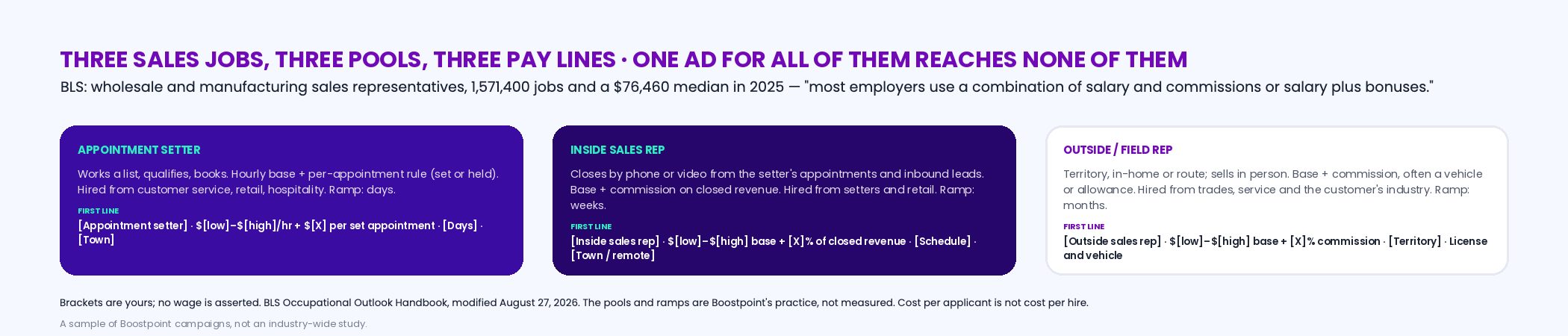
Sales hiring goes wrong when one ad is written for three jobs. The appointment setter — the SDR, the BDR, the phone or chat opener — works a list, reaches decision makers or homeowners, qualifies and books; paid an hourly base plus a per-appointment or per-held-appointment rule; hired from customer service, retail and hospitality far more than from sales; ramp measured in days. The inside sales rep closes by phone or video, from the setter's appointments or inbound leads; base plus commission on closed revenue; hired from setters, from retail and from adjacent sales; ramp in weeks. The outside or field rep — territory, in-home, route — sells in person; base plus commission, often a vehicle or allowance; hired from trades, service and the customer's own industry as often as from sales; ramp in months. Each of the three needs its own posting; our sales rep job description template covers all three. The BLS's wholesale and manufacturing sales representatives — 1,571,400 jobs in 2025 — earned a median $76,460 a year ($36.76 an hour) in May 2025, with employment projected to hold flat at 0% through 2035, with roughly 123,400 openings a year; and the BLS's description of how the job pays is the one every ad should follow: "Most employers use a combination of salary and commissions or salary plus bonuses. Commissions usually are based on a percentage of sales." The setter's pool is the largest and the cheapest to reach; the field rep's the smallest and the most credential-like, because a driver's license, a territory and a vehicle sit in the first line the way a CDL does.
Where the applicants are: the adjacent pool, in the feed
The person who'll be your best setter is answering phones at a call center, running a register, or waiting tables tonight, and doesn't search for "sales" because they don't think of themselves as in sales. In July 2026 the BLS counted 23.45 employed people for every unemployed one; the setter pool is inside the employed majority, in adjacent hourly work, and it is reached in a feed by an ad that names the pay and the job in words that person already uses — "phones," "appointments," "$[X] an hour plus $[Y] per booking," "paid training." The adjacent pool converts: in the benchmark, customer service and administrative campaigns ran a median $2.71 per applicant at a 25% apply rate (24 campaigns), the cheapest family we publish, and the sales family itself ran $11.61 at 21% across 100 campaigns — dearer than customer service because the ads that carry "sales" in the first line select a smaller pool, cheaper than the technician and nurse families because no license gates it. Two rules follow. First, the title in the first line is the targeting — Indeed's figure is that 36% of job seekers search by exact title, and on a social feed where demographic targeting is locked the words do all the work — so "Appointment setter" reaches setters and "Business Development Representative" reaches nobody you meant. Second, the inside rep and the field rep are often your own setters six months on, which makes the setter ad the one most sales organizations should be running continuously; the call center page covers the pool this ad draws from.
The pay line that passes the rules
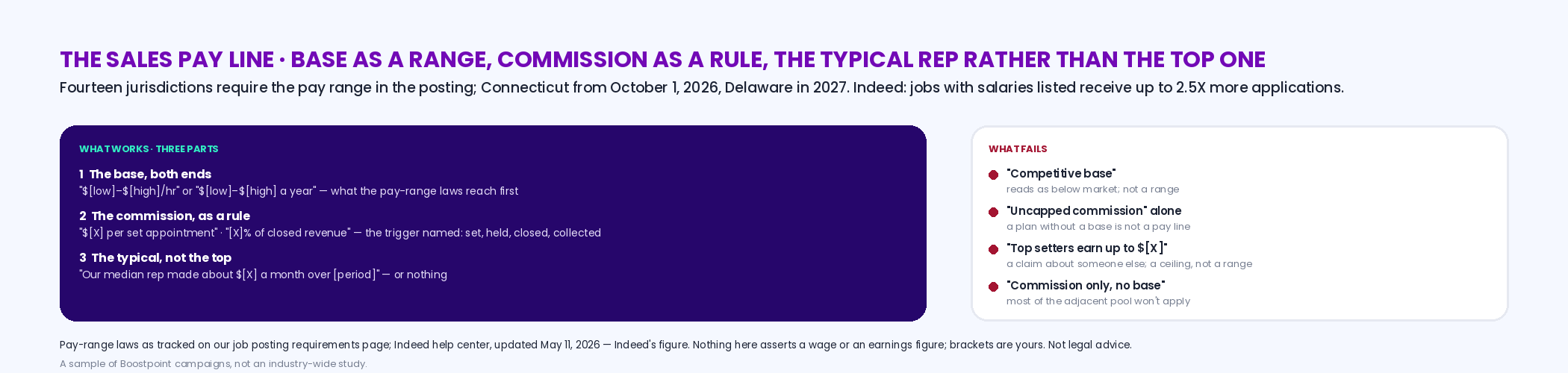
Sales ads fail at the pay line more than anywhere else, and they fail in a specific way: they print what the top rep earned. "Top setters earn $[X] a month" is a claim about someone else, it's read as a lie by the people you want, and where a pay-range law applies it isn't the disclosure the law wants. The line that works has three parts. The base, as a range with both ends: "$[low]–$[high]/hr" or "$[low]–$[high] a year." Fourteen jurisdictions now require the pay range in the posting itself, Connecticut's requirement takes effect October 1, 2026 and Delaware's in 2027 — the posting requirements page has the table — and the base is what those laws reach first; Indeed's own figure is that jobs with salaries listed receive up to 2.5 times more applications. The commission, as a rule: "$[X] per set appointment," "$[X] per held appointment," "[X]% of closed revenue," stated the way the plan document states it, with the trigger named — set, held, closed, collected. The typical, not the top: if you print earnings at all, print what the median rep made over a stated period, and say it's the median. The pay-line writer below builds the line from your base, your rule and your median rep's volume, computes on-target earnings at the median, and flags the words that fail. Nothing in it asserts a wage; the brackets are yours. One more rule for setters who call consumers: the FTC's Telemarketing Sales Rule prohibits calls before 8 a.m. or after 9 p.m. in the consumer's time zone and requires National Do Not Call Registry compliance, with exemptions such as an established business relationship or written permission — so the ad that says "we train you on the script and the rules" is telling the truth about the job, and this page is not legal advice.
Interactive
Sales pay-line writer — your base range, your commission rule and your median rep's volume; get the pay line for the ad, on-target earnings at the median, and the words the rules reach
Nothing is stored or sent — this runs in your browser. The defaults are illustrative placeholders, not a wage claim; every figure is yours to replace. Median volume means your typical rep over a stated period, never the top one.
—
—
low–high × hours × 52
—
rule × median volume × 12
—
base range + median commission
—
of on-target earnings, at the base midpoint
The ad, then the screen that predicts the job
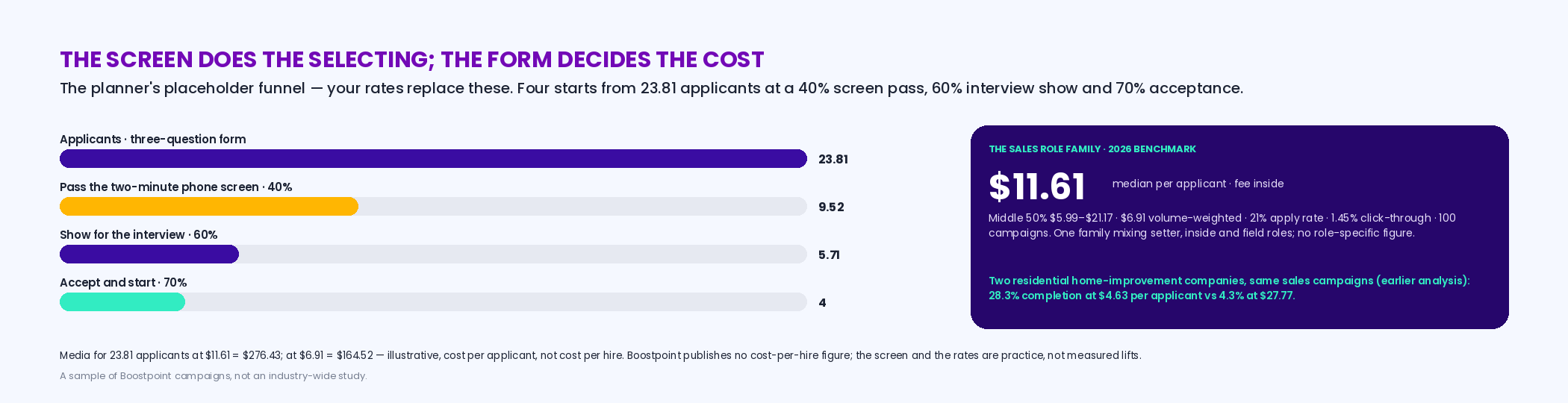
The ad is five lines, the same shape as every frontline ad on this site: the role in the worker's words, the pay line above, the schedule and whether it's on-site or remote, the job in a sentence ("[X] calls a day from a list we give you, booking [what] for [whom]"), and the ask ("three questions, 60 seconds, no résumé"). The copywriting page has the setter template and the rewrite table. What's different about sales is the screen. A résumé predicts almost nothing about whether someone can open a call, and an interview predicts only whether they interview well; the thing that predicts the job is the job. So the screen we run is short and it makes the applicant do it: three knockout questions in the form (can you work the schedule, have you sold or set by phone before — not required — and the best number and time to reach you), then a two-minute phone screen the same day in which the recruiter plays the customer and the applicant opens, handles one objection, and asks for the appointment. It isn't scored on polish; it's scored on whether they'll do it, because a third of applicants won't, and that third would have cost you an interview slot and a week of training. The same-day call matters more in sales than anywhere: the applicant who'll set appointments for you is being screened by two other employers this week, and speed is the first thing they learn about how you sell. All of that is our practice, not a measured lift; what the data measures is the form — across 891 campaigns, what happened after the click explained 70% of cost variation, and the two residential home-improvement sales campaigns that ran the same offer converted at 28.3% and 4.3% and paid $4.63 and $27.77 per applicant for it. The conversion page has the bands; the first-90-days page has what happens after the start, which in sales is where most of the hires are lost.
Interactive
Screen-to-start funnel planner — the starts you need and your rates at each stage; get the applicants to find, the stage counts, and the media at the benchmark's sales-family figures
Nothing is stored or sent — this runs in your browser. Every rate is yours; the defaults are placeholders, not Boostpoint data. The media figures use the benchmark's sales family, one family that mixes setter, inside and field roles, and are illustrative — cost per applicant, not cost per hire.
—
starts ÷ (screen × show × accept)
—
× $11.61 · illustrative
—
× $6.91 · illustrative
What a sales applicant costs, and what it doesn't tell you
The sales family in the benchmark is one row and it should be read as one: 100 campaigns, a median $11.61 per applicant, the middle half between $5.99 and $21.17, $6.91 volume-weighted because the larger programs ran cheaper, a 21% apply rate and a 1.45% click-through rate. It sits between customer service ($2.71) and the licensed families — technicians at $13.41, nurses at $19.08 — which is what you'd expect of a pool with no license and a word in the first line that half the adjacent pool won't claim. It is not split by setter, inside and field, and we won't pretend it is; the spread of the middle half is mostly that mix and the form behind each ad. What the figure can't tell you is what a rep costs to hire or what a rep produces: we don't see the start, the ramp or the quota, and a cost per hire built from ad spend and an assumed ratio is an assumption with a dollar sign. The funnel planner above uses your rates for exactly that reason. What it can tell you is the shape of the ad line — a normal campaign in the benchmark ran $334 a month for 20 applicants and reached about 6,061 people — and that the cheapest sales applicants come from the same three moves as everywhere else: the pay line as a range and a rule, the form at three questions, and the call the same day.
| Role family | Median cost per applicant | Apply rate | Click-through | Campaigns |
|---|---|---|---|---|
| Customer service / administrative | $2.71 | 25% | 1.77% | 24 |
| Sales (setter, inside and field — one family) | $11.61 (middle 50% $5.99–$21.17; $6.91 volume-weighted) | 21% | 1.45% | 100 |
| Technician / mechanic | $13.41 | 16% | 1.17% | 145 |
| Registered nurse | $19.08 | 11% | 1.15% | 173 |
| All campaigns | $13.88 ($8.02 volume-weighted) | — | — | 891 |
Source: Boostpoint 2026 Social Job Advertising Benchmark — 891 Boostpoint-managed campaigns on Meta (1,334 campaign-months), 2026; costs are what advertisers paid for advertising only.
When this isn't the way to hire a salesperson
Three cases. The senior seat described at the top — a rep with a book, a manager, a technical seller — where the pool is twelve named people and a recruiter's phone beats any feed. A commission-only role with no base, which most of the adjacent pool won't take and which several pay-range statutes make awkward to post; fix the plan before the ad. And a sales organization that loses most of its setters in the first month, where the funnel planner will tell you to find sixty applicants a quarter and the honest answer is that the first two weeks are the problem, not the top of the funnel. For the setter desk, the inside team and the field crew that hire steadily, the feed, the pay line and the two-minute screen are the way, and the benchmark's sales row is the cost to expect for the applicant — and only the applicant.
Sales rep applicant cost: the latest 12 months
The benchmark row above mixes setter, inside and field roles. Boostpoint's newest cut looks at campaigns classified as sales representative roles: across 31 Boostpoint-managed Meta campaigns, October 2025–September 2026, the median sales rep applicant cost $6.94, with the middle half of campaigns between $4.47 and $12.50.
| Measure | Figure |
|---|---|
| Median cost per applicant (sales representative) | $6.94 |
| Middle half of campaigns (25th–75th percentile) | $4.47–$12.50 |
| Click-through rate | 1.32% |
| Clicks that became applicants | 25.2% |
| Campaigns | 31 |
| Sample | Boostpoint-managed Meta campaigns, October 2025–September 2026 |
| Basis | Cost per applicant: what advertisers paid. Not cost per hire. |
Two cautions. Thirty-one campaigns is a modest sample, and it is a sales representative figure, not an appointment-setter figure. Side by side: Boostpoint's 2026 Social Job Advertising Benchmark reports an $11.61 median for its sales family across 100 campaigns, and this latest-12-months cut shows $6.94 across 31. They are different samples and windows, so plan against the ranges rather than either single number. The part that carries over is the form: 25.2% of clicks became completed applications, which is what a three-question form is for.
Frequently asked questions
How do you hire sales reps?
Decide which of the three jobs you're hiring for — appointment setter, inside rep, field rep — and write one ad for that job with the pay as a base range plus a commission rule. Run it in a feed, where the adjacent pool (customer service, retail, hospitality) is; keep the form to three questions; screen the same day with a two-minute call in which the applicant does the job. In our benchmark the sales family ran a median $11.61 per applicant at a 21% apply rate across 100 campaigns — cost per applicant, not cost per hire.
How do you hire appointment setters?
From the adjacent pool, with an ad that says "appointment setter," names the hourly base as a range and the per-appointment rule with its trigger (set, held), describes the job in a sentence — calls a day, from what list, booking what — and promises a 60-second application. Then a same-day two-minute phone screen where the applicant opens a call and asks for the appointment. Setters are usually hired from customer service and retail, not from sales, and inside reps are usually promoted from setters.
What should a sales job ad say about pay?
The base as a range with both ends, the commission as a rule with its trigger named, and — if you print earnings at all — the median rep's figure over a stated period, labeled as the median. Never "top reps earn," "up to," or "uncapped" as the only pay fact. Fourteen jurisdictions require the pay range in the posting itself, with Connecticut following October 1, 2026 and Delaware in 2027, and Indeed reports jobs with salaries listed receive up to 2.5 times more applications — Indeed's figure.
How much does it cost to recruit a sales rep?
We can answer for the applicant: the benchmark's sales family ran a median $11.61 per applicant, middle 50% $5.99 to $21.17, $6.91 volume-weighted, across 100 campaigns, mixing setter, inside and field roles. What a rep costs to hire depends on your screen, show and acceptance rates and on everything after the ad, and the funnel planner on this page computes the applicant count from your rates. Cost per applicant is not cost per hire; we don't track hires and publish no cost-per-hire figure.
Where do you find sales reps who aren't already in sales?
In the employed majority — the BLS counted 23.45 employed people per unemployed one in July 2026 — and specifically in customer service, retail and hospitality, reached in a social feed by an ad that names the pay and the job in their words. In our benchmark customer service campaigns ran a median $2.71 per applicant at 25% apply, the cheapest family we publish; that pool is where setters come from.
What's the best way to screen sales candidates?
Make them do the job for two minutes. Three knockout questions in the form, then a same-day phone screen in which the recruiter plays the customer and the applicant opens, handles one objection and asks for the appointment — scored on whether they'll do it, not on polish. It's our practice, not a measured lift; the measured part is the form, where what happens after the click explained 70% of cost variation across 891 campaigns.
Do appointment setters need to know telemarketing rules?
If they call consumers, yes, and the employer trains them: the FTC's Telemarketing Sales Rule prohibits calls before 8 a.m. or after 9 p.m. in the consumer's time zone and requires compliance with the National Do Not Call Registry, with exemptions such as an established business relationship or written permission. The ad can say the training is provided; nothing on this page is legal advice.
Does Boostpoint have appointment-setter recruiting data?
Not separately. Our benchmark publishes one sales family — 100 campaigns, median $11.61 per applicant, 21% apply rate — that mixes appointment setting, inside sales and field sales as the campaigns were labeled, and we don't claim a setter-specific or inside-sales-specific figure. The one sales-specific comparison we have is two residential home-improvement companies running the same campaigns at 28.3% and 4.3% completion, $4.63 and $27.77 per applicant, from an earlier analysis.
Run the setter ad continuously; screen the same day
Bring the base range, the commission rule and the number of starts you need. We'll write the ad in the adjacent pool's words, put the three-question form behind it, run it where the people who'll be your best setters are scrolling tonight, and report what each applicant cost — and no cost per hire we didn't measure.
Book a DemoBoostpoint figures come from the 2026 Social Job Advertising Benchmark — 891 campaigns and 1,334 campaign-months: sales role family median $11.61 per applicant, middle 50% $5.99–$21.17, $6.91 volume-weighted, 21% apply rate, 1.45% click-through, 100 campaigns — one family mixing appointment-setting, inside and field sales roles; no role-specific sales figure is published or implied; customer service / administrative $2.71, 25%, 1.77%, 24; technician / mechanic $13.41, 16%, 1.17%, 145; registered nurse $19.08, 11%, 1.15%, 173; all campaigns $13.88 median, $8.02 volume-weighted; a normal campaign $334 a month, 20 applicants, 6,061 reached; conversion explaining 70% of cost variation. Earlier campaign-level analysis: two residential home-improvement companies running the same sales campaigns, 28.3% completion at $4.63 per applicant against 4.3% at $27.77. Third-party, verified August 27, 2026: BLS Occupational Outlook Handbook, "Wholesale and Manufacturing Sales Representatives," modified August 27, 2026 — 2025 median $76,460 a year, $36.76 an hour; 1,571,400 jobs, 2025; 0% growth 2025–35, about 123,400 openings a year; "Most employers use a combination of salary and commissions or salary plus bonuses. Commissions usually are based on a percentage of sales."; FTC, "Complying with the Telemarketing Sales Rule," modified September 11, 2025 — calling hours and National Do Not Call Registry requirements as summarized; BLS Employment Situation, July 2026 — 23.45 employed per unemployed; Indeed, May 11, 2026 — "Jobs with salaries listed receive up to 2.5X more applications," "36% of job seekers search by exact job title," Indeed's figures; SHRM, October 15, 2025 — $5,475 average nonexecutive cost per hire, SHRM's figure; state pay-range-in-posting jurisdictions as tracked on our job posting requirements page. Arithmetic (placeholders): $17–$19 × 2,080 = $35,360–$39,520; $40 × 30 × 12 = $14,400; on-target at the median $49,760–$53,920; 4 ÷ (0.40 × 0.60 × 0.70) = 23.81 applicants, × $11.61 = $276.43, × $6.91 = $164.52. Boostpoint is priced as a product subscription plus ad spend: the subscription is priced on job volume and quoted on a call, ad spend is separate and recommended at a minimum of $750 a month per job category, there is one bill, through Boostpoint, and every cost-per-applicant figure we publish includes campaign management. The pay-line writer and funnel planner compute on the reader's numbers; the screen, the same-day call and the pay line are Boostpoint's practice, not measured lifts; no wage or earnings figure is asserted. Nothing on this page is legal advice. Cost per applicant is not cost per hire; we do not track hires and publish no cost-per-hire figure. A sample of Boostpoint campaigns, not an industry-wide study.