
Recruiting Video Ideas and Scripts: Twelve You Can Shoot on a Phone This Week
The recruiting videos frontline employers can actually make are 12 to 15 seconds, vertical, shot on a phone by the person who runs the shift, and built around three beats: the pay, shift, and place in the first two seconds, a real employee on the real floor, and an ask with a time on it. This page gives you twelve ideas sorted by what you need to shoot them, three full scripts with timestamps, Meta's current specs and safe zones, and a shot-list builder that keeps you inside fifteen seconds. No performance claims — we don't publish video-specific results — just what to film and what to say.
A note on who's writing this
Boostpoint builds and runs social media job ads for frontline, healthcare, trades, and driving employers, and vertical video is one of the formats we produce for those campaigns — so this is a vendor's page, written from the shooting we do rather than from a study. Two honesty points up front. First, our published benchmark does not split results by creative format, so nothing on this page says video performs better or worse than anything else; every Boostpoint figure we publish is cross-creative, and the ones cited here (a $13.88 median cost per applicant across 891 campaigns, plus role-level medians in the tools; advertising costs only) are context for why every script below ends at the form. Second, the ideas are the ones we have found practical to shoot with a phone and an hour of a supervisor's time; they are not ranked. The specs are Meta's, read on August 25, 2026, and linked in the methodology note.
The three beats every recruiting video shares
Before the ideas, the skeleton they all hang on, because it is the same one on our what makes a good job ad page. Seconds zero to two: the number, on screen as text and spoken — pay, shift, town. Seconds two to nine: the place and the person — one pan of the real work area and one sentence from a real employee about why they took the job, plus the single hard requirement. Seconds nine to fifteen: the ask — "tap apply, sixty seconds, no résumé" — pointing at the button. Captions burned in, because most feed viewing is muted. Everything below is a different way to fill the middle seven seconds.
Twelve recruiting video ideas, sorted by what you need
Tick what you have access to this week and the ideas you can shoot stay lit; the rest dim. Most employers can do seven of the twelve with a phone, a supervisor, and one willing employee.
Nothing is stored or sent — this runs in your browser. Untick anything you don't have.
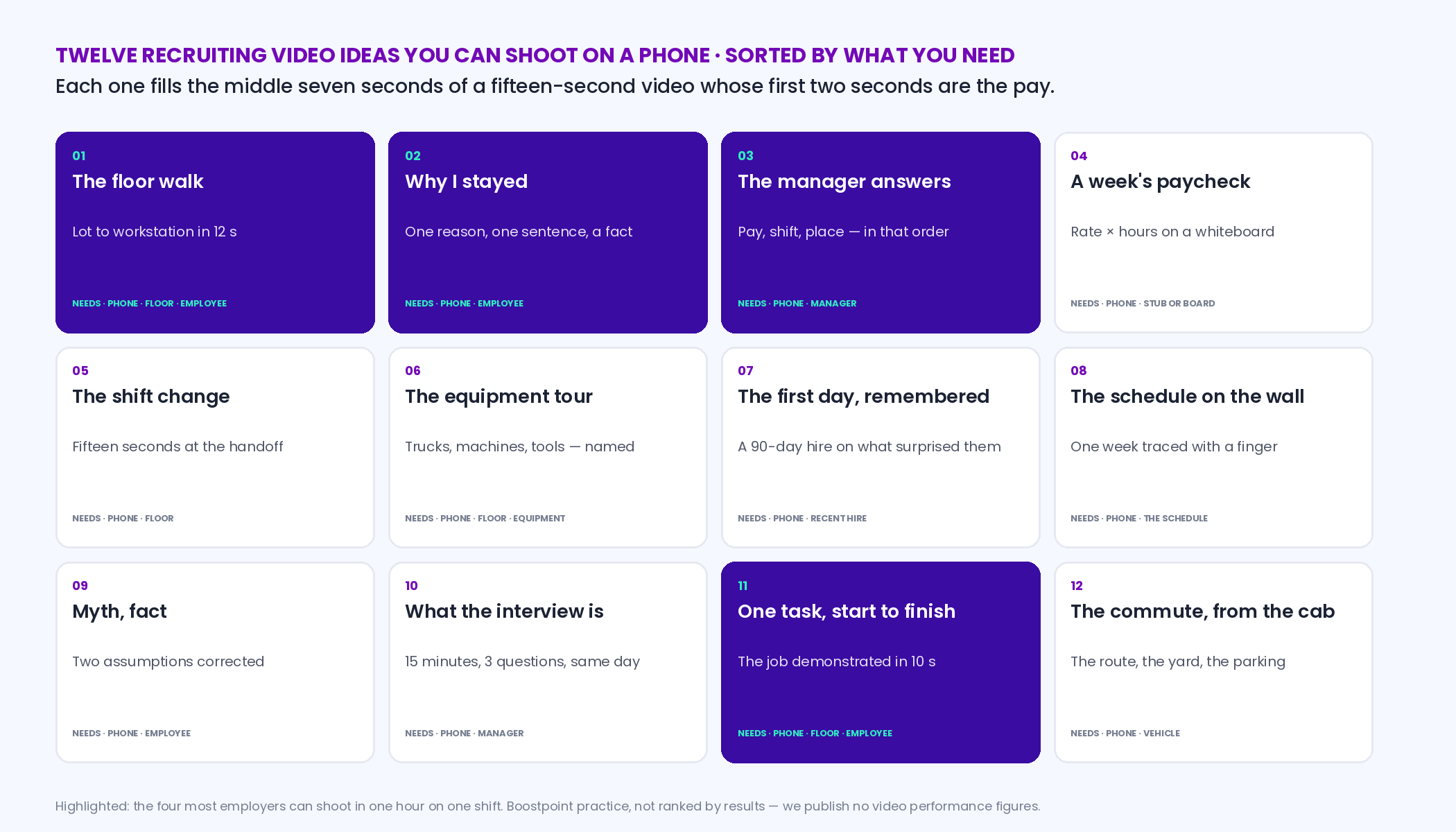
Parking lot to workstation in twelve seconds
One continuous walk from where they'll park to where they'll stand, with the pay on screen the whole way. Ends at the actual station.
Needs: phone, floor, one employee
One employee, one reason, one sentence
"I've been here four years because…" — and the reason has to be a fact: the pay, the schedule, the supervisor's name. Not "the culture."
Needs: phone, one employee
What it pays, when it is, where it is
The person who does the interviews says the three things every applicant asks first, in that order, to camera, in under ten seconds.
Needs: phone, the hiring manager
The math from hourly rate to take-home
Rate × hours + differential, written on a whiteboard or a pay stub with the name covered. Turns "$19.50/hr" into "$780 a week before overtime."
Needs: phone, a stub or a whiteboard
Fifteen seconds at the handoff
Film the moment one crew leaves and the next arrives. Shows the real people, the real pace, and that people go home on time.
Needs: phone, floor access
The truck, the machine, the tools — named
Model year on the door, the controls on the mill, the tool crib. Skilled applicants price a shop by its equipment; show it and say what it is.
Needs: phone, floor, equipment
A 90-day hire on what surprised them
"I thought it would be…, it was actually…" from someone who just went through your onboarding. Honest, specific, and it pre-answers the applicant's fear.
Needs: phone, a recent hire
Show the rotation, not the phrase "flexible"
The posted schedule, a finger tracing one person's week: 3 on / 4 off, or Mon–Fri 6 to 2:30. The applicant sees their life before applying.
Needs: phone, the schedule
Two things people assume about the job, corrected
"You need experience — no, we train on site." "It's nights — no, this opening is days." The employee says the myth; the caption says the fact.
Needs: phone, one employee
Fifteen minutes, three questions, an answer the same day
The manager describes the hiring process out loud, including how fast. Removes a common reason employed people hold off: they assume it's a month of hoops.
Needs: phone, the hiring manager
The job, demonstrated in ten seconds
A pick, a weld, a transfer, a pre-trip. The applicant sees what "the work" is instead of reading a bullet list. Narrated by the person doing it.
Needs: phone, floor, one employee
The route in, the yard, the parking spot
For drivers and field roles: where the truck lives, what the yard looks like at 5 a.m., where you park your own car. Answers "where is it, really."
Needs: phone, a vehicle
Three recruitment video scripts, with timestamps
Illustrative scripts for three roles, written for this page. The employer names are invented and nothing about them is a result. Read them aloud with a stopwatch; each lands between twelve and fifteen seconds at a normal speaking pace.
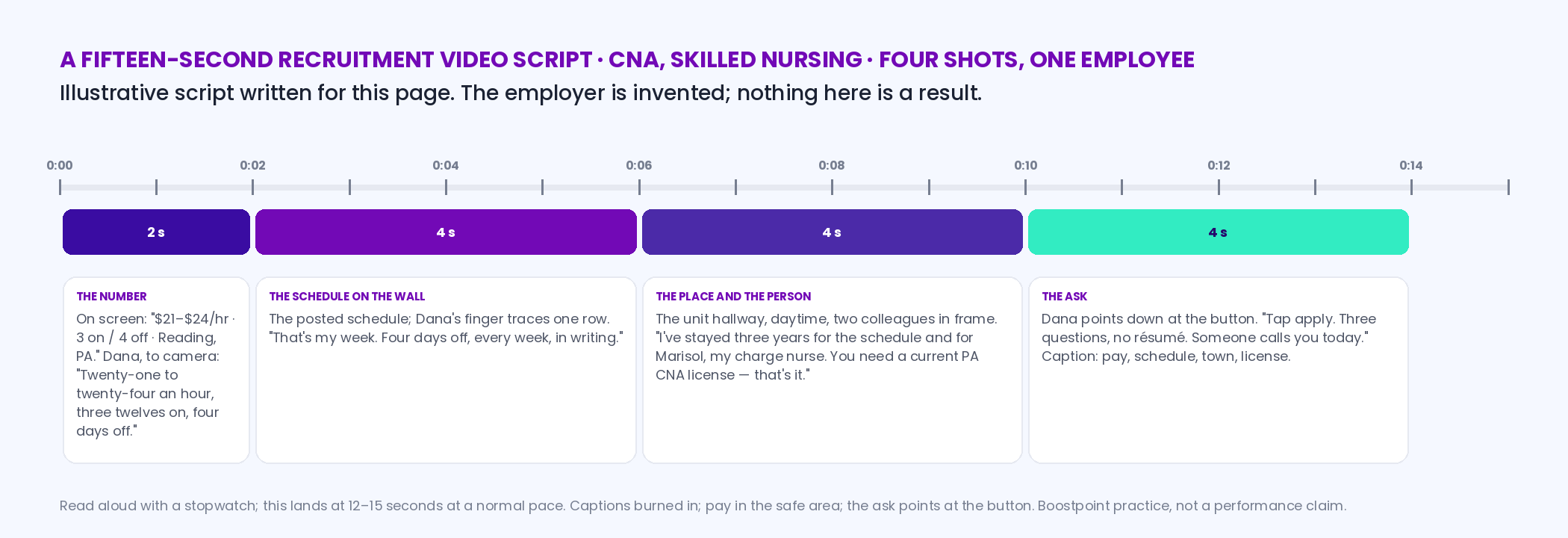
Script A · CNA, skilled nursing · idea 08 + 02
- 0:00–0:02On screen: "$21–$24/hr · 3 on / 4 off · Reading, PA." Dana (CNA), to camera: "Twenty-one to twenty-four an hour, three twelves on, four days off."
- 0:02–0:06Shot: the posted schedule on the wall; Dana's finger traces one row. Dana: "That's my week. Four days off, every week, in writing."
- 0:06–0:10Shot: the unit hallway, daytime, two colleagues in frame. Dana: "I've stayed three years for the schedule and for Marisol, my charge nurse. You need a current PA CNA license — that's it."
- 0:10–0:14Shot: Dana points down at the button. Dana: "Tap apply. Three questions, no résumé. Someone calls you today." Caption: pay, schedule, town, license.
Script B · Forklift operator, distribution · idea 01 + 04
- 0:00–0:02On screen: "$19.50/hr · 2nd shift 2–10:30 · Lancaster, PA." Marcus (operator), walking from the lot: "Nineteen-fifty an hour, second shift, weekly pay."
- 0:02–0:07Shot: continuous walk — door, break room, dock, his forklift. Marcus: "Park here, badge in, this is the dock. Forty hours is $780 a week before any overtime."
- 0:07–0:11Shot: Marcus on the forklift, stationary. Marcus: "Certified or we certify you here in the first week. You need to lift fifty pounds and show up at two."
- 0:11–0:14Shot: points at the button. Marcus: "Apply in sixty seconds, no résumé. We call the same day." Caption: pay, shift, town, the 50-lb line.
Script C · CDL-A regional driver · idea 12 + 10
- 0:00–0:02On screen: "$0.62–$0.68/mile, all miles · Home weekly · York, PA." Ray (driver), in the cab, parked: "Sixty-two to sixty-eight a mile, all miles, home every weekend."
- 0:02–0:07Shot: out the windshield — the yard at dawn, the trucks, the employee lot. Ray: "This is the yard. Dry van, no touch, twenty-two to twenty-six hundred miles a week. Your car sits right there."
- 0:07–0:11Shot: the dispatcher, Kim, at her desk. Kim: "Class A and twelve months OTR. The interview is fifteen minutes on the phone, and you'll have an answer the same day."
- 0:11–0:15Shot: back to Ray, points down. Ray: "Tap to apply — four questions, a minute." Caption: rate, home time, miles, requirements.
Meta's current specs and safe zones for a vertical recruiting video
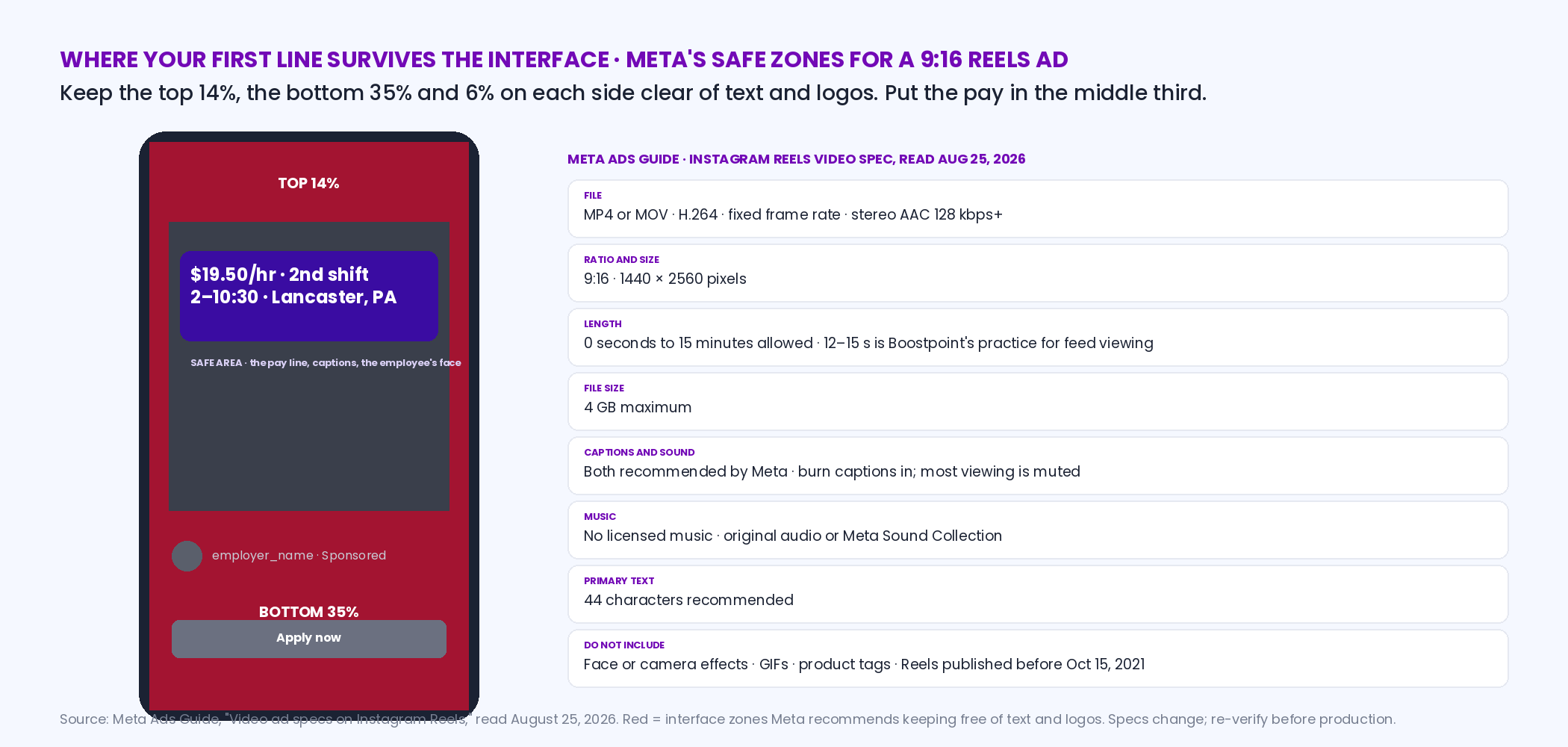
Meta publishes the technical requirements for Reels ads, and they are the same file you'll run in Stories and, cropped, in Feed. As of August 25, 2026, the Instagram Reels spec calls for MP4 or MOV, a 9:16 ratio at 1440 × 2560 pixels, captions and sound both recommended, a duration anywhere from 0 seconds to 15 minutes, a 4 GB maximum, and no licensed music — Meta points advertisers to its Sound Collection instead. The line most employers miss is the safe zone: Meta recommends leaving "at least 14% of the top, 35% of the bottom, and 6% on each side" free of text, logos, or anything important, because the profile icon, caption, and call-to-action button sit there. Put the pay in the middle third of the frame, not the bottom, or the button covers your best line.
Build the shot list and stay inside fifteen seconds
A common way a recruiting video goes wrong is length: a supervisor with something to say will talk for forty seconds, and the number the viewer needed was at second thirty. Set the seconds per shot below and the bar tells you when you've spent the budget.
Nothing is stored or sent — this runs in your browser. Drag each shot's length; the total should land at 12–15 seconds with the number inside the first two.
Runtime targets are Boostpoint's practice for feed-viewed recruiting video; Meta's technical spec allows 0 seconds to 15 minutes. Specs from Meta Ads Guide, "Video ad specs on Instagram Reels," read August 25, 2026; re-verify before production. Not a performance claim.
Recruitment video examples: what the good ones have in common
We can't show you our clients' videos here, and we won't describe results we don't publish. What we can describe is the pattern in the ones we're glad we shot. The employee is someone who does the job, not someone who manages it, and they say their own first name. The pay is the first thing on screen and the first thing said, and it is a number. The camera is at eye level on the floor, not on a tripod in a conference room. Nobody says "family," "fast-paced," or "rockstar." The requirement is stated once, plainly, and it is the same one the form asks. And the video ends by pointing at the button and saying how long the application takes — a promise the in-app form then has to keep, because no video makes up for a form that takes twenty minutes.
Where the video runs, and the rules it runs under
The same 9:16 file runs as an Instagram Reel and Story, a Facebook Reel and Story, and — cropped to 4:5 — in both feeds; our Instagram recruiting page covers the placements, and our TikTok recruiting page covers that platform's separate rules. Wherever it runs on Meta, an employment video is an employment ad: it must be declared in the Special Ad Category, which removes age, gender, ZIP, and lookalike targeting, and it must not indicate a preference by age, sex, or national origin in its words or its casting. Show the crew you have; don't stage the crew you're hoping to hire. The first line does the selecting, legally, for everyone. If the person on camera is a paid creator rather than your own employee, our guide to creator recruiting covers disclosure and approvals.
A recruiting video is a phone, a real employee, and a stopwatch. Say the number in the first two seconds, show the place, state the one requirement, and point at the button.
The employer brand video, and why it is scored differently
Everything above is a recruiting ad: it names a role, a wage and a location, and it asks for an application. An employer brand video does none of those things. It shows what working somewhere is actually like, and it asks for nothing.
That is a measurement problem before it is a creative one. A recruiting ad is judged on cost per applicant, because applicants are what it produces. An employer brand video produces very few applicants directly, so scoring it the same way guarantees it looks like a failure — and it is often canceled on that basis before it has had time to work.
What it does instead is work on people who are not ready to apply yet, over months rather than days. Two honest measures exist for it. The first is watch-through: whether people who do not need a job stay to the end, which is a real signal because nothing is compelling them to. The second is lift: whether the direct-response ad you run to the same audience afterward converts better than the same ad did before. If neither moves, the video is not working, and no amount of production value will change that.
The order that works
Get the job ad working first. If you cannot fill a role with an ad that names the pay, the shift and the location, a brand film will not fix it — it will just be a nicer-looking version of the same unattractive offer. Employer brand video is a multiplier on a system that already converts, not a substitute for one. Fix the pay line, then film.
When you do film it, the first two beats are the same as any recruiting video on this page. The third one changes. Instead of an application prompt, end on a person saying one specific true thing — the crew lead who has been there eleven years, the tech who names the truck he was given, the supervisor who says what the shop does when someone's kid is sick. Specific beats polished. A narrator saying your people are your greatest asset is the version that gets skipped.
For what this costs to do without a production budget, and for the rest of the brand picture the video sits inside, see employer branding on a budget and employer branding.
Employee testimonial videos: the format, and why most of them fail
The employee testimonial is a common request and an easy one to waste. The usual failure is the same: a staff member is put in front of a camera in a meeting room and asked what they like about working here, and they say the people are great. Every employer's video then says the people are great, and the format stops meaning anything.
What makes a testimonial work for frontline hiring is specificity and setting. Film the person doing the job, in the place the job happens, and ask questions whose answers cannot be generic.
- "What did you do before this, and what is different?" The comparison is the whole value. A tech who left a dealership for your shop will name the exact thing that changed.
- "What is the hardest part of the week?" Honesty here buys credibility for everything else in the video, and it filters people who would not last.
- "What do you get paid to learn here?" Progression, said by someone who went through it, beats any careers-page paragraph.
- "What would you tell someone at [competitor] who is thinking about moving?" This is the question that produces the line you will actually cut the ad around.
Three practical rules. Keep the finished cut to fifteen seconds or less for an ad, like every script on this page, and under 90 for a careers page. Use one person per video rather than a montage of five, because a single face is what a viewer trusts. And caption everything — most of the audience watches with the sound off, which means the strongest line has to be readable, not audible.
Do not script it. A testimonial read from a script sounds like one, and frontline candidates are unusually good at spotting it. Ask the four questions, film for ten minutes, and cut to the few seconds that were true.
The consent side is straightforward and worth doing once: get a written release for using someone's image in advertising, and agree what happens to the video if they leave. A testimonial from a former employee still running as an ad is a small problem that is easy to avoid. The employer-brand version of this, and what it is worth against the other levers, is on employer branding on a budget.
How to make a recruitment video, start to finish
Everything needed is on this page in pieces. In order, this is how to make a recruitment video in an afternoon rather than a quarter.
- 1. Pick one message. One role, one thing about it that is true and specific. A video trying to say three things says none of them in fifteen seconds.
- 2. Choose the idea. From the twelve above, pick the one that matches what you actually have: a willing employee, access to the workplace, or neither.
- 3. Write the three beats. Hook, proof, ask. The scripts above are written out with timestamps; copy the structure and change the words.
- 4. Shoot it vertically on a phone. Good light, close to the speaker, and shoot each beat two or three times. The specs and safe zones are further up this page.
- 5. Caption it. Most of the audience watches with the sound off, so an uncaptioned video is an uncaptioned still.
- 6. Cut it to length and attach the form. Inside fifteen seconds, with the application one tap away. A video that sends people to a careers site puts extra steps between the click and the application.
The part employers over-invest in is step four and the part they under-invest in is step six. A phone-shot clip pointed at a short form fits the decision being made better than a produced film pointed at a careers page: whether to apply now, on a phone, in a break.
Frequently asked questions
What are good recruiting video ideas for hourly and frontline jobs?
Twelve we've found practical to shoot on a phone: the parking-lot-to-workstation walk; one employee's one reason for staying; the hiring manager answering pay, shift, and place; a week's paycheck worked out on a whiteboard; the shift handoff; the equipment tour with models named; a 90-day hire on what surprised them; the posted schedule with one week traced; two myths corrected; what the interview actually is and how fast; one task demonstrated start to finish; and the commute from the cab. Each fills the middle seven seconds of a fifteen-second video whose first two seconds are the pay.
How long should a recruitment video be?
Twelve to fifteen seconds for feed placements, in our practice — long enough for a real employee to say one true sentence, short enough that the pay lands before the viewer scrolls. Meta's technical spec for Reels ads allows anything from 0 seconds to 15 minutes, so length is a choice, not a limit. Put the number in the first two seconds, the ask in the last three, and cut the middle before you cut either.
How do you write a recruitment video script?
Three beats with timestamps. 0:00–0:02: pay, shift, and town on screen as text and spoken by a real employee. 0:02–0:09: one shot of the real work area and one sentence on why they took the job, plus the single hard requirement. 0:09–0:15: "Tap apply, sixty seconds, no résumé," pointing at the button, with a caption that repeats pay, shift, location, and the requirement. The three scripts on this page follow that shape for a CNA, a forklift operator, and a CDL driver.
What are Meta's video specs for a Reels recruiting ad?
Per Meta's Ads Guide for Instagram Reels, read August 25, 2026: MP4 or MOV; 9:16 ratio at 1440 × 2560 pixels; H.264, fixed frame rate, stereo AAC audio; captions and sound recommended; duration 0 seconds to 15 minutes; 4 GB maximum; primary text 44 characters; no licensed music (use original audio or Meta's Sound Collection); no face or camera effects. Keep the top 14%, bottom 35%, and 6% on each side free of text and logos so the interface doesn't cover them. Specs change; re-check before production.
Who should be on camera in a recruiting video?
The person who does the job, saying their own first name, on the floor where they do it — and, for one shot, the person who will interview the applicant. Not an executive, not an actor, not a voiceover. Show the crew you actually have; staging a crew to signal who you want to hire is both a bad idea and, if it indicates a preference by age, sex, or origin, an unlawful one in an employment ad.
Does Boostpoint publish data on how recruiting videos perform?
No. Our 2026 benchmark reports cost per applicant across 891 campaigns without splitting by creative format, so we don't publish video-specific results or a video-versus-photo comparison, and this page makes no such claim. Every script here still ends with an ask about a one-minute form rather than a brand line, because starting an application is the job the video is there to do.
Can we use music in a recruiting video ad?
Not licensed music, per Meta's Reels ad spec; Meta directs advertisers to original audio or its Sound Collection. In practice a recruiting video doesn't need a track: the employee's voice with captions burned in carries it, and most feed viewing is muted anyway. If you add sound, keep it under the voice.
How many recruiting videos do we need?
Three or four variants of the same offer — a different employee, a different opening line, a different idea from the twelve above — so you can rotate as frequency climbs. Shooting them in one hour on one shift is the practical unit: the same supervisor, three people, the same pay line, and you have a month of creative.
What is an employer brand video, and how is it different from a recruiting video?
A recruiting video advertises a specific job — role, pay, shift, location — and asks for an application. An employer brand video shows what working at the company is like and asks for nothing, which means it produces almost no applicants directly and cannot fairly be scored on cost per applicant. Score it on watch-through instead, and on whether your direct-response ads to the same audience convert better afterward. The sequencing matters more than the production: get a job ad that names the pay working first, because an employer brand video multiplies an offer that already converts rather than fixing one that does not.
What is a recruitment video?
A recruitment video is a short piece of video used to advertise an open role — usually fifteen seconds or less, shot vertically, and built to be understood with the sound off in a feed. It is not a company overview or a culture film: it names the job, the pay and the shift, shows the actual place and the actual people, and ends on a single apply step. The three-beat structure earlier on this page is the one to use.
What are good recruitment video examples?
The ones that work share four things, whoever made them: a real employee rather than a manager or a voiceover, the workplace filmed as it actually looks, the pay or shift stated on screen in the first two seconds, and no music bed carrying the message. The weakest examples are the most produced — drone footage and a corporate voiceover tell an applicant less than a phone video of a supervisor saying what the shift is.
How do you make an employee testimonial video for recruiting?
Film the person doing the job in the place the job happens, ask four questions whose answers cannot be generic, keep one person per video, cut to fifteen seconds or less for an ad, and caption it because most viewers have the sound off.
What questions should you ask in an employee testimonial?
What they did before and what is different, the hardest part of the week, what they are paid to learn, and what they would tell someone at a competitor who is thinking about moving. The comparison questions produce the usable lines.
Why do most employee testimonial videos not work?
Because they are filmed in a meeting room and answer a generic question, so every employer ends up with the same clip saying the people are great. Specific answers, filmed where the work happens, are what make one credible.
Do I need recruitment video production, or can we shoot it ourselves?
For recruiting ads, shoot it yourself. Recruitment video production companies are worth paying for when the video has a long shelf life and a brand purpose, such as a careers-site film that will run for two years. For a role you are filling this month, the produced version costs more and takes weeks longer, and polish tends to read as advertising while a phone-shot employee reads as true. Recruitment video services also tend to price per finished minute, which is the wrong unit for something that should last twelve seconds.
Is there a recruitment video template?
The three scripts above are the closest useful thing: a structure with timestamps that you fill with your own role, pay and location. Recruitment video templates sold as drag-and-drop projects mostly supply motion graphics, which is the part that matters least. What makes the video work is who is on camera and what they say in the first two seconds, and no template can supply either.
What recruiting video editing software do we need?
Less than you think. Trimming, captions and a vertical crop cover the whole requirement, and the editor built into a phone or a free app does all three. Recruiting video editing software becomes worth paying for when several people edit and you need shared assets and brand consistency. If the choice is between better editing software and getting the video shot this week, shoot it this week.
Do animated recruitment videos work?
For explaining something, sometimes. For hiring, rarely. An animated recruitment video removes the one asset a recruiting video has, which is a real person the viewer can picture working alongside. The exception is where the workplace cannot be filmed, for privacy or safety reasons, in which case animation with a real voice is better than stock footage of an office nobody works in.
What is recruiting video software?
The phrase covers two unrelated products. One is editing and distribution tooling for making and running recruitment videos. The other, usually written as video recruiting software, means video interviewing: recorded or live candidate interviews, which is a screening product rather than an advertising one. They get confused constantly in software listings, so establish which one a vendor means before comparing prices.
Do we need employer branding videos as well as recruiting videos?
Only once the recruiting videos are running. Employer branding videos are about the company and are judged over quarters; a recruiting video is about one job and is judged on applications this week. The sequence that works is to make the job videos first, then reuse the best footage for the brand version. Doing it the other way around produces a handsome film and an unfilled shift.
Shoot it this week, run it with the form inside
We'll help you pick the three ideas your site can shoot, script them, and run them as employment ads with a one-minute application — costs, and no video claim we can't back.
Book a Demo




Boostpoint figures come from the 2026 Social Job Advertising Benchmark — 891 campaigns and 1,334 campaign-months: $13.88 median cost per applicant; advertising costs only. The benchmark does not split results by creative format; Boostpoint publishes no video-specific performance figures and no comparison of video against other creative, and nothing on this page should be read as one. Ideas, scripts, shot lengths, and casting guidance are Boostpoint's practice, not measured results; the scripts are illustrative, name no real employer, and carry no performance claim. Video specifications are from Meta Ads Guide, "Video ad specs on Instagram Reels" (file type, ratio, resolution, captions, safe zones of 14% top / 35% bottom / 6% sides, 0 second to 15 minute duration, 4 GB maximum, 44-character primary text, licensed-music restriction), read August 25, 2026; specs change, re-verify before production. Employment ads must comply with Meta's Special Ad Category rules and with laws prohibiting discriminatory advertising. Cost per applicant is not cost per hire; we do not track hires and publish no cost-per-hire figure. This is a sample of Boostpoint campaigns, not an industry-wide study.