
Line Cook & Kitchen Staff Recruiting: Hire the Station, Pay the Stage, Feed the Ladder
"Kitchen staff" is not a job. The dish pit, the prep list, the line and the pass are four different recruits, and each reads a different first line: the dishwasher reads the schedule and the meal, the prep cook reads the morning start, the line cook reads the station and the rate, the lead reads who runs the pass. Hire each one separately, make a paid trial shift the interview, and treat the dish pit as where next year's line cook starts. Boostpoint publishes no kitchen-specific cost figure; cost per applicant is never cost per hire.
A note on who's writing this
Boostpoint runs social media job ads for restaurants, hotels, senior living kitchens and every other business that has to replace hourly staff every month. We are not a staffing agency and not a shift app, and we say below when one of those is the right first call. Our data measures advertising, not hiring, and none of it is broken out by kitchen role, so every Boostpoint figure on this page is either a structure figure that applies to any role or an adjacent figure labeled as such. The station lines, the paid stage and the same-day call are our practice with kitchen clients, not measured results. The turnover and workforce numbers are the BLS's, Black Box Intelligence's and the National Restaurant Association's, and are dated where they appear.
The condition: a kitchen replaces itself every year
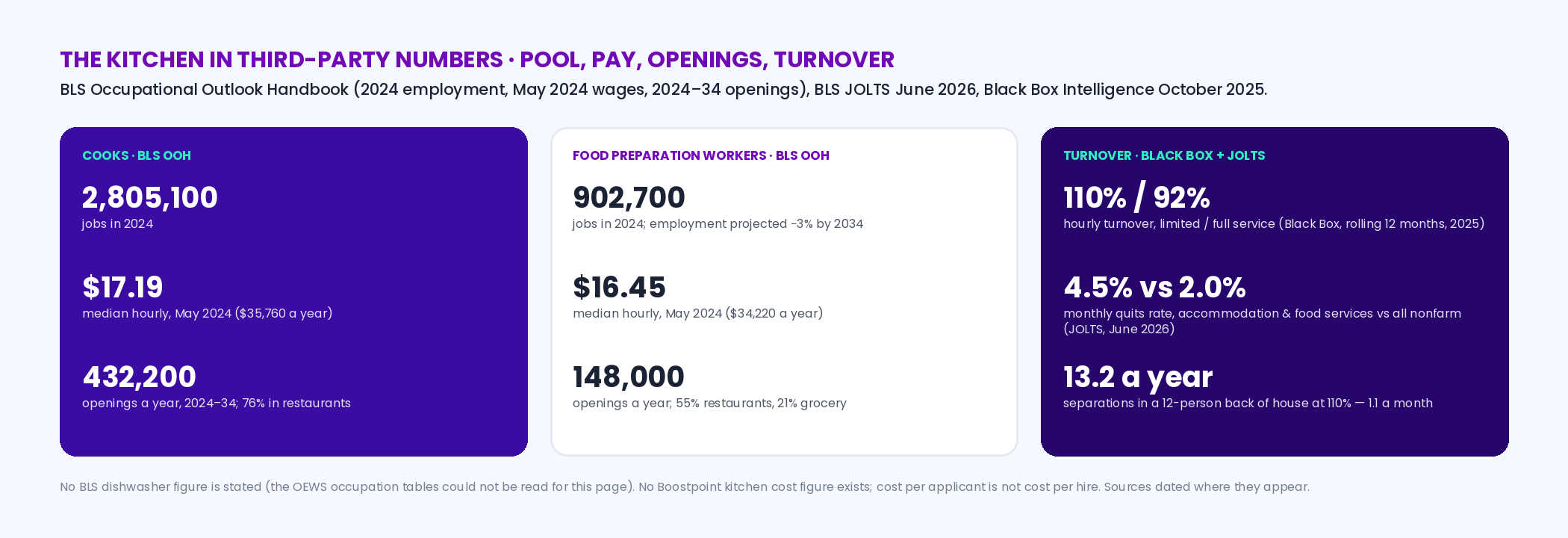
Every kitchen operator knows the feeling; the numbers say it is not just your kitchen. Black Box Intelligence's rolling twelve-month hourly turnover ran 110% in limited service (2025 Q3) and about 92% in full service (2025 Q1–Q3), against 133% and 101% in 2019 (State of the Restaurant Workforce, October 29, 2025). The BLS's quits rate for accommodation and food services was 4.5% a month in June 2026 against 2.0% for all nonfarm employment, and the sector's hires rate was 5.0% against 3.4% (JOLTS, released August 4, 2026). Put a number on it: a twelve-person back of house at 110% turnover separates 13.2 people a year, 1.1 a month; at 92%, 11.04 a year, 0.92 a month. The kitchen is not hiring for an opening; it is hiring at a rate. The month-by-month planning for that rate, front and back of house together, is on our hospitality recruiting page; this page is what changes when the role is behind the pass.
The pool, in the BLS's numbers
The Bureau of Labor Statistics counts 2,805,100 cooks (2024) at a median $17.19 an hour ($35,760 a year, May 2024), with about 432,200 openings a year projected through 2034, 76% of them in food services and drinking places, and no formal education typically required. It counts 902,700 food preparation workers at a median $16.45 an hour ($34,220), with about 148,000 openings a year and employment projected to fall 3% over the decade, 55% in restaurants and 21% in grocery and specialty food retail, trained on the job in "several weeks" (Occupational Outlook Handbook, read August 2026). The BLS's dishwasher tables could not be read for this page, so no dishwasher figure is stated. The National Restaurant Association's 2026 State of the Restaurant Industry (February 12, 2026) projects 15.8 million restaurant jobs and says nearly three quarters of operators plan to hire but expect difficulty finding experienced managers and chefs. Two things follow. Most of the 2.8 million cooks are working tonight, not searching, so the ad has to reach a phone in a break, not a job board. And the openings are not evenly spread: prep employment is shrinking while cook openings run 432,200 a year, which is why the ladder from prep to line matters more than the prep posting.
| Station | BLS pool · median (May 2024) | Who is actually in the pool | What they compare against their current job | Source |
|---|---|---|---|---|
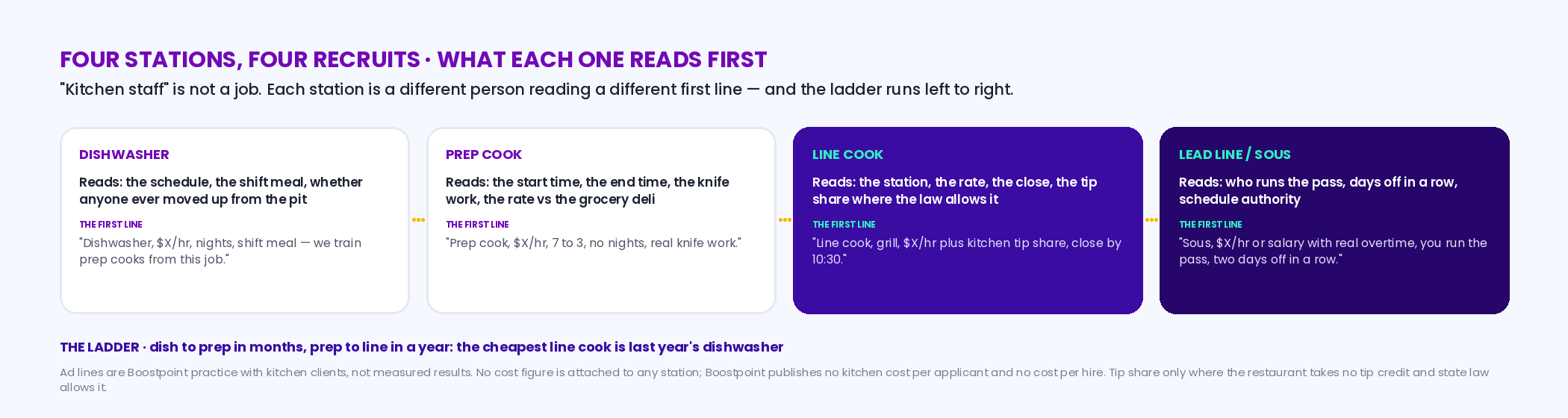
| Dishwasher | No BLS figure stated on this page | Entry: first jobs, second jobs, people who need the schedule to fit around something | The schedule, the shift meal, whether they are left alone, and whether anyone has ever been moved up from the pit | Boostpoint practice |
| Prep cook | 902,700 food preparation workers · $16.45 | Morning people; often the dishwasher from last year; grocery and commissary prep workers (21% of the pool is in grocery) | The start time, the end time, the knife work they get to do, and the rate against the grocery deli across the street | BLS OOH; Boostpoint practice |
| Line cook | 2,805,100 cooks · $17.19 | Employed cooks at every other restaurant in the radius, on a phone between the lunch and dinner push | The station (grill, sauté, fry, pantry), the rate, the closing time, the tip share where the law allows it, and who runs the pass | BLS OOH; Boostpoint practice |
| Lead line / sous | Inside the cooks figure; the NRA says operators expect difficulty finding experienced chefs | The best line cook at a competitor, and your own best line cook if you don't make the offer first | Who runs the pass, schedule authority, days off in a row, a salary or a rate with real overtime, and whether the chef will leave in a year | NRA SOI Feb 2026; Boostpoint practice |
Four stations, four recruits
The posting that says "kitchen staff wanted, all positions" is read by nobody in particular, because nobody applies for "all positions." A dishwasher who wants Tuesday and Thursday nights and a line cook who wants the grill at $X are not the same person, and each of them stops reading at the first line that isn't about them. So the kitchen runs one ad per station, or one campaign with a distinct ad per station inside it. That is the multi-role structure, and in our 2026 benchmark multi-role campaigns ran a median $9.83 per applicant at a 12% apply rate across 46 campaigns, against $14.45 and 18% for single-role campaigns across 1,210; the cheapest structure of all was the event-driven one, $8.02 and 21% across 78, which for a kitchen means a dated hiring day with the stage built in (more below). Those are structure figures across every industry we serve, not kitchen figures. The board below is the four first lines.
Interactive
Station board — pick the station and get who is in the pool, the knockouts, the first line of the ad and what the stage is
Nothing is stored or sent — this runs in your browser. Lines and stages are Boostpoint practice with kitchen clients, not measured results.
What a cook reads first: the station, the rate, the close, and the tip share
A cook decides in the first sentence. The station tells him whether the job is his; the rate tells him whether to keep reading; the closing time tells him what his life is; and in some kitchens a fourth thing tells him more than the other three. Federal wage law lets an employer require servers to share tips with "non-tipped employees, such as dishwashers and cooks, but only if all workers receive a direct cash wage of at least the federal minimum wage" ($7.25) — that is, only when the restaurant takes no tip credit — and managers and supervisors may never take from the pool (DOL Wage and Hour Division, Fact Sheet #15, read August 2026). States add their own rules, and some forbid it; check yours, and treat this as a summary, not legal advice. Where it is lawful, a kitchen tip share is the single most persuasive line a back-of-house ad can carry, because it is the one thing the competitor across the street probably isn't offering, and it belongs in the first sentence with the number: "Line cook, grill, $X/hr plus a kitchen tip share that averaged $Y last quarter, close by 10:30." Say what it averaged, not what it might.
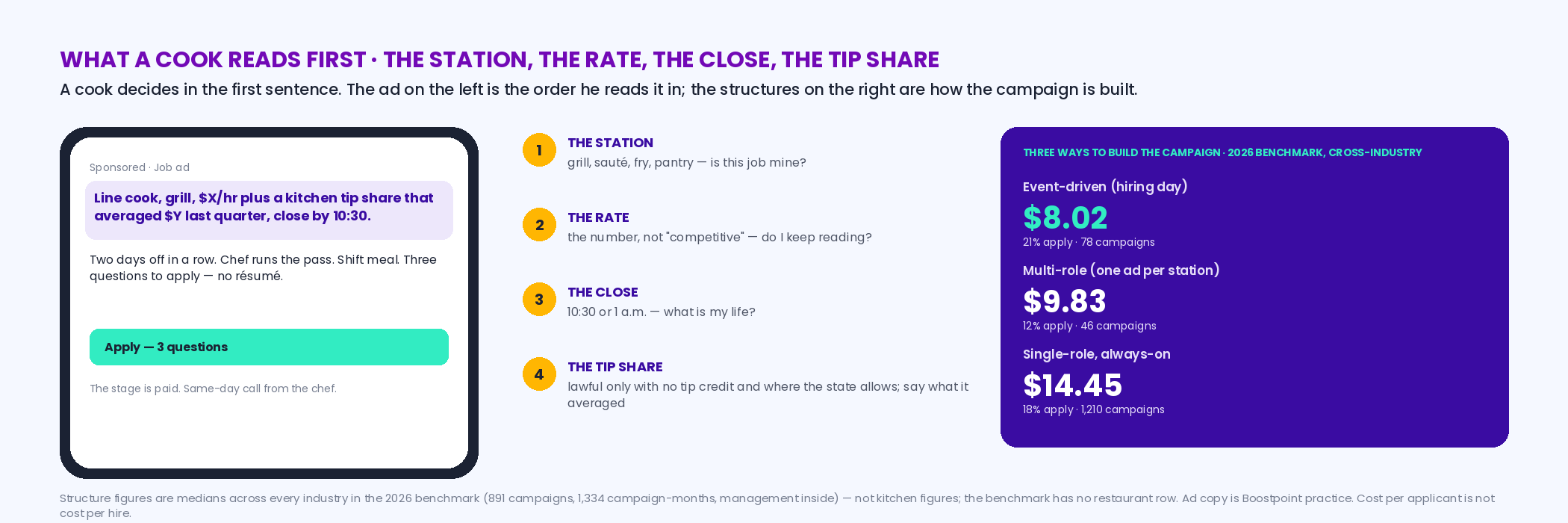
Then the form: three questions and a phone number. Which station have you worked, and where? Which nights can you close? When can you come in for a paid stage? Nothing else; no résumé, no portal, no "tell us about yourself." Our general form guidance is on what makes a good job ad. And then the call, the same day, from the chef or the kitchen manager, not from a recruiter — a cook applies on a phone in a break and is back on the line in ten minutes, and the kitchen that texts him back before his shift ends is the kitchen that gets the stage. Same-day contact is our practice, not a statistic we have measured.
The case for a staffing agency or a shift app first
Be honest about when advertising is the wrong first call. A dishwasher who no-shows on a Saturday with 200 covers is a tonight problem, and a shift app or an hourly staffing agency solves tonight problems; an ad solves next month's. A new opening that needs twelve people trained and on the line in three weeks is a mass-hiring problem with a hiring day at the center, and an agency can supply the bridge crew while the direct hires come through. A banquet kitchen with a 400-cover wedding every other weekend needs a bench, and a bench is what an agency sells. What an agency does not sell is a line cook who stays, and what the markup buys, hour after hour, is on our hospitality staffing agency cost page; this page does not repeat those figures. The rule we use with kitchen clients: agency for the shift, ads for the station, and the ladder for the line.
The paid stage is the interview
No chef has ever learned anything from a cook's answer to "where do you see yourself in five years." The interview for a kitchen is a stage: two to four hours on the station, at the rate, during a real service or a real prep list, with the chef watching the knife, the mise and whether the cook asks or guesses. Pay it. A trial shift in which a person does productive work is work, and unpaid stages are how kitchens end up in wage-and-hour trouble; paying $X for three hours is also the cheapest reference check you will ever run. Book it on the first call, offer a lunch prep slot and a dinner service slot, tell the cook the result before he leaves, and make the offer in the alley with the start date on it. The cook who staged well has a job to give notice at; the rest of the checks run in parallel with the notice period, not before the offer. The one-day version of that sequence, for any frontline role, is on on-the-spot hiring.
How to hire line cooks fast: the hiring day with the stage built in
Fast is not a shorter stage; it is more stages in one day. A dated hiring day — "Tuesday the 9th, 2 to 6, come cook a plate" — puts the passive pool in your kitchen at once: cooks stage on the line in forty-minute slots, dishwashers and prep candidates talk to the kitchen manager at a table by the walk-in, and offers go out the same afternoon with start dates. In our 2026 benchmark the event-driven campaign was the cheapest structure we run, a median $8.02 per applicant at a 21% apply rate across 78 campaigns, against $14.45 for the always-on single-role campaign; that is a cross-industry figure, and a kitchen's mileage is its own. Run the event ad two weeks out, one campaign with a distinct ad per station, and keep a small always-on campaign for the line cook opening that never quite closes. The mechanics of the day, invitations to no-shows to offers, are on open house hiring events, and the volume version for a new opening is on mass hiring.
Feed the ladder: the cheapest line cook is last year's dishwasher
The dish pit is the only station that can be filled from outside the trade, and the line is the station hardest to fill from outside the kitchen. That is the whole case for the ladder: hire dishwashers who want to cook, put a knife in their hands on slow afternoons, move the good ones to prep in months and to the line in a year, and the line cook you would otherwise be bidding for against every kitchen in the radius already knows your menu. It changes the dishwasher ad ("dishwasher, $X/hr, nights, we train prep cooks from this job — two of our line cooks started here") and it changes what you count: not line cook applicants, but dishwashers hired who could climb. The planner below is arithmetic on your own promotion rates, which is what it should be; Boostpoint has no data on kitchen promotion and publishes none.
Interactive
Kitchen ladder planner — how many line cooks the dish pit produces, and how many you still hire from outside
Nothing is stored or sent — this runs in your browser. Every rate is yours; Boostpoint publishes no promotion rate and no cost per hire.
What our data can and can't say about kitchens
Our 2026 benchmark has no restaurant or kitchen row, and we won't invent one. What it has is a set of structure figures that hold across every role we run — event-driven $8.02, multi-role $9.83, single-role $14.45 — and a picture of a normal campaign: a median monthly budget of $334, 20 applicants a campaign-month, 6,061 people reached, which is a useful counter to the idea that a single-location restaurant needs a big budget. The nearest role row is customer service and administrative work, which ran a median $2.71 per applicant ($2.98 blended, 25% apply rate, 24 campaigns); it is adjacent evidence that high-turnover hourly roles with no credential gate produce applicants cheaply, and it is not a kitchen figure. The sector figures are on the benchmark. What no figure of ours can tell you is how many staged cooks it takes to hire one who stays past the ninety-day mark, because we measure advertising and you measure that.
Worth setting that advertising against the wage bill it protects: industry-wide, wages ran 28.9 percent of restaurant sales in the first half of 2026, and the full calculation is on restaurant labor costs.
Frequently asked questions
How do you recruit line cooks?
Station by station, not "kitchen staff": one ad per station with the station, the rate, the closing time and, where the law allows it, the kitchen tip share in the first sentence; a three-question form; a call from the chef the same day; and a paid stage on the station within 48 hours, with the offer made before the cook leaves. Most of the BLS's 2.8 million cooks are working tonight, so the ad has to reach a phone in a break, not a job board.
How do you hire line cooks fast?
Run a dated hiring day with the stage built in — cooks in forty-minute slots on the line, offers the same afternoon — and keep a small always-on ad for the opening that never closes. Event-driven campaigns ran a median $8.02 per applicant at a 21% apply rate across 78 campaigns in our 2026 benchmark, the cheapest structure we run; that is a cross-industry figure, not a kitchen one. What you can't compress is the cook's notice at the kitchen he is leaving.
Should a trial shift (stage) be paid?
Pay it. A trial shift in which someone does productive work is work under wage-and-hour law, and a few paid hours on the station is the cheapest, most honest interview a kitchen can run. Book it on the first call, offer a prep slot and a service slot, and tell the cook the result before he leaves. Check your state's rules; this is our practice, not legal advice.
Can back-of-house staff share in tips?
Under federal law an employer may require servers to share tips with "non-tipped employees, such as dishwashers and cooks, but only if all workers receive a direct cash wage of at least the federal minimum wage" — that is, when the restaurant takes no tip credit — and managers and supervisors may not take from the pool (DOL Fact Sheet #15). States add their own rules and some forbid it. Where it is lawful, put the average share in the first line of the ad, with the number.
What does a line cook job ad need to say?
In the first sentence: the station (grill, sauté, fry, pantry), the hourly rate, the closing time, and the tip share if you have one. Then the schedule, who runs the pass, the shift meal, and how to apply in three questions. Under Meta's Special Ad Category there is no age, gender or ZIP targeting for job ads, so the copy does the selecting; a vague ad reaches everyone and interests no one.
Where do you find dishwashers and prep cooks?
Dishwashers from outside the trade — first jobs, second jobs, people who need the schedule — through an ad that leads with the schedule, the meal and the ladder; prep cooks from your own dish pit first, then from grocery and commissary prep (the BLS puts 21% of food preparation workers in grocery and specialty food retail), with an ad that leads with the morning start and the knife work. Both through the multi-role campaign with the line cook ad, which ran a median $9.83 per applicant across 46 campaigns in our benchmark.
What is kitchen turnover, and what does it mean for recruiting?
Black Box Intelligence puts rolling twelve-month hourly turnover at 110% in limited service (2025 Q3) and about 92% in full service (2025 Q1–Q3); the BLS quits rate for accommodation and food services was 4.5% a month in June 2026, more than double the economy's 2.0%. For a twelve-person back of house at 110% that is 13.2 separations a year, 1.1 a month — so the kitchen recruits at a rate, every month, and the ladder from the dish pit is how that rate stops being all outside hires.
What does it cost to recruit kitchen staff?
We don't publish a kitchen or restaurant figure; our 2026 benchmark has no such row. The nearest evidence is structural: event-driven $8.02, multi-role $9.83 and single-role $14.45 per applicant, a normal campaign at $334 a month for 20 applicants, and the adjacent customer service row at $2.71, none of which is a kitchen figure. Agency and app fees are on our hospitality staffing agency cost page. Cost per applicant is not cost per hire; we do not track hires.
How do you recruit restaurant managers?
Treat it as a promotion first and an outside hire second. Your best shift lead, sous chef or assistant manager already knows the menu, the team and the numbers, so post the role internally and say what the step up pays. For outside hires, lead the ad with the salary or rate, the schedule pattern (how many closes, how many weekends, days off in a row), the unit's size and who the manager reports to, then use a short form that asks about management experience and the sales volume they ran. BLS Employment Projections 2025-35 count 344,300 food service managers with about 38,800 openings a year, at a BLS, May 2025 median annual wage of $69,390. The Management / professional family in Boostpoint's 2026 Social Job Advertising Benchmark ran a $16.87 median per applicant with a 16% apply rate; that is a family figure, not a restaurant manager figure.
Where do you find restaurant managers?
Mostly running a shift somewhere else: assistant managers and kitchen managers at other restaurants in the radius, managers at quick-service chains who want a full-service unit, and hospitality managers from hotels, catering and senior living dining. Reach them with a local social ad they see after a shift, ask your own managers for referrals, and look inside your own crew for the lead who is ready. Job boards reach the ones already searching, who have usually applied to every operator in town.
How do you recruit cooks?
Name the kind of cook and the station, because a line cook, a prep cook and a short-order or institutional cook compare different things. Put the hourly rate, the start and closing times and the station in the first line, ask three questions on a mobile form, have the chef or kitchen manager call the same day, and book a paid stage within a couple of days. BLS Employment Projections 2025-35 count 1,417,500 restaurant cooks with about 218,600 openings a year, at a BLS, May 2025 median annual wage of $37,390, so nearly everyone you want is cooking somewhere tonight.
Put the station in the first line
We'll write one ad per station, run them where working cooks scroll, put a three-question form and a stage booking behind them, and show you the hourly-turnover campaigns closest to yours — costs, and never a kitchen figure we don't have.
Book a DemoBoostpoint figures come from the 2026 Social Job Advertising Benchmark — 891 campaigns and 1,334 campaign-months: campaign structures event-driven median $8.02 per applicant, 21% apply rate, 78 campaigns; multi-role $9.83, 12%, 46; single-role $14.45, 18%, 1,210; a normal campaign $334 a month, 20 applicants, 6,061 reached; customer service / admin $2.71 median, $2.98 blended, 25%, 24 campaigns, used here only as adjacent evidence. The benchmark contains no restaurant, hospitality or kitchen row and none is implied; no seasonality claim is made. Third-party figures are dated where they appear: BLS Occupational Outlook Handbook (2024 employment, May 2024 wages, 2024–34 projections), BLS JOLTS (June 2026 preliminary, released August 4, 2026), Black Box Intelligence (October 29, 2025), National Restaurant Association (February 12, 2026), DOL Fact Sheet #15. Station lines, the paid stage and same-day contact are Boostpoint practice, not measured results; the tip-pool summary is not legal advice. Cost per applicant is not cost per hire; we do not track hires and publish no cost-per-hire figure. A sample of Boostpoint campaigns, not an industry-wide study.