
Delivery Driver Recruiting: Hiring Last-Mile and Courier Drivers From a Pool That Doesn't Read Trucking Ads
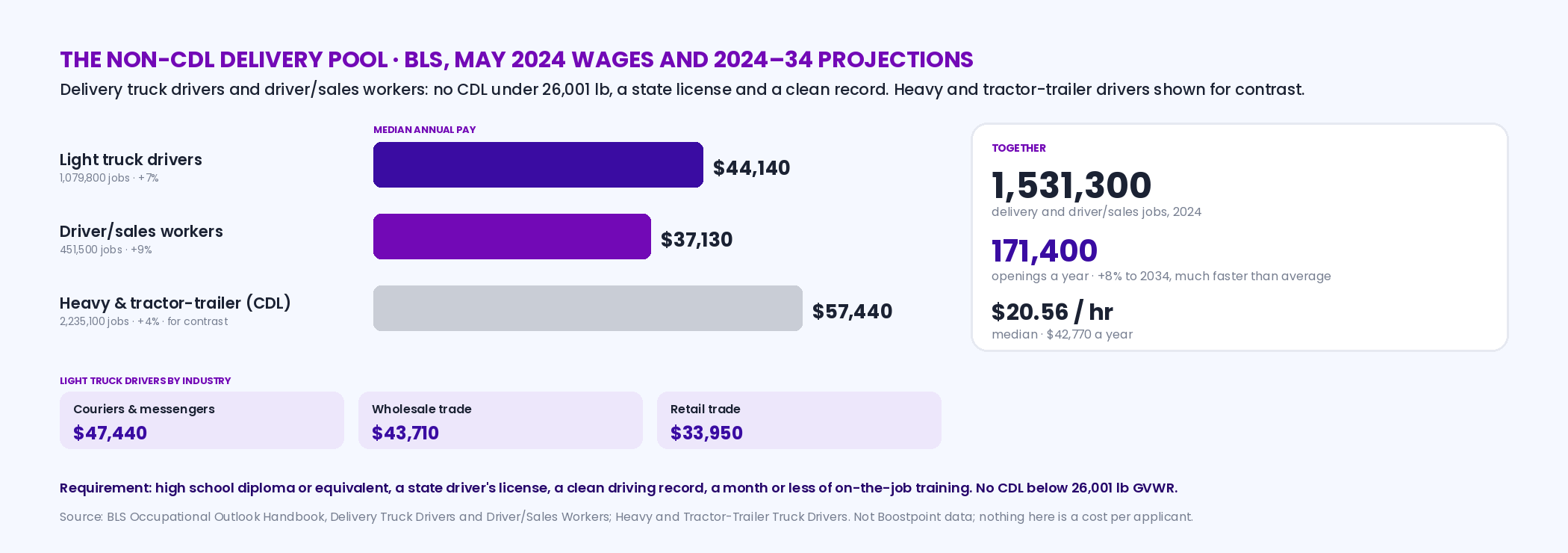
Delivery driver recruiting is not CDL recruiting. The last-mile pool — BLS counts 1,531,300 delivery truck drivers and driver/sales workers, growing 8% with about 171,400 openings a year at a median $20.56 an hour — needs a state license and a clean record, not a CDL, and it is recruited against warehouses, restaurants and gig apps, not fleets. Two things decide the plan: the vehicle's weight, because federal DOT rules attach at 10,001 lb and a CDL only at 26,001, and the route count, because routes a day times seven divided by days a driver works is the headcount. We publish no delivery-driver figure; the adjacent uncredentialed row in Boostpoint's 2026 Social Job Advertising Benchmark, warehouse and production, ran a blended $4.44 per applicant.
Source: Boostpoint 2026 Social Job Advertising Benchmark — 891 Boostpoint-managed campaigns on Meta (1,334 campaign-months), 2026; costs are what advertisers paid for advertising only.
A note on who's writing this
Boostpoint runs social media job ads for employers hiring drivers, warehouse workers and other frontline roles, so the advertising sections of this page describe what we sell. We publish no cost-per-applicant figure for delivery, last-mile or courier drivers; the figures we cite are adjacent — the uncredentialed warehouse row and the Transportation & Logistics sector — and are labeled as such. Where Amazon's Delivery Service Partner program appears, the figures are Amazon's own published statements, not ours, and nothing here describes any DSP's campaign results. Vehicle-weight rules are summarized from the federal regulations as read today and are not legal advice. Every figure of ours is a cost per applicant, never a cost per hire.
The pool, and why it isn't the CDL pool
BLS counts 1,079,800 light truck drivers and 451,500 driver/sales workers (2024), projects 8% growth to 2034 — much faster than average, and the fastest of any driving occupation — and about 171,400 openings a year. Median pay was $42,770 a year or $20.56 an hour in May 2024: light truck drivers $44,140, driver/sales workers $37,130, and by industry, light truck drivers earned a median $47,440 with couriers and messengers, $43,710 in wholesale and $33,950 in retail. The requirement is a high school diploma or equivalent, a state driver's license, a clean driving record and a month or less of on-the-job training; no CDL, because the vehicles are under 26,001 lb. The largest single employer structure in the pool is Amazon's Delivery Service Partner program, which by Amazon's account has created 390,000 driving jobs across 4,400 small businesses in 19 countries delivering over 20 million packages a day (October 2024), with Amazon saying in September 2025 that it expects DSP driver pay to reach a national average of nearly $23 an hour depending on the DSP and location. What this pool has in common with CDL drivers is a phone and a driver's license; what it doesn't share is the trucking identity. A delivery driver applied to a warehouse last month and will apply to a restaurant next month, and the ad that reaches him is written for a job, not a career on the road — the CDL playbook on how to recruit CDL drivers is a different page for that reason.
Is there a delivery driver shortage?
Not in the way the trucking shortage gets argued. BLS publishes no shortage figure for any occupation; it publishes growth and openings, and for delivery drivers those describe a pool that is large, growing and turning over. In its Employment Projections released August 27, 2026, BLS counts 1,511,400 delivery truck drivers and driver/sales workers in 2025 (1,068,500 light truck drivers and 442,900 driver/sales workers) and projects 7% growth to 2035, against 3.5% for total employment. It expects about 152,700 openings a year, and says many of them come from replacing workers who move to other occupations or leave the labor force, not from growth.
Two things in the new edition are worth reading closely. BLS trimmed its outlook from the 2024–34 figures quoted above, 8% growth and 171,400 openings a year, and median pay kept rising, from $20.56 an hour in May 2024 to $21.13 in May 2025 ($43,950 a year; light truck drivers $44,860, driver/sales workers $38,770). A pool that size, with most openings coming from people leaving, is a churn problem at the station rather than a national scarcity: the drivers exist, and they are choosing between you, the warehouse down the road and the gig apps. That is why the route arithmetic below matters more to your hiring than any national number.
The weight line that decides the rules
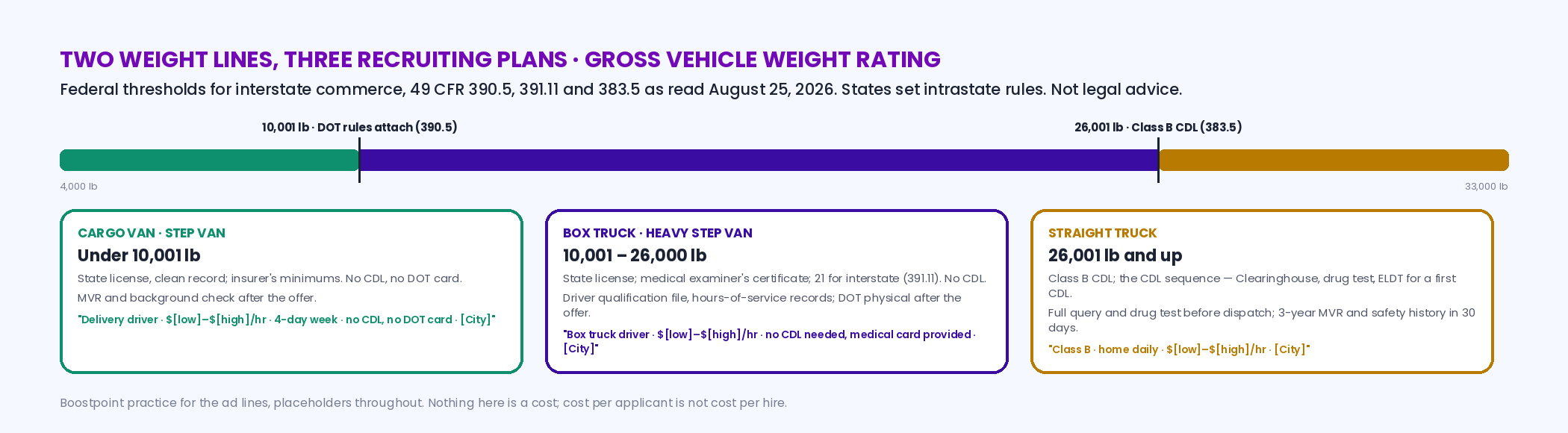
Delivery fleets run three kinds of vehicle, and the recruiting requirements change at two weights. Under 10,001 lb gross vehicle weight rating — cargo vans, most step vans, cars — the driver needs a state license and whatever your insurer requires; federal motor-carrier rules do not apply. At 10,001 lb or more in interstate commerce, the vehicle is a "commercial motor vehicle" under 49 CFR 390.5, and the driver is a DOT-regulated driver without a CDL: a medical examiner's certificate, a driver qualification file, hours-of-service limits, and 21 years old for interstate work under 391.11. At 26,001 lb the vehicle needs a Class B CDL and the driver is in the CDL pool with the CDL rules — the Clearinghouse, the drug test, the three-year MVR and safety history. The recruiting consequence is that a fleet running 16-foot box trucks at 12,000 lb GVWR is recruiting a DOT-regulated non-CDL driver — a category the applicant has never heard of — and the ad has to say "no CDL needed" and "medical card provided" in the same line, because the first fact expands the pool and the second explains the paperwork. Intrastate operations follow state versions of these rules, which vary; the federal thresholds are the floor.
Interactive
The weight line — slide the vehicle's GVWR and see which rules attach, and what the first line of the ad has to say
Nothing is stored or sent — this runs in your browser. Federal thresholds for interstate commerce, summarized from 49 CFR 390.5, 391.11 and 383.5 as read August 25, 2026; intrastate rules are your state's. Not legal advice.
Thresholds are federal and for interstate commerce: 49 CFR 390.5 (commercial motor vehicle at 10,001 lb GVWR/GCWR or actual weight, more than 8 passengers for compensation, or placarded hazmat), 391.11(b)(1) (21 for interstate), 383.5 (Class B at 26,001 lb). Your state's intrastate rules, your insurer and your customer contracts may require more. The ad lines are Boostpoint practice with placeholders; nothing here is a cost.
Routes to headcount: the arithmetic that sets the recruiting load
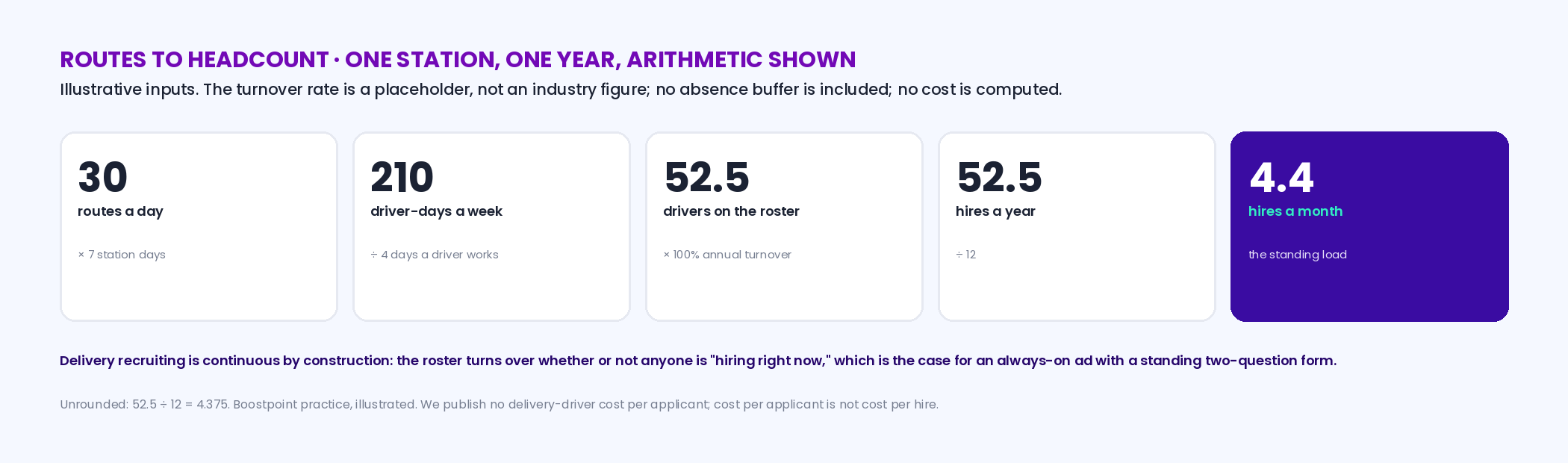
A last-mile operation is sized in routes, not drivers, and the conversion is the recruiting plan. Routes a day times days a week the station runs, divided by days a week a driver works, is the drivers you need on the roster; the turnover rate you actually experience, applied to that roster, is the hires a year; and hires a year divided by twelve is the standing monthly recruiting load — the number the ad has to produce every month whether or not anyone is "hiring right now." A station running 30 routes a day, seven days, with drivers on four-day weeks, needs 52.5 drivers on the roster before a single absence; at 100% annual turnover, which is not unusual in this pool, that is 52.5 hires a year or about 4.4 a month. The point of the arithmetic is that delivery recruiting is continuous by construction, which argues for an always-on ad with a standing form rather than a posting that goes up when the dispatcher panics. The posting itself, with the light truck and driver/sales versions, is our delivery driver job description.
Interactive
Routes-to-headcount planner — the roster, the hires a year and the monthly recruiting load from your route count
Nothing is stored or sent — this runs in your browser. Enter routes and your own turnover; nothing is prefilled from any customer.
Arithmetic on your inputs; no absence or vacation buffer is added, so the real roster is larger. No cost is computed: applicants per hire are yours, we publish no delivery-driver cost per applicant, and cost per applicant is not cost per hire.
The ad, the form and what it costs to reach the adjacent pool
The delivery driver ad is a warehouse ad with a van in it. On Meta it runs in the Special Ad Category — no age, gender or ZIP targeting, the policy on Meta Special Ad Category, explained — so the first line does the selecting: "Delivery driver · $[low]–$[high]/hr · 4-day week, 10-hour routes · no CDL needed · [City]," then the vehicle (a van with AC, a box truck, medical card provided), then the start date. The form asks two things: a valid driver's license and the years held, and availability for the schedule pattern; the MVR and the background check come after the offer, and where the vehicle is DOT-regulated, the medical certificate does too. What we can say about cost is adjacent and labeled: the uncredentialed warehouse and production row in the 2026 benchmark ran a median $9.83 per applicant, blended $4.44, with a 20% apply rate across 82 campaigns, and warehouse campaigns in an earlier manufacturing analysis ran $2.14; the Transportation & Logistics sector, which includes the CDL campaigns, ran a median $13.34 with a 13% apply rate across 184 campaigns; CDL campaigns alone ran $26.86 with 8%. A delivery driver is recruited from the first pool and the ad is measured against it. The rest of the warehouse playbook applies unchanged — warehouse recruiting has the channel and form detail — and for a station opening or a peak build, a walk-in day with a van in the lot is the structure that ran a median $8.02 per applicant in the benchmark, mechanics on on-the-spot hiring and walk-in interviews and, at scale, mass hiring.
| Vehicle | GVWR | Driver requirement | What you must do | First line of the ad | Adjacent benchmark row |
|---|---|---|---|---|---|
| Cargo van, car, most step vans | Under 10,001 lb | State license, clean record; insurer's minimums | MVR and background check after the offer; your own driving test | "Delivery driver · $[low]–$[high]/hr · 4-day week · no CDL, no DOT card · [City]" | Warehouse / production $9.83 median, $4.44 blended, 20% apply (82 campaigns) |
| Box truck, heavy step van | 10,001 – 26,000 lb | State license; medical examiner's certificate; 21 for interstate (391.11) | Driver qualification file, hours-of-service records; medical card scheduled after the offer | "Box truck driver · $[low]–$[high]/hr · no CDL needed, medical card provided · [City]" | Same row; no separate figure published |
| Straight truck | 26,001 lb and up | Class B CDL (383.5); the CDL sequence | Clearinghouse, drug test, 3-year MVR and safety history — the CDL page | "Class B · home daily · $[low]–$[high]/hr · [City]" | CDL truck driver $26.86 median, 8% apply (59 campaigns) |
A delivery driver isn't a trucker who hasn't got a CDL yet. Recruit from the warehouse pool, say "no CDL" in the first line, and size the ad to the routes, because the hiring never stops.
How to recruit couriers
Couriers are a separate BLS occupation from the delivery truck drivers above, and a smaller one. In BLS Employment Projections 2025-35, couriers and messengers held 228,900 jobs in 2025, are projected to grow 8.0% by 2035 and produce about 23,800 openings a year, at a BLS, May 2025 median annual wage of $39,200. The typical entry requirement is a high school diploma or equivalent with short-term on-the-job training. The work is also different in shape: time-critical runs rather than a fixed route, often in the courier's own car, with windows of work rather than a set of stops.
That changes the recruiting in four ways.
- Know which courier you are hiring. A medical courier moving lab specimens and pharmacy orders, a legal or document courier, and a same-day parcel courier read different things first. Name the kind of run in the first line, and say plainly if your customer contracts require extra training or a background check.
- Answer the vehicle question before they ask it. Say whether you provide the vehicle or the courier drives their own, and if it is their own, state the mileage reimbursement or vehicle allowance and any insurance requirement. That is the line a gig driver compares.
- Sell predictability against the apps. Most people who could courier for you can already take app-based delivery work whenever they like. What you can offer that the apps usually do not is a guaranteed hourly rate, set shifts and a dispatcher who knows their name. Put those in the ad.
- Screen for the record, then drive fast. Ask for a valid driver's license and years held, the shifts or windows they can cover, and (if relevant) whether they have a reliable vehicle. Run the MVR after the conversation, and call the same day, because a courier who is waiting on you is taking app orders in the meantime.
Recruit from the same adjacent pools as last-mile drivers: warehouse and retail workers, rideshare and food delivery drivers who want a steadier paycheck, and your own couriers' referrals. We publish no courier cost figure; the nearest uncredentialed row in Boostpoint's 2026 Social Job Advertising Benchmark is Warehouse / production, at a $9.83 median per applicant with a 20% apply rate, and it is an adjacent row, not a courier figure. The posting itself is on our courier job description.
Frequently asked questions
How do you recruit delivery drivers?
From the warehouse and service pool, not the trucking pool: a first line that says the rate, the schedule pattern and "no CDL needed," a two-question form (license and years held, availability), a callback the same day, and the MVR, background check and — for vehicles of 10,001 lb or more — the medical certificate after the offer. Run it always-on, sized to routes times station days divided by driver days, because the hiring is continuous.
Do delivery drivers need a CDL?
Not under 26,001 lb gross vehicle weight rating — cargo vans, step vans and most box trucks. Between 10,001 and 26,000 lb in interstate commerce the vehicle is a commercial motor vehicle under 49 CFR 390.5, so the driver needs a medical examiner's certificate and must be 21, but no CDL. At 26,001 lb and up, a Class B CDL. States set their own intrastate rules.
What do delivery drivers earn?
BLS puts the May 2024 median for delivery truck drivers and driver/sales workers at $42,770 a year or $20.56 an hour — light truck drivers $44,140, driver/sales workers $37,130 — with light truck drivers earning $47,440 with couriers and messengers and $33,950 in retail. Amazon says it expects Delivery Service Partner driver pay to average nearly $23 an hour nationally depending on the DSP and location (September 2025); that is Amazon's figure.
How many delivery drivers do I need for my routes?
Routes a day times days a week the station runs, divided by days a week a driver works — 30 routes, seven days, four-day driver weeks is 52.5 on the roster before absences. Multiply the roster by your annual turnover for hires a year and divide by twelve for the standing monthly recruiting load. The planner on this page runs it on your numbers.
What does a delivery driver applicant cost?
We publish no delivery-driver figure. The adjacent uncredentialed row in our 2026 benchmark — warehouse and production — ran a median $9.83 per applicant, blended $4.44, 20% apply rate, 82 campaigns, campaign; CDL drivers ran $26.86 with an 8% apply rate. Cost per applicant is not cost per hire; we do not track hires.
What should a delivery driver job ad say?
The rate range, the schedule pattern (four 10-hour days, no nights), "no CDL needed," the vehicle, the city and a start date, in the first line — then what the job is like, in the driver's words. Under Meta's Special Ad Category there is no age, gender or ZIP targeting for employment ads, so the first line is the targeting. Ask two questions on the form and nothing else before the offer.
How is courier recruiting different from last-mile recruiting?
Mostly by vehicle and schedule: couriers often drive their own cars or small vans, work windows rather than routes, and are recruited against gig apps, so the ad leads with the guaranteed hourly rate and the vehicle allowance where the gig app offers neither. BLS reports the highest light-truck-driver median in couriers and messengers, $47,440. The weight rules are the same; under 10,001 lb none of the federal motor-carrier rules apply.
How do you keep delivery drivers once hired?
The same three things the ad promised: the schedule pattern holding, the rate paid on time, and the vehicle in the condition described. Beyond that, a route that fits in the shift and a dispatcher who answers the phone. We measure applicants, not retention; the arithmetic on this page shows what turnover does to the hiring load, which is the strongest case for fixing it.
How do you recruit couriers?
Name the kind of run (medical, legal, same-day parcel) and whether you provide the vehicle, then lead with a guaranteed hourly rate and set shifts, which is what app-based delivery usually does not offer. Ask for a valid driver's license, years held and availability on a short mobile form, run the MVR after the conversation and call the same day. BLS Employment Projections 2025-35 put couriers and messengers at about 23,800 openings a year.
Where do you find delivery drivers?
Mostly outside trucking: warehouse and retail workers, restaurant and food delivery drivers, rideshare drivers who want steady hours, and your current drivers' friends, since a referral bonus paid after the new driver stays is the cheapest source. Reach them with a local social job ad that says the rate, the schedule pattern and "no CDL needed" in the first line, and keep a free listing up for people actively searching. Our delivery driver job description has posting language for each vehicle type.
What is the delivery driver hiring process?
Size the need from your routes, then run the ad with the rate, the schedule pattern and "no CDL needed" in the first line. Ask two questions on a mobile form (license and years held, availability), text and call the same day, interview and ride along or road test the driver in your own vehicle, then make a conditional offer and run the motor vehicle record and background check. If the vehicle is rated 10,001 lb or more and runs in interstate commerce, add the steps for a DOT-regulated driver: a current medical examiner's certificate (49 CFR 391.41) and a driver qualification file, including a motor vehicle record inquiry within 30 days of the start date (49 CFR 391.23). DOT drug and alcohol testing under part 382 applies to drivers who must hold a CDL (49 CFR 382.103), so it is a company policy choice for van and box truck drivers. Not legal advice; states set intrastate rules.
How long does it take to hire a delivery driver?
It depends mostly on your own speed, because no federal rule adds a waiting period for a driver of a vehicle under 10,001 lb. The steps you control are how fast you reply to an application, how soon you can interview and road test, and whether you make the offer on the spot. The steps you wait on are the motor vehicle record and background check turnaround, the medical exam if the vehicle is DOT-regulated, and your ride-along or route training before the driver runs alone. Delivery candidates also apply to warehouses and gig apps at the same time, so a same-day call and a fixed start date usually decide who gets the driver. Keep an always-on ad running at the monthly load your routes imply, so you are not starting from zero each time.
What does it cost to hire a delivery driver?
Boostpoint publishes no delivery driver cost per hire or cost per applicant; the benchmark rows on this page are adjacent roles and are labeled that way. Cost per hire is your total internal and external recruiting cost divided by hires. For a delivery driver that usually means the advertising (your cost per applicant divided by your applicant-to-hire rate), the motor vehicle record and background check, the medical exam for vehicles of 10,001 lb or more in interstate commerce, and the paid time for ride-alongs and route training. Because delivery hiring is continuous, multiply that figure by the monthly hiring load from the routes-to-headcount planner above to see the yearly budget. See Boostpoint's 2026 Social Job Advertising Benchmark for how applicant costs vary by role.
Size the ad to the routes
We'll write the delivery driver ad for your vehicle class with "no CDL" where it belongs, put a two-question form behind it, run it always-on at the monthly load your routes imply, and show you the warehouse and driver campaigns closest to yours.
Book a DemoOnce you have applicants, the interview is where the vehicle rating and the route reality get established. See delivery driver interview questions.
Boostpoint figures come from the 2026 Social Job Advertising Benchmark — 891 campaigns and 1,334 campaign-months — and are ADJACENT to this page's role, labeled as such: warehouse / production median cost per applicant $9.83, middle 50% $3.15–$18.72, blended $4.44, 20% apply rate, 82 campaigns; Transportation & Logistics sector $13.34, $5.26–$25.17, 13%, 184 campaigns; CDL truck driver $26.86, 8%, 59; event-driven $8.02, 21%. Earlier manufacturing analysis (different methodology): warehouse $2.14 per applicant. No delivery, last-mile or courier figure is published, and no delivery-service-partner campaign result is described anywhere on this page. Third-party figures — BLS Occupational Outlook Handbook (May 2024 wages, 2024–34 projections), Amazon's published DSP program statements (October 2024, September 2025), 49 CFR 390.5, 391.11 and 383.5 as read August 25, 2026 — are theirs and attributed in place; regulatory notes are summaries, not legal advice. No customer is named. The planner and weight-line tool are arithmetic and rule summaries on your inputs, not measured results. Cost per applicant is not cost per hire; we do not track hires and publish no cost-per-hire figure. A sample of Boostpoint campaigns, not an industry-wide study.