
Monster Alternatives for Employers: The Board That Publishes Its Price, and the Pool It Can't Reach
Monster is the rare job board that publishes its price — promoted posts from $8 a day, a Pro plan at $299 a month — so the case for a Monster alternative is not about price. It is about audience: every board sells the same searching minority, and in July 2026 the BLS counted 23.45 employed people for every unemployed one. Below, Monster's pricing explained from its own page, eight alternatives graded on what each is best at, Monster vs Indeed, and the two channels that reach people who aren't searching.
A note on who's writing this
Boostpoint sells one of the alternatives below — social feed advertising that reaches employed people on their phones — so read our grade on it the way you would read a vendor's grade on itself. We have tried to be fair the other way too: every price on this page was read on the vendor's own site on the date given, vendor claims are labeled as the vendor's, and where a vendor doesn't publish a price we say so instead of repeating a number from someone's blog. Monster in particular gets credit it rarely gets: it is one of two paid boards here whose price you can read without a sales call. Our own figures come from our published benchmark and are labeled; none of them is a cost per hire.
Monster pricing for employers, from Monster's own page
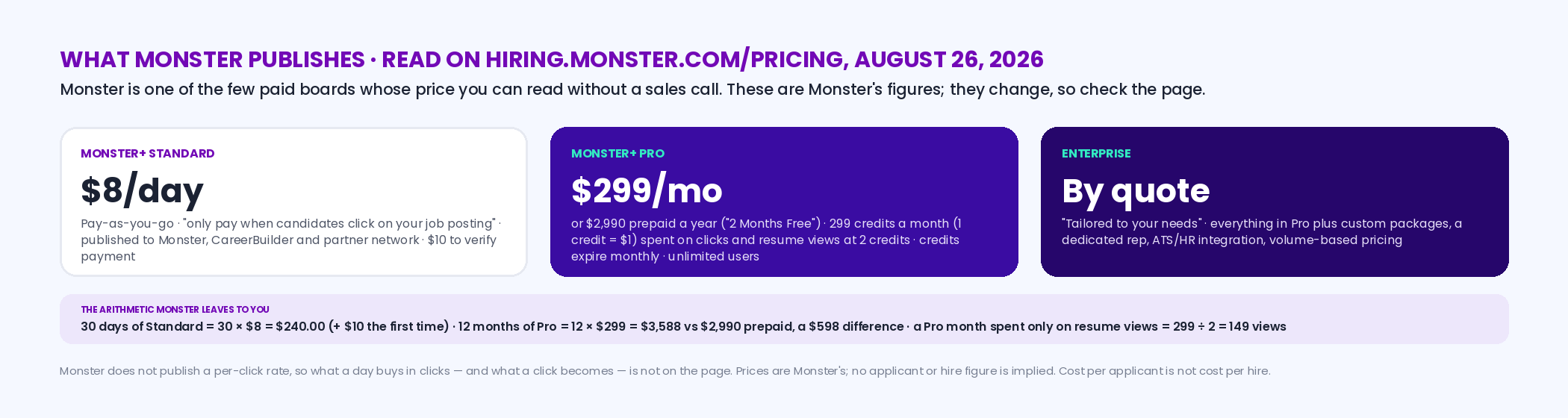
As read on hiring.monster.com/pricing on August 26, 2026: Monster+ Standard is pay-as-you-go from $8 a day for a promoted job posting "published to Monster, CareerBuilder and our partner network," where you "only pay when candidates click on your job posting," and a $10 charge is taken "to set up and verify your payment method." Monster+ Pro is $299 a month as a subscription, or $2,990 prepaid for a year, which Monster describes as "2 Months Free"; it delivers 299 credits a month (one credit is one dollar), spent when candidates click your postings and when you view resumes at 2 credits ($2) a view, with unlimited user access and credits that "expire monthly." Enterprise is "tailored to your needs" with volume-based pricing by quote. The arithmetic Monster leaves to you: thirty days of Standard is 30 × $8 = $240.00, plus $10 the first time; twelve months of Pro month-to-month is 12 × $299 = $3,588, so the $2,990 prepay saves $598; and a Pro month spent entirely on resume views is 299 ÷ 2 = 149 views. What none of that tells you is what a click or a view turns into, because Monster bills you for the click, and the applicant is on the other side of your own form.
Interactive
Monster plan planner — what a month on each published plan costs, and what it buys in Monster's own units
Nothing is stored or sent — this runs in your browser. Prices are Monster's as published August 26, 2026. This computes dollars, days and credits only; no applicant or hire is predicted.
Why employers look for Monster alternatives
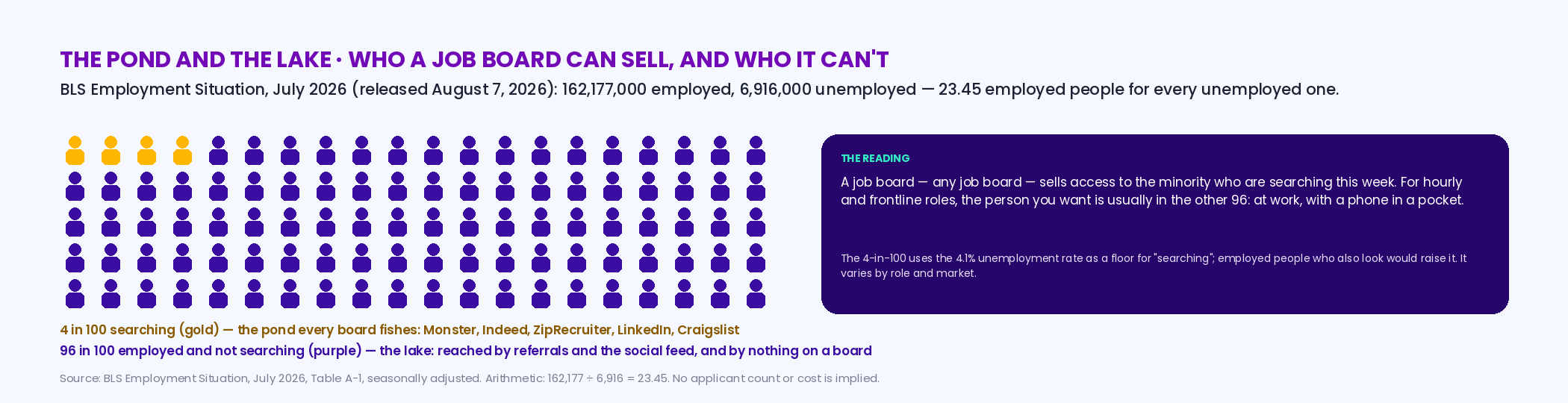
Rarely because of the price list. The complaints we hear are about what the money buys: fewer applicants than the same post drew on Indeed in the same metro, because Monster's searching audience is smaller in most markets; a Pro plan whose credits expire at month-end whether or not the hiring did; and the same applicants, from the same small pool, that every other board in town is also sending. That last one is not Monster's fault, and it is the whole subject of this page. In July 2026 the BLS counted 162,177,000 employed Americans and 6,916,000 unemployed — a 4.1% unemployment rate, and 162,177 ÷ 6,916 = 23.45 employed people for every unemployed one (Employment Situation, released August 7, 2026). A job board, any job board, sells access to the minority who are searching this week. The employed majority, who are the people most frontline employers actually want, are not on Monster, not on Indeed, not on ZipRecruiter; they are at work, with a phone in a pocket. The active-versus-passive frame that follows from that is on our passive candidate recruiting page; the short version is the calculator below.
Interactive
The pond and the lake — how many of the people in your role are searching this month, and how many boards are fishing the same pond
Nothing is stored or sent — this runs in your browser. The national ratio is the BLS's for July 2026; your role and radius are yours.
Most people in your role are not searching this month. No board reaches them; a Facebook or Instagram ad does.
See ads for my rolesEight Monster alternatives, graded on what each is best at
Every channel below is good at something, and the grade is on that, not on whether it is "better than Monster." Prices are as verified on the vendor's own site on the date shown; where we couldn't verify, we say so and state no figure.
| Channel | Reaches | Best at | Pricing, as verified | Watch out for |
|---|---|---|---|---|
| Indeed (free posts + Sponsored Jobs) | Active seekers — the largest board audience in most metros | Volume for roles people search by title; where a searching candidate starts | Published: "Many jobs can be posted for free, subject to Indeed's terms, conditions, quality standards, and usage limits"; "Sponsored Jobs start at $5 per day or $150 per month," varying by role, title and location; daily budgets charged per click to view, monthly budgets per click to apply (Indeed, Aug 26, 2026) | Sponsored cost rises with competition for the title; free posts sink; the searching pool is the same one Monster sells |
| ZipRecruiter | Active seekers across a syndication network | Distribution — "Send jobs to 100+ job boards with one submission" (ZipRecruiter); matching and invitations to apply | Not published: the pricing page shows a free trial and monthly or annual payment with no prices displayed (ZipRecruiter, Aug 26, 2026) | Budget from a quote; syndicated applicants may never have seen your company |
| LinkedIn Jobs | Active seekers with profiles — professional and salaried | Salaried, office, management and licensed-professional roles; employer brand | Not verified for this page; no figure stated | Thin for hourly and trades roles |
| Craigslist | Local active seekers, especially hourly and trades | Cheap, local, immediate; still used for trades, drivers and shop roles in many metros | Published: US job categories $10–$75 per post, fee varies by area (Craigslist, verified Aug 25, 2026) | No screening tools; spam; quality varies by city |
| Google for Jobs | Active seekers searching Google directly | Free reach for any job page with JobPosting structured data, including your own careers site | Free: no listing fee; eligibility needs JobPosting markup on your pages | Eligible is not shown; you need your own job pages and markup |
| State job banks / National Labor Exchange | Active seekers using public workforce services; veterans; UI claimants | Free public reach; required listings for federal contractors; workforce-board referrals | Free through your state job bank | Modest flow; process-heavy in some states |
| Employee referrals | The employed, non-searching pool — your people's former coworkers | Retention and fit; the highest-quality single source most frontline employers have | Whatever bonus you set; pay it in installments | Runs dry without promotion; skews toward who you already have |
| Social feed advertising (Boostpoint's channel) | The employed, non-searching majority — on their phones, by geography and interest | Hourly, trades, driving, care and production roles where the people you want are working elsewhere; dated hiring events | Published: $13.88 median campaign and $8.02 volume-weighted cost per applicant across 891 campaigns (Boostpoint 2026 benchmark) | Needs the wage and the shift in the first line and a short form; a job board is still the right tool for the searching few |
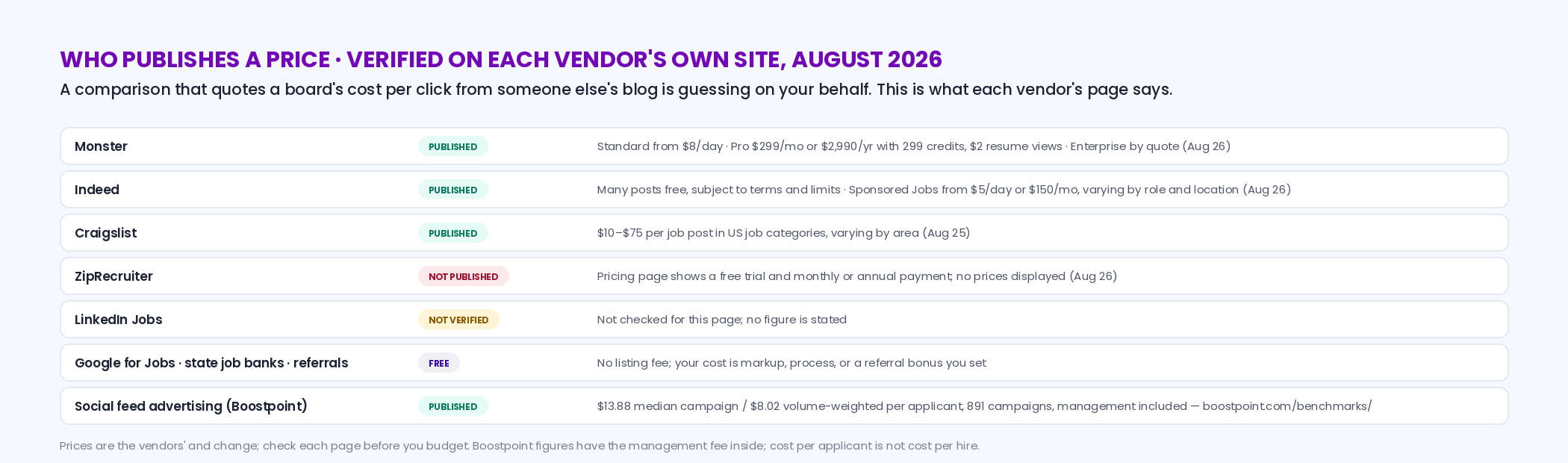
Who publishes their prices — the scoreboard, August 2026
A comparison page that quotes a board's cost per click from someone else's blog is guessing on your behalf. This is what we could read on each vendor's own site. Three paid channels publish a price; one doesn't; one we didn't verify for this page. Monster is on the published side, which is a point in its favor that the search results rarely mention.
Monster vs Indeed, fairly
Different strengths, and both now publish enough to budget from. Monster's Standard plan is a flat daily rate from $8 with distribution to CareerBuilder and its partner network, and the Pro plan bundles resume search, which Indeed's published pricing page does not mention; if you want to search resumes and message candidates on a known monthly number, Monster is the easier line item. Indeed has the larger searching audience in most metros, lets many jobs post free "subject to Indeed's terms, conditions, quality standards, and usage limits," and starts sponsorship at $5 a day or $150 a month, with monthly budgets charged per click to apply rather than per click to view, which is the closer proxy to an applicant. For a role people search by title in a large metro, Indeed usually finds more of them; for a resume-search workflow on a fixed budget, Monster is the more predictable spend. Neither reaches the person who isn't searching, and for hourly and frontline roles that is most of the people you want. The longer Indeed treatment, with its own alternatives graded, is on Indeed alternatives for employers.
The case for staying on Monster
Made honestly: if your openings are roles people search for by title, if you use resume search and messaging as a real workflow, and if you want a price you can put in a budget without a sales call, Monster does exactly what it says at a price it states. A Pro subscription at $299 a month with 299 credits is a knowable spend, the CareerBuilder distribution is a second audience without a second contract, and pay-as-you-go from $8 a day is a low-risk way to test a market. The right question is not "Monster or something else" but "which pool does this hire come from"; for the searching pool, Monster is a reasonable place to be, and for the employed pool no board is.
What social feed advertising costs — and what decides it
Our 2026 benchmark, 891 campaigns and 1,334 campaign-months, puts the median campaign at $13.88 per applicant and the volume-weighted average at $8.02; a normal campaign runs on $334 a month, produces 20 applicants a campaign-month and reaches 6,061 people. Those are not Monster's numbers to compare against a click, because they price an applicant, not a click, and the difference between the two is the form. Applicant conversion explains 70% of the cost variation in the benchmark: campaigns converting under 5% of clicks paid a median $53.77 per applicant, 5–10% paid $23.13, 10–20% paid $11.11, 20–35% paid $4.41, and over 35% paid $1.61; 41% of all budget ran in campaigns converting under 10%, and it produced 11% of applicants. A twelve-field portal, a hidden wage and a slow reply do the same damage behind a Monster click as behind a social ad, which is why the first fix for any channel is on what makes a good job ad. For a burst of hires the dated hiring event ran a median $8.02 per applicant at a 21% apply rate across 78 campaigns (open house hiring events). The sector cuts are on the benchmark; none of this is a cost per hire, which we don't compute.
| Click-to-application rate | Median cost per applicant | Share of budget | Share of applicants |
|---|---|---|---|
| Under 5% | $53.77 | 18% | 3% |
| 5–10% | $23.13 | 24% | 8% |
| 10–20% | $11.11 | 32% | 23% |
| 20–35% | $4.41 | 21% | 38% |
| Over 35% | $1.61 | 6% | 28% |
Source: Boostpoint 2026 Social Job Advertising Benchmark — 891 Boostpoint-managed campaigns on Meta (1,334 campaign-months), 2026; costs are what advertisers paid for advertising only.
Which channel for which hire
A salaried accountant or a marketing manager: LinkedIn and Indeed first, because those people search by title and have profiles. A retail supervisor or an office role in a big metro: Indeed, with Monster as a second active-seeker audience if you want resume search on a fixed number. A welder, a CNA, a delivery driver, a line cook, a warehouse associate: referrals and the feed first, because most of those people are working today and not on any board, with a free post on Indeed and your state job bank for the few who are searching. A dozen hires on one date: a dated hiring event with the feed driving it. Reading your own funnel to decide, channel by channel, is on recruiting analytics; and if the alternative you're weighing is an agency rather than a board, the markup arithmetic is on staffing agency markup.
Frequently asked questions
What are the best Monster alternatives for employers?
It depends on who you're hiring. For active job seekers: Indeed (free posts subject to its terms; Sponsored Jobs from $5 a day or $150 a month, as published), ZipRecruiter (syndication; pricing not published), LinkedIn Jobs for salaried roles, Craigslist ($10–$75 a post), Google for Jobs and your state job bank (free). For the employed majority who aren't searching — most hourly and frontline candidates — employee referrals and social feed advertising, which reach people where they already are. The BLS counted 23.45 employed people per unemployed one in July 2026; boards sell the second group.
How much does Monster cost for employers?
As published on Monster's pricing page (August 26, 2026): Monster+ Standard is pay-as-you-go from $8 a day for a promoted post, charged when candidates click, with a $10 payment-verification charge; Monster+ Pro is $299 a month or $2,990 prepaid for a year, with 299 credits a month spent on clicks and on resume views at 2 credits each, credits expiring monthly; Enterprise is by quote. Thirty days of Standard is $240; twelve months of Pro is $3,588 month-to-month or $2,990 prepaid. Prices change — check the page.
Monster vs Indeed — which is better for employers?
Different strengths. Monster publishes a flat daily rate from $8, distributes to CareerBuilder and its partners, and bundles resume search into a $299 Pro plan, which makes it the more predictable spend for a resume-search workflow. Indeed has the larger searching audience in most metros, posts many jobs free subject to its terms, and starts sponsorship at $5 a day or $150 a month with monthly budgets charged per click to apply. For title-searched roles in a big metro, Indeed usually finds more; neither reaches people who aren't searching.
Is Monster still worth it in 2026?
For the searching pool, yes, if you value a published price and resume search: it does what it says at a stated number. What it can't do — what no board can do — is reach the employed majority, which for hourly and frontline roles is most of the people you want. Run it for the searching few, and put the rest of the budget where the non-searching are: referrals and the feed.
What does Monster's pay-per-click model mean in practice?
On Standard you set a daily budget from $8 and Monster charges when candidates click your posting; on Pro your 299 monthly credits are drawn down by clicks and by resume views at 2 credits each. Monster doesn't publish a per-click rate, so what a day's budget buys in clicks depends on your market, and what a click buys in applicants depends on your form — in our benchmark, campaigns converting under 5% of clicks paid a median $53.77 per applicant and those over 35% paid $1.61. The form, the wage line and the reply time decide more than the channel.
Which job boards publish their pricing?
As verified on the vendors' own sites in August 2026: Monster (from $8 a day; Pro $299 a month), Indeed (Sponsored Jobs from $5 a day or $150 a month; many posts free subject to terms) and Craigslist ($10–$75 a post) publish; ZipRecruiter's pricing page shows a free trial with no prices; LinkedIn was not verified for this page. Google for Jobs, state job banks and referrals are free. Boostpoint publishes its benchmark: $13.88 median campaign, $8.02 volume-weighted.
What is the cheapest alternative to Monster?
Free channels first: Google for Jobs (JobPosting structured data on your careers pages), your state job bank and the National Labor Exchange, and employee referrals at a bonus you set. Among paid boards, Craigslist publishes $10–$75 a post and Indeed starts sponsorship at $5 a day. "Cheapest per listing" is not cheapest per applicant: in our benchmark the click-to-application rate explains 70% of cost variation, and a cheap post behind a long form is the expensive option.
How do you reach candidates who aren't on job boards?
Where they already are: through your own employees' phones (a referral bonus paid in installments), and in the social feed with the wage, the shift and the site in the first line, under Meta's Special Ad Category with no age, gender or ZIP targeting so the copy does the selecting. In our benchmark that channel ran a median $13.88 per applicant and $8.02 volume-weighted across 891 campaigns, and a normal campaign cost $334 a month for 20 applicants. Cost per applicant is not cost per hire; we don't compute the latter.
Reach the pool no board sells
We'll show you what your roles cost per applicant in our benchmark, and build the campaign that reaches the employed majority — the wage in the first line, a short form, and a reply the same day. Keep Monster for the searching few if it's working.
Book a Demo

Boostpoint figures come from the 2026 Social Job Advertising Benchmark — 891 campaigns and 1,334 campaign-months: $13.88 median cost per applicant, $8.02 volume-weighted average; a normal campaign $334 a month, 20 applicants, 6,061 reached; apply-rate bands under 5% $53.77 (18% of budget, 3% of applicants), 5–10% $23.13 (24%, 8%), 10–20% $11.11 (32%, 23%), 20–35% $4.41 (21%, 38%), over 35% $1.61 (6%, 28%), with conversion explaining 70% of cost variation and 41% of budget under 10% producing 11% of applicants; event-driven campaigns $8.02, 21%, 78. Vendor prices were read on each vendor's own site on the dates stated (Monster, Indeed and ZipRecruiter August 26, 2026; Craigslist August 25, 2026) and are the vendors' figures, subject to change; LinkedIn pricing was not verified and no figure is stated. BLS Employment Situation, July 2026 (released August 7, 2026). The plan planner computes dollars, days and credits from published prices and predicts no applicant or hire. Cost per applicant is not cost per hire; we do not track hires and publish no cost-per-hire figure. A sample of Boostpoint campaigns, not an industry-wide study.