
How to Hire Servers and Front-of-House Staff: The Shift Is the Job, and the Ad Has to Say What It Pays
A server is paid mostly by the guests, so the only thing a good server compares is what a shift pays — and most restaurant ads never say. To hire servers, hire the shift and the section, not "servers wanted": say what Friday close took home last quarter, with the number; ask three questions; call the same day; run a paid trail or a walk-in afternoon; and offer the section, not the job. Boostpoint publishes no restaurant cost figure; cost per applicant is never cost per hire.
A note on who's writing this
Boostpoint runs social media job ads for restaurants, bars and hotels that replace front-of-house staff every month. We are not a staffing agency or a shift app, and we say below when one of those is the right call first. Our data measures advertising, not hiring, and none of it is broken out by restaurant role, so every Boostpoint figure on this page is a structure figure that applies to any role, labeled as such. The shift lines, the paid trail, the walk-in afternoon and the same-day call are our practice with restaurant clients, not measured results. Pay, pool and turnover figures are the BLS's, the Department of Labor's and Black Box Intelligence's, dated where they appear. The back-of-house twin of this page is line cook and kitchen staff recruiting; the month-by-month plan for the whole restaurant is on hospitality recruiting.
The front of house, in the BLS's numbers
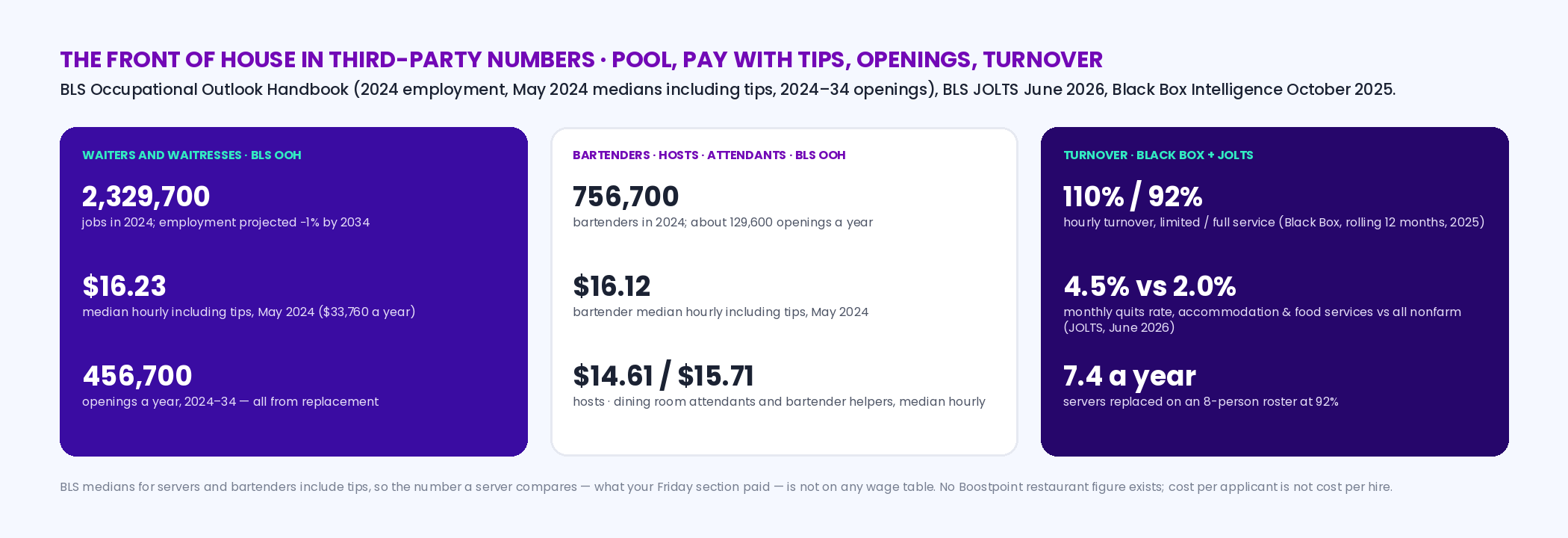
The Bureau of Labor Statistics counts 2,329,700 waiters and waitresses (2024) and projects about 456,700 openings a year through 2034, every one of them from replacement — employment itself is projected to fall 1%. Median pay was $16.23 an hour including tips ($33,760 a year, May 2024); 85% work in food services and drinking places; training is on the job, "several days to a few weeks"; part-time is common. Bartenders: 756,700 jobs, about 129,600 openings a year, median $16.12 an hour including tips, 41% in full-service restaurants and 24% in drinking places. Hosts and hostesses earned a median $14.61 an hour and dining room attendants and bartender helpers $15.71 (Occupational Outlook Handbook, read August 2026). Two things to read out of that. Front-of-house openings run at almost 600,000 a year across servers and bartenders alone, all of it replacement, which is why Black Box Intelligence's rolling twelve-month hourly turnover of 110% in limited service and about 92% in full service (October 29, 2025) and the BLS's 4.5%-a-month quits rate for accommodation and food services (June 2026, against 2.0% for all nonfarm employment) are not a crisis but the condition. And the medians include tips, which means the number a server actually compares is not on any wage table; it is what your Friday section paid last quarter.
The shift is the job: Friday close and Tuesday lunch are two recruits
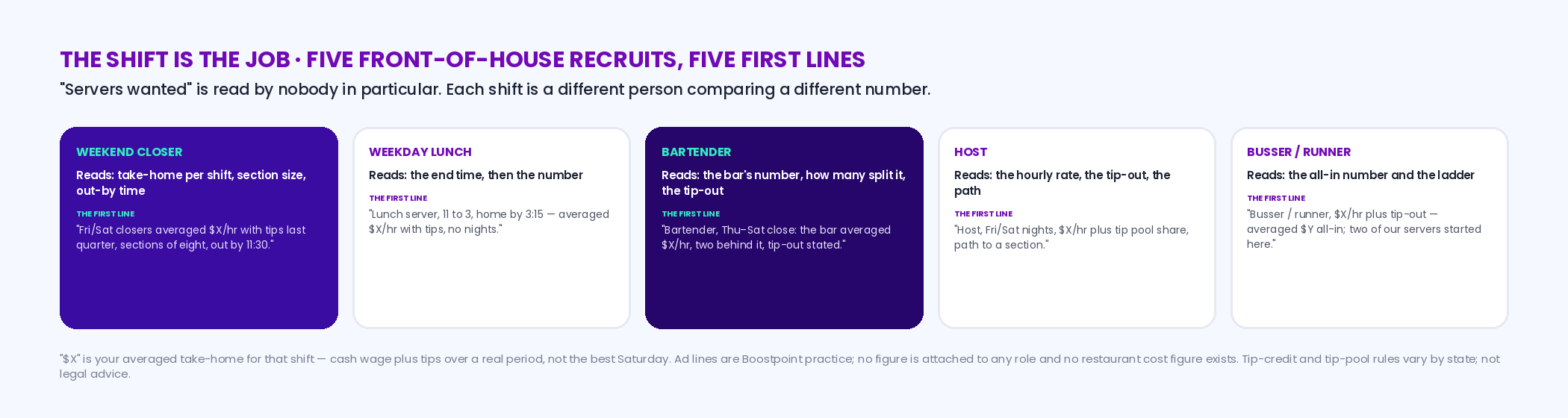
"Servers wanted" is read by nobody in particular because nobody is a server in general; a server is a Friday-and-Saturday closer with a section of eight tables, or a weekday lunch server who needs to be home by three, or a brunch server who can carry a twelve-top, and each of them stops reading at the first line that isn't about their shift. A restaurant that needs weekend closers and writes "servers wanted, all shifts" gets applicants who want Tuesday lunch and no-shows on Friday. So the ad is written by shift and section, and where several shifts are open at once, it is one campaign with a distinct ad per shift — the multi-role structure, which in our 2026 benchmark ran a median $9.83 per applicant at a 12% apply rate across 46 campaigns, against $14.45 and 18% for single-role campaigns across 1,210. Those are structure figures across every industry we serve, not restaurant figures. The board below writes the five front-of-house first lines.
Interactive
Shift and section ad builder — pick the shift and get who it's for, the three knockouts, the first line and what the trail is
Nothing is stored or sent — this runs in your browser. Lines and trails are Boostpoint practice with restaurant clients, not measured results.
The number: what a shift pays, and how to say it lawfully
Federal law lets a restaurant pay a tipped employee a cash wage of $2.13 an hour and count up to $5.12 of tips toward the $7.25 federal minimum; the employer makes up the difference in any week the tips fall short (DOL Wage and Hour Division, Fact Sheet #15, read August 2026). Many states set a higher cash wage or allow no tip credit at all, and the rules on tip pools differ by state too; check yours, and read this as a summary, not legal advice. What that means for the ad is simple: the hourly figure on the pay stub is the least informative number in the building, and the one a server compares is take-home per shift or per hour with tips in. So say it, with the number, averaged over a real period: "Friday and Saturday closers averaged $X an hour with tips last quarter, sections of eight." A restaurant that won't say it is read as a restaurant whose number is bad. Where a house tip pool exists, say who is in it and what the tip-out is, because a server's first question is whether the busser and the bar take from the same pot. The calculator below turns your cash wage and your measured tips into the line, and checks it against the federal floor.
Interactive
Take-home line and section planner — the number for the first line of the ad, and how many servers the Friday floor needs on the roster
Nothing is stored or sent — this runs in your browser. Every input is yours; the only fixed figures are the federal $2.13 cash wage and $7.25 minimum, and your state may set higher ones.
Restaurant recruitment strategies for the front of house, honestly ranked
Every restaurant runs some of these; the order matters more than the list. First, your own floor: a server who likes the section knows three servers who'd want it, and a referral bonus paid at sixty days, said out loud in the pre-shift, costs nothing until it works. Second, the guests you already have: the regular who works the bar across the street, the industry night crowd, the "we're hiring closers" line on the check presenter and the host stand — the cheapest passive reach a restaurant has is its own dining room. Third, the feed, with the shift and the take-home number in the first sentence, under Meta's Special Ad Category with no age, gender or ZIP targeting, so the copy selects; in our benchmark a normal campaign ran on a median $334 a month and produced 20 applicants a campaign-month, reaching 6,061 people, which is a useful counter to the idea that a single restaurant needs a big budget. Fourth, a walk-in afternoon, the event-driven structure — a median $8.02 per applicant at 21% across 78 campaigns, the cheapest we run, cross-industry. Fifth, job boards, for the between-jobs few and everyone else's ad next to yours. Last, a staffing agency or a shift app, which solves tonight and is the right call when tonight is the problem; what the markup buys is on our hospitality staffing agency cost page, not repeated here.
| Channel | Who it reaches | What it costs to try | Source |
|---|---|---|---|
| Your own floor (referrals) | Servers at other restaurants who'd take your section; the most passive pool there is | A bonus paid only at sixty days | Boostpoint practice |
| Your own dining room (regulars, industry night, the check presenter) | Industry people who already like the room | A printed line and a manager who asks | Boostpoint practice |
| The feed (Meta, Special Ad Category) | Employed servers on a phone between shifts, in the radius | A normal campaign: median $334 a month, 20 applicants, 6,061 reached | 2026 benchmark, all industries |
| A walk-in afternoon (dated) | The passive pool in the room at once, 2 to 4 on a weekday | Event-driven campaigns: median $8.02 per applicant, 21% apply, 78 campaigns | 2026 benchmark, all industries |
| Job boards | The between-jobs few; every restaurant's ad beside yours | Per post or per click, bid up by the radius | Boostpoint practice |
| Staffing agency / shift app | Tonight's shift, not next month's server | An hourly markup or a per-shift fee — see the agency-cost page | Linked, not repeated |
Where to find servers, in the order they actually turn up
Hiring restaurant employees is a distribution problem before it is a persuasion problem. The people you want are working — most of them in a restaurant three blocks away — and they are not on a job board on a Tuesday afternoon. Ranked by what actually produces a hire in the front of house:
- Your own staff. Servers move in groups and they know who is unhappy. A referral bonus paid in two halves, at thirty and ninety days, out-produces every paid channel in this list and costs less than one week of job-board spend.
- The feed, at the right hour. Social job ads reach employed servers because they are scrolling at 11pm after a close, not searching at 9am. This is the channel that reaches the people who were not looking, which is most of the good ones.
- Your own door and windows. A sign that names the shift and the number works because the people walking past already know the neighborhood, the parking and the commute. It fails only when it says “now hiring” and nothing else.
- Regulars and the bar. The people who eat and drink in your restaurant already like it. In independent restaurants this is a genuine pipeline and it costs nothing but asking.
- Culinary and hospitality programs. Slower and seasonal, but the only reliable route to people you can train into your own service style rather than un-train out of someone else’s.
- Job boards. They work, and they reach the actively-searching slice — people between jobs, new to the area, or leaving somewhere badly. Useful, but it is the shallowest end of the pool and it is where every competitor is bidding.
One thing to stop doing: posting the same ad to all six and waiting. Each channel reaches a different person. The referral ask and the window sign talk to people who already know your restaurant; the feed talks to people who have never heard of it and need the shift and the money in the first line.
The interview is a trail, or an afternoon
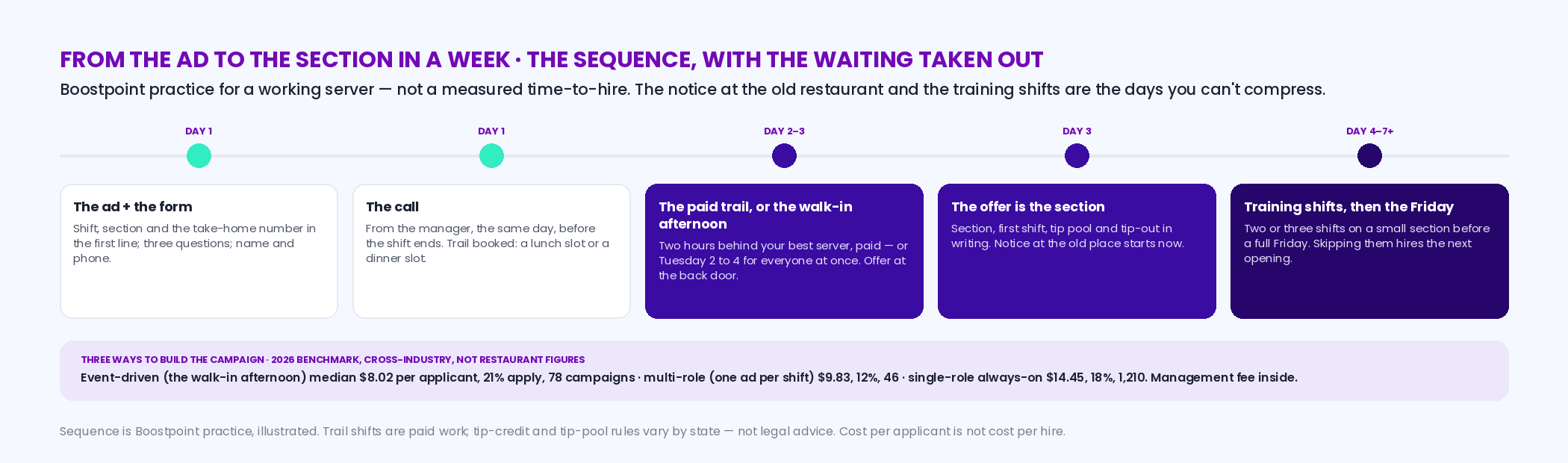
A server interview across a table tells you whether someone interviews well. A paid trail — two hours following your best server through a real service, carrying, running, watching the section — tells you whether they can read a table, and it tells them whether they want your room, which is half the point. Pay it; a trail in which someone works is work. Book it on the first call, offer a lunch and a dinner slot, and make the offer in the alley with the section and the first shift on it. The faster version is the walk-in afternoon: "Tuesday 2 to 4, come meet the manager," with a fifteen-minute conversation, a walk through the section, and an offer on the spot for the ones who fit; whether that works and when it doesn't, with the data, is on on-the-spot hiring and walk-in interviews, and the mechanics of a full hiring event are on open house hiring events. Between the application and either one there is the form — which shifts can you work, have you served before and where, when can you trail — and a call the same day from the manager, not a recruiter; a server applies on a phone in the break and is back on the floor in five minutes, and same-day contact is our practice, not a statistic we have measured. The general form guidance is on what makes a good job ad.
How to hire servers fast: what compresses and what doesn't
Fast is the same sequence with the waiting taken out. The application-to-call gap compresses to the same day; the call-to-trail gap compresses to 48 hours if you offer a lunch slot and a dinner slot; the trail-to-offer gap compresses to the walk out the back door. The walk-in afternoon compresses all three into one. What does not compress is the notice a good server gives at the restaurant they are leaving, usually a week or two, and the two or three training shifts before they take a full section on a Friday; a restaurant that skips the training shifts to fill Friday is hiring the next opening. If Friday is tonight, that is a shift app or an agency, not an ad. The apply-rate bands in our benchmark are the other reason speed starts with the ad: campaigns with an apply rate under 5% ran a median $53.77 per applicant and the ones over 35% ran $1.61, and the difference is almost always the first line and the form, not the budget.
What our data can and can't say about restaurants
Our 2026 benchmark has no restaurant, hospitality or front-of-house row, and we won't invent one. What it has is structure: event-driven campaigns at a median $8.02 per applicant (21% apply rate, 78 campaigns), multi-role at $9.83 (12%, 46), single-role at $14.45 (18%, 1,210); the normal campaign at $334 a month, 20 applicants, 6,061 reached; and the apply-rate bands from $53.77 under 5% to $1.61 over 35%. All of it is advertising cost, and all of it is cross-industry; the sector cuts are on the benchmark. What no figure of ours can say is how many trailed servers it takes to keep one past the ninety-day mark, or what a server costs to hire, because we measure advertising and you measure that; cost per applicant is not cost per hire.
Once people are booking in, our server interview questions page covers what to ask and how to score it consistently.
How to recruit hostesses: the first job at the stand, and the rules that come with it
The host stand is the front of house's entry job, and it is recruited differently from the server floor. The BLS counts 444,200 hosts and hostesses (2025), projects about 107,100 openings a year through 2035, and puts the median at $31,200 a year (May 2025), with no formal credential and short on-the-job training. The openings are almost all replacement: hosts move up to server, go back to school or leave for another first job, which means a restaurant is recruiting for the stand most months of the year.
Who takes the job shapes the ad. Many hosts are students and first-time workers, others are people who want evening and weekend hours around another job, and some are the future servers you most want. So the first line says the shifts ("Friday and Saturday nights, 5 to 10"), the hourly rate and any tip-out the stand shares, and the second line says the path: "Hosts who want to serve get the first trail." That sentence is the reason to take your stand over the one down the street. Ask three questions: which shifts, when they can start, and, if you hire under 18, their age for scheduling purposes.
Age matters because federal child labor rules limit when minors can work. Fourteen- and fifteen-year-olds may do permitted food service work, but no more than 3 hours on a school day and 18 hours in a school week, and only between 7 a.m. and 7 p.m. outside the June 1 to Labor Day window, when the limit is 9 p.m. (29 CFR 570.35). A Friday dinner host shift ends after that, so a restaurant that needs closing hosts is recruiting sixteen and older in practice, and many states add rules of their own. Because employment ads on Meta cannot be targeted by age, state any minimum age in the ad and let the form question handle it. Interview hosts the way you trail servers: an hour on the stand during a real rush shows who can manage a waitlist and a smile at once. The posting is on our hostess job description, and the rules on Meta's targeting are on Meta's Special Ad Category.
Frequently asked questions
How do you hire servers?
By shift and section, not "servers wanted": the first line names the shift and what it actually took home last quarter with tips in, the form asks three questions (which shifts, where have you served, when can you trail), the manager calls the same day, the interview is a paid two-hour trail or a walk-in afternoon, and the offer is the section with the first shift on it. Most of the BLS's 2.3 million servers are working tonight, so the ad has to reach a phone between shifts, not a job board.
How do you hire servers fast?
Take the waiting out of the sequence: a same-day call, a trail within 48 hours with a lunch and a dinner slot, the offer at the back door — or a dated walk-in afternoon that does all three at once. Event-driven campaigns ran a median $8.02 per applicant at a 21% apply rate across 78 campaigns in our 2026 benchmark, the cheapest structure we run, cross-industry. What doesn't compress is the server's notice and the training shifts before a full Friday section; if Friday is tonight, that is a shift app or an agency.
What should a server job ad say?
In the first sentence: the shift (Friday and Saturday close, weekday lunch, brunch), the section size, and the take-home number — cash wage plus tips per hour or per shift, averaged over a real period. Then who is in the tip pool and what the tip-out is, the schedule, and three questions to apply. Under Meta's Special Ad Category a job ad has no age, gender or ZIP targeting, so the first line does the selecting; "competitive pay" is read as a bad number.
Can you advertise what servers make in tips?
Say what they actually averaged, over a real period, and say it is an average that varies by shift. Federal law allows a $2.13 cash wage with up to $5.12 of tips credited toward the $7.25 minimum, and requires the employer to make up any shortfall; many states set a higher cash wage or no tip credit, and tip-pool rules vary by state. Check yours — this is a summary, not legal advice — and never put a best-night number in the ad as if it were typical.
Should a server trail shift be paid?
Pay it. A trail in which someone carries, runs or serves is work, and two paid hours behind your best server is the most honest interview a restaurant can run — for both sides, because the candidate learns whether they want your room. Book it on the first call, offer a lunch and a dinner slot, and make the offer before they leave. Check your state's rules; this is our practice, not legal advice.
What are the best restaurant recruitment strategies?
In the order we'd run them: referrals from your own floor with a bonus paid at sixty days; your own dining room (regulars, industry night, a hiring line on the check presenter); the feed with the shift and the number in the first line; a dated walk-in afternoon; job boards for the between-jobs few; and a staffing agency or shift app when tonight is the problem. In our benchmark a normal campaign ran on a median $334 a month for 20 applicants — a single restaurant does not need a big budget, it needs the right first line.
How many servers do you need to hire a year?
Roughly your roster times your turnover: Black Box Intelligence puts full-service hourly turnover at about 92% and limited service at 110% (rolling twelve months, 2025), and the BLS projects 456,700 server openings a year, all from replacement. A Friday floor of 120 covers at 20 covers per server is 6 servers on the floor and 8 on the roster with days off; at 92% that roster replaces about 7.4 servers a year. The planner on this page runs it on your numbers.
What does it cost to recruit servers?
We publish no restaurant or server figure; our 2026 benchmark has no such row. The structural evidence is event-driven $8.02, multi-role $9.83 and single-role $14.45 per applicant, a normal campaign at $334 a month, and the apply-rate bands from $53.77 under 5% to $1.61 over 35%, all cross-industry and all. Agency and app fees are on our hospitality staffing agency cost page. Cost per applicant is not cost per hire; we do not track hires.
Where can I find servers to hire?
In rough order of what produces a hire: your existing staff through a referral bonus, social job ads that reach servers who are employed and not searching, a sign on your own door that names the shift and the pay, your regulars, culinary and hospitality programs, and then job boards. The first three reach people who are working somewhere else, which is where most good servers are.
What is the best way to hire restaurant employees?
Advertise the specific shift rather than the job title, put the money in the first line in a form that is lawful in your state, make applying take under two minutes with no resume, and reply the same day. Restaurant candidates apply to several places in one sitting, so the deciding factor is usually which manager called first, not which posting was best written.
How do you recruit hostesses?
Advertise the shifts and the path. Put the nights and hours, the hourly rate and any tip-out in the first line, and say that hosts who want to serve get the first trail, since many of the best hosts are future servers. Ask which shifts, a start date and, if you hire minors, their age for scheduling. Call the same day and use an hour on the stand during a rush as the interview. The BLS projects about 107,100 host and hostess openings a year, almost all from replacement.
Can a restaurant hire a 15-year-old as a host?
Federally, yes, within hour limits: 14- and 15-year-olds may work no more than 3 hours on a school day and 18 hours in a school week, and only between 7 a.m. and 7 p.m., or 9 p.m. from June 1 through Labor Day (29 CFR 570.35). Evening closing shifts therefore usually go to hosts aged 16 and over. States can set stricter rules and require work permits, so check yours.
Put the shift and the number in the first line
We'll write one ad per shift with your real take-home in it, run them where working servers scroll, put a three-question form and a trail booking behind them, and show you the hourly-turnover campaigns closest to yours — costs, and never a restaurant figure we don't have.
Book a DemoBoostpoint figures come from the 2026 Social Job Advertising Benchmark — 891 campaigns and 1,334 campaign-months: campaign structures event-driven median $8.02 per applicant, 21% apply rate, 78 campaigns; multi-role $9.83, 12%, 46; single-role $14.45, 18%, 1,210; a normal campaign $334 a month, 20 applicants, 6,061 reached; apply-rate bands under 5% $53.77 and over 35% $1.61. The benchmark contains no restaurant, hospitality or front-of-house row and none is implied; no seasonality claim is made. Third-party figures are dated where they appear: BLS Occupational Outlook Handbook (2024 employment, May 2024 wages including tips, 2024–34 projections), BLS JOLTS (June 2026 preliminary, released August 4, 2026), Black Box Intelligence (October 29, 2025), DOL Fact Sheet #15. Shift lines, the paid trail, the walk-in afternoon and same-day contact are Boostpoint practice, not measured results; the tip-credit summary is federal only and not legal advice. Cost per applicant is not cost per hire; we do not track hires and publish no cost-per-hire figure. A sample of Boostpoint campaigns, not an industry-wide study.